



Quick Facts:
- Topic: Starlink monthly cost for overlanders and campers
- Cheapest plan: Roam 100GB at $55/mo
- Mid plan: Roam 300GB at $80/mo (US and Canada)
- Top plan: Roam Unlimited at $175/mo
- Hardware: Starlink Mini Kit from $199; Standard Kit around $349
- Rent option: $10/mo kit rental on Residential plans in select areas
- Pause option: Standby Mode at $10/mo
- Best for: Campers and overlanders who need internet far past cell coverage
8 min read
In This Guide
- Starlink Monthly Cost Overview for Overlanders
- Starlink Plans and Pricing at a Glance
- Starlink Monthly Cost by Plan
- Hardware Costs: Buy the Kit or Rent It
- Hidden Costs Most Buyers Miss
- How Much Data You Use at Camp
- Starlink Mini vs Standard Kit
- Pros and Cons for Travelers
- Final Verdict
- Frequently Asked Questions
Starlink Monthly Cost Overview for Overlanders
Starlink monthly cost is the first number you need before you bolt satellite internet to your rig. For overlanders and campers, the price depends on which Roam plan you pick and which dish you run. Most travelers land between $55 and $175 a month for service. On top of service, you either buy the hardware once or rent it. This guide breaks down every charge, so you know your real number before you order.
I have run Starlink for five years across remote camps and long highway days. Today I run a Starlink Mini on the $50 plan, and it works well for how I travel. Before this setup, I leaned on cell boosters and hotspots. Those tools quit the moment I dropped past the last tower. Starlink keeps working where cellular dies, and this single difference is why it earns its monthly fee.
Campers and overlanders sit in a specific spot here. You do not want the home Residential plan, because it locks to a fixed address. Instead, you want a Roam plan, which travels with you and allows in-motion use. Therefore, the rest of this guide focuses on Roam pricing, Mini hardware, and the smaller fees most buyers forget until the first bill arrives. If you are still dialing in your setup, our guide to maximize off-grid comfort pairs well with adding connectivity.
Starlink Plans and Pricing at a Glance
Below is the current Roam pricing for the US, pulled from the official Starlink Roam plans in June 2026. These three plans cover almost every camper and overlander. Many campers ask how much is Starlink per month before they buy, so the table answers it at a glance. Your Starlink Roam cost depends entirely on the data tier you pick, not on the dish you own. Residential plans appear at the bottom for context, since some readers also want home service when the rig is parked.
| Plan | Monthly Price | High-Speed Data | Best For |
|---|---|---|---|
| Roam 100GB | $55/mo | 100GB, then unlimited low-speed | Weekend and seasonal campers |
| Roam 300GB | $80/mo | 300GB, then unlimited low-speed | Frequent travelers and light remote work |
| Roam Unlimited | $175/mo | Unlimited high-speed | Full-time overlanders and heavy streamers |
| Residential 100 Mbps | $55/mo | Unlimited | Fixed home address only |
| Residential Max | $130/mo | Unlimited, 400+ Mbps | Home power users |
Notice the entry Roam plan and the entry Residential plan both start at $55. The difference is mobility. Roam moves with you and works in-motion, while Residential stays put. For a camper, the $55 Roam 100GB plan is the true starting point for your monthly bill. Your Starlink Roam cost rises only when you need more data, and these same tiers set the Starlink RV monthly cost for vans and trucks.
Starlink Monthly Cost by Plan
Roam 100GB sits at $55 a month and suits most weekend and seasonal campers. Starlink rates this bucket at roughly one week of typical use, so light users stretch it across a month easily. After you pass 100GB, service drops to unlimited low-speed data instead of charging overage fees. Email, messaging, and calls still work, while streaming and video calls slow down.
Roam 300GB runs $80 a month in the US and Canada. This tier fits travelers who work from the road a few days a week or stream most evenings. The same low-speed fallback applies once you cross 300GB, so your monthly bill never spikes from a surprise overage.
Roam Unlimited costs $175 a month and removes the data ceiling entirely. Full-time overlanders, remote workers on video calls, and families streaming nightly find this tier worth the jump. My own Starlink monthly cost stays at the $50 rate I locked in earlier, which is close to today’s $55 entry plan. For my travel style, the 100GB tier covers navigation, weather, messaging, and the occasional movie without strain.
One more note on flexibility. You change Roam plans anytime through the Starlink app, and the change takes effect immediately or at your next cycle. Therefore, you size up before a big trip and size back down afterward. For the latest figures, review the latest Starlink Roam price changes before you commit.
Ready to Get Connected?
Check Starlink Plans and Pricing
Confirm Roam availability for your area, compare plans, and start with the 30-day trial. Pick the plan suited to how you travel.
Hardware Costs: Buy the Kit or Rent It
Service is only half of your spend. You also need a dish, and overlanders face two real choices here. Starlink’s Mini Kit starts at $199 and ships with a built-in router in a unit close to the size of a laptop. The Standard Kit lists near $349, though Starlink discounts it often. For travel, the Mini wins because it stows in a backpack and sips less power. The Starlink Mini monthly cost equals any Roam plan, since the Mini runs the same Roam tiers as larger dishes.
Starlink also added a rental path in 2026. On Residential plans in select areas, you skip the upfront hardware and pay $10 a month to rent the kit instead. If you cancel service, you return the dish. For a camper who wants home service part of the year, renting trims the entry price, although it adds a recurring line to your bill over time.
For most overlanders, buying the Mini outright is the better math. You pay once, you own the dish, and you avoid a monthly rental fee stacked on your Starlink monthly cost. I bought my Mini and never looked back. Owning the hardware also means you swap plans freely without worrying about a leased unit tied to one service type.
Hidden Costs Most Buyers Miss
The plan price is clear. The smaller fees are where budgets slip. First, a one-time Roam activation charge applies at checkout, so confirm the current amount before you click order. Starlink lists this charge as fully refundable within 30 days. Second, Standby Mode now costs $10 a month if you pause service between trips. Standby keeps your account active, allows emergency messaging, and skips reactivation friction when you return to a dead zone.
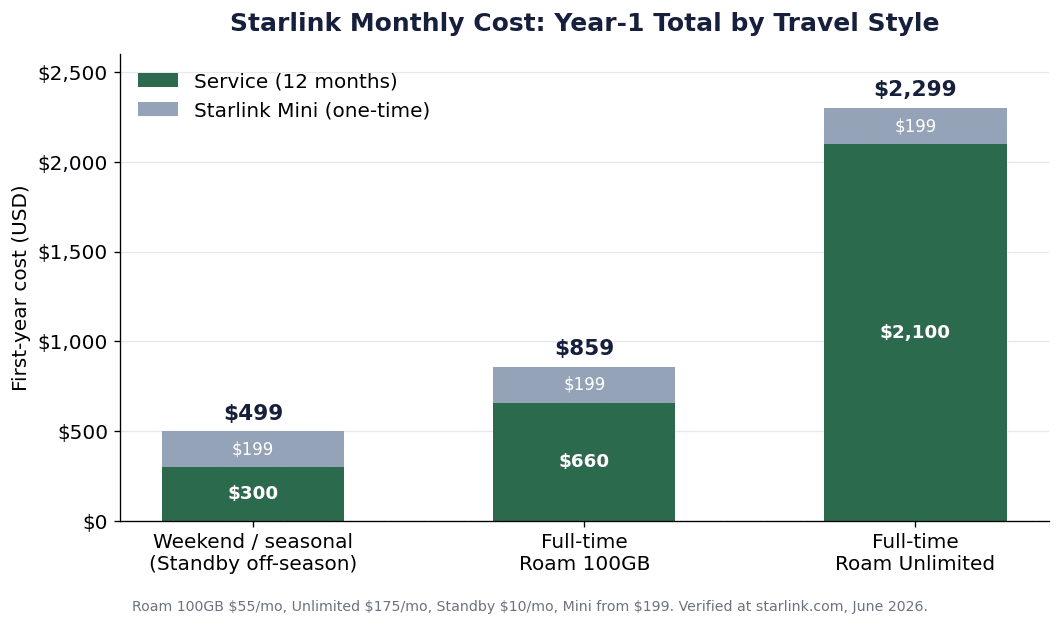
Standby Mode matters most for seasonal campers. For example, say you travel four months a year on Roam 100GB. During those months you pay about $55, which totals $220. For the other eight months you hold the account on Standby at $10, adding $80. Your yearly total lands near $300, compared to roughly $660 for twelve months of full service. Therefore, Standby saves about $360 a season, and it lowers the real Starlink cost per month across the year.
Mounting and Power Costs
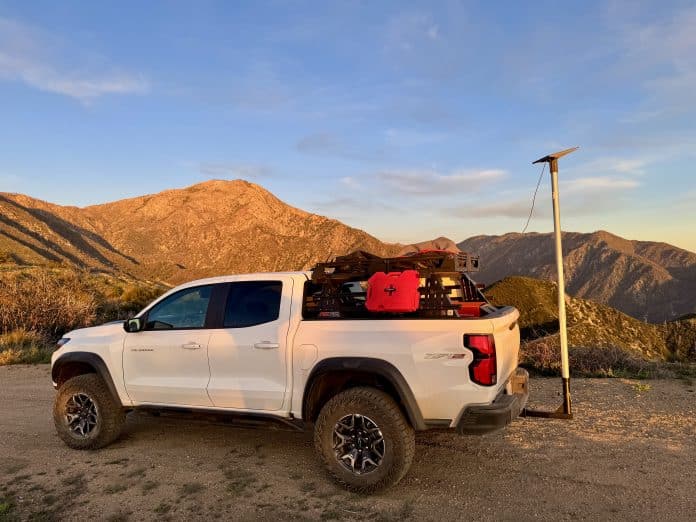
Third, plan for mounting and power. I hold my Mini to the truck roof with a flagpole-style magnetic mount, and for the last month I have left it on full-time. Fourth, the Mini draws about 20 to 40 watts, so a modest battery or solar setup keeps it fed off-grid. Pair this with a solid plan to power your gear off-grid before your first long trip.
Mounts deserve their own line in your budget, because the range is wide. Dozens of options fill the market, from cheap brackets to heavy-duty rigs. For example, a solid setup runs anywhere from $20 to $280 or more. After years of testing, I keep coming back to the Flagpole Buddy magnetic mount as the best for overland use. It comes available with either magnets or a suction cup. For the full rundown, see my guide to the best Starlink Mini accessories of 2026.
How Much Data You Use at Camp
Data caps feel abstract until you map them to camp life. Streaming standard-definition video burns about 1GB per hour, while high-definition climbs to roughly 3GB per hour. A single evening movie in HD eats 6GB to 8GB. Navigation, weather checks, messaging, and email barely register by comparison.
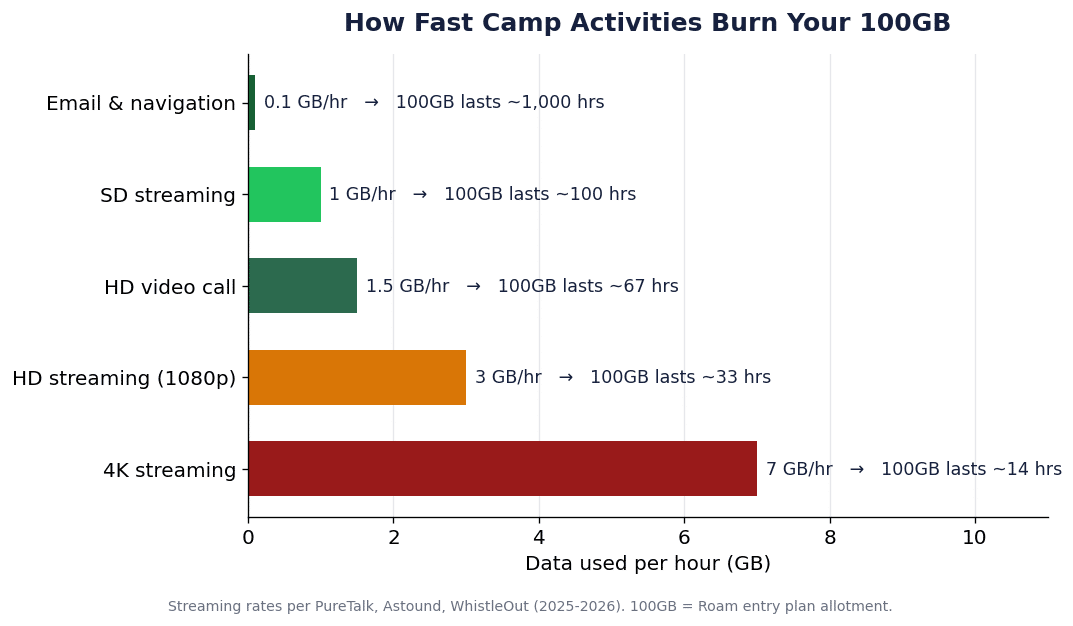
Here is the lesson I learned firsthand. I once tested a smaller, cheaper data plan to trim my Starlink monthly cost, and I burned through the full allotment overnight with streaming. The next morning I sat on slow data until the cycle reset. After one rough night, I moved back to a plan with real headroom and never repeated the mistake.
In addition, offline maps trim your data needs. Download routes before you leave service, using the best off-road GPS and navigation apps, and you lean on Starlink mainly for messaging and weather. For planning, treat the 100GB tier as plenty for navigation, remote work, and light streaming. Choose 300GB if two people stream most nights or you push large work files. Pick Unlimited only when you truly live online from the trail. Honest data math keeps your monthly spend predictable and stops you from overbuying a tier you never fill.
Starlink Mini vs Standard Kit: Which Should You Buy?
The Mini and the Standard Kit run the same Roam plans, so the choice comes down to size, power, and price. At $199, the Mini packs a built-in router and draws far less power, which suits a truck, van, or small camper. The Standard Kit lists near $349 and pushes slightly higher peak speeds, yet it is bigger and thirstier on power.
| Feature | Starlink Mini | Standard Kit |
|---|---|---|
| Hardware price | From $199 | Around $349 |
| Power draw | About 20 to 40 watts | Higher |
| Size | Backpack-size, built-in router | Larger and bulkier |
| Peak speed | 300+ Mbps | Slightly higher |
| Best for | Trucks, vans, campers, Standby cycling | Fixed base camp with ample power |
For overlanders cycling power off batteries and solar, the Mini is the smarter pick. Its lower draw and faster boot make it ideal for daily setup and Standby cycling between trips. The Standard Kit makes more sense for a stationary base camp or a rig with abundant power and a permanent mount.
On total spend, the Mini almost always wins for travel. You pay less upfront, you carry less weight, and you spend less energy keeping it online. Unless you need the Standard Kit’s extra ceiling for a fixed setup, the Mini delivers the best Starlink Mini monthly cost for the money.
Pros and Cons for Travelers
Pros
- Roam plans start at $55 a month with no overage fees
- Works far past cell coverage where boosters fail
- In-motion use included on every Roam plan
- Mini hits 300+ Mbps and stows in a backpack
- Standby Mode at $10 a month cuts off-season spend
- Change plans anytime through the app
Cons
- Hardware adds $199 or more on top of service
- The 100GB tier drops to slow data after heavy streaming
- Unlimited service runs a steep $175 a month
- Draws power, so off-grid rigs need battery or solar
- A one-time activation charge applies at signup
Final Verdict
For overlanders and campers, Starlink earns its place in the kit. The real Starlink monthly cost for most travelers starts at $55 for Roam 100GB, plus a one-time dish purchase from $199. After five years of remote travel, I rate it the single best tool I have added to my setup, because it works where every other option quits.
Look elsewhere only if your trips stay inside strong cell coverage. In those cases, a $24 unlimited cellular hotspot covers most of the US for less money. The moment your routes push into true dead zones, though, this argument collapses and Starlink becomes the clear answer.
On value, the math favors most campers. Buy the Mini, start on Roam 100GB, and use Standby Mode during your off-season to hold down your yearly spend. If you work from the road daily, step up to Roam 300GB or Unlimited and treat the higher fee as a business cost.
My recommendation is simple. Start with the Mini and the 100GB Roam plan, then adjust after one real trip shows your true data habits. If you find yourself parked at a fixed base most of the year, compare a Standard Kit or the $10 rental option before you commit to a second dish.
Frequently Asked Questions
How much is Starlink per month for campers?
For campers, Roam plans set the price. Roam 100GB costs $55 a month, Roam 300GB costs $80, and Roam Unlimited costs $175. Most weekend and seasonal campers do well on the $55 Roam 100GB plan.
What is the cheapest Starlink monthly cost?
The cheapest travel option is Roam 100GB at $55 a month. If you also want home service, Residential 100 Mbps also starts at $55. For seasonal use, Standby Mode at $10 a month lowers your yearly Starlink cost per month between trips.
How much does Starlink equipment cost?
The Starlink Mini Kit starts at $199, and the Standard Kit lists near $349, though Starlink discounts it often. On Residential plans in select areas, you rent a kit for $10 a month instead of buying it outright.
Does Starlink have a monthly fee for RV use?
Yes. Starlink rv monthly cost runs on the Roam plans, starting at $55 a month for 100GB. Roam includes in-motion use and country-wide coverage, which makes it the right fit for RVs, vans, and trucks.
How do you pause Starlink between trips?
To pause service, switch on Standby Mode for $10 a month. Meanwhile, it keeps your account active and your hardware ready. You reactivate instantly through the app, which suits campers who travel only part of the year.
Is Roam better than Residential for overlanders?
For overlanders, Roam is the right plan. Residential locks to a fixed address and does not support travel use. Roam moves with you, allows in-motion use, and matches the way campers and overlanders live on the road.