


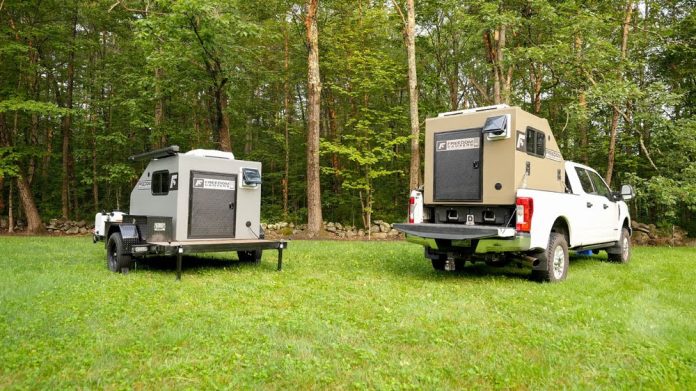

I’ve been camping and overlanding most of my life. Over the decades, I’ve run nearly every shelter configuration a truck owner faces. Ground tents staked into rocky soil, rooftop tents in the wind, lightweight bed campers, and trailers down roads with no business being called roads. Each setup taught me something different about what a truck does well and where it holds you back. The consistent lesson across all of it is that the trucks that get used the most aren’t the most expensive or the most built-out. They’re the ones where the setup is simple, the gear fits without drama, and you spend Friday night driving instead of packing.
A pickup truck is one of the most capable camping platforms ever made, and most people use maybe 40 percent of what it offers. Payload capacity, bed space, 4WD, and tow capability sit unused while the truck hauls groceries and commutes. Getting more out of your pickup for truck camping doesn’t require a $30,000 build. It requires a smart bed setup, the right shelter, a few key gear choices, and a repeatable system. Departure prep then takes 20 minutes instead of three hours. This guide covers all of it, with real prices and the approach I’ve dialed in after years of getting it wrong first.
Quick Facts:
- Topic: How to maximize a pickup truck for camping
- Skill level: All levels – beginner to experienced overlander
- Key categories: Shelter, bed organization, sleep system, power, recovery
- Recommended shelter: Freedom Camper truck bed camper – $3,499.99 (sale)
- Shelter weight: 175 to 270 lbs depending on model
- Insulation rating: Four-season, all-weather
- Fits: Midsize and full-size pickups plus utility trailers
- Best for: Truck owners who want a weather-tight truck camping setup without a complex build
9 min read
In This Guide
- Truck Camping Overview: What Your Pickup Already Does Well
- Bed Setup: The Foundation of Every Good Truck Camping Rig
- Shelter: The Biggest Upgrade You’ll Make
- Sleep System: How to Actually Rest in the Field
- Power and Camp Kitchen: Keep It Light and Functional
- Truck Bed Camper vs. Rooftop Tent: Which Setup Wins?
- Pros and Cons of Truck Camping
- Final Verdict
- Frequently Asked Questions
Truck Camping Overview: What Your Pickup Already Does Well
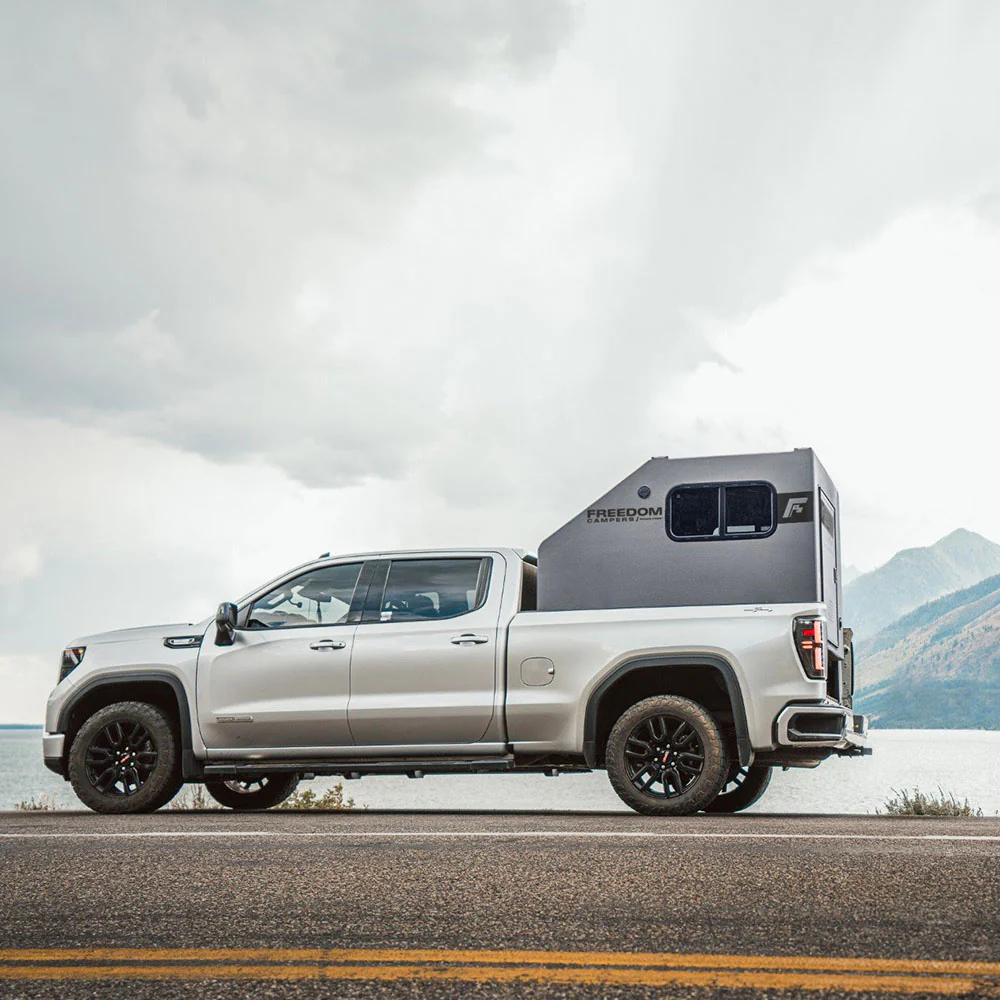
Truck camping works because pickups are built to carry load, go places, and run independent of infrastructure. Truck camping with a capable pickup opens up dispersed sites, forest roads, and backcountry spots that trailers and RVs can’t reach. The platform includes 4WD, high ground clearance, 1,000 to 2,300 lbs of payload depending on the model, and a flat, weatherproof cargo area. Most setups don’t take advantage of even half of that.
The rise of lightweight truck camping over the past several years reflects a shift away from over-built rigs and toward setups people use regularly. The truck owners going out most often aren’t running $15,000 roof platforms and slide-in campers with slide-outs. They’re running lean bed setups with an insulated shelter, a solid sleep kit, and recovery gear. Those rigs leave on Thursday night instead of Saturday morning because prep takes 20 minutes.
This guide is built for truck owners who want more trips from their pickup without financial regret. Whether you’re on a Tacoma, a Gladiator, an F-150, or a Silverado, the principles are the same. Maximize the bed, choose the right shelter, dial in a sleep system, and keep the kitchen simple enough for one tote. Each section covers a specific category with real prices and practical guidance.
Bed Setup: The Foundation of Every Good Truck Camping Rig
The truck bed is your floor plan. How you organize it determines how fast you set up camp, how much you carry, and whether the shelter fits correctly. The bed serves three zones: the shelter mount, gear storage under the platform, and a daily-access zone for items you need without digging. Getting those three zones defined before buying any gear prevents the most common mistake: buying stuff that doesn’t fit together.
Platform Builds and Drawer Systems
Lightweight insulated campers like the Freedom Camper require a raised platform over the wheel wells for the three smaller models (48×79, 58×79, 58×89). The platform elevates the camper above the wheel arches and creates storage space underneath. That organized space makes camp setup and departure genuinely fast. Freedom Campers provides a free DIY platform guide, and the build runs $100 to $300 in materials depending on lumber and hardware choices. Aftermarket drawer systems from brands like Decked ($1,100 to $1,400) integrate with the platform and add weather-resistant storage below. Both approaches work. The DIY platform is cheaper. The drawer system is more polished and road-proof.
Regardless of platform choice, organization bins are worth more than most people realize. Three to four stackable bins ($15 to $25 each) sorted by category eliminate the dig-through scramble at camp. Label them. Stack them in the same order every time. After a few trips, loading becomes automatic and departure stops being a production.
Shelter: The Biggest Upgrade You’ll Make

Shelter is where truck camping setups diverge most sharply in cost, capability, and real-world usability. At one end, a ground tent costs $100 to $400 and offers zero weather advantage over a dedicated shelter. At the other end, a full hard-side slide-in truck camper runs $15,000 to $50,000 and permanently commits your truck to hauling it. Between those extremes sit rooftop tents ($900 to $3,500), truck bed tents ($100 to $500), and lightweight insulated hard-shell campers. For most truck campers who want a genuine four-season shelter at a reasonable price, the lightweight hard-shell is the right answer.
The Freedom Camper: Best Value in the Category
The Freedom Camper is the shelter I’d recommend to most truck owners building a practical camping setup. It’s a lightweight, insulated hard-shell that mounts in a truck bed or on a utility trailer. Four sizes cover midsize trucks (48×79) through full-size platforms (58×79, 58×89) and trailer-only use (72×89), all starting at $3,499.99 for the smallest model. The 48×79 weighs 175 lbs and the 58×89 – the most popular model – weighs 195 lbs. Both require two people to load without equipment. The camper is four-season rated, built in Lamar, Missouri, and backed by a 3-year limited warranty.
What sets it apart from a rooftop tent at the same price point is weather protection and sleeping room. A rooftop tent at $2,500 to $3,500 puts you off the ground. However, it leaves you exposed to condensation, cold floors, and wind noise in ways a hard-shell doesn’t. The Freedom Camper’s insulation handles all-weather conditions. The interior runs 74.5 inches long on the 48×79 and 84.5 inches on the 58×89, enough for most adults to sleep flat. For the full breakdown by size and use case, read the Freedom Camper review.
Best Shelter for Truck Camping
Freedom Camper: Four-Season Shelter That Fits Your Truck
Four sizes from 175 to 270 lbs. Built in Missouri, backed by a 3-year warranty. On sale at $3,499.99 – fits midsize and full-size pickups plus trailers.
Sleep System: How to Actually Rest in the Field
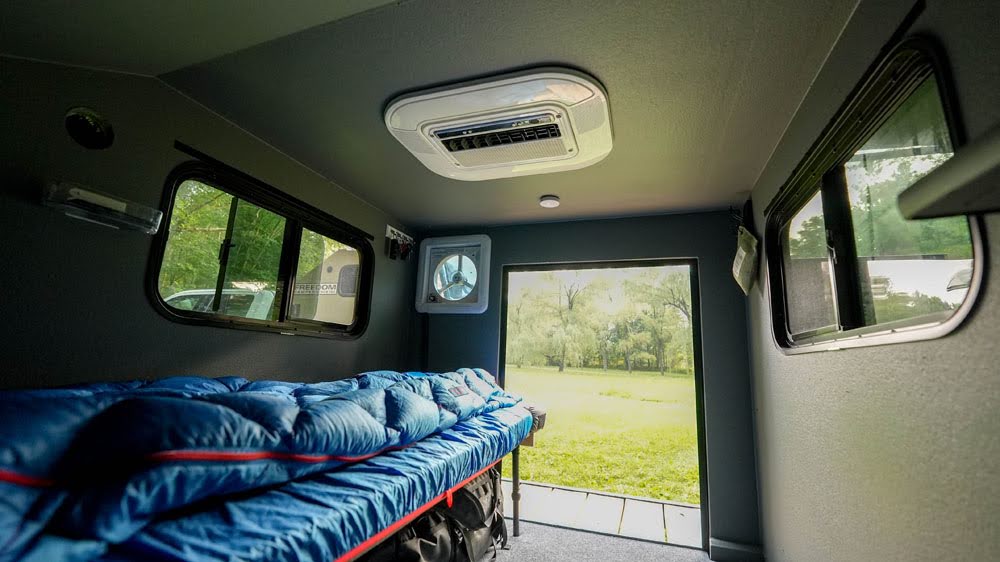
The shelter keeps weather out. The sleep system keeps you comfortable once you’re inside. Most truck campers underinvest in the sleep system relative to shelter and regret it on the second or third trip. A sleeping bag rated 10 to 15 degrees warmer than your expected overnight low gives you a safety margin without overheating in milder conditions. For three-season use in the West, a bag rated to 15 to 20 degrees F covers most scenarios. Expect to pay $150 to $400 depending on fill type. Down fills are lighter and more compressible at a higher cost; synthetic fills are heavier but perform better when wet.
Sleeping pad choice matters more than most people expect. In a truck bed camper, the pad provides both cushioning and insulation from the floor. A foam pad provides R-2 to R-4 insulation at $30 to $60 and packs flat. An insulated inflatable pad provides R-4 to R-6 at $80 to $250 and compresses smaller. A foam pad and a sleeping bag liner extend your temperature range by 10 to 15 degrees F for around $40 extra. That is a better value than buying a new bag every time conditions change.
Pillow, eye mask, and ear plugs cost under $30 combined and make a larger difference to sleep quality than most gear purchases. Truck camping near trailheads involves other campers, wildlife, and wind noise. Treating those variables early pays off on every subsequent trip.
Power and Camp Kitchen: Keep It Light and Functional
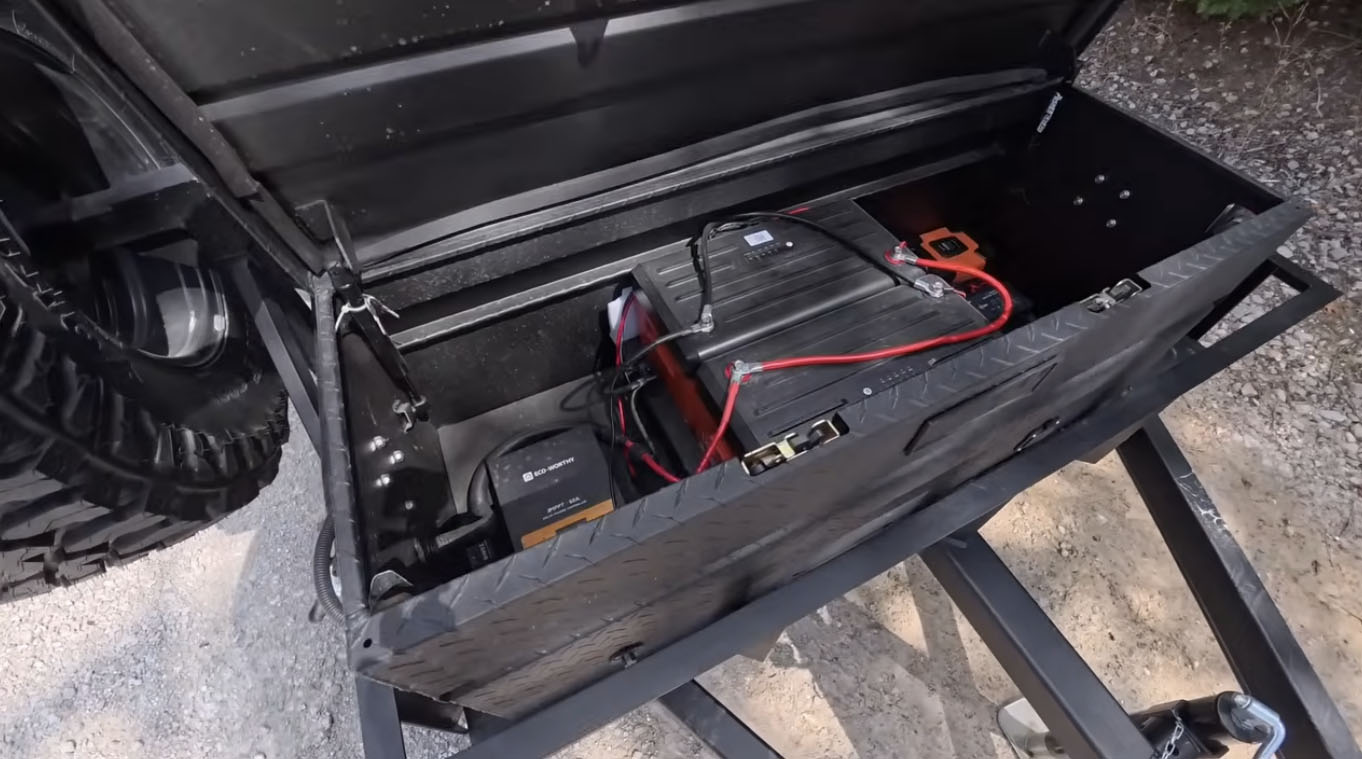
A 12-volt power system is optional for most weekend truck camping trips and worthwhile for anything longer. The Freedom Camper’s roof composite panels support solar mounts. Pair them with a lithium battery bank to run lights, a 12-volt fridge, a phone charger, and the optional Freedom Campers ventilation fan. A 100-watt solar panel costs $80 to $150. A 100Ah lithium battery runs $200 to $400. Together, that system handles four days of camp lighting and phone charging without a generator. Add a 12-volt portable fridge (ARB, BougeRV, or similar at $300 to $700) to eliminate ice costs on multi-day trips.
On longer Wyoming trips, a 12-volt fridge pays for itself in ice savings within two outings. Camp kitchen simplicity is underrated. A two-burner propane stove at $40 to $120 covers everything from boiling water for coffee to cooking dinner for two. Cast iron or titanium cookware costs $30 to $80. A bear canister or locking storage box ($60 to $200) keeps food secure at dispersed sites. Water storage via two five-gallon jerry cans ($40 to $80) handles most weekend trips without requiring a water tank. The entire kitchen setup runs $200 to $500 depending on whether you add a fridge. Keep it in one dedicated tote and loading becomes automatic.
| Truck Camping Category | Entry Setup | Mid-Range Setup |
|---|---|---|
| Shelter | Ground tent $200-400 | Freedom Camper $3,499.99 |
| Sleep System | Bag + foam pad $180-250 | Bag + inflatable $280-650 |
| Camp Kitchen | Stove + cooler $100-200 | Stove + 12V fridge $400-850 |
| Power | None ($0) | Solar + battery $280-550 |
| Bed Platform | DIY $100-300 | Drawer system $1,100-1,400 |
| Recovery Gear | Basic kit $300-500 | Full kit $600-1,200 |
Upgrade Your Truck Camping Shelter
Stop Sleeping Cold. The Freedom Camper Has You Covered.
Insulated hard-shell camper that mounts in minutes. Two people load it – no equipment needed. Ships in the lower 48 with a 3-year warranty.
Truck Bed Camper vs. Rooftop Tent: Which Setup Wins?
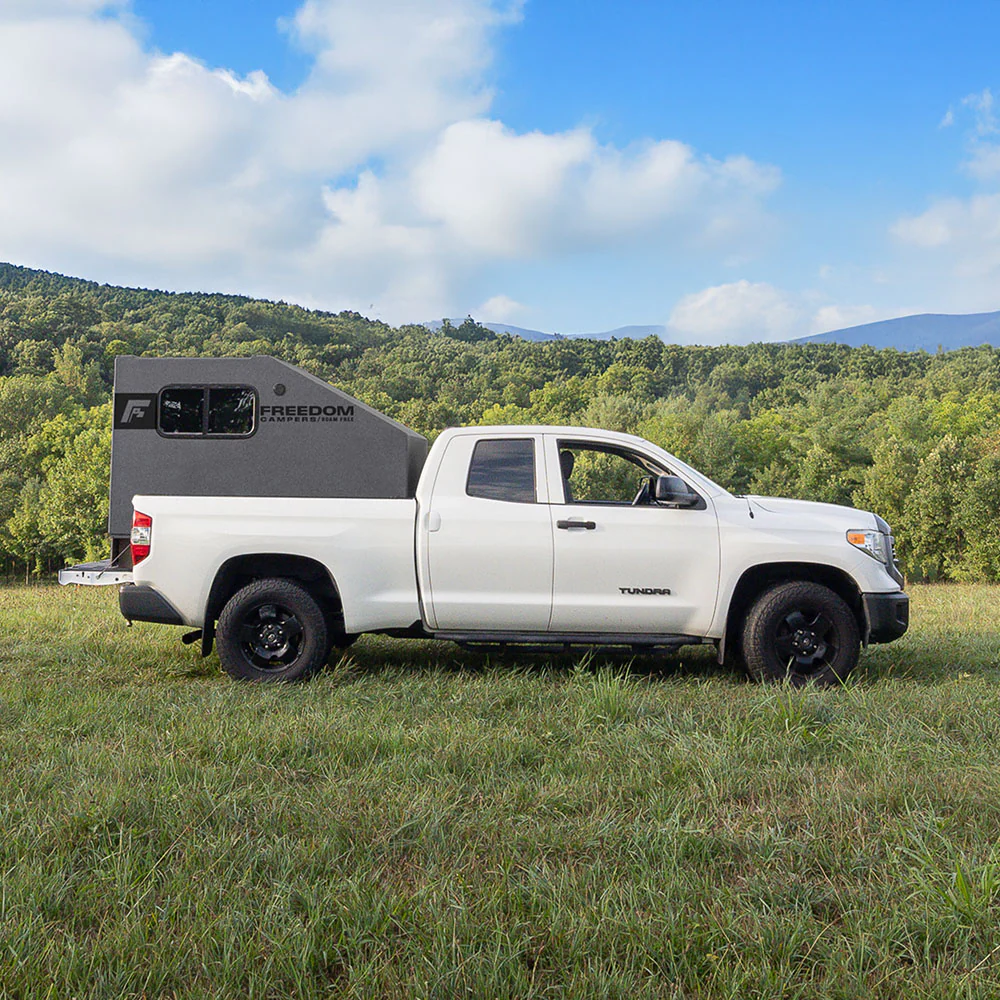
Both options work for truck camping. The right choice depends on what you care about most. A rooftop tent elevates your sleeping position off the ground, sets up in minutes, and doesn’t occupy your truck bed. The bed stays available for gear, a fridge, and storage. Quality hardshell rooftop tents run $2,000 to $3,500. They add 60 to 100 lbs to your roof (plus the mattress), raise your center of gravity, and increase fuel consumption. In wind and cold, a rooftop tent also exposes you to the elements in ways a bed camper doesn’t. In winter conditions or high-wind sites, a rooftop tent becomes uncomfortable faster than a well-insulated bed camper.
A truck bed camper like the Freedom Camper gives up gear storage in the bed. It compensates with far better weather protection and a longer sleeping surface. You also leave the shelter at basecamp while you drive the trail unencumbered. At $3,499.99, the Freedom Camper costs less than or comparable to a quality rooftop tent. It offers a larger interior (84.5 inches long on the 58×89 vs. 56 to 60 inches on most RTTs), real four-season insulation, and 48 inches of interior height for sitting up. For a detailed breakdown of how these two approaches compare on price, weight, and flexibility, see our truck camper vs. teardrop trailer comparison.
The decision framework is simple: if you need your truck bed for gear and want a fast fold-down shelter, the rooftop tent wins. If you want the best weather protection, the longest sleeping surface, and the flexibility to disconnect your shelter from your truck, the Freedom Camper wins. Most four-season truck campers land on the bed camper eventually, especially after spending a cold night in a rooftop tent at elevation.
Pros and Cons of Truck Camping
Pros
- Access to dispersed sites and forest roads unavailable to trailers and RVs
- No tow vehicle commitment – your truck is your camping platform
- Lower setup cost than RV or trailer camping; Freedom Camper starts at $3,499.99
- The Freedom Camper disconnects so you drive the trail unburdened
- 1,000 to 2,300 lb payload capacity covers shelter, gear, water, and recovery kit
- Faster departure prep than any trailer-based system
- Rooftop tent or bed camper options suit different priorities and budgets
Cons
- Bed camper occupies the full truck bed – no gear storage below unless platform is built
- No onboard kitchen or bathroom in lightweight setups; camp stove required
- 48-inch interior height in the Freedom Camper means sitting, not standing
- Less living space than a full trailer for multi-week expeditions
- Platform build required for midsize and most full-size trucks ($100 to $300 DIY)
Final Verdict

Truck camping rewards simplicity and punishes complexity. The pickups that see the most backcountry miles aren’t the most built-out. Each has a system: same bins, a fast-loading shelter, and a sleep setup that works from 20 to 80 degrees without swapping bags. Getting more out of your pickup for truck camping is mostly about removing friction. Fewer steps between “I want to go” and “I’m leaving” is the whole goal. Every improvement that reduces that gap pays off every subsequent trip.
The Freedom Camper is the shelter upgrade worth making for most truck campers moving beyond a ground tent or rooftop tent. At $3,499.99, it costs less than a quality rooftop tent. It delivers more interior length, real four-season insulation, and the flexibility to leave it at camp while your truck runs the trails. The 48×79 model suits midsize trucks including the Tacoma, Gladiator, Ranger, and Colorado. The 58×89 (most popular, 195 lbs) covers the F-150, Silverado, Tundra, and Ram 1500 through 3500.
For truck campers who want a kitchen and bathroom, a full slide-in hard-side camper makes sense and starts around $15,000. For those who want the best shelter value at the lightweight price point, the Freedom Camper is the answer. Pair it with a quality sleep system, a camp kitchen in one tote, and a basic recovery kit. The result is a truck camping setup that goes out often and comes back without drama. Register the camper after purchase to activate the 3-year limited warranty.
Ready to Upgrade Your Setup?
Check Today’s Price on the Freedom Camper
Ships direct in the lower 48. 3-year limited warranty. Register after purchase to activate coverage. On sale now.
Frequently Asked Questions
How do I set up my pickup truck for camping?
Start with a bed platform or wheel well clearance solution. Then add a shelter, a sleep system rated to your conditions, and a camp kitchen in one tote. Organize the bed into three zones: shelter mount, gear storage, and a daily-access zone for items you need without digging. The goal is a system you repeat identically every trip so departure prep takes 20 minutes.
What is the best shelter for truck camping?
For four-season weather protection at a mid-range price, the Freedom Camper is the strongest option in the lightweight truck camping category. It starts at $3,499.99 and weighs 175 to 195 lbs for the three smaller models. Both midsize and full-size pickups are covered, plus utility trailers. Rooftop tents ($900 to $3,500) are a strong alternative if you need the truck bed for gear storage. Ground tents work for fair-weather use but provide no weather advantage over a dedicated shelter.
Is truck camping comfortable?
Truck camping is as comfortable as your sleep system and shelter make it. A sleeping bag rated to your expected low, an insulated pad, and a weatherproof shelter produce genuinely comfortable sleep in backcountry conditions. The Freedom Camper’s interior runs 74.5 to 84.5 inches long depending on model – enough for most adults to sleep flat. The 48-inch interior height limits movement to sitting rather than standing, which is the main comfort trade-off compared to a full-size trailer.
How do I organize my truck bed for camping?
Build or buy a wheel well platform for your shelter, then assign the under-platform space as your storage garage. Use labeled stackable bins organized by category: kitchen, sleep kit, recovery, and personal gear. Put the heaviest items lowest and closest to the cab. Keep the daily-access items at the tailgate end. After two or three trips with the same layout, loading becomes automatic and you stop forgetting gear. A Decked drawer system ($1,100 to $1,400) formalizes this organization if you want a more permanent solution.
Does the Freedom Camper fit my truck?
The 48×79 model fits most midsize trucks including the Toyota Tacoma, Ford Ranger, Ford Maverick, Chevrolet Colorado, GMC Canyon, Nissan Frontier, Honda Ridgeline, and Jeep Gladiator. Full-size trucks including the F-150, F-250, F-350, Silverado, Sierra, Tundra, Ram 1500 through 3500, and Nissan Titan take the 58×79 and 58×89 models. For flatbed trucks and trailers only, the 72×89 model is the right fit. Download the Freedom Campers Truck Compatibility Guide from their product page for the full fitment list.
Just so you know, some of the cool stuff we mention comes with affiliate links, meaning we earn a commission if you buy (no extra charge to you!). Plus, we occasionally feature sponsored content, but rest assured, we only shout out products we genuinely stand behind.