




Quick Facts:
- Product: Rivian x iKamper Skycamp 4.0 DLX, the second Rivian rooftop tent collaboration
- Sizes: Duo for the R1T bed, Trio for the R1S and R2 roof
- Announced: August 18, 2026, and shipping now
- Base price: $4,800 Duo, $5,050 Trio, before a $249 freight charge
- Loaded weight: 140 to 155 lb Duo, 153 to 170 lb Trio
- Power: 12V to 24V input, 324W combined output, external source required
- Setup: 60 seconds claimed, with a new integrated HC Staircase ladder
- Warranty: 2 years limited, original purchaser only
- Best for: Rivian owners who camp often enough to justify a permanent roof load
9 min read
Some links on this page are affiliate links. Buying through them supports 4wdTalk at no extra cost to you.
In This Article
- What the New Rivian Rooftop Tent Lineup Adds
- Duo or Trio: Which Size Fits Your Rivian
- The Published Weight Is Not the Weight on Your Roof
- The 12V System Does Not Run Off Your Rivian
- Range: What Is Known and What Nobody Has Measured
- Rivian Rooftop Tent vs. the Standard Skycamp 4.0
- Final Verdict
- Frequently Asked Questions
What the New Rivian Rooftop Tent Lineup Adds
Rivian and iKamper announced the Skycamp 4.0 DLX on August 18, 2026, and the tents are shipping now. This Rivian rooftop tent lineup replaces a single-size product with two, and the new size is the headline. Previously the collaboration offered a single Mini-sized tent for the R1T and R1S. Now a wider Trio joins it, cut to follow the rooflines of the R1S and the new R2.
Both tents sit on iKamper’s redesigned Skycamp 4.0 platform. Compared to the outgoing generation, the shells gain headroom, larger doors and windows, and a bigger skylight. Notably, the closed footprint does not grow. Rivian-specific touches include exclusive badging, a Rocky Black shell finish and yellow accents.
Two features are genuinely new for iKamper rather than cosmetic. First comes the HC Staircase, a ladder with wide steps built into the rails instead of a bolt-on accessory. Second is an electrical junction box, iKamper’s first, feeding integrated lighting plus USB-A, USB-C and 12-volt outlets. Both tents also carry dual HVAC passthrough ports for a separate air conditioner or heater.
This is the second collaboration between the two companies. The first was the Skycamp Mini, built on the older Skycamp 3.0 Mini platform. Today the Skycamp Mini shows as discounted and out of stock on iKamper’s site. Anyone shopping the wider market should first read our roundup of the best rooftop tents of 2026. After all, the wider hardshell market starts well below $4,800.
iKamper released a four-minute walkthrough of both configurations on August 18. Rivian followed on August 20 through its own Stories channel, and the product went live in the Rivian Gear Shop the same week.
Duo or Trio: Which Size Fits Your Rivian
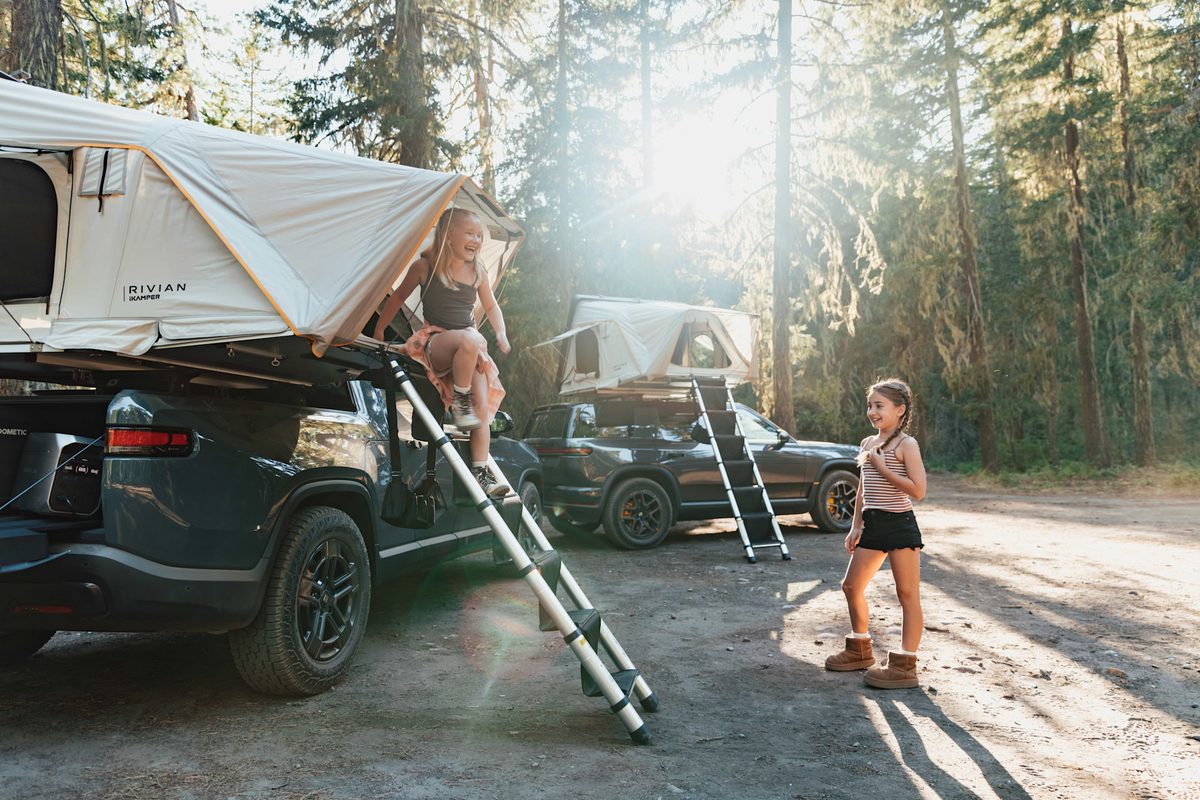
These two sizes are not interchangeable. Instead of the sleeping count, the deciding factor is where the tent mounts. The Duo sits in the R1T bed on the bed accessory ports, below cab height. Meanwhile, the Trio goes on the roof of an R1S or an R2, following the roofline.
A tent in the bed sits behind the cab and out of clean airflow. In contrast, a roof-mounted tent stands in the worst place aerodynamically. iKamper concedes the point in its product FAQ, calling the bed mount’s range impact minimal and the roof mount’s greater, without publishing a figure either way.
Here is how the two compare on the specifications iKamper publishes.
| Specification | Duo | Trio |
|---|---|---|
| Vehicle fitment | R1T (bed or roof) | R1S, R2 (roof) |
| Sleeping capacity | 1 to 2 people | Up to 3 people |
| Sleeping area | 60 1/4 in x 82 5/8 in | 67 3/8 in x 82 5/8 in |
| Tent plus brackets | 119 lb | 132 lb |
| Loaded weight range | 140 to 155 lb | 153 to 170 lb |
| Crossbar spacing | 22 in to 41 in | 24 in to 49 in |
| Height closed / open | 13 3/4 in / 46 1/2 in | 13 3/4 in / 46 1/2 in |
| Base price | $4,800 | $5,050 |
The $250 gap between them buys roughly seven inches of extra width and a third sleeping position. Freight adds $249 to most addresses in the contiguous United States. Both prices exclude the optional self-inflating mattress. At iKamper’s checkout the mattress adds about $208 on the Duo and about $251 on the Trio.
The Published Weight Is Not the Weight on Your Roof
Coverage of this launch has led with 119 lb for the Duo and 132 lb for the Trio. Both come from iKamper’s specification table, and both are accurate as far as they go. Yet they account for the tent plus mounting brackets only, and no write-up has flagged the figure sitting above them.
Scroll further up the same product page and iKamper’s own “At a Glance” panel gives a different figure. The Trio is listed at 153 to 170 lb, and the Duo at 140 to 155 lb. Those higher numbers include hardware most owners fit anyway. Specifically, the HC Staircase ladder adds 20.5 lb. Meanwhile, the mattress adds another 15.2 lb on the Duo or 17.1 lb on the Trio.
Running the numbers against Rivian’s dynamic roof load
Rivian’s own Cargo Crossbars documentation rates the R1T and R1S bars at 250 lb while driving and 780 lb parked. A fully loaded Trio at 170 lb therefore consumes 68 percent of the R1 driving allowance. Similarly, a loaded Duo at 155 lb uses 62 percent. Neither breaks the limit, so forum warnings about an over-limit R1 tent do not hold up.
The R2 is a different story, and no launch coverage has run the numbers. Rivian rates the separate R2 Cargo Crossbars at 187 lb while driving and 606 lb parked, well under the R1 figures. A loaded Trio at 153 to 170 lb therefore uses 82 to 91 percent of the R2 dynamic roof load. Headroom drops to somewhere between 17 and 34 lb, which is an awning and nothing else.
Two things follow. First, the R2 Cargo Crossbars are listed as coming soon at $700, so an R2 owner cannot fit this tent yet. Second, on an R1 the same tent leaves roughly 80 lb spare. For scale, an empty hardshell cargo box runs 40 to 55 lb and a full-size awning 30 to 40 lb. You get one, not two. Before you commit either way, work through how to check your rig’s payload capacity, because roof weight also counts against total vehicle payload.
The 12V System Does Not Run Off Your Rivian
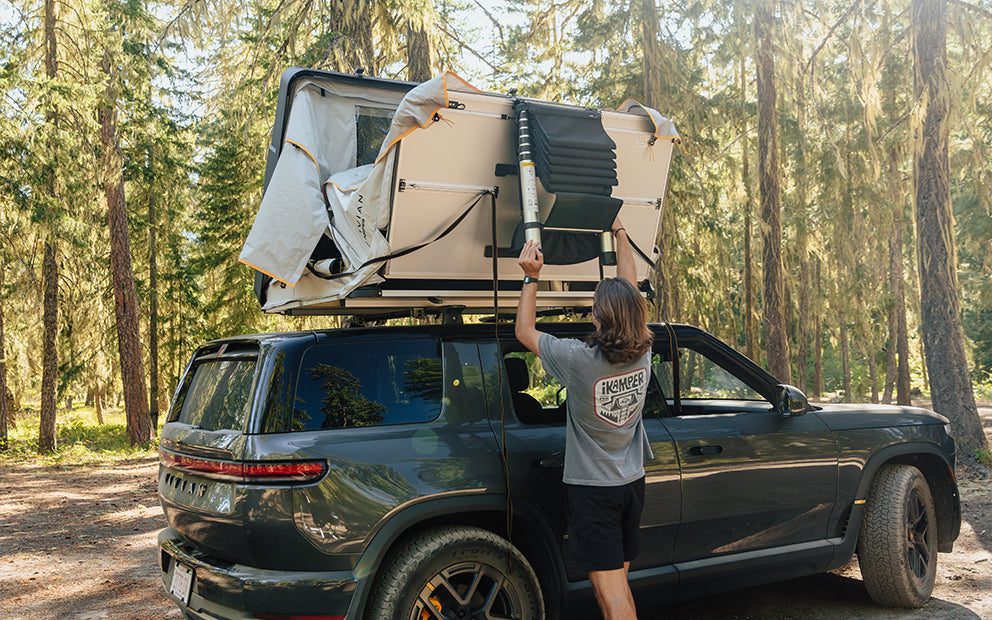
The 12V junction box is the most misreported part of this launch. Several write-ups have implied the tent taps the vehicle’s own systems. It does not. Rivian’s Gear Shop listing is explicit: an external 12-volt source is required to run the lighting and outlets.
In practice, you feed the tent through an Anderson SB50 port on its underside. Power comes from either a 12-volt accessory socket in the vehicle or a portable power station. The 12V junction box accepts 12V to 24V input at up to 15 amps. It also delivers a maximum combined output of 324W across USB-A, USB-C and 12-volt outlets. For a limited period, iKamper is including the 12-volt adapter cable at no charge.
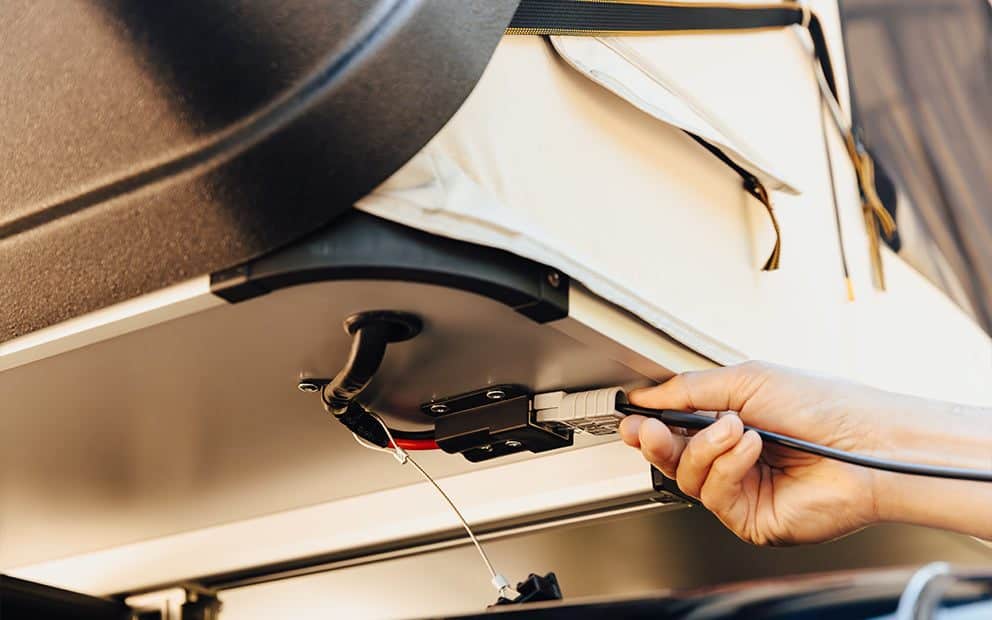
Draw on the Rivian rooftop tent is modest. The integrated light bars pull 6.25W on white, 5.15W on amber and 5.55W on red. Dimming is independent, inside and out. Running those overnight off a vehicle accessory circuit is a small load. Although the draw is minor, a portable power station remains the safer choice on a multi-night trip. The HVAC passthrough ports follow the same logic. Since they carry air rather than power, any heater needs its own supply.
Range: What Is Known and What Nobody Has Measured
No manufacturer publishes a range figure for this tent, and iKamper answers the question with adjectives rather than data. An EV owner needs the number more than a diesel owner does, since charging stops depend on real-world range.
The physics are consistent across vehicle types. Our own analysis of whether rooftop tents are worth it puts the typical efficiency penalty near 10 to 17 percent. Moreover, the loss grows with speed, because aerodynamic drag rises with the square of velocity. Owners posting in Rivian forums and regional owners clubs report highway losses in a similar band. However, none of those figures come from controlled testing.
Two practical conclusions follow. First, the Duo’s bed mount is the cheaper option in every sense, since it sits lower and behind the cab. Second, the penalty is a highway phenomenon. A Rivian rooftop tent therefore costs far less on forest roads than on a 70 mph interstate run. Owners who tow already understand this trade. Anyone planning long transit legs should treat the tent as a removable item rather than a permanent fixture.
Rivian Rooftop Tent vs. the Standard Skycamp 4.0
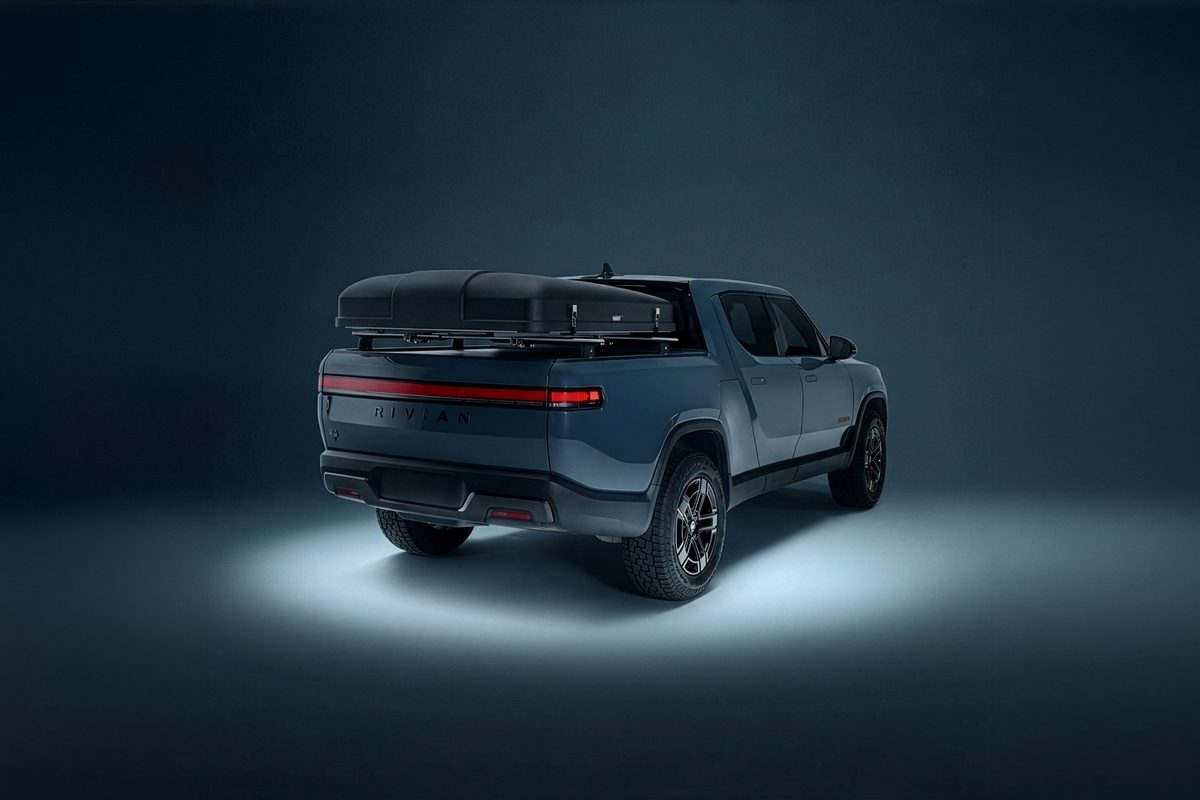
The obvious question is whether the Rivian rooftop tent badge earns its keep against a standard Skycamp 4.0. Three things come with the Rivian edition. First, vehicle-specific sizing, so the shell follows the roofline. The exclusive colorway and badging also come standard. Finally, mounting brackets compatible with Rivian’s Adventure Key Set, so the tent keys match the vehicle keys. The cork-topped ThermaSeal floor is not among them, since iKamper now fits it across the whole Skycamp 4.0 series.
One thing goes the other way. iKamper’s product FAQ confirms a real omission. Notably, the latches on the Rivian edition do not lock, in contrast to the standard Skycamp 4.0. Security shifts to the mounting brackets, and the Adventure Key Set is sold separately. On a $5,000 product left unattended at a trailhead, the missing lock is a concession no launch coverage has mentioned.
Resale deserves a thought. Rivian badging and a bespoke shell finish narrow the second-hand buyer pool compared to a standard Skycamp. iKamper’s two-year warranty covers original purchasers only and does not transfer. Against a broader field, a Cinch Sky Cruiser hardshell tent lands at similar money without the vehicle-specific fitment. Therefore the Rivian premium buys integration rather than raw capability.
Final Verdict
The Trio is the more interesting half of this launch. In particular, it opens factory-supported rooftop camping to the R1S and, once its crossbars ship, the R2. If you own an R1S or have an R2 on order, the fitment work is done for you. Moreover, the integration is genuine rather than cosmetic. Our look at the Rivian R2 overland platform covers where the rest of the ecosystem stands.
The trade-offs are real. You pay a premium over an equivalent standard Skycamp, and you give up locking latches. In addition, the loaded Trio eats roughly two-thirds of an R1’s dynamic roof load, and as much as 91 percent of the R2’s. Occasional campers who take two or three trips a year will struggle here. Compared to the cost of a ground tent and a decent sleeping system, $5,050 plus freight is hard to justify.
On value, the honest read is simple. You are paying for integration and finish, instead of camping performance rivals lack. We have not slept in one, so treat build quality as unproven. On paper the HC Staircase and the lighting are meaningful upgrades. Neither upgrade is exclusive to the Rivian edition beyond the badge.
Buy the Duo if you own an R1T, because it costs less, weighs less and hurts your range less. Choose the Trio for the third sleeping position on an R1S, or on an R2 once its crossbars ship. If neither applies, a standard Skycamp 4.0 Trio delivers the same tent with locking latches, plus a wider resale market. Both Rivian editions are sold through iKamper directly. They also appear in the Rivian Gear Shop, which routes orders back to iKamper for checkout.
Frequently Asked Questions
Does a Rivian rooftop tent reduce range?
Yes, though no controlled test has been published for this specific tent. Rooftop tents typically cost 10 to 17 percent in efficiency, and the loss concentrates at highway speeds. A bed-mounted Duo sits below cab height and costs noticeably less than a roof-mounted Trio.
What is the roof load limit on Rivian Cargo Crossbars?
Rivian rates the R1T and R1S bars at 250 lb while driving and 780 lb parked. However, the separate R2 bars are rated lower, at 187 lb and 606 lb. A loaded Trio at 153 to 170 lb therefore leaves roughly 80 lb spare on an R1, but only 17 to 34 lb on an R2.
How much does the Rivian rooftop tent weigh once loaded?
Once the ladder and mattress are fitted, iKamper lists the Duo at 140 to 155 lb. Similarly, the Trio is listed at 153 to 170 lb. The lower 119 lb and 132 lb figures quoted in most coverage describe the tent and mounting brackets alone.
Will the Skycamp 4.0 DLX fit a non-Rivian vehicle?
Both tents use a universal bracket system. Specifically, crossbar spacing runs 22 to 41 inches on the Duo and 24 to 49 inches on the Trio. Fitment on another vehicle is therefore possible where spacing and load rating allow. However, you lose the Adventure Key Set compatibility.
Does the tent draw power from the vehicle?
Not directly. The tent is not wired into the vehicle at the factory. Instead, you connect an external 12V to 24V source through an Anderson SB50 port. Either a vehicle accessory socket or a portable power station works.
How much does the Rivian rooftop tent cost?
The Duo starts at $4,800 and the Trio at $5,050. Both prices exclude a $249 freight charge to most contiguous United States addresses. Adding the self-inflating mattress raises those figures by roughly $208 and $251 respectively.