



Quick Facts:
- Engines compared: 2.0L turbocharged four and 3.6L Pentastar V6
- Output: 270 hp and 295 lb-ft versus 285 hp and 260 lb-ft
- Transmissions: turbo is automatic only; the V6 still offers a six-speed manual
- EPA combined: 21 mpg versus 20 mpg, four-door automatic
- Towing: identical, up to 5,000 lb on the four-door Rubicon
- Open bulletin: Stellantis TSB 09-011-25, intake camshaft and rocker wear
- Affected build range: 2018 to 2025 JL Wranglers built on or before August 15, 2024
- Best for: buyers weighing a discounted leftover against long-term repair risk
9 min read
In This Guide
- Where the Wrangler Turbo vs Pentastar Argument Stands
- Key Numbers Side by Side
- The Bulletin Stellantis Wrote About Its Own V6
- What Altitude Does to the V6 Horsepower Lead
- Crawling, Engine Braking, and Gearing
- What the 2.0 Turbo Gets Wrong
- Three Spec Sheet Myths Worth Killing
- Wrangler Turbo vs Pentastar: Which to Buy
- Frequently Asked Questions
Where the Wrangler Turbo vs Pentastar Argument Stands
For years the Wrangler turbo vs Pentastar question had a stock answer. Buy the V6, because six cylinders and a long production run beat a small turbo. However, the sentiment on owner forums has visibly turned, and the reason sits in a document Stellantis published itself.
In 2025 the company issued a technical service bulletin on the 3.6L Pentastar. It describes worn intake camshaft lobes and rocker arm wear. Specifically, it names the 2018 through 2025 JL Wrangler engine in two forms: the 3.6L with stop-start, sales code ERC, and the 3.6L eTorque, code ERG. It also lists a typical failure window of 10,000 to 60,000 miles. In the cause field, Stellantis writes two words: manufacturing issue. Meanwhile, the publicly searchable bulletins for the 2.0L turbo cluster around its cooling system rather than its rotating assembly.
Because of this asymmetry, the Wrangler turbo vs Pentastar comparison is no longer a debate about refinement or sound. Instead it is a question of which valvetrain you would rather own at 60,000 miles. Both engines remain on the 2026 order sheet. Therefore the choice is live for anyone shopping today.
This guide works through the documented evidence on both sides. First the specifications, then the bulletin, then altitude and trail behavior. Finally it covers 2.0 turbo reliability and where the four-cylinder falls short. Jeep has moved this direction elsewhere too, as Jeep’s turbo four replacing the V6 in the Grand Cherokee shows.
Key Numbers Side by Side
| Specification | 2.0L Turbo I4 | 3.6L Pentastar V6 |
|---|---|---|
| Horsepower | 270 hp at 5,250 rpm | 285 hp at 6,400 rpm |
| Torque | 295 lb-ft at 3,000 rpm | 260 lb-ft at 4,800 rpm |
| Transmission | Eight-speed automatic only | Six-speed manual or eight-speed automatic |
| EPA combined, four-door auto | 21 mpg | 20 mpg |
| Max towing, four-door Rubicon | 5,000 lb | 5,000 lb |
| Fuel per Jeep | 87 octane meets emissions requirements, 91 recommended for peak output | 87 octane |
| Engine oil | SAE 5W-30 full synthetic | SAE 0W-20 full synthetic |
| Open valvetrain bulletin | None | TSB 09-011-25 |
Output figures and towing ratings come from Jeep’s published 2026 Wrangler specifications and FAQ. Fuel economy figures come from EPA testing for the 2026 model year.
| Best Budget | Top Pick | Best Premium | |
|---|---|---|---|
| Product |  Foxwell NT301 Code Reader Foxwell NT301 Code Reader | TOP PICK BlueDriver Pro Bluetooth BlueDriver Pro Bluetooth | Autel MK808S Bidirectional |
| Rating | ★★★★☆ 4.5 30,100 ratings | ★★★★☆ 4.5 62,400 ratings | ★★★★☆ 4.4 3,900 ratings |
| Bidirectional Control | No | No | Yes, 3000+ active tests |
| Live Data | Yes, with graphing | Yes, plus Mode 6 | Yes, 5-in-1 graphing |
| Works With | Wired handheld | Bluetooth to phone | 7-inch tablet, FCA gateway |
| Price | $55.95 as of Sep 10, 5:14 pm | $139.95 as of Sep 10, 4:23 pm | |
| Check Price → | Check Price → | Check Price → |
Video: Mishimoto Automotive on YouTube
The Bulletin Stellantis Wrote About Its Own V6
Technical service bulletin 09-011-25 carries a 5/17/2025 date. Its title reads “Misfire Diagnostic Trouble Codes (DTCs), Rough Idle, Valvetrain Noise.” Notably, the affected list runs well beyond the Wrangler. It also takes in the Ram 1500, Gladiator, Durango, Grand Cherokee, Pacifica, and ProMaster.
The discussion section is blunt about the mechanism. Stellantis describes “worn intake camshaft high lift lobe(s), and/or intake rocker arm(s) high lift slider wear.” It then gives a typical mileage range of 10,000 to 60,000 miles. Because the bulletin names specific camshaft kit numbers, dealers repair the top end rather than swapping a long block. You will find the full text in the bulletin PDF filed with regulators.
What the Bulletin Does Not Do
Read the policy line before drawing conclusions. It says “Information Only.” In practice the document is diagnostic guidance and a parts list, not a warranty extension. Therefore an owner outside the factory warranty pays for a Pentastar lifter failure.
There is also no safety recall for this failure. Owners sometimes confuse it with warranty extension X56. However, X56 covers a 2011 to 2013 cylinder head casting defect on an older engine generation. Dealers routinely deny X56 claims for valvetrain noise, since X56 targets the head rather than the cams.
What the Repair Costs
Reported quotes vary enormously. One JL owner documented an invoice of $2,096.04 at an independent shop, covering intake camshafts, rocker arms, and lash adjusters. Meanwhile owners have posted dealer figures ranging from roughly $2,600 to nearly $8,000 for the same job. Considering how quickly a Pentastar lifter failure escalates, our look at what Jeep ownership costs is worth reading alongside this.
What Altitude Does to the V6 Horsepower Lead
On paper the Pentastar wins horsepower by 15. At sea level, fine. Above 5,000 feet the arithmetic falls apart, and this is the strongest technical argument for the turbo.
Garrett Motion, a turbocharger manufacturer, publishes the rule of thumb. A naturally aspirated engine loses roughly 3% of its power for every 1,000 feet of elevation. Apply the rule to the Pentastar’s 285 hp. At Denver’s 5,280 feet the V6 makes somewhere near 240 hp. Climb to 10,000 feet and output falls toward 200 hp.
Forced induction resists the loss. Because the control strategy raises boost pressure, the engine compresses thinner air and restores cylinder air mass toward sea-level values. Consequently a turbo four gives up far less at elevation than a V6 does. Anyone who wheels in Colorado, Utah, or the Sierra should weigh this heavily. Our acceleration testing at 5,280 feet shows how much thin air punishes a naturally aspirated engine.
One honest caveat belongs here. No published dyno test compares these two engines at a measured elevation. Therefore the figures above come from applying a manufacturer rule, not from an instrumented Wrangler comparison.
Crawling, Engine Braking, and Gearing
Off-idle torque delivery is where the V6 keeps a genuine advantage. MotorTrend’s Christian Hazel has driven both extensively. He put it plainly: there is more off-idle torque with the 3.6L than with the 2.0L. The manual V6 Wranglers he has wheeled, he wrote, have a better ability to crawl obstacles without stalling, even with your foot off the throttle.
Hazel still picked the turbo as his personal choice for its linear delivery. Similarly, Mishimoto ran both engines on the same dyno, posting 227 wheel horsepower and 264 lb-ft for the turbo. Reading the two curves together, the turbo makes higher peak torque while the V6 makes torque sooner and holds it longer, an assessment Mishimoto’s engineer called fair in the thread.
Video: Mishimoto Automotive on YouTube
Engine Braking on Long Descents
Turbo owners report a second trade-off on long descents. Engine braking is weaker with the 2.0L. An extended steep downhill therefore demands more brake application, even in a properly selected low gear. On a shelf road with a loaded rig, this matters more than a 15 hp difference ever will. Owner reports also disagree about the Rubicon’s 4:1 transfer case. Some say it smooths the turbo’s tip-in, while others find it surge-prone, so treat both claims as unsettled.
Gearing for 35-Inch Tires
Gear shops frame the regear decision around the Pentastar’s low-end deficit. RANDYS Worldwide specialist Gus Pyeatt recommends 4.88 gears for a manual 3.6L four-door on 35-inch tires. He describes the engine as no torque monster. For heavily built rigs, or anyone planning to tow on 35s, Pyeatt says 5.38s are not uncommon. For the full math, see our guide to gear ratios for 35-inch tires.
What the 2.0 Turbo Gets Wrong
Fair treatment demands the other column. The 2.0L has documented problems, and pretending otherwise would be dishonest. Its weak point is the cooling system around the turbocharger rather than the rotating assembly.
Two bulletins cover it. TSB 07-001-20 Rev. C and TSB 07-001-22 Rev. B both address water pump inlet tube fastener torque, issued against coolant leaks and low coolant level. Vehicle guides attribute the pattern to packaging. The turbo sits close to plastic coolant components, where heat soak warps or cracks them.
Where 2.0 Turbo Reliability Claims Outrun the Evidence
Everything else you read about 2.0 turbo reliability lives in the anecdotal column. Oil consumption, turbocharger failure, timing chain rattle, and intake valve carbon all circulate widely with no bulletin behind them. Direct injection carbon is a category-wide trait of engines without port injection. Because no fuel washes the intake valves, deposits build up over time. It is worth managing rather than fearing.
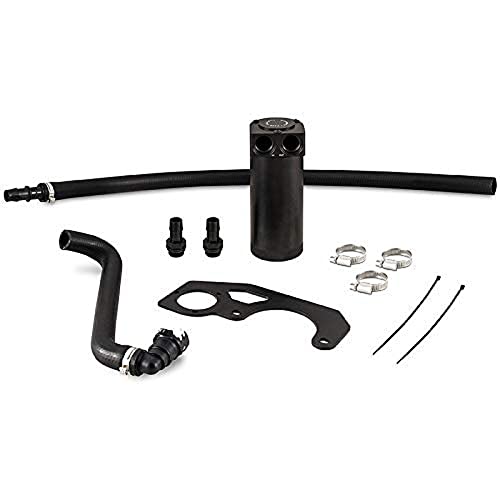
Mishimoto MMBCC-JLH-18CBE Baffled Oil Catch Can Compatible With Jeep JL 2.0L 2018+ Black
The only true direct-fit baffled catch can built specifically for the 2.0T JL engine bay.
- Vehicle-specific brackets and hoses mean no fabricating under the hood
- Baffled 7.5 oz reservoir separates oil instead of just collecting mist
- Keeps blow-by off intake valves the GME-T4 has no port injection to wash
- Installs in about an hour with hand tools
- Rated 4.2 stars on only 38 reviews, a thin sample for a part this expensive
- Not CARB-exempt, so it is an off-road-only part in emissions-test states
Why Reliability Scores Cannot Settle This
Reliability trackers will not settle the Wrangler turbo vs Pentastar question for you. None of them publish engine-level scores. J.D. Power, Consumer Reports, iSeeCars, and RepairPal all score the nameplate instead. iSeeCars states outright it has insufficient data for a 2018 to 2025 generation score. For broader context, our breakdown of Jeep’s 2026 reliability scores covers where the brand lands overall.
Three Spec Sheet Myths Worth Killing
The first myth is fuel economy. Owners talk about the turbo as the thrifty choice. Yet EPA figures put the four-door automatic turbo at 21 mpg combined, against 20 mpg for the V6 automatic. One mile per gallon is the entire advantage. It grows to two only against the six-speed manual V6.
The second myth is cylinder deactivation. Readers frequently blame the Pentastar’s valvetrain trouble on MDS, the system Stellantis uses to shut down cylinders. However, the Wrangler’s 3.6L does not have MDS at all. In the Wrangler line, MDS appears only on the 6.4L V8, which for 2026 means the Willys 392 and the Moab 392. The failure is a roller rocker and lash adjuster problem, independent of any cylinder deactivation.
The third myth is smaller but useful. Towing capacity is identical between the engines at every body style, despite dealer pages implying otherwise. Both four-door Rubicons tow up to 5,000 lb, and both two-doors are limited to 2,000 lb.
Wrangler Turbo vs Pentastar: Which to Buy
Buy the 2.0L turbo if you keep vehicles past the factory warranty. It also suits anyone who wheels at elevation, since boost holds output where a naturally aspirated engine loses it. Its documented weak point is a cooling system repair rather than a top-end teardown, and the bulletin history reflects the difference.
Buy the 3.6L Pentastar if you want the six-speed manual. The 2.0L turbo has been automatic-only in the US since its 2018 introduction. Choose the V6 as well for technical crawling, where off-idle torque and engine braking outweigh peak numbers. Verify the service history first, though, and listen for valvetrain noise on a cold start.
Video: Stellantis North America on YouTube
On value, a discounted leftover deserves real scrutiny. Current September 2026 programs include up to $3,000 in bonus cash on four-door models, or 0% financing for 36 months on select 2026 trims. Two-doors show $1,500, and both offers expire September 30. Leftover 2025 discounts appear to be dealer-level rather than factory-backed. Consequently the headline number often shrinks once loyalty and inventory bonuses drop away.
For a used JL Wrangler engine, the build date matters more than the badge. Vehicles built after 8/15/2024 fall outside the bulletin’s stated scope. Stellantis never says later builds are immune, however. If you want a longer proven record instead, our ranking of the most reliable overlanding engines sets a useful benchmark.
Frequently Asked Questions
Is there a recall for the lifters in a Jeep Wrangler 3.6L engine?
No. There is a technical service bulletin, 09-011-25, naming intake camshaft and rocker arm wear as a manufacturing issue. A bulletin is diagnostic guidance for technicians, not a recall and not a warranty extension. Repairs outside the factory warranty period fall to the owner.
Does the 3.6 Pentastar have lifter issues?
Yes. What owners call lifter failure on this engine is a rocker arm and lash adjuster problem, and Stellantis documents it. The bulletin records wear on intake camshaft high lift lobes and rocker arm high lift sliders. It covers 2018 to 2025 JL Wranglers built on or before August 15, 2024, with the 3.6L in stop-start or eTorque form, sales codes ERC and ERG. The company lists a typical failure window of 10,000 to 60,000 miles.
How much does it cost to replace the lifters on a 3.6 Pentastar?
Owner-posted invoices at independent shops start near $2,096 for camshafts, rockers, and lash adjusters, while dealer figures owners report run from roughly $2,600 to nearly $8,000. No published book rate exists. Getting a second quote is worth the effort, given how wide the reported spread runs.
Does the Jeep Wrangler 2.0 turbo require premium gas?
No. Jeep’s own FAQ states both engines meet all emissions requirements and deliver their rated efficiency and performance on 87 octane regular. For the 2.0L turbo, Jeep adds, 91 octane or higher lets the engine reach optimal performance. Premium is therefore recommended rather than required. EPA rates both engines on regular fuel.
Which Wrangler engine is better at high altitude?
The turbo, by a clear margin. Naturally aspirated engines lose roughly 3% of output per 1,000 feet of elevation. Applied to the V6, the rule drops 285 hp to near 240 hp at 5,280 feet. Boost pressure compensates for thin air, so the turbo holds far more of its rated output.
Is the Jeep 2.0 turbo reliable?
Its documented weak point is the cooling system around the turbocharger, covered by two water pump bulletins. The publicly searchable bulletins for this engine cluster around cooling rather than the rotating assembly. Claims about oil consumption, turbo failure, and carbon buildup circulate widely online without a bulletin behind them.