


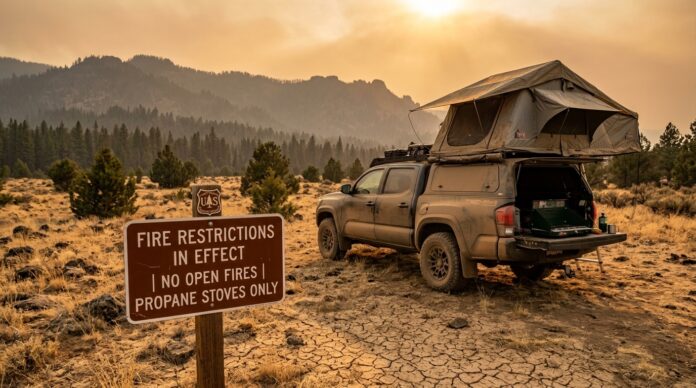

Quick Facts:
- Topic: Fire restrictions for camping and overlanding
- Region: 10 Western US states
- 2026 outlook: Above-normal wildfire risk, May through August (NIFC)
- Acres burned by early May: 1.85 million, nearly double the 10-year average
- Drought coverage: About 63% of the US as of May 1, 2026
- Where to check: InciWeb, BLM, US Forest Service, state forestry sites
- Cost: Free
- Best for: Campers and overlanders planning Western trips
8 min read
In This Guide
Fire Restrictions for Camping: The 2026 Outlook
Fire restrictions for camping arrive earlier across the Western US in 2026, and the season looks like one of the toughest in decades. A dry winter and historically low snowpack primed the region to burn. If you plan to camp or overland this summer, you will probably cross at least one area under a campfire ban. This guide hands you the official tools to confirm the rules before you leave home.
The audience here is simple: campers, overlanders, and dispersed-camping fans heading into national forests, BLM land, and state parks — including anyone using the Dispersed Camping for Overlanders pillar guide to find free sites. Because restrictions shift week to week, a plan from last summer will not hold this year. For example, a site open in June might close to all open flame by mid-July. Smart trip planning now includes a restriction check at every overnight stop.
The stakes are practical, not abstract. Across the country, 1.85 million acres had already burned by early May 2026, nearly double the 10-year average. Meanwhile, drought covered about 63% of the United States. As a result, land managers across the West moved to early-season orders sooner than usual. Knowing how to read those orders keeps your trip legal and keeps the backcountry open for everyone.
The National Interagency Fire Center expects above-normal fire potential through August, with no part of the country below average. Therefore, this resource focuses on action: where to check, what each restriction stage means, and how to keep camping safely while the West stays dry.
2026 Fire Season at a Glance
The numbers below come from the National Interagency Fire Center, the US Drought Monitor, and USDA snowpack data. Together they explain why the 2026 fire season pushed restrictions earlier than normal.
| Indicator | 2026 Status |
|---|---|
| Acres burned (by early May) | 1.85 million, nearly 2x the 10-year average |
| US land in drought (May 1) | About 63%, with 19% extreme or exceptional |
| Western snowpack | Many basins under 20% of normal; some snow-free |
| NIFC outlook | Above-normal fire potential, much of the West, May-Aug |
| Peak risk, Northwest | July and August (UT, ID, OR, WA, N. California) |
| Lower-risk zones | Southern California and the Sierra Nevada (near average) |
Check Before You Camp
See Active Fires and Restrictions Nationwide
InciWeb is the official interagency map for active wildfires, closures, and incident updates. Scan your route in two minutes.
How to Check Fire Restrictions for Camping
Checking fire restrictions for camping takes three layers. First, scan the national picture for active fires near your route. Second, open the agency page for the exact land you will camp on — use how to read MVUMs and find legal campsites to confirm you are on the right parcel, because a national forest, a BLM district, and a state park each set their own rules. Third, call the local ranger district the morning you leave, since field orders change faster than websites update.
Federal and national tools
Start with the national sources below. Each one is free, official, and updated regularly during fire season.
- InciWeb shows active wildfires, prescribed burns, and closures on one interactive map.
- NIFC Fire Information posts national fire news and links to agency resources.
- BLM Fire Restrictions links current rules for every state with BLM land.
- US Forest Service Fire Information routes you to forest-by-forest alerts.
- US Drought Monitor shows current drought severity for your destination.
Bring the rules with you
Cell service drops fast in the backcountry, so screenshot each restriction order before you lose signal. Also pack a printed copy of the relevant agency order. Strong overlanding fire safety means a complete safety kit with a fire extinguisher, which many fire-season orders require in your vehicle, plus a shovel and water to drown any approved fire fully.
Official Lookup Tools by Western State
Each Western state runs its own fire-restriction portal for state and federal land. Bookmark the page for every state on your route. The table below links the official tool for all ten.
| State | Official Lookup Tool |
|---|---|
| Arizona & New Mexico | wildlandfire.az.gov/fire-restrictions |
| California (permits) | readyforwildfire.org/permits |
| California (BLM land) | blm.gov California fire restrictions |
| Colorado | dfpc.colorado.gov fire restrictions |
| Idaho | idl.idaho.gov Idaho Fire Map |
| Montana | mtfireinfo.org/pages/restrictions |
| Nevada | nevadafireinfo.org/restrictions |
| Oregon | Oregon ODF public fire restrictions |
| Utah | Utah Fire Info active restrictions |
| Washington | WA DNR burn restrictions |
Know Your Public Land
Find BLM Restrictions for Every Western State
The Bureau of Land Management hub links current campfire, vehicle, and target-shooting rules by state. Bookmark it for the season.
Stage 1, Stage 2, and Closures Explained
Most Western agencies use a staged system. Knowing the stage tells you exactly what your camp setup is allowed to include.
Stage 1 restrictions
Stage 1 is the most common summer order. Under it, wood and charcoal fires are limited to permanent metal rings inside developed campgrounds. Dispersed campfires outside those sites are prohibited. Smoking is restricted to enclosed vehicles or cleared areas. However, a propane or gas stove with a shutoff valve usually stays legal, which keeps hot meals on the menu. Review these campfire safety tips for your next overland adventure to be fully prepared when fires are permitted.
Stage 2 restrictions
Stage 2 tightens the rules sharply. All open flame is banned, including charcoal and developed-site campfires. Generator use, vehicle travel off cleared roads, and equipment with internal combustion often face time-of-day limits. Notably, many Stage 2 orders still permit a fully enclosed gas stove, though some do not. Therefore, always read the specific order rather than assuming.
Closures and propane workarounds
A closure goes further than any restriction and bars entry to the area entirely. When wood fires are off the table, a sealed gas stove or an approved portable fire pit with a propane feed is often the only legal heat source. Still, confirm the exemption in writing for the specific district before you rely on it.
Restrictions vs. Closures: Which Stops Your Trip?
Campers confuse restrictions and closures, yet the difference decides whether you travel at all. A restriction limits what you do on the land, such as banning open fire while still allowing camping. A closure shuts the gate completely, so no camping, driving, or hiking is permitted inside the boundary.
Restrictions reward flexibility. If a Stage 2 order bans campfires, you adapt with a gas stove and continue the trip. Closures demand a backup plan instead, because the destination is simply off-limits until conditions improve or suppression crews finish work.
For 2026, build both into your route. Check restrictions to adjust your gear and check active-incident closures to confirm the road in is open. When a primary site closes, a pre-chosen alternative at higher elevation or in a lower-risk zone keeps the weekend alive — see options for the best free dispersed camping in Utah as one example of a destination with well-mapped fallback areas.
Final Verdict
The 2026 season rewards campers and overlanders who plan around the rules instead of against them. With above-normal risk forecast through August and snowpack near record lows, the West will sit under restrictions for most of the summer. Your biggest advantage is information, and every tool in this guide is free. Solid overlanding fire safety in 2026 starts with checking the rules and ends with the gear to follow them.
The real trade-off is spontaneity. If a wood campfire defines your trip, the Northwest in July and August will frustrate you — the best free dispersed camping in Washington sits squarely in the peak-risk window — so look earlier in the season or toward near-average zones like the best free dispersed camping in Southern California and the Sierra Nevada. Anyone unwilling to carry a gas stove or verify orders before each leg should rethink a Western trip during peak weeks.
For value, the math is clear. A two-minute restriction check costs nothing and protects a trip worth hundreds in fuel and time. Pair this habit with a complete safety setup and you travel legally through a hard season.
Our recommendation: bookmark InciWeb and your state portals now, pack a propane stove as your primary cook source, and keep a higher-elevation backup site on every route. Treat the lookup tools as required pre-trip gear, the same as recovery boards or a full water supply. Follow Leave No Trace camping principles when clearing ash and packing out fire debris — keeping access open for everyone depends on it.
Before Every Trip
Confirm Your Campfire Permit and Local Rules
California and several states require a free campfire permit even for a camp stove. Check requirements and current orders before you roll out.
Frequently Asked Questions
How do I check fire restrictions for camping in my area?
Start with InciWeb for active fires near your route, then open the state portal and the specific agency page for the land you will camp on. Finally, call the local ranger district the morning you leave. Field orders change faster than websites, so the phone call confirms the current rule.
What are Stage 1 and Stage 2 fire restrictions?
Stage 1 limits wood and charcoal fires to permanent rings in developed campgrounds and bans dispersed campfires. Stage 2 bans all open flame, including charcoal, and often limits generators and off-road vehicle use. A Stage 2 order sometimes still allows a fully enclosed gas stove, so read the specifics.
Is a propane stove allowed during a campfire ban?
Most Stage 1 and many Stage 2 orders allow a propane or gas stove with a shutoff valve, because you control the flame instantly. However, a small number of strict orders prohibit it. Always verify the exemption for your specific district before relying on a gas stove.
Do I need a campfire permit in California?
Yes. California requires a free campfire permit for any fire, including a camp stove or lantern, on most federal, state, and private land. You complete a short online module and carry the permit. Get it through the Ready for Wildfire permits page linked above.
Why is the 2026 fire season so severe?
A dry winter left many Western river basins under 20% of normal snowpack, and warm March temperatures melted what remained early. Consequently, soils and fuels dried sooner. With about 63% of the country in drought, the NIFC forecasts above-normal fire potential across the West through August.
What happens if you violate fire restrictions?
Penalties range from fines in the thousands of dollars to liability for the cost of fighting a fire you start. Some violations carry criminal charges. Beyond the legal risk, one escaped campfire endangers other people and shuts public land for everyone, so the rules protect access as much as safety.