


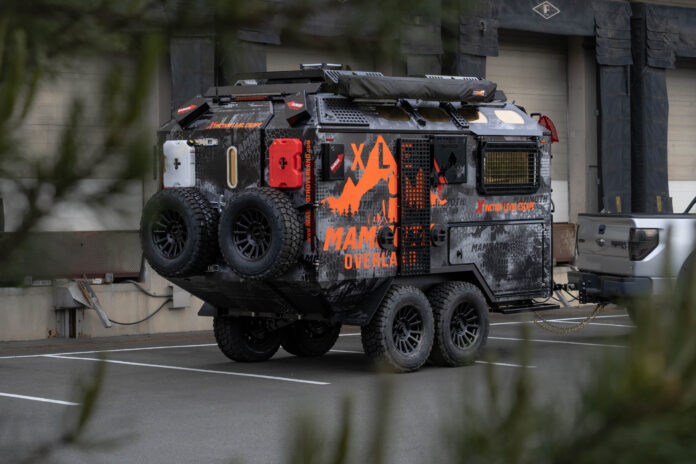

Quick Facts:
- Product: Mammoth Overland XLE (Xtinction Level Escape)
- Dry Weight: 4,500 lb
- Max Gross Weight: 5,200 lb
- Tongue Weight: 400 lb
- Dimensions: 18’4″ long, 7’4″ wide, 9’6″ tall
- Power: 1,200Ah battery, 400W solar, portable generator
- Tires: 33″ HD terrain on forged aluminum wheels
- Price: $123,994 base
- Best for: Buyers wanting a survival-focused luxury trailer
8 min read
In This Review
Mammoth Overland XLE Overview: Spectacle Meets the Trail
The Mammoth Overland XLE, or Xtinction Level Escape, arrives as the brand’s most extreme off-road camper trailer yet. Mammoth Overland set the base price at $123,994. The build fuses the survival hardware of the ELE with the family livability of the TL platform. Coverage in outlets like Robb Report framed it as a luxury survival machine. For overlanders, the wild feature list raises one practical question first. Will your rig tow it at all?
The Mammoth Overland trailer targets a specific buyer. Picture someone who wants base-camp comfort, true off-grid autonomy, and a security package pulled straight from a movie set. The name nods to its Hollywood inspiration. However, the hardware is real, and so is the weight. At 4,500 pounds dry, the XLE sits far above the teardrop trailers many overlanders tow today.
Pricing puts the XLE near the top of the off road camper trailer market. Most capable overland trailers run between $15,000 and $45,000, so the XLE asks for a serious premium. Because of this gap, the value question matters as much as the spec sheet. For perspective on the tradeoffs of towing anything, our breakdown of the pros and cons of overlanding with a trailer is worth a read before you commit.
I read every trailer spec sheet through a towing lens first. After years pulling gear with a Jeep Gladiator and a Chevy Colorado ZR2, plus a week living out of a Bronco Badlands rental, I have learned where heavy trailers punish a mid-size rig. The XLE is impressive. Still, it demands honesty about what sits in your driveway.
Mammoth Overland XLE Specs at a Glance
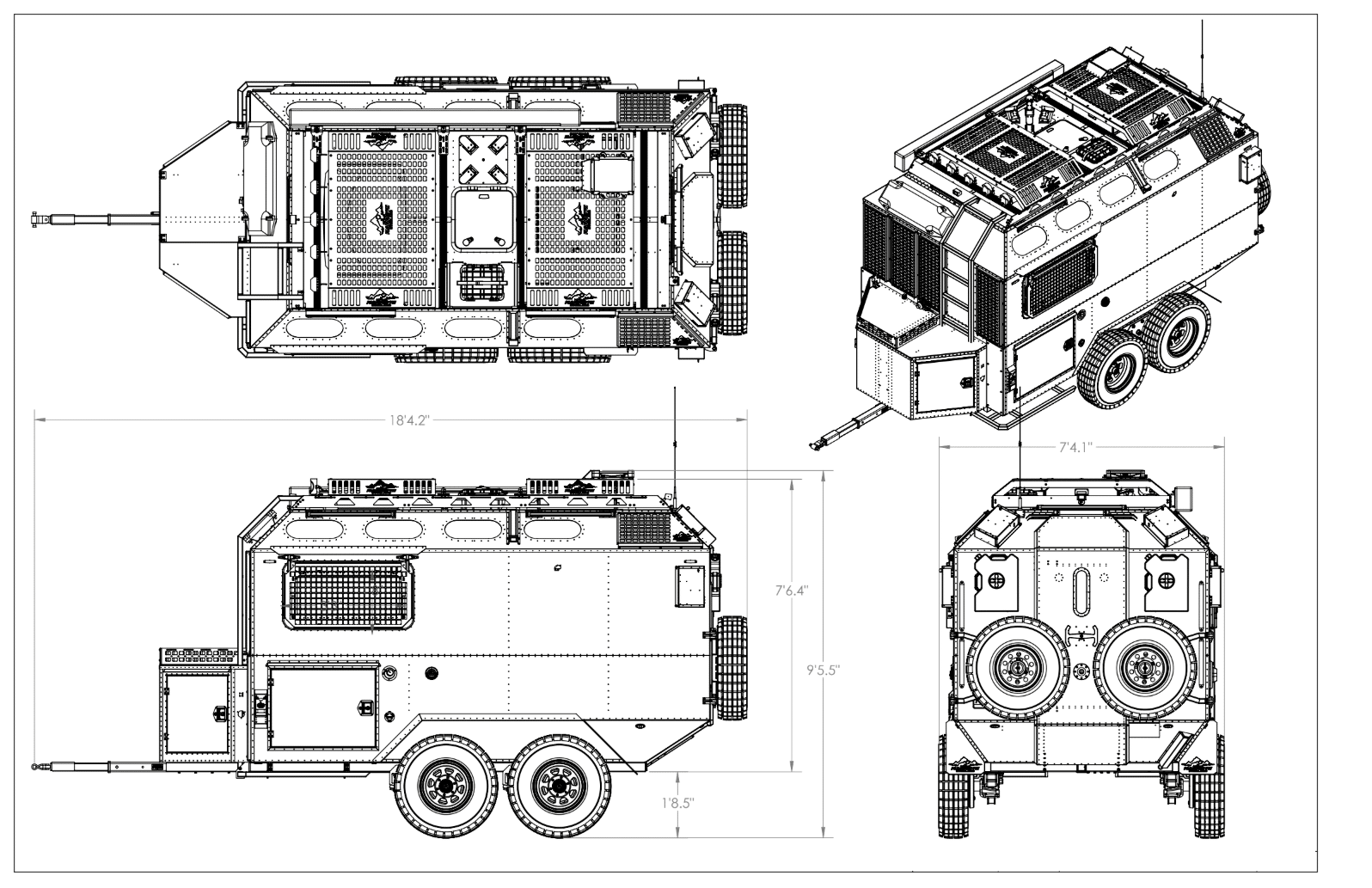
The numbers below come from Mammoth Overland’s official spec sheet. Notably, the weight and tongue figures drive every towing decision later in this review.
| Specification | Details |
|---|---|
| Base Price | $123,994 |
| Dry Weight | 4,500 lb |
| Max Gross Weight | 5,200 lb |
| Tongue Weight | 400 lb |
| Length | 18 ft 4 in |
| Width | 7 ft 4 in |
| Height | 9 ft 6 in |
| Interior Height | 6 ft 3 in |
| Power System | 1,200Ah battery, 400W solar, portable generator |
| Tires | 33″ HD terrain, forged aluminum wheels, dual spares |
Survival Features: What $123,994 Buys
The Mammoth Overland trailer family centers on isolation, and the XLE pushes the theme hardest. First, the cabin runs fully pressurized with dual medical-grade HEPA filtration. One-inch bulletproof windows wrap the living space, while a reinforced rear vault door uses a multi-point locking system. Mammoth Overland shares the exact protection rating on request. For buyers focused on a bulletproof camper feel, the XLE delivers on the theme.
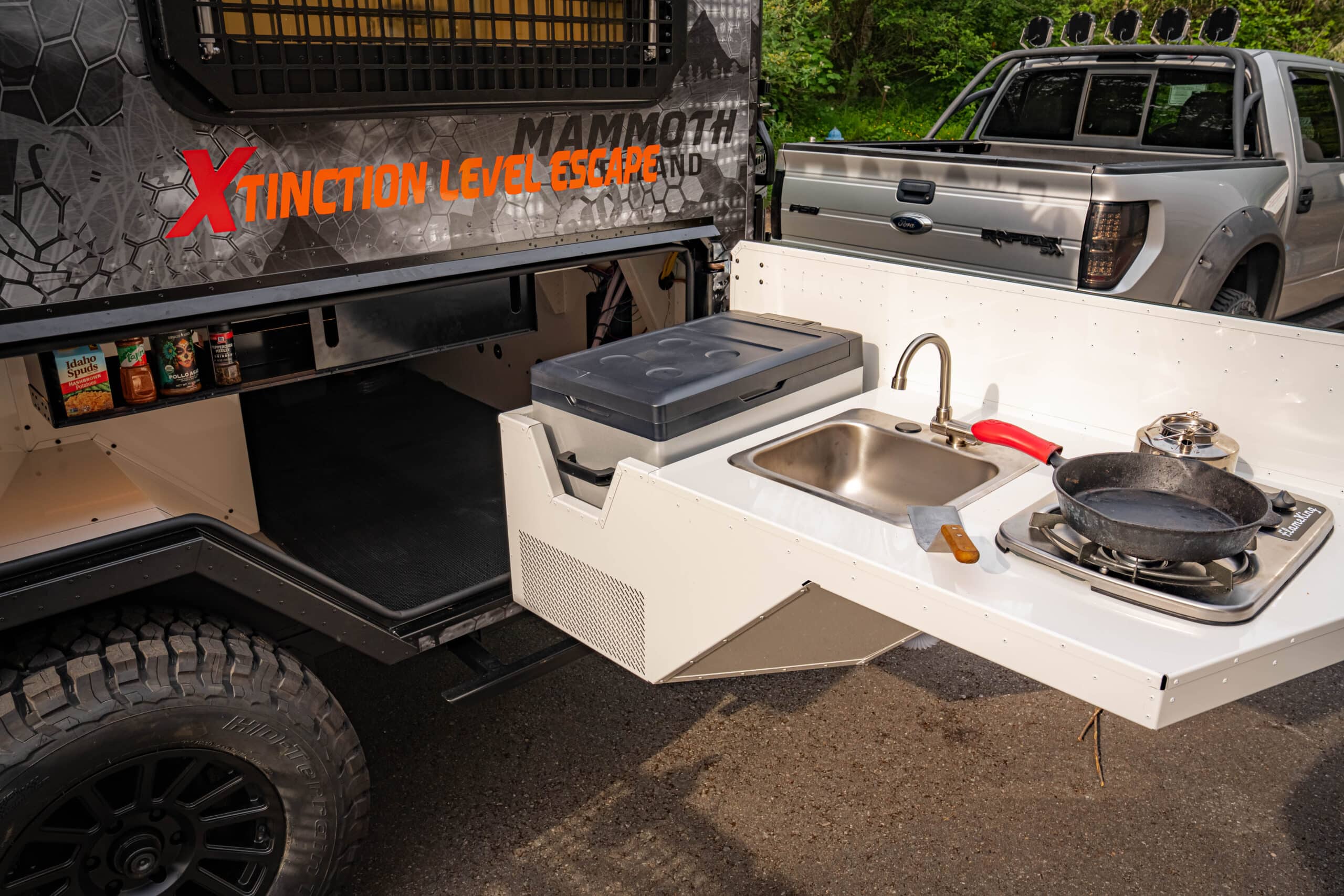
Off-grid power anchors the package. The 1,200Ah battery bank pairs with a 400W solar array and a portable generator for backup. In addition, a 12V air conditioner, a 45L 12V fridge, dual propane, and an armored Truma VarioHeat system keep the cabin livable. Integrated Starlink keeps you connected far past cell range.
Then the build leans into spectacle. The XLE adds a 360-degree night-vision CCTV array, a remote-activated sonic deterrent, and quad remote-controlled bear deterrent units. Mammoth Overland also includes a HAM radio, a weather station, and a Geiger counter. Six remote strobe units and remote blast shields round out the theatrical security layer.
Practical overland touches survive the drama. Specifically, the trailer carries an expedition roof rack with dual standing platforms, a rapid-access roof escape hatch, four passthrough storage bays, and MOLLE panels loaded with a shovel, traction boards, and a hi-lift jack. An onboard water filtration system lets you refill from most sources.
Will Your Truck Tow It? The Reality Check
Here is where the off-road audience needs the truth. At 4,500 pounds dry and 5,200 pounds gross, the XLE is no lightweight teardrop. Load the king bed, the 1,200Ah battery bank, full water, and gear, and you approach the 5,200-pound ceiling fast. Therefore your tow vehicle choice becomes the whole ballgame.
The official tongue weight reads 400 pounds dry. Real-world loading usually pushes tongue weight higher, so plan for more once the trailer fills up. A mid-size truck like a Gladiator or a Colorado ZR2 lists tow ratings near 6,000 to 7,700 pounds. On paper they qualify. In practice, payload runs out before tow capacity does.
This is the trap most luxury coverage skips. Your truck’s payload must absorb tongue weight, passengers, and cargo together. A loaded mid-size truck with a family inside has limited payload left for a 400-plus-pound tongue. As a result, many half-ton and three-quarter-ton trucks make a safer match for the XLE. Run the math with our guide to payload vs. towing capacity before you sign anything.
Before you buy, confirm your rig’s real numbers. You will find your towing capacity on the door-jamb sticker and in the owner’s manual, not in a marketing brochure. Match those numbers against the loaded weight, the tongue weight, and your altitude. Mountain grades and heat shrink real capability quickly.
Reserve Direct From Mammoth Overland
Ready to Build Your XLE?
Deliveries begin before year-end. Place a reservation, choose your paint and options, and lock your spot in the build queue.
Size, Height, and Trail Access
Towing weight tells half the story. The other half is bulk. The XLE measures 18 feet 4 inches long, 7 feet 4 inches wide, and 9 feet 6 inches tall. Those numbers behave far differently from a low teardrop on a tight trail.
Height alone deserves attention. At nearly 9.5 feet, the XLE meets low branches, rock overhangs, and garage doors a teardrop slides under. Width near 7.5 feet also fills narrow forest two-tracks. Consequently, route planning becomes part of ownership, especially on older logging roads or desert washes.
Weight shapes trail access too. Heavier trailers stress brakes, drivetrain, and recovery gear, and they sink into soft sand more easily. A lighter rig reaches terrain a 5,200-pound box should avoid, which protects your drivetrain and fuel budget over the long haul. The XLE works best as a base-camp machine, not a tight-trail explorer.
Are the Defense Systems Legal?
The XLE’s headline gadgets also raise real legal questions. For example, the optional Smoke and Flare Launcher fires 37mm countermeasures and adds $8,000. The quad bear deterrent units spray chemical agents on command, while the sonic deterrent blasts sound to push intruders back.
Legality varies by state and even by county. Chemical deterrents, signal launchers, and high-output sonic devices fall under different rules depending on where you camp. Because enforcement differs widely, buyers should confirm local law and insurance coverage before deploying any of these systems. Treat the defense package as a serious responsibility, not a novelty.
Mammoth Overland XLE vs. the TL Tall Boy: Which Should You Buy?
The XLE shares its living platform with the Mammoth Overland TL Tall Boy, which lists near $72,000. The XLE adds roughly $52,000 in survival and security hardware on top of the base livability. So the real decision comes down to how much you value the defense and autonomy package.
Choose the TL Tall Boy if you want the spacious cabin, strong off-grid power, and Mammoth build quality without the bulletproof glass and deterrent systems. Choose the XLE if total self-reliance and the security theme drive your purchase. Both trailers tow heavy, so the towing math stays the same either way.
Against the wider field, the XLE competes with premium expedition trailers loaded with bathrooms, A/C, and solar. A comparable luxury rig like the OBi Dweller 15, one of several luxury off-road trailers with a bathroom, delivers similar comfort for tens of thousands less. So if amenities matter more than armor, the math favors a cheaper build. The XLE earns its premium only when the survival package is the point.
Mammoth Overland XLE Pros and Cons
Pros
- True off-grid autonomy with a 1,200Ah battery, 400W solar, and a backup generator
- Pressurized cabin with dual medical-grade HEPA filtration
- One-inch bulletproof windows and a reinforced multi-point vault door
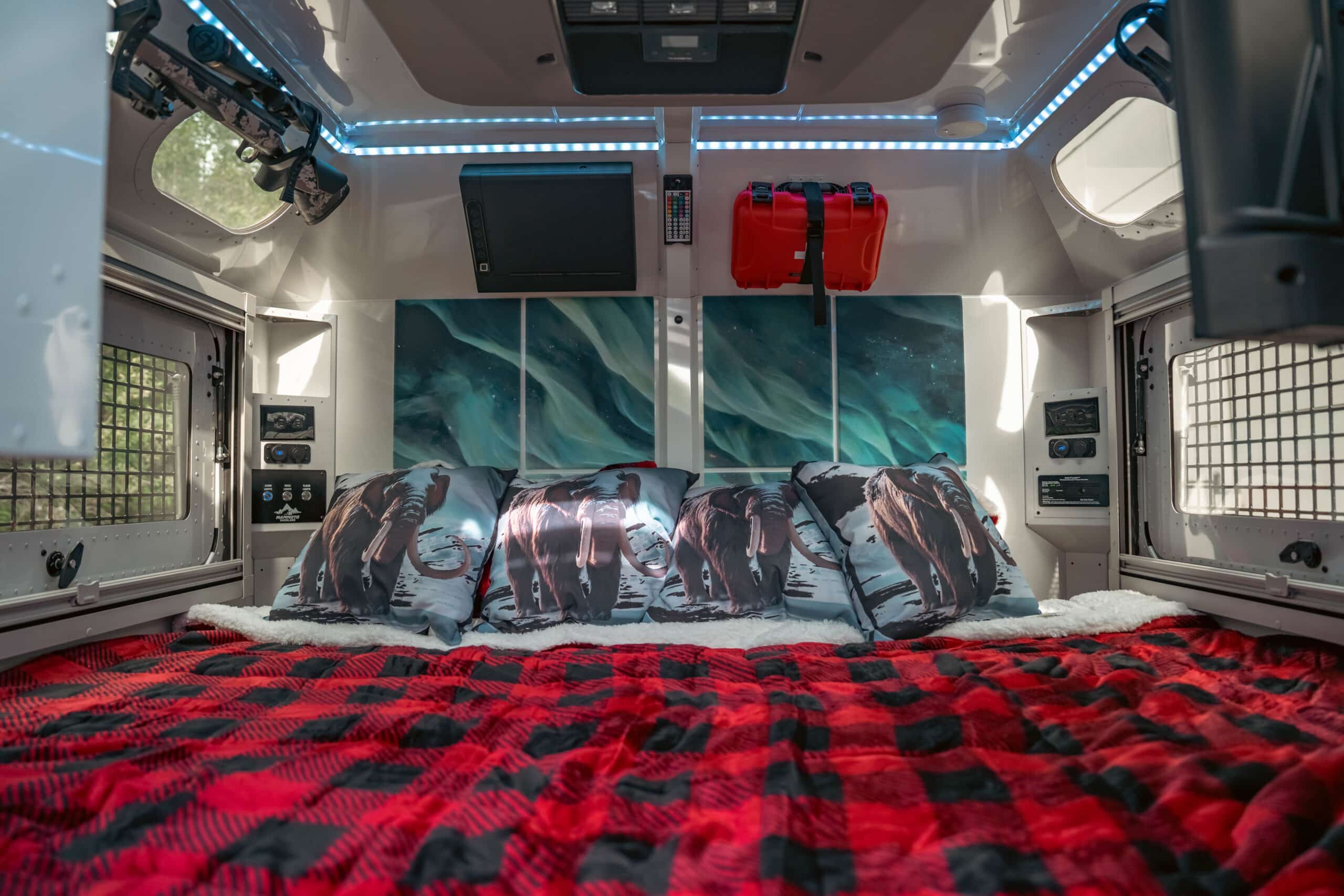
- Family livability with a king bed, 6-foot 3-inch interior height, and bunks
- Integrated Starlink and a HAM radio for connectivity far off grid
- 33-inch terrain tires, dual spares, and an expedition roof rack
Cons
- $123,994 base price sits far above the $15,000 to $45,000 trailer market
- 4,500-lb dry weight rules out many mid-size tow vehicles when loaded
- 9-foot 6-inch height and 7-foot 4-inch width limit tight-trail access
- Defense systems raise legality and insurance questions by state
- Roughly $52,000 premium over the TL Tall Boy for the survival package
Final Verdict
The XLE is the boldest survival trailer on the market, and it backs the theme with real hardware. For a buyer who prizes total autonomy, armored protection, and a movie-grade security suite, nothing else matches the package. Its biggest strength is self-reliance, full stop.
The tradeoffs are equally real. At 4,500 pounds dry and 5,200 pounds gross, the XLE demands a properly rated tow vehicle, and its height and width keep it out of tight terrain. Buyers chasing nimble trail access or a tighter budget should look elsewhere. Off-road capability here favors the base camp, not the technical line.
On value, the XLE asks roughly $52,000 over the TL Tall Boy for the defense and survival layer. This premium makes sense only when armor and autonomy top your list. For most overlanders, a well-built overland rig in the $30,000 to $45,000 range covers the real needs. To weigh this path, our guide to budget overland trailer options lays out the criteria.
My recommendation is simple. Buy the XLE if the survival mission is the whole point and you own a truck rated to tow it safely. Otherwise, the TL Tall Boy or a premium expedition trailer delivers the comfort and capability most families want for far less money. Confirm the full spec list on the official XLE specs page before you decide.
Frequently Asked Questions
How much is a Mammoth Overland XLE?
The XLE starts at $123,994 before options. Add-ons like the $8,000 Smoke and Flare Launcher and the $7,500 custom wrap push the total higher. Pricing places it at the top of the off road camper trailer market.
How much does the Mammoth Overland XLE weigh?
The XLE weighs 4,500 pounds dry with a 5,200-pound max gross weight and a 400-pound tongue weight. Loaded with water, power, and gear, real towing weight climbs toward the gross ceiling. Plan your tow vehicle around the loaded figure.
What truck tows the Mammoth Overland XLE?
A truck with enough payload and a tow rating above the loaded weight is the right match. Many half-ton and three-quarter-ton trucks fit well. Mid-size trucks qualify on tow rating, yet payload often runs short once passengers and tongue weight stack up.
Is the Mammoth Overland XLE bulletproof?
The XLE uses one-inch bulletproof windows and a reinforced rear vault door with a multi-point locking system. The cabin also runs pressurized with HEPA filtration. These features give it a genuine bulletproof camper character, though Mammoth Overland states the protection rating on request.
Are the XLE defense systems legal?
Legality depends on your state and local rules. The flare launcher, chemical bear deterrents, and sonic deterrent fall under varying regulations. Confirm local law and insurance coverage before you use any defense feature on public land or roads.
How does the XLE compare to the Mammoth Overland TL?
The XLE builds on the Mammoth Overland TL platform and adds survival and security hardware. The TL Tall Boy lists near $72,000, while the XLE asks $123,994. Choose the TL for livability and the XLE for armor and autonomy.