


Suspension is the one spec that separates a trailer that tracks smoothly over a rutted two-track from one that beats itself (and your gear) to pieces. After 30 years of camping and 15 years overlanding, I’ve towed trailers riding on leaf springs, torsion axles, and axleless setups across everything from forest roads to slickrock, and the suspension underneath makes a bigger day-to-day difference than almost any other component on the rig.
The axleless vs. traditional trailer suspension debate comes up constantly among overlanders shopping for their first off-road trailer, and for good reason. Each design solves the same problem: keeping your wheels planted and your cargo intact over rough terrain in a fundamentally different way, with real trade-offs in cost, articulation, and long-term maintenance. In this guide, I’ll break down how each system works, where each one shines, and where each one falls short, so you can match the suspension to the way you actually camp.
Quick Facts:
- Topic: Axleless vs. traditional trailer suspension
- Traditional types: Leaf spring, torsion axle
- Axleless design: Independent trailing arms, no connecting axle tube
- Best articulation: Axleless
- Lowest cost: Leaf spring
- Best for washboard/rough trail: Axleless
- Example rig: Rustic Mountain Overland Patrol XCT (Timbren HD 2,200 lb axleless suspension)
9 min read
In This Guide
- Traditional Trailer Suspension: Leaf Springs and Torsion Axles
- Axleless Suspension: How It Works
- See Axleless Suspension in Action
- Articulation and Off-Camber Performance
- Ride Quality on Washboard and Rough Trail
- Maintenance and Long-Term Durability
- The Patrol XCT’s Suspension Advantage
- Cost Comparison
- Which Suspension Is Right for You?
- Frequently Asked Questions
Traditional Trailer Suspension: Leaf Springs and Torsion Axles
Most trailers on the road today ride on one of two traditional setups: leaf springs or torsion axles. Both connect the left and right wheels with a single solid axle tube running underneath the frame.
Leaf spring suspension is the older, simpler design. A stack of curved steel plates absorbs bumps by flexing, and the whole assembly bolts directly to the axle and frame. It’s cheap to manufacture, easy to repair with parts available at nearly any trailer shop, and it’s been proven over decades of towing. The downside is that leaf springs are stiff and don’t flex much side to side, so when one wheel drops into a rut, the solid axle tips the opposite wheel up with it.
Torsion axles improve on that formula. Instead of steel leaves, rubber cords inside the axle tube twist to absorb impact, giving a noticeably smoother ride on washboard and pavement. Torsion axles also need less maintenance since there’s nothing to grease or replace on a regular schedule. However, they share the same core limitation as leaf springs: because both wheels connect through one solid tube, articulation is limited, and a hard hit on one side transfers force to the other.
Axleless Suspension: How It Works

Axleless suspension throws out the connecting tube entirely. Instead, each wheel mounts to its own independent trailing arm, usually cushioned by a rubber or polyurethane spring rather than a coil or leaf. Because there’s no shared axle, each wheel moves independently of the other.
That independence is the whole point. When the left wheel drops into a rut, the right wheel stays planted instead of tipping up with it. The result is better traction, less body roll, and a chassis that stays more level over uneven terrain. Rubber-based axleless systems, like the Timbren design used on the Rustic Mountain Overland Patrol XCT, also tend to be simpler mechanically since there are fewer moving parts to wear out than a shackle-and-leaf setup.
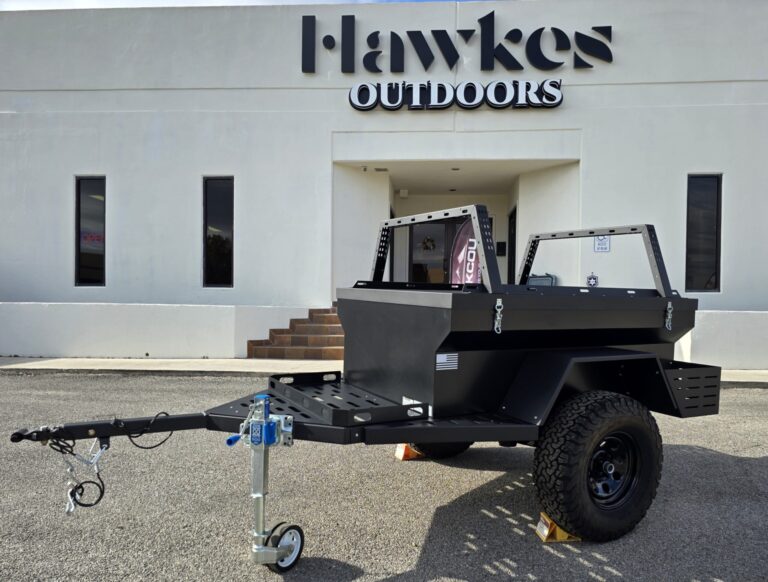
2025 Rustic Mountain Overland Patrol XC
The baseline Patrol, and the cheaper of the two Rustic Mountain trailers Hawkes Outdoors has on the lot. Enclosed cargo bay with a tilting lid and rear tailgate, Timbren HD 2200 lb axleless suspension, and 31-inch AT tires on 15-inch wheels. Listed at $10,737 in black, stock SA1124.
- Enclosed, lockable cargo bay
- Timbren HD 2200 lb axleless suspension
- 31-inch AT tires on 15-inch wheels
- Lock-N-Roll articulating hitch
- ARK tongue jack
- No tongue box, so galley gear rides in the main bay
- One unit on the lot at this price
Articulation and Off-Camber Performance
Articulation is where the axleless design earns its reputation. On an off-camber trail, a solid axle forces both wheels to move together, which means one wheel can lift off the ground entirely while the other digs in. That’s the moment traction disappears and wheelspin starts.
With independent trailing arms, each wheel keeps working the terrain on its own. I’ve towed axleless trailers across rutted, off-camber sections in Wyoming and Utah where a solid-axle trailer behind me visibly rocked side to side, while mine stayed composed. That stability matters most when you’re threading a narrow two-track with a drop-off on one side.
Ride Quality on Washboard and Rough Trail

Washboard roads are a fact of life in overlanding, and suspension design shows its character fast on a long, rippled forest road. Leaf springs transmit a lot of that vibration straight through to the frame and everything strapped to it. Torsion axles smooth things out somewhat thanks to the rubber cords, but they’re still limited by the shared axle tube.
Axleless suspension handles washboard noticeably better in my experience. Each wheel absorbs its own bump independently instead of fighting the opposite wheel’s input, so the ride stays calmer and gear inside the trailer takes less of a beating. That matters for anyone hauling a fridge, cookware, or fragile camera gear, since fewer vibrations mean fewer things rattling loose by the time you make camp.
Maintenance and Long-Term Durability
Leaf springs need periodic attention. Shackles wear, bushings dry out, and the leaves themselves can crack after years of hard use, especially in rocky terrain that hammers the suspension daily. Parts are cheap and widely available, so repairs are usually straightforward, but they do come up more often.
Torsion axles need less routine maintenance since there’s no grease fitting or shackle to service, but when the rubber cords inside eventually wear out, the whole axle assembly typically needs replacing rather than a simple parts swap. Axleless systems split the difference: fewer moving parts than leaf springs, and because each wheel is independent, a failure on one side doesn’t take out the whole axle assembly, so a single trailing arm can often be serviced without pulling the entire suspension.
Cost Comparison
Leaf spring suspension remains the cheapest option to manufacture and repair, which is why it’s still common on entry-level and budget trailers. Torsion axles cost more upfront but save on maintenance over time. Axleless suspension typically sits at a similar or slightly higher price point than torsion, reflecting the added engineering of independent trailing arms, but the trade-off is meaningfully better trail performance for overlanders who spend real time off pavement.
Which Suspension Is Right for You?

If you’re mostly towing on pavement and maintained gravel roads, a traditional leaf spring or torsion axle trailer will serve you fine and cost less upfront. But if your trips regularly take you onto rutted forest roads, off-camber trail sections, or long stretches of washboard, axleless suspension is worth the investment. In my experience, the independent articulation and smoother ride pay for themselves in less wear on your gear and a more confident, controlled tow behind rough terrain.
The Patrol XCT is a solid example of the axleless approach done right, pairing a Timbren HD 2,200 lb suspension with 31″ all-terrain tires for a trailer built specifically for backcountry use rather than adapted from a standard utility design.
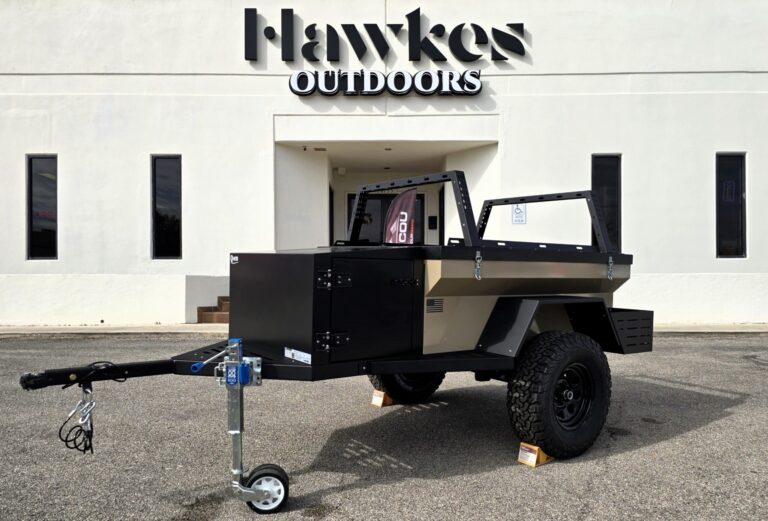
2025 Rustic Mountain Overland Patrol XCT
The XC with a lockable tongue box added forward on the frame, sized for a fridge, electrical, and galley gear, with an access door on the driver and passenger side. That is the piece that keeps cooking gear out of the main bay entirely. 1,250 lbs, tan, listed at $11,489, stock SA1122.
- Tongue box with driver and passenger access doors
- Enclosed main bay with tilting lid and rear tailgate
- Timbren HD 2200 lb axleless suspension
- Custom 16-inch roof rack and front cargo basket
- 1,250 lbs dry
- About $750 more than the Patrol XC
- One unit on the lot at this price
Frequently Asked Questions
What is axleless trailer suspension?
Axleless suspension replaces the traditional connecting axle tube with independent trailing arms for each wheel, usually cushioned by rubber or polyurethane rather than steel springs. Each wheel moves independently instead of sharing motion through a solid axle.
Is axleless suspension better than leaf springs for overlanding?
For rough, rutted, or off-camber terrain, yes. Independent wheel movement keeps both tires planted and improves traction where a solid axle would lift one wheel off the ground. For pavement and light gravel towing, leaf springs perform adequately at a lower cost.
Does axleless suspension require more maintenance than traditional axles?
Generally less. There are fewer moving parts than a leaf spring setup, and because each wheel is independent, a single trailing arm can often be serviced without replacing the entire suspension assembly.
What suspension does the Patrol XCT use?
The Patrol XCT uses a Timbren HD 2,200 lb axleless suspension paired with 31″ all-terrain tires on 15″ wheels, built specifically for backcountry towing.
Friendly disclaimer: Our articles may contain affiliate links that support us without costing you more, and sometimes we spice things up with sponsored content—but only for products we truly stand behind!