


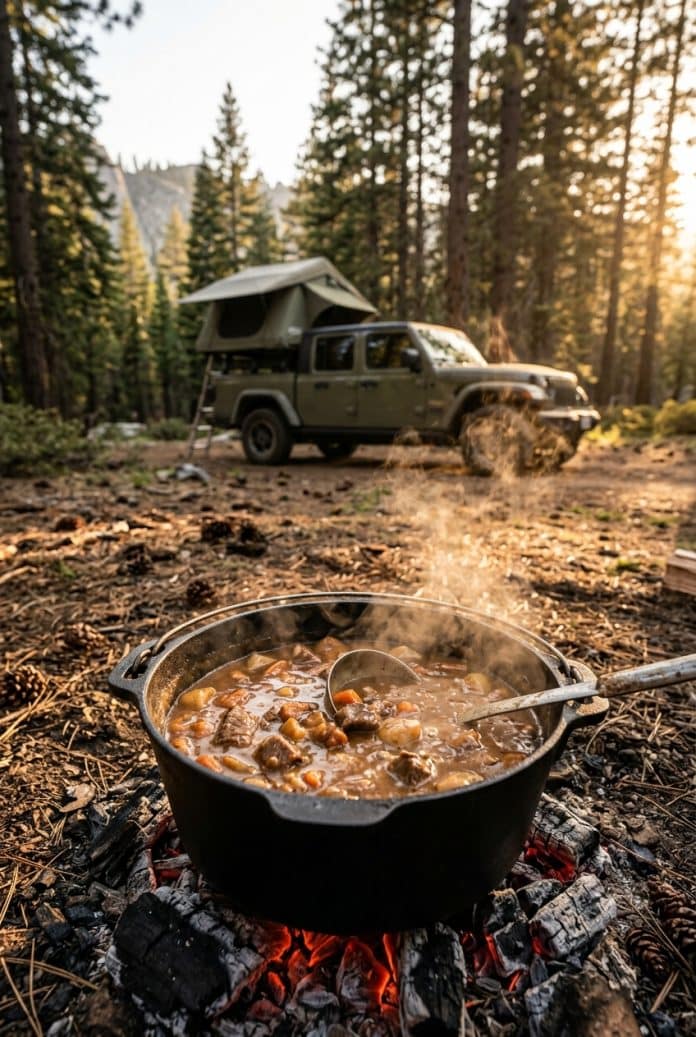

Save this recipe for your next trip.
Last updated: April 2026 | Prep: 30 min | Cook: 2 hours | Serves: 6
Written by Alex Schult
Editor in Chief of [4wdTalk.com](http://4wdTalk.com). 15+ years of off-road and overlanding experience with 1,000+ hours on the trail. Tests Dutch oven recipes at base camp on a Jeep Gladiator and Chevy Colorado ZR2 across the Sierras, Mojave, and Big Bear backcountry.
We tested this recipe on actual overland trips. Amazon affiliate links support [4wdTalk.com](http://4wdTalk.com) at no extra cost to you.
In This Recipe
Why This Recipe Works for Overlanders
Dutch oven beef stew is the textbook set-and-forget base camp dinner. First, a 2-hour braise at 325F breaks down connective tissue in chuck roast, turning a cheap cut into fall-apart beef. Second, the braise needs zero attention once the Dutch oven goes on the coals, so you set up camp, hike, or glass for wildlife while dinner cooks itself. Third, the chuck-and-root-vegetable base holds shape in a cooler for 3 days, so leftovers become lunch on a multi-night trip.
Last fall, on a 3-night Sierras trip at 7,200 feet near Rock Creek Lake, I cooked this Dutch oven beef stew for 6 guys camped out of a Chevy Colorado ZR2 and a Jeep Gladiator. Specifically, I seared 3 pounds of chuck roast cubes in batches on 15 lit briquettes. Then I braised at 325F on 12 top and 11 bottom for 2 hours. Moreover, the beef hit a fork-tender 205F internal per Cook’s Illustrated braise doneness guidance, well past the USDA whole beef minimum of 145F.
This recipe is part of our dutch oven camping recipes collection. For a spicier dinner option, check the Dutch Oven Chili. Both spokes roll up to our camp cooking for overlanders guide.
Equipment You Need
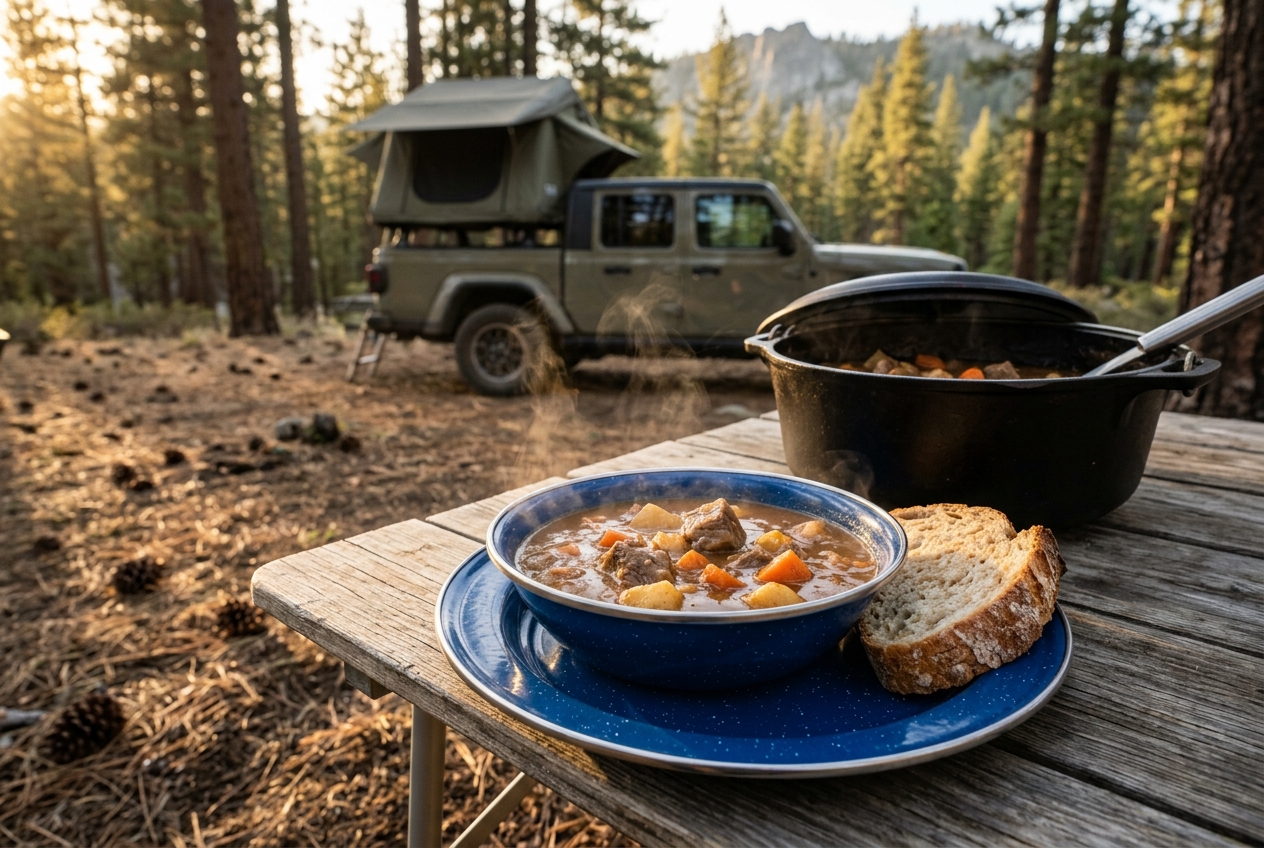
- Lodge 12-inch Camp Dutch Oven (6 quart): handles 3 pounds of beef plus vegetables
- Charcoal chimney starter: lights 30 briquettes in 15 minutes
- Kingsford Original briquettes: steady 325F across a 2-hour braise
- Lid lifter, 12-inch minimum: for inspection without dumping coals
- Chef knife and cutting board: for cubing chuck and dicing aromatics
- Long-handled wooden spoon: for stirring the roux without scraping seasoning
- Long-handled tongs, 16-inch: Cuisinart 16-inch tongs for coal placement
- Heat-resistant gloves rated 932F: RAPICCA gloves for safe Dutch oven lifting
- Instant-read thermometer: confirms 205F for braise doneness
- Heat-safe jar: for reserving beef fat after the sear
The Workhorse
Lodge 12-Inch Camp Dutch Oven, 6 Quart
Pre-seasoned cast iron with three legs and a flanged lid. The 6-quart holds 3 pounds of chuck plus 4 cups of root vegetables with a 1-inch headspace for the braise to bubble without boil-over. The single most important cookware piece in an overland drawer system.
Ingredients
Serves 6
- 3 pounds boneless chuck roast, cut into 1 1/2-inch cubes
- 1 1/2 teaspoons kosher salt, plus more for seasoning
- 1 teaspoon cracked black pepper
- 1/3 cup all-purpose flour (for dredging)
- 3 tablespoons olive oil
- 1 large yellow onion, diced
- 4 garlic cloves, minced
- 3 tablespoons tomato paste
- 1 1/2 cups dry red wine (Cabernet Sauvignon or Merlot)
- 4 cups beef broth
- 1 tablespoon Worcestershire sauce
- 3 fresh thyme sprigs (or 1 teaspoon dried)
- 2 fresh rosemary sprigs (or 1/2 teaspoon dried)
- 2 bay leaves
- 1 1/2 pounds Yukon Gold potatoes, cut into 1-inch chunks
- 4 medium carrots, peeled and cut into 1-inch pieces
- 10 ounces frozen pearl onions (or 1 cup peeled fresh)
- 8 ounces cremini mushrooms, quartered
- 1 cup frozen peas
- 2 tablespoons cold water mixed with 1 tablespoon flour (slurry, if needed)
- Fresh parsley for serving
Step-by-Step Instructions
Phase 1: Prep the Beef and Light Coals
- Light the briquettes: Load 30 Kingsford briquettes into a chimney over newspaper. Wait 15 to 20 minutes until the briquettes coat in gray ash and glow orange-red. Meanwhile, prep the beef and vegetables.
- Dredge the beef: Pat the chuck cubes dry with paper towels. Season with 1 1/2 teaspoons kosher salt and 1 teaspoon black pepper. Next, toss the cubes in 1/3 cup of flour until lightly coated on all sides. Finally, shake off excess flour in a colander.
Phase 2: Sear and Build the Braise Base
- Sear the beef in batches: Place the Lodge 12-inch Dutch oven on 15 lit briquettes spread flat. Add 3 tablespoons of olive oil. Then sear the chuck cubes in 3 batches, 3 to 4 minutes per side, until deep brown crusts form. Transfer each batch to a bowl. Avoid crowding; crowded beef steams instead of searing.
- Saute the aromatics: Add the diced onion to the hot Dutch oven with the residual oil and fond. Cook 5 to 6 minutes until soft and lightly browned. Afterward, add the minced garlic and stir 45 seconds until fragrant.
- Bloom the tomato paste: Stir 3 tablespoons of tomato paste into the onions. Cook 2 minutes, stirring constantly, until the paste darkens from orange to brick red. Therefore, this step concentrates the umami foundation of the braise.
- Deglaze with red wine: Pour 1 1/2 cups of red wine into the Dutch oven. Then scrape the fond from the bottom with a wooden spoon. Reduce 4 to 5 minutes until the wine thickens to a syrup and the raw alcohol smell fades.
- Add broth, beef, and herbs: Return the seared beef (plus any juices) to the Dutch oven. Next, add 4 cups of beef broth, 1 tablespoon Worcestershire, thyme, rosemary, and 2 bay leaves. Subsequently, stir once to distribute.
Phase 3: Long Braise on the Coals
- Switch to braise coals: Using tongs and gloves, rearrange the coals. Specifically, pull 4 briquettes off the bottom so 11 remain. Then lift 12 fresh lit briquettes onto the lid in a ring. As a result, this holds 325F for the 2-hour braise.
- Braise 1 hour: Cover and braise at 325F for 60 minutes. Rotate the Dutch oven 90 degrees every 20 minutes. Additionally, add 10 fresh lit briquettes from a second chimney batch at the 45-minute mark, replacing spent coals.
- Add root vegetables: Lift the lid with a lid lifter. Then stir in the potatoes, carrots, pearl onions, and mushrooms. Cover and braise another 45 to 60 minutes, until the beef pulls apart with a fork and root vegetables are tender.
Phase 4: Finish and Serve
- Finish with peas and adjust: Stir in the frozen peas. Then replace the lid for 5 minutes to heat through. If the broth is thin, whisk the cold-water flour slurry into the simmering stew and cook 3 minutes. Subsequently, taste and adjust salt and pepper.
- Rest and serve: Remove the Dutch oven from the coals with gloves. Rest 10 minutes so the broth thickens slightly. Finally, discard the bay leaves, ladle into enamel bowls, and garnish with chopped parsley. Serve with crusty bread.
Briquette Math for 325F Braise
A 12-inch Dutch oven at 325F for a braise needs 23 briquettes total in a 1-to-1 ratio: 12 top and 11 bottom. Specifically, the nearly-even ratio holds heat through the liquid braise without scorching the meat or vegetables against the cast iron bottom.
Lodge briquette counts for 325F braise (1-to-1 ratio):
- 8-inch (2 quart): 7 top / 7 bottom
- 10-inch (4 quart): 10 top / 10 bottom
- 12-inch (6 quart): 12 top / 11 bottom
- 14-inch (8 quart): 15 top / 14 bottom
Adjustments for High-Altitude Braising
Altitude extends braise time. Therefore, above 5,000 feet elevation, add 1 top and 1 bottom briquette and extend total braise by 20 minutes. Above 7,500 feet, add 2 top and 2 bottom and extend by 35 minutes.
On the Rock Creek trip at 7,200 feet, the standard 2-hour braise ran 2 hours 20 minutes with 13 top and 12 bottom before the chuck broke down to fork-tender. Additionally, a second chimney batch at the 45-minute mark is non-negotiable at altitude.
Field Tips for Base Camp Braise
Pick Chuck Roast Over Pre-Cut Stew Meat
Chuck roast beats stew meat every time for a Dutch oven beef stew. Specifically, pre-cut stew meat sold in grocery stores is usually the cheapest trimmings from multiple cuts, which cook unevenly. Instead, buy a single 3-pound chuck roast and cube it yourself into uniform 1 1/2-inch pieces for even doneness across the 2-hour braise. Moreover, the marbling in chuck melts into the broth and builds body.
Sear in Batches, Never Crowded
Sear in 3 batches, never crowded. Specifically, crowding the Dutch oven drops the surface temperature below 350F and the beef releases water, which steams instead of browning. Consequently, the Maillard crust fails to form and the stew tastes flat. Therefore, give each cube 1 inch of space and sear in 3 rounds even when time is tight at camp.
Choose a Dry Red Wine
Red wine matters. Specifically, a dry Cabernet Sauvignon or Merlot adds tannic depth; sweeter wines like Pinot Noir throw off the balance. However, if you skip the wine, replace with 1 1/2 cups of beef broth plus 2 tablespoons of balsamic vinegar and 1 tablespoon of Worcestershire. As a result, the acidity keeps the braise from tasting muddy.
Variations and Substitutions
Liquid Swaps
- Guinness stew swap: Replace red wine with 1 bottle (12 oz) of Guinness Draft. Adds roasted malt notes and pairs with mushrooms. Omit the Worcestershire to avoid double-umami overload.
- No-wine version: Replace wine with 1 1/2 cups extra beef broth plus 2 tablespoons balsamic vinegar. Delivers similar acidity and depth without alcohol.
- Coffee-braised (high altitude): Replace 1 cup of beef broth with 1 cup of strong black coffee during deglaze. Boosts depth and improves braise at 8,000+ feet where heat transfer lags.
Protein and Vegetable Variations
- Venison stew: Swap chuck for 3 pounds of cubed venison shoulder. Add 2 extra tablespoons of olive oil since venison is leaner. Then simmer an additional 20 minutes to fully tenderize.
- Root vegetable heavy: Add 2 parsnips and 1 turnip alongside the potatoes and carrots. Traditional Celtic-style profile with a sweeter finish. Cut into 1-inch pieces to match the root vegetable timing.
- Herb and mustard finish: Stir in 2 tablespoons of Dijon mustard and 1 tablespoon of fresh chopped dill during the last 10 minutes. Bright, cold-weather finish reminiscent of European countryside stews.
Scaling for Different Group Sizes
- Scaled for 4 people: Use a Lodge 10-inch Camp Dutch Oven. Reduce chuck to 2 pounds, broth to 3 cups, wine to 1 cup. Then braise on 10 top and 10 bottom briquettes for 90 minutes.
- Scaled for 10 people: Use a Lodge 14-inch Camp Dutch Oven. Increase chuck to 5 pounds, broth to 6 cups, wine to 2 1/2 cups. Subsequently, braise on 15 top and 14 bottom briquettes for 2 1/2 hours.
Essential Tool
Camp Chef 12-Inch Dutch Oven Lid Lifter
Hooked steel end lifts the flanged lid cleanly off the Dutch oven without dumping coals into the stew. Additionally, the 12-inch reach keeps hands safely away from the rim during the mid-braise vegetable addition.
Storage and Leftovers
Cooler Storage and Reheating
Leftover Dutch oven beef stew holds safely in a cooler below 40F for up to 4 days per USDA food safety guidelines. Then reheat in the Dutch oven over 10 bottom briquettes for 15 minutes, stirring every 5 minutes. Alternatively, warm single portions in a cast iron skillet over medium-low heat with a splash of broth to loosen.
Freezer Storage
For freezer storage, cool fully, portion into 1-quart ziplock bags, press flat, and freeze up to 3 months per USDA guidance. Specifically, flat-frozen bags double as cooler ice blocks on the next trip. Moreover, flavors marry overnight and deepen the stew on day 2.
Frequently Asked Questions
How many briquettes for Dutch oven beef stew at 325F?
A 12-inch Lodge Camp Dutch Oven at 325F for a braise uses 12 briquettes on the lid and 11 underneath in a 1-to-1 ratio. Moreover, a 10-inch Dutch oven uses 10 top and 10 bottom. Therefore, braise ratios run 1-to-1 because heat at the base prevents scorching during long liquid cooks.
What cut of beef works best for Dutch oven beef stew?
Boneless chuck roast works best because it has the collagen and marbling needed to break down during a 2-hour braise into fork-tender meat. Specifically, cube a single 3-pound chuck roast into 1 1/2-inch pieces for uniform cook. However, avoid pre-cut stew meat because it mixes cuts with uneven cook times.
Do you need to sear the beef before braising?
Yes, searing is non-negotiable for depth of flavor. Specifically, the Maillard crust formed during searing becomes the fond at the bottom of the Dutch oven, which then lifts into the braise during the wine deglaze. Consequently, skipping the sear produces a bland stew with pale beef and thin broth.
How long does Dutch oven beef stew need to braise?
2 hours at 325F delivers fork-tender chuck with intact but soft root vegetables. Specifically, braise the meat alone for the first hour, then add the root vegetables for the final 45 to 60 minutes. However, shorter braises under 90 minutes produce tough chuck because the collagen has not fully broken down.
What wine works in Dutch oven beef stew?
Dry red wines like Cabernet Sauvignon, Merlot, or a Cotes du Rhone deliver tannic depth which pairs with beef. However, avoid sweet wines like Pinot Noir or Zinfandel because the sugar throws off the balance. Moreover, the wine boils off alcohol during deglaze, leaving concentrated grape flavor.
Do root vegetables go in at the start or later?
Add root vegetables after the first hour of braising. Specifically, potatoes and carrots need 45 to 60 minutes of cook time while chuck needs 2 hours. Otherwise, adding them at the start turns the potatoes to mush before the beef is ready. Pearl onions and mushrooms join at the same point as the roots.
What temperature is safe for braised beef?
USDA food safety guidance specifies 145F internal for whole beef cuts. However, braised chuck needs 195F to 205F internal for the collagen to fully break down into gelatin and produce fork-tender results. As a result, a 2-hour braise at 325F holds the meat at 200F+ for the final 45 minutes, well past both USDA and braise doneness targets.
Does Dutch oven beef stew taste better the next day?
Yes, day-2 beef stew tastes noticeably better because the flavors marry overnight in the cooler. Specifically, the broth thickens from gelatin continuing to set, and the beef absorbs additional flavor from the wine and herbs. Therefore, many overlanders intentionally cook this stew on night 1 of a multi-night trip for a deeper second serving.
You Might Also Like
- Dutch Oven Chili (sibling recipe)
- Dutch Oven Pot Roast (sibling recipe)
- Dutch Oven Chicken and Dumplings (sibling recipe)
- Return to the full Dutch Oven Camping Recipes collection
- Pair with Dutch Oven Cornbread