


Quick Facts:
- Best solar generator for camping: a 1,000Wh-class LiFePO4 power station paired with 200W to 400W of folding panels.
- Typical camp day: about 600Wh for a 12V fridge, a Starlink Mini, lights and phones.
- Battery only: about 1.4 to 1.5 days of this load from either station.
- Solar refill: one 200W panel returns about 1,140Wh on a June day near Denver.
- Price: $549 per station at Amazon, price checked November 19, 2026.
- Best for: truck, Jeep and SUV campers who stay out three days or longer.
9 min read
In This Guide
- Why the Best Solar Generator for Camping Is a Kit
- Key Specs for the Best Solar Generator for Camping Picks
- How Big a Solar Generator Do You Need for Camping?
- How Much Panel to Pair With Each Station
- Best Solar Generator for Camping for Most Rigs: BLUETTI AC180
- Best Lightweight Pick: BLUETTI Elite 100 V2
- BLUETTI AC180 vs. Elite 100 V2
- Setup Tips for the Best Runtime
- Final Thoughts
- FAQ
4wdTalk earns a commission when you buy through links on this page, at no extra cost to you. As an Amazon Associate, 4wdTalk also earns from qualifying purchases.
Best Picks at a Glance
- BLUETTI AC180 kit: best for most rigs and for buyers who want the longer owner track record. $549 at Amazon for the station, price checked November 19, 2026. Check price at Amazon.
- BLUETTI Elite 100 V2 kit: best when weight and solar input matter, at 25 pounds with up to 1,000W of solar input. $549 preorder at Amazon, price checked November 19, 2026. Check price at Amazon.
Why the Best Solar Generator for Camping Is a Kit
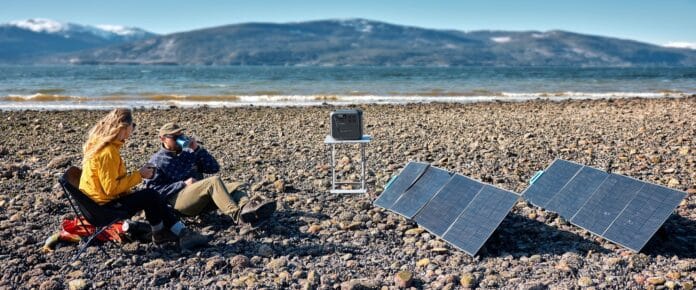
The best solar generator for camping is a kit. It pairs a lithium power station with a folding panel to refill it each day. A battery alone gives you a countdown. For example, a 1,152Wh station runs a typical camp load for about a day and a half. Then you drive home or idle the engine to recharge.
Add a 200W panel, however, and the math changes. NASA POWER solar data shows one 200W panel returns about 1,140Wh on a June day near Denver. In summer, the sun covers a 600Wh camp day. Your trip length then depends on food and water instead of battery percentage.
I’ve used Starlink for about five years. At camp, I run a Starlink Mini to handle work for my businesses. Staying online lets me camp longer instead of driving back toward cell coverage. Because of this, the power behind the dish matters to me as much as the dish.
Why Both Picks Are BLUETTI Kits
This guide covers two kits, each a power station with solar panel input: the BLUETTI AC180 and the BLUETTI Elite 100 V2. Both come from BLUETTI, a 4wdTalk affiliate partner. I haven’t tested either station, so the owner notes below come from owner reviews. Both cost $549 at Amazon (price checked November 19, 2026), both use LiFePO4 cells, and both carry a five-year warranty. Still, they differ on weight, solar input and owner track record, so the right pick depends on your rig.
Panels belong in full sun, while the station stays in shade. Because of this, a Kimbluth 25-foot 10AWG MC4 extension cable bridges the distance. The CASIMY MC4 to DC7909 adapter fits the AC180, and the GELRHONR MC4 to XT60 cable fits the Elite 100 V2.
Solar Connection Gear for Your Kit


CASIMY DC 8mm/DC7909 Solar Generator Adapter Extension Cable to Sol…

GELRHONR 4.9FT 12AWG Solar Connector to XT60 Female Extension Cable…
Key Specs for the Best Solar Generator for Camping Picks
Both stations land in the same 1kWh class, so the details decide the pick. The table below uses BLUETTI’s published specs and Amazon prices checked November 19, 2026.
| Specification | BLUETTI AC180 | BLUETTI Elite 100 V2 |
|---|---|---|
| Capacity | 1,152Wh LiFePO4 | 1,024Wh LiFePO4 |
| AC output | 1,800W (2,700W lifting mode) | 1,800W (3,600W surge) |
| Max solar input | 500W, 12V to 60V, 10A | 1,000W, 12V to 60V, 20A |
| Wall charging | 0 to 80% in 45 minutes | 0 to 80% in 45 minutes |
| Weight | 35.3 lb | 25 lb |
| Rated cycles | 3,500+ to 80% | 4,000+ to 80% |
| 12V car outlet | 12V/10A | 12V/10A |
| Warranty | 5 years | 5 years |
| Amazon price (Nov. 19, 2026) | $549, delivery by January 6 | $549 preorder, release December 14 |
Neither station arrives fast right now. On November 19, 2026, Amazon showed the AC180 arriving by January 6. The Elite 100 V2 sat at preorder with a December 14 release.
How Big a Solar Generator Do You Need for Camping?
Start with your daily watt-hours, not the station’s label. Next, add up what runs in camp over 24 hours. Here is a common overland setup.
| Load | Daily use |
|---|---|
| 12V compressor fridge, about 45 liters | about 300Wh |
| Starlink Mini, 8 hours | about 240Wh |
| LED camp lights and two phone charges | about 60Wh |
| Total | about 600Wh |
The fridge line sits between two ratings. ICECO rates its VL45 at about 347Wh per 24 hours, and ARB’s Zero 47-quart works out to about 230Wh. Our 12V fridge sizing guide covers both in detail. Similarly, the Starlink line uses the 20W to 40W active draw from our Starlink Mini power consumption guide.
Now divide by usable capacity. BLUETTI’s runtime formula uses 90% depth of discharge and 85% to 90% inverter efficiency. On this basis, the AC180 delivers about 880Wh and the Elite 100 V2 about 830Wh. As a result, either one runs the 600Wh day for about 1.4 to 1.5 days on battery alone.
Drop the Starlink, and the fridge-only number stretches to about three days. In contrast, a laptop charge each night or a second fridge shortens it. For this reason, a 1kWh station without panels suits a weekend, while a longer trip needs solar.
How Much Panel to Pair With Each Station
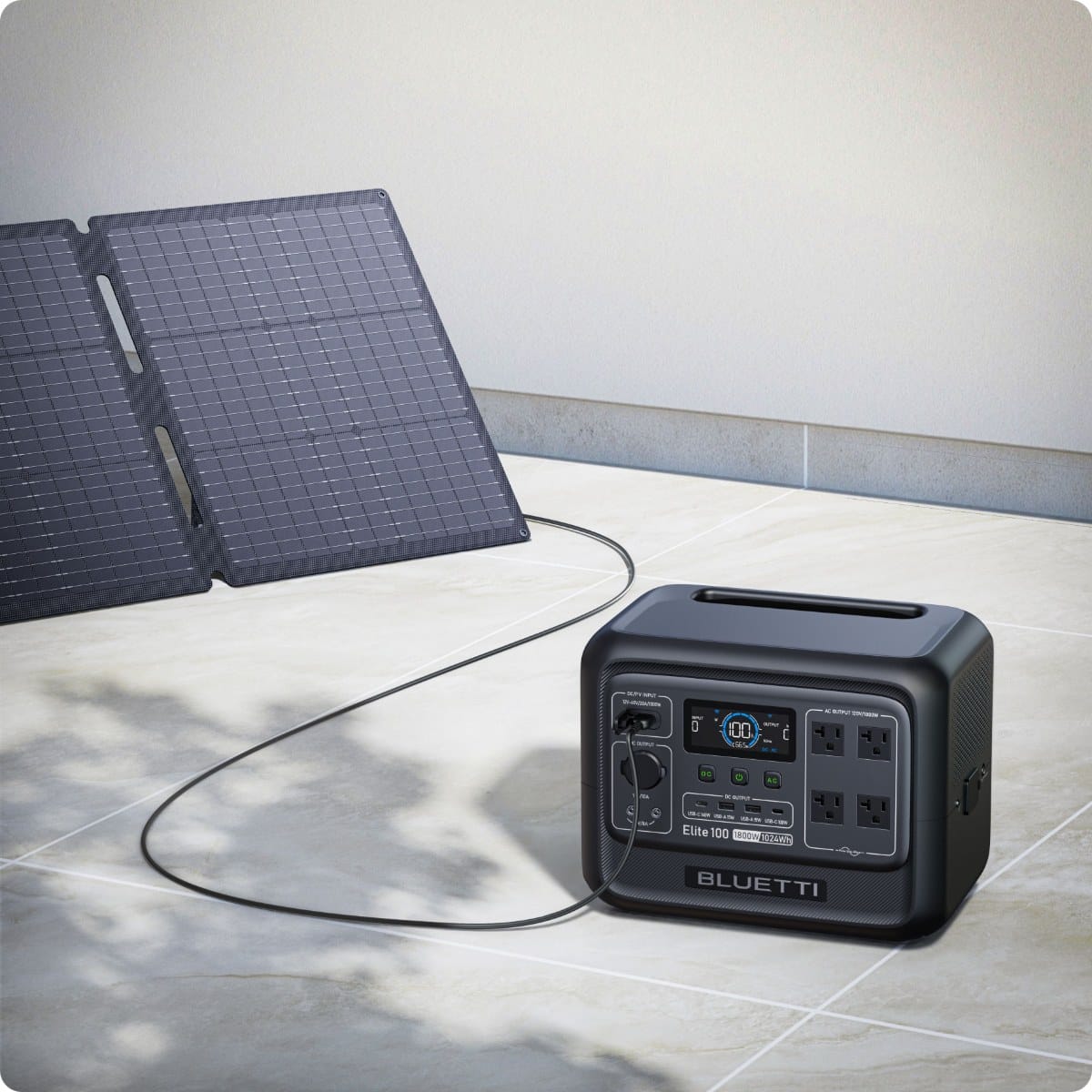
Rated panel watts and real watts differ. Our solar panel sizing guide applies a 0.79 derate for heat, dust, wiring and conversion. BLUETTI owners report similar results, with a 200W folding panel giving about 130W to 160W in good sun.
From there, multiply by peak sun hours for your season and region. Near Denver, NASA POWER data shows 7.22 peak sun hours in June and 2.29 in December. One 200W panel therefore returns about 1,140Wh on a June day and about 360Wh on a December day.
Summer Trips Versus Winter Trips
In summer, one 200W panel covers the 600Wh camp day with room to spare. Winter is harder, however, because the same panel covers about half the load. Two 200W panels return about 720Wh in December, enough for the 600Wh day. Both stations accept 400W of portable solar panels.
Matching Panels to Each Station’s Input
Input limits set the ceiling. The AC180 takes up to 500W between 12V and 60V. Owners report its current drops below 32V, so wire two 200W panels in series and keep the combined open-circuit voltage under 60V. By comparison, the Elite 100 V2 takes up to 1,000W through an XT60 input. For example, one 350W panel or two 200W panels in series sit well under its limit.
Panel Handling at Camp
Owners flag two handling issues. Folding kickstand legs feel flimsy, and wind knocks panels over. Weigh them down with a rock or a water jug. Also, re-aim the panel every two or three hours, because angle and clouds swing output more than panel size.
Best Solar Generator for Camping for Most Rigs: BLUETTI AC180
The BLUETTI AC180 is the best solar generator for camping when you want capacity and a long owner record. It stores 1,152Wh in LiFePO4 cells rated for 3,500 cycles to 80%. In addition, its 1,800W inverter runs a coffee maker or a 1,400W camper microwave.
For me, the standout here is the track record. Owners report a year or two of trouble-free use. Two who later bought an Elite 100 V2 say the AC180 stayed the more dependable unit. Fans stay quiet under load and get louder during turbo wall charging.
Weight is the trade-off. At 35.3 pounds, the AC180 is about 10 pounds heavier than the Elite 100 V2. Van and small SUV buyers mention the bulk often. Its solar input also tops out at 500W through a barrel-style connector. One owner says the plug works loose while driving.
On Amazon, the AC180 listing also offers an AC180 plus 200W panel bundle at $899, price checked November 19, 2026. As a solar generator kit, it pairs well with a second 200W panel for winter trips.
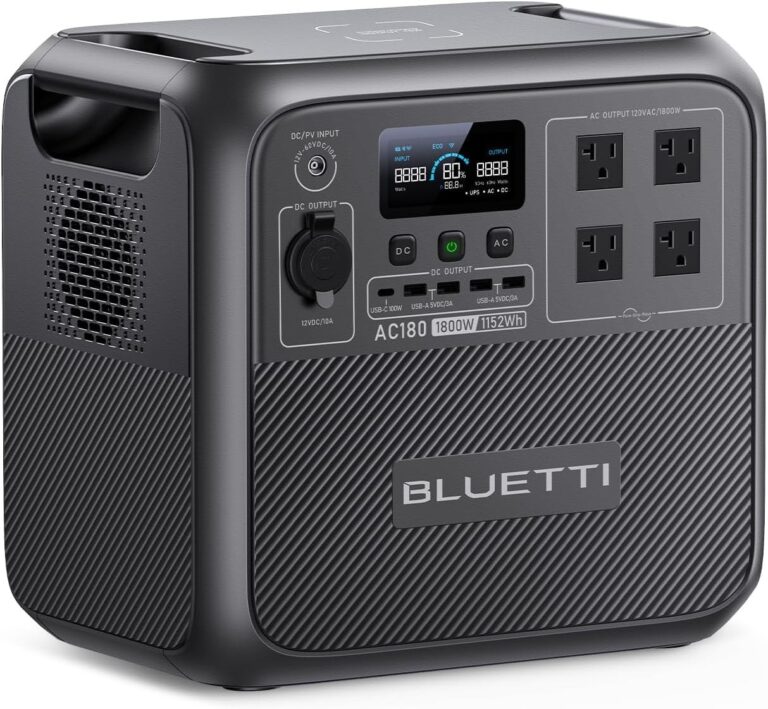
BLUETTI AC180: 1,152Wh for Longer Camps
LiFePO4 cells rated for 3,500 cycles to 80%, an 1,800W inverter and up to 500W of solar input. Five-year warranty.
Check Price at AmazonBest Lightweight Pick: BLUETTI Elite 100 V2
The BLUETTI Elite 100 V2 suits campers who carry the station from the truck to the tent. It weighs 25 pounds and measures 12.6 by 8.5 by 9.8 inches. Compared with the AC180, it gives up 128Wh of capacity but doubles the solar input to 1,000W.
Buyers praise the XT60 solar connector and the app, which shows input and runtime over Wi-Fi or Bluetooth. Its 20A input also accepts two 200W panels wired in parallel. Either way, two portable solar panels refill it in about three hours of strong midday sun. Its port mix also suits camp electronics, including a 140W USB-C port for laptops.
The one trade-off I’d flag is idle drain, which eats into a small battery overnight. Owners running 12V fridges report faster drops with the DC outputs on. A minority also report units failing to power on after a firmware update in the first few months. For this reason, test yours at home before a trip.
Amazon prices the Elite 100 V2 at $549 as a preorder, down from $899 (price checked November 19, 2026). The listing shows a December 14, 2026 release, so new orders wait until then. Owner reports date back to mid-2025, so the preorder covers new stock, not a new model. A bundle with a 200W panel costs $799.99.
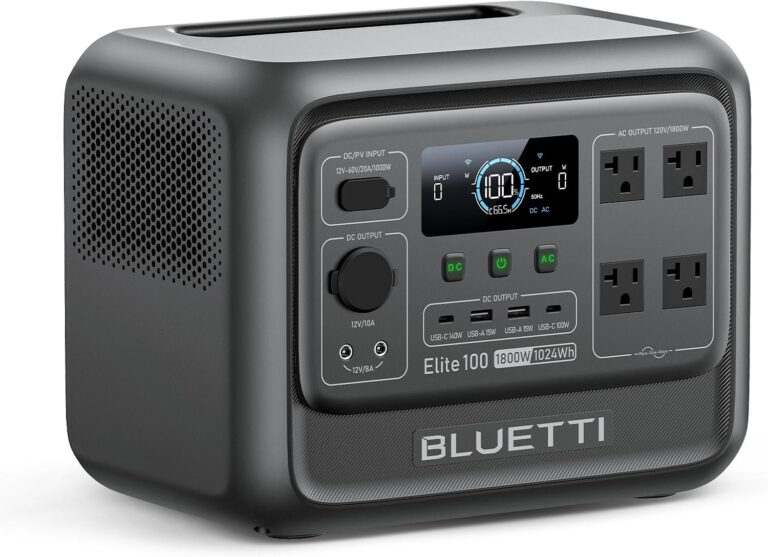
BLUETTI Elite 100 V2: 25 Pounds, 1,000W Solar Input
1,024Wh of LiFePO4 rated for 4,000 cycles to 80%, an XT60 solar input and a five-year warranty. Amazon lists a December 14, 2026 release.
Check Price at AmazonBLUETTI AC180 vs. Elite 100 V2
Pick the AC180 if the station stays in the truck bed or the camper. Its extra 128Wh and longer owner history matter more than weight when the unit never moves. Also, owner reports of units failing to power on cluster on the Elite 100 V2. This counts when you camp far from a return counter.
Pick the Elite 100 V2 if you carry the station or run lots of solar. In particular, its 1,000W input leaves room for extra panels on short winter days. Its 25-pound weight also makes it the easier choice for a tent camp or a small SUV.
Both cost $549 at Amazon (price checked November 19, 2026), so price does not separate them. Instead, decide on weight and solar input first, then match the solar generator kit to your season.
Both stations run camp gear through a 12V car outlet and USB-C ports. For example, the TNP 15-foot 12V extension cord reaches a light or fan across camp. The Cable Matters 240W USB-C cable carries full laptop power, while the ALL-TOP 12V LED strip lights the site.
Camp Gear to Run From Your Kit


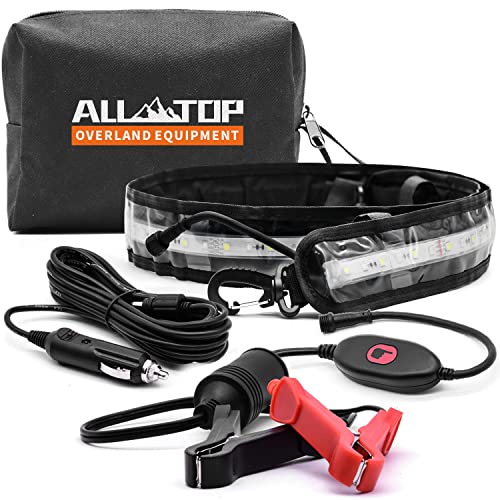
ALL-TOP Dimmable Amber LED Camping Flex Strip With Mounting Jacket
Setup Tips for the Best Runtime
Even the best solar generator for camping needs one setting change. First, turn off ECO mode in the BLUETTI app before a trip. ECO mode causes the most common AC180 complaint by shutting off the outputs overnight. A compressor fridge at rest draws too little power to keep them awake. After the change, the fridge stays powered through the night.
Second, run a full test at home. Charge the station, power the fridge for 24 hours and check the app reading the next morning. This test catches a weak unit while the return window stays open.
Finally, top up from the vehicle on drive days. AC180 owners report about 100W from a 12V socket, so a four-hour drive adds roughly 400Wh. For faster charging, our DC to DC charger guide covers alternator options. Pre-chill the fridge on sunny afternoons, since the panel covers the extra draw then.
Final Thoughts
If you camp three days or longer, the best solar generator for camping pairs a station with a panel. Either BLUETTI kit runs a fridge, a Starlink Mini and lights for about 1.4 to 1.5 days on stored power. In summer sun, one 200W panel covers the full day.
The AC180 is my pick for most rigs because of its owner track record and its extra capacity. In exchange, you carry 35.3 pounds and accept a 500W solar ceiling. If weight or winter solar matters more, the Elite 100 V2 fits better. Whichever you choose, run the 24-hour fridge test at home before the first trip.
Both stations sit at $549 on Amazon (price checked November 19, 2026). The Elite 100 V2 preorder releases December 14, and the AC180 arrives by January 6. Either date leaves the rest of winter for the home test. Then head out in spring with a full kit, and let food and water set your trip length instead of the battery.
FAQ
What size solar generator do I need for camping?
Add up your daily watt-hours first. A 12V fridge, a Starlink Mini and lights use about 600Wh a day. As a result, a 1,000Wh-class station covers about 1.4 days. For longer trips, the best solar generator for camping adds a 200W panel.
Will a solar generator run a 12V fridge?
Yes. A 45-liter compressor fridge uses about 300Wh a day, so a 1kWh station runs it for about three days alone. Turn off ECO mode first, because it shuts off the outputs when the fridge cycles off.
How long does a solar generator take to charge with solar?
One 200W panel refills either station in about one June day near Denver. In December, the same panel returns about 360Wh a day. Two 200W panels in series cut the June time roughly in half. On wall power, both BLUETTI stations reach 80% in 45 minutes.
Is the AC180 or the Elite 100 V2 the best solar generator for camping?
The AC180 suits most rigs because of its 1,152Wh capacity and longer owner record. In contrast, the Elite 100 V2 suits campers who carry the station, since it weighs 25 pounds. It also takes 1,000W of solar.
Are solar generators good for camping?
Yes, for quiet power at a fixed camp. A power station with solar panel input runs quietly, and since there is no fuel to carry, refills come from the sun. Many national park campgrounds also limit gas generator use to set hours. For example, Yosemite allows generators only 7 to 9 a.m., noon to 2 p.m. and 5 to 7 p.m. A quiet station runs any time.