



Quick Facts:
- Vehicle: Traveler Spirit of ’26, a one-off Scout SUV concept
- Revealed: July 3, 2026, on the Scout Motors blog
- Heritage: 1976 Spirit of ’76 bicentennial package
- Powertrain: None installed; static display only
- Production Traveler price: Under $60,000, projected
- Range: Up to 350 miles electric, 500-plus with the Harvester
- Production start: Targeted for 2027, deliveries in 2028
- Best for: Off-road fans tracking the Scout relaunch
7 min read
In This Article
- Overview: The Spirit of ’26 Scout SUV Concept
- Key Facts at a Glance
- The 1976 Roots: Olympic Scout Fleet and the Spirit of ’76
- Design Details on the Spirit of ’26
- Traveler and Terra: Timeline, Plant, and Pricing
- Will the Spirit of ’26 Scout SUV Reach Production?
- Scout vs. Bronco, Wrangler, and Rivian
- Final Verdict
- FAQ
Overview: The Spirit of ’26 Scout SUV Concept
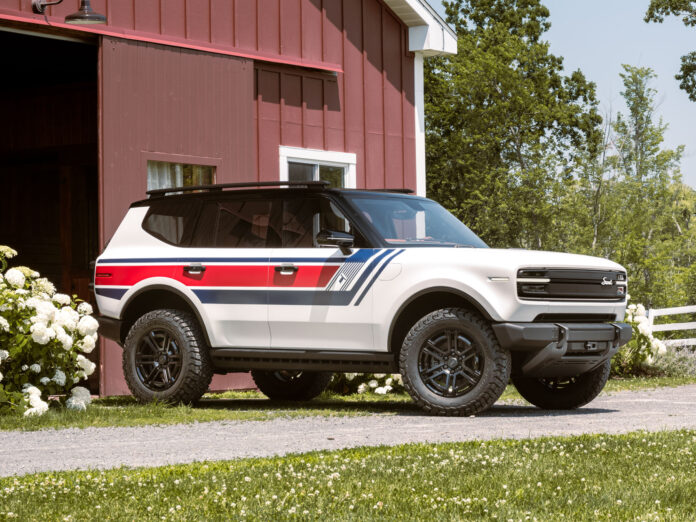
Scout Motors revealed a patriotic one-off on July 3, 2026: the Traveler Spirit of ’26. The red, white, and blue Scout SUV concept marks America’s 250th birthday. Instead of an auto-show debut, the company posted the reveal on its own blog. National coverage from Forbes, MotorTrend, and Road & Track followed within two weeks.
The concept wraps the production Traveler, Scout’s upcoming electric 4×4, in a livery pulled from the brand’s 1976 bicentennial trucks. Specifically, the graphics trace back to the Spirit of ’76 package on the original International Scout. Those trucks rank among the most collectible American off-roaders of the 1970s. Compared to the originals, deeper colors and sharper angles update the look for 2026.
Scout confirmed the Spirit of ’26 is a display piece with no working powertrain. Even so, the timing matters. The reveal landed while Scout preps the Traveler SUV and the Scout Terra pickup for 2027 production in South Carolina.
This analysis covers the design, the 1976 heritage behind it, and the production timeline. It also weighs what the reveal signals about Scout’s position against Bronco, Wrangler, and Rivian. Every figure comes from Scout Motors or the national outlets covering the story, such as Forbes and MotorTrend.
Key Facts at a Glance
The table below sums up the concept and the production models behind it. However, all range and pricing numbers are manufacturer projections rather than EPA ratings or final window stickers.
| Specification | Details |
|---|---|
| Vehicle | Traveler Spirit of ’26, one-off concept |
| Revealed | July 3, 2026, on the Scout Motors blog |
| Base body | Production-shape Traveler electric SUV |
| Paint | White Cap metallic with red and blue stripes |
| Powertrain | None installed; imagined around the Harvester EREV |
| Heritage basis | 1976 Spirit of ’76 package and US Ski Team fleet |
| Traveler entry price | Under $60,000, projected |
| Electric range | Up to 350 miles, projected |
| Harvester EREV range | 500 miles or more, projected |
| Production start | Targeted for 2027 in South Carolina |
| First deliveries | Expected in 2028 |
The 1976 Roots: Olympic Scout Fleet and the Spirit of ’76
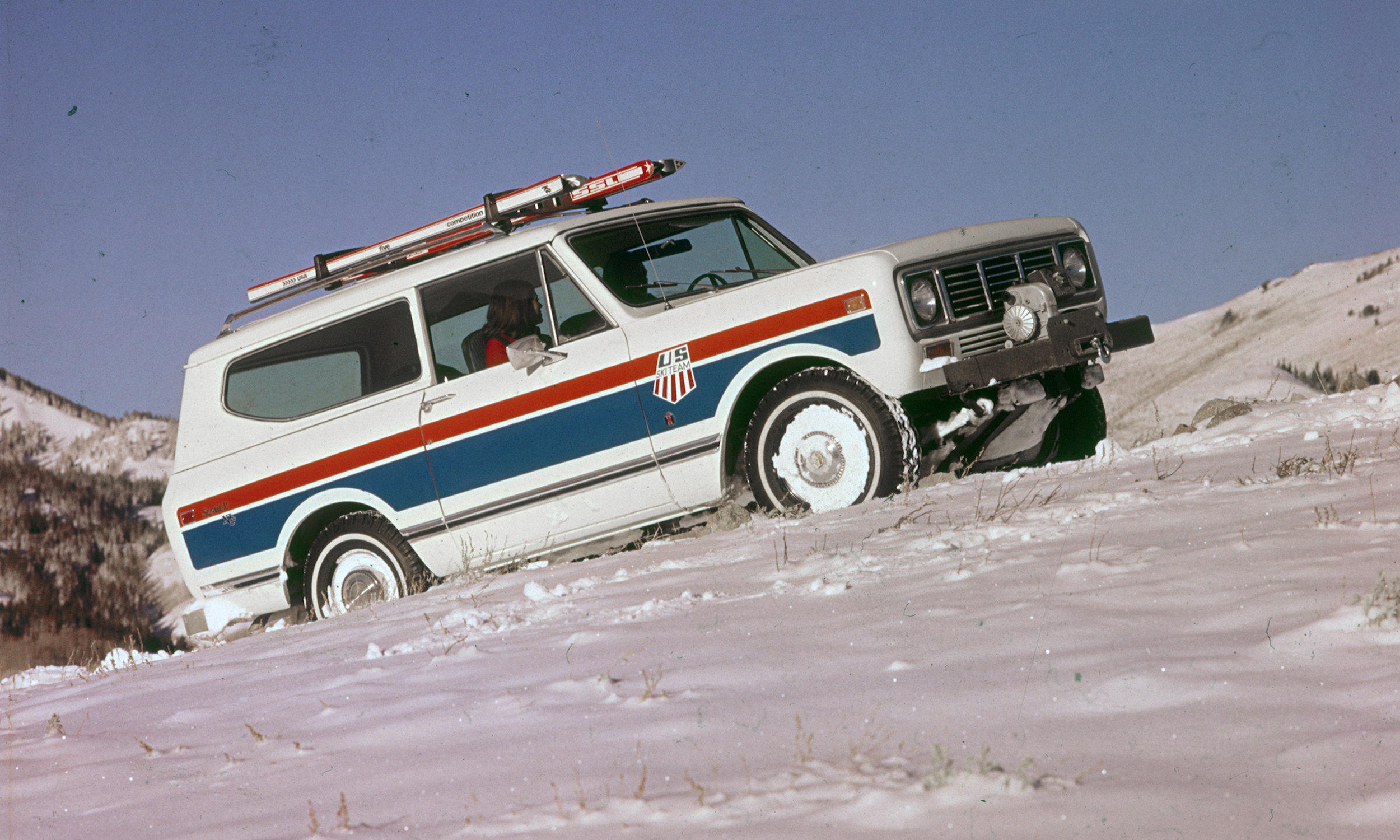
The backstory starts at the 1976 Winter Olympics in Innsbruck, Austria. International Harvester supplied the US Ski Team with 17 support vehicles for the bicentennial year. The fleet included ten 1976 Traveler models and seven Scout II Traveltop rigs. All 17 also ran 345-cubic-inch V8s, three-speed automatics, and two-speed transfer cases. Some carried electric winches, while every truck wore roof-mounted ski racks and US Ski Team fender decals.
The fleet look proved popular, so International Harvester turned it into a factory option called the Spirit of ’76. Buyers got a Winter White body with red and blue stripes and a Wedgwood Blue interior. Each package added a matching roll bar, a denim Safari soft top, and Rallye wheels. The option started on the 100-inch wheelbase, then expanded to hardtops on the 100-inch and 118-inch chassis as the Patriot.
Collectors treat those trucks as icons today. International Scout production ran from 1960 to 1980. Surviving examples trade alongside vintage Broncos and Jeeps, including several rigs on our list of the coolest American classic off-roaders.
Design Details on the Spirit of ’26
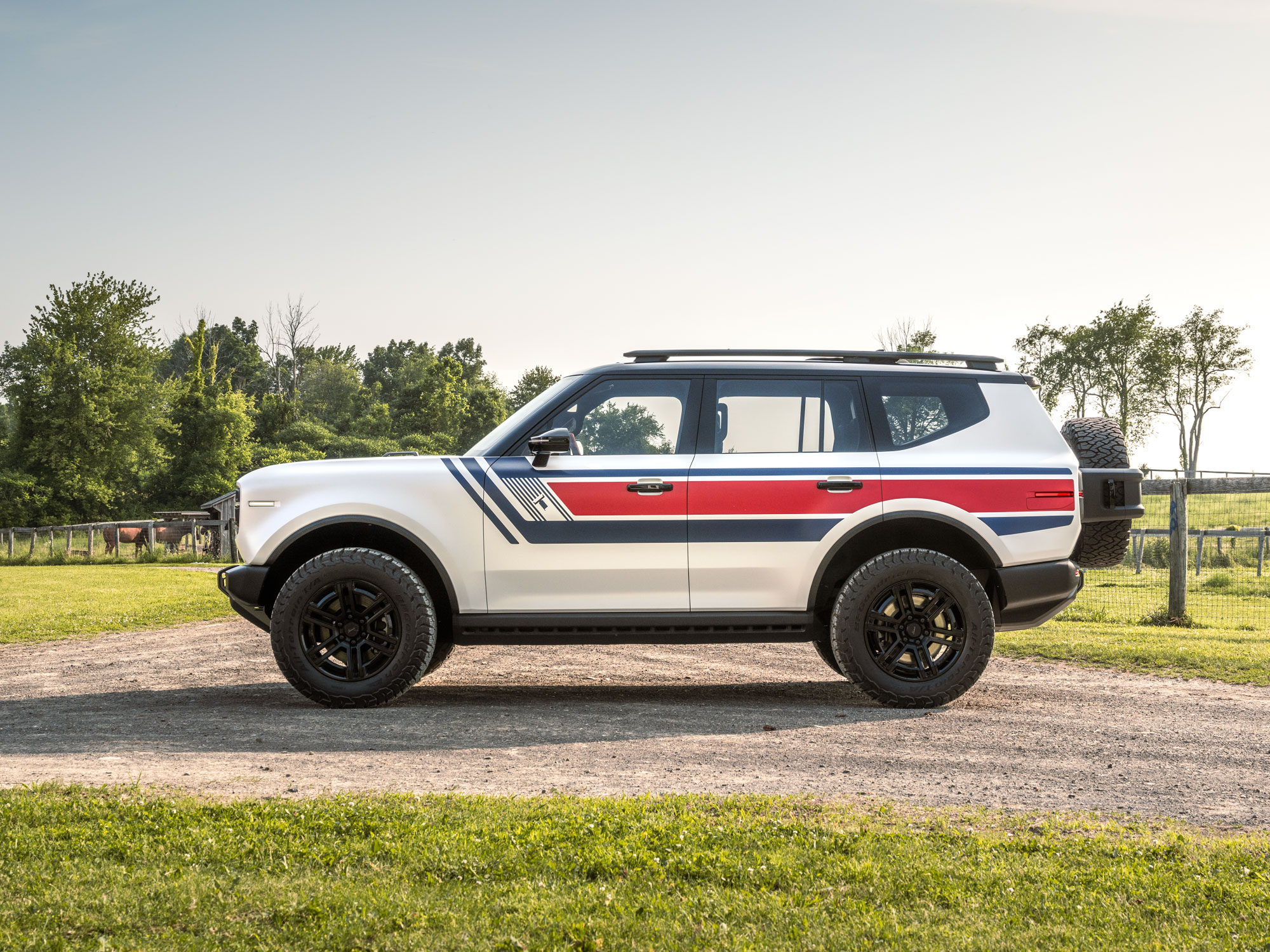
Scout designer Dongwon Kim built the livery around three elements. He combined the vintage Rallye graphic, the brand’s Harvester motif, and a red, white, and blue palette. Specifically, the body wears White Cap paint, a metallic update of the 1976 Winter White. Blue stripes sweep the length of the body. Meanwhile, a combine-harvester graphic cuts through them ahead of the red line, a nod to the company’s farm-equipment roots.
“We did a lot of different versions,” Kim said on the Scout blog. “It’s trying to balance heritage and reinterpretation. Do we try to come up with something entirely fresh? How do we respect the original designs while drawing new inspirations?” The finished stripes sit deeper in color and cut sharper angles than the 1976 originals. As a result, the truck reads as modern rather than as a costume.
Under the graphics sits a standard production body. A company spokesperson told Forbes the concept carries no powertrain, since the team built it as a static display. Scout imagined the vehicle around its Harvester range extender, although the pure electric drivetrain fits the same shell. The reveal also included a Spirit of ’76 merchandise capsule with tees, hats, and coolers inspired by the 1970s graphics. For a single build, the concept previews how far Scout might push factory graphics packages on the production Scout SUV.
Traveler and Terra: Timeline, Plant, and Pricing
Scout’s production plan holds two models: the Traveler SUV and the Terra pickup. Factory output remains targeted for 2027 at the company’s new plant in South Carolina. Customer deliveries then begin in 2028, according to MotorTrend. Company president Scott Keogh told reporters at a briefing near Detroit the launch remains “on course and on plan.”
Entry pricing for the Traveler starts under $60,000, per Scout’s published projections. Pure electric versions target up to 350 miles of range. Meanwhile, the Harvester extended-range models pair a roughly 63 kWh battery with a gasoline generator. Electric-only range lands around 150 miles, while the projected total reaches 500 miles or more.
Reservation data explains the Harvester bet. Scout reported 160,000 reservation holders in March 2026. Notably, 87 percent chose the range-extended versions, and three quarters picked the SUV over the truck. The generator itself will be a naturally aspirated four-cylinder sourced from Volkswagen’s engine plant in Silao, Mexico. For the pickup side of the lineup, our Scout Terra vs F-150 Lightning breakdown covers the numbers.
The rear-mounted generator carries trade-offs. MotorTrend reports towing on the extended-range pickup drops from 10,000 pounds to 5,000, pending final specs. Keogh also calls each vehicle a $65,000 asset, which suggests optioned builds land above the sub-$60,000 entry point. Direct sales, in his view, move each one into a driveway with the least waste.
Will the Spirit of ’26 Scout SUV Reach Production?
So does the livery reach showrooms? Scout left the door open without promising anything. Communications manager Kathy Graham called the vehicle “a one-off right now.” She said the team wants feedback on a possible production version. Demand decides the outcome; a strong response turns the livery into an option, while silence keeps it a museum piece.
History favors the option route. The original Spirit of ’76 began as an Olympic support fleet, then became a factory package within the same model year. A stripe-and-trim package costs little to engineer, especially compared to a new trim level with unique hardware. MotorTrend’s first look argued for offering the stripe design on the production Scout SUV, even without the full patriotic theme.
On the other side of the ledger, Scout faces bigger problems than paint. The federal $7,500 EV tax credit ended in 2025. Dealer groups in several states have also sued over the direct-sales model, while the engine program pushed deliveries into 2028. Every engineering hour now flows toward finishing two models rather than toward commemorative packages.
Scout vs. Bronco, Wrangler, and Rivian
The Spirit of ’26 also works as a positioning statement. Bronco and Wrangler own the heritage off-road market, and both lean on decades of history in their marketing. By reviving a documented 1976 program, Scout claims comparable heritage depth, which no EV startup matches. Rivian builds capable trucks; however, it has no 1976 to point back to.
The product strategy targets the space between those rivals. Neither Bronco nor Wrangler offers a full-electric version in the US today, since Jeep’s 4xe stops at plug-in hybrid range. Rivian sells pure EVs at premium prices. Scout splits the difference with a projected sub-$60,000 entry point plus the Harvester option, which erases trail range anxiety. Our Scout vs Rivian R1T comparison shows how the spec sheets line up.
Keogh has already sketched the next moves. A stretched three-row SUV comes first, then a smaller model aimed at the Rivian R2, per MotorTrend. The concept fits the same playbook. Scout wants shoppers comparing it to Bronco on heritage and to Rivian on hardware, not judging it on price alone.
Retail reach shapes the fight too. The company plans stores in 16 metro areas at launch. By 2032 the network grows to roughly 100 US and Canada locations. Compared to the thousands of Ford and Jeep dealers, the footprint looks thin, so direct online sales carry the load. Buyers in rural trail states should weigh service access before ordering.
Final Verdict
For classic Scout fans and reservation holders, the Spirit of ’26 delivers substance behind the flag-waving. The livery pulls from a documented 1976 program, down to the Rallye graphics and the Winter White base color, rather than generic patriotic paint. As brand-building for a company with zero vehicles delivered, this Scout SUV concept hits its mark.
The weakness sits in the timing. Scout celebrates 2026 with a vehicle nobody drives before 2028. Anyone needing an off-road SUV within the next year should cross-shop a Bronco Badlands or a discounted Rivian instead of waiting on reservations.
On value, the production math still rewards patience. An entry price under $60,000 undercuts comparable Rivian trims on paper. So do 350 miles of electric range, or 500-plus with the Harvester. Reservation demand backs the appeal, since 160,000 hand-raisers form a real order book, although paper interest converts to sales only after test drives.
The final call: treat the Spirit of ’26 as a signal rather than a product. It shows Scout understands its strongest asset, an American off-road heritage stretching back to 1960. Watch the 2027 production milestones next; meanwhile, this concept buys Scout another season of attention at almost no cost.
FAQ
When will the Scout Traveler be available?
Scout targets factory production in 2027 at its new South Carolina plant. Customer deliveries follow in 2028, according to company statements and MotorTrend reporting. The Terra pickup arrives after the SUV.
How much will the Scout Traveler cost?
Scout projects entry pricing under $60,000 before options and fees. Final window stickers arrive closer to production. No federal purchase incentive applies, since the $7,500 EV tax credit ended in 2025.
What is the Harvester range extender?
The Harvester pairs a roughly 63 kWh battery with an onboard gasoline generator. It targets a total range of 500 miles or more, compared to 350 miles for the pure electric Scout SUV. Notably, 87 percent of reservation holders picked this setup.
Who owns Scout Motors?
Volkswagen Group backs Scout Motors as a standalone American brand, incorporated in September 2022. The company revives the International Scout name, a nameplate International Harvester produced from 1960 to 1980.
Is the Spirit of ’26 a production model?
No. Scout built it as a one-off display concept without a working powertrain. A production version stays possible if demand appears, although the company has announced no such plans.