


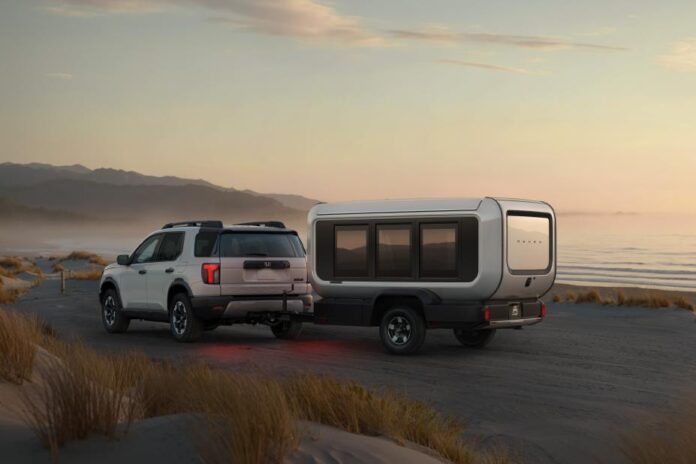

Quick Facts:
- Product: Honda Base Station Prototype towable travel trailer
- Reported weight: Around 1,400 to 1,500 lbs (unofficial; Honda has not published a figure)
- Tow vehicle: Compact SUVs and crossovers, including the Honda CR-V and Toyota RAV4
- Sleeps: Four, via a queen futon plus an optional kids’ bunk
- Stand-up height: 7 feet with the pop-up roof raised
- Power: Lithium battery, inverter, and integrated solar panels
- Price: Not announced
- On sale: No date announced (prototype)
- Best for: Small-SUV owners who want a garageable camper
6 min read
In This Article
- Honda Base Station Prototype Overview
- Key Specs and Features
- Why the Base Station Tows Behind a Crossover
- Inside the Base Station: Space, Sleeping, and Smart Lighting
- Modular Accessories and Off-Grid Power
- Base Station Prototype vs. Traditional Travel Trailers
- What the Honda Base Station Prototype Means for Overlanders
- Frequently Asked Questions
Honda Base Station Prototype Overview
The Honda Base Station Prototype is a lightweight towable camper built for drivers who skipped the full-size truck. Honda revealed it in January 2026, then put it back in the spotlight in late June. Unlike most travel trailers, it does not need a big SUV or pickup behind it. Instead, a crossover handles the job.
Honda’s U.S. research and development teams in Los Angeles and Ohio designed the trailer. The same group built the Motocompacto e-scooter, so clever packaging runs in the family. Specifically, their stated goal is to open camping to people who never considered towing before, especially young families.
For off-roaders and overlanders, the appeal is narrower but real. A garageable, sub-1,500-pound box pulled by a CR-V points toward the lightweight camper trailer market. Below, you get the confirmed specs, the open questions, and an honest read on where this fits.
Key Specs and Features
Honda has shared features but withheld hard numbers like curb weight, dimensions, and price. The table below separates confirmed details from reported estimates.
| Specification | Details |
|---|---|
| Type | Towable travel trailer (prototype) |
| Reported weight | ~1,400 to 1,500 lbs (unofficial) |
| Tow vehicles | CR-V, RAV4, EVs like the Honda Prologue |
| Sleeping capacity | Four (queen futon plus optional bunk) |
| Stand-up height | 7 ft with pop-up roof raised |
| Windows | Five large side windows, removable and swappable |
| Power | Lithium battery, inverter, integrated solar |
| Price / on-sale date | Not announced |
Why the Base Station Tows Behind a Crossover
Weight drives everything here. Honda says the Base Station rides light enough for compact SUVs like the CR-V, America’s best-selling SUV across the last 25 years, and the Toyota RAV4. Electric crossovers also make the list, including the Honda Prologue and the upcoming Honda 0-Series SUV.
Most travel trailers force a different math. Once a trailer clears 3,000 or 4,000 pounds loaded, you need a midsize or full-size tow rig, plus the right hitch and brake controller. However, a reported sub-1,500-pound dry weight sidesteps the wall. As a result, a two-car family with a CR-V suddenly has a path to camping without buying a truck. In short, you tow with a crossover instead of shopping for a pickup.
I have towed with capable rigs, from a Jeep Gladiator to a Chevy Colorado ZR2, and the comfort margin is great. Still, plenty of buyers never want so much vehicle. For them, the option to tow with a crossover is the whole point. If you are new to this, our tips for towing a camper trailer cover the basics before your first trip.
Inside the Base Station: Space, Sleeping, and Smart Lighting
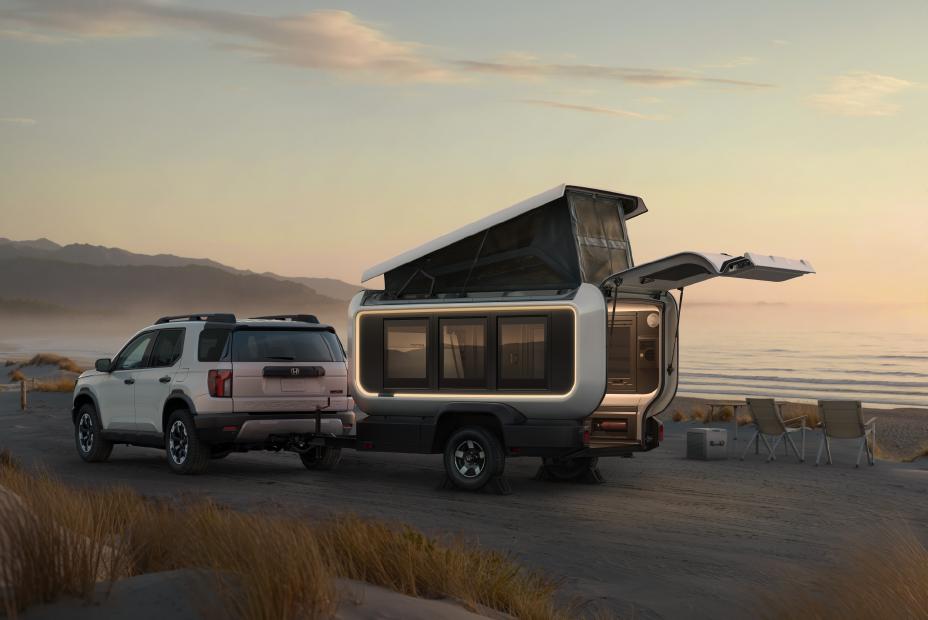
Honda leans on its “Man Maximum, Machine Minimum” philosophy, the same packaging logic behind its cars. The trailer parks in a standard garage, yet the cabin feels open and bright. Five large windows pull in daylight, and the pop-up roof raises to create 7 feet of stand-up room.
Sleeping works for a family of four. A large futon-style couch folds flat into a queen-sized bed, while an optional bunk handles two kids. A top-hinged rear tailgate swings up, so the cabin and campsite flow together rather than staying walled off.
Notably, the lighting deserves a callout. Programmable rings circle each window, and you adjust brightness and color from inside. Those rings also throw light outward, which helps when you arrive after dark and need to set up. For families wrangling tired kids at a late check-in, the practical value beats the novelty.
Modular Accessories and Off-Grid Power
Modularity is the headline idea. Because the windows pop out, Honda swaps in accessories where glass used to sit. The prototype shows an air conditioner, an external shower, and an external kitchen with running water and an induction cooktop.
Power supports real off-grid camping. A standard lithium battery, an inverter, and integrated solar panels run the trailer without shore power. Moreover, when you want longer comfort, a campsite hookup or a Honda generator plugs in quickly. Therefore the Base Station works both at a developed campground and well away from one.
Two cautions belong here. First, every accessory adds weight, and a loaded trailer tows differently than an empty one. Second, solar output drops under tree cover and in winter sun. Plan power around your real conditions, not the brochure photo.
Base Station Prototype vs. Traditional Travel Trailers
Against a conventional travel trailer, the trade is space for access. A 25-foot trailer offers a fixed bed, a wet bath, and a full galley. However, it also demands a heavy tow vehicle, a longer parking pad, and storage you might not have. The Base Station flips those priorities toward small footprint and easy towing.
Against teardrops and tiny off-road trailers, the comparison gets closer. Teardrops tow light and store easily, yet most cap you at two sleepers and a galley hatch. By contrast, the Base Station counters with stand-up height, four berths, and swappable gear. For a deeper look at this lightweight camper trailer category, see our breakdown of truck camper versus teardrop trailer trade-offs.
What the Honda Base Station Prototype Means for Overlanders
For hardcore overlanders, this is not a rock-crawling trailer, and Honda never pitched it as one. The box shape, large glass, and on-road tow targets read as campground and forest-road duty, not the Rubicon. So temper any backcountry expectations.
The bigger story is market pressure. When a major automaker enters the lightweight camper trailer segment, suppliers and dealers pay attention. Moreover, more competition usually means better pricing and features across the segment, which helps buyers shopping any brand. If you are weighing options now, our guide on what to look for in an overlanding camper trailer still applies.
My take is cautiously positive. A garageable camper a CR-V tows lowers the entry cost to camping, which grows the community. Still, the open questions are weight, price, and whether Honda builds it at all. Until those land, treat the Base Station as a strong signal rather than a purchase decision. For the full details, read Honda’s announcement on the Honda newsroom.
Frequently Asked Questions
How much does the Honda Base Station Prototype weigh?
Honda has not published an official curb weight. Several outlets report a figure around 1,400 to 1,500 pounds, light enough for compact-SUV towing. Treat any number as an estimate until Honda confirms it.
Which vehicles tow the Honda Base Station?
Honda points to compact SUVs and crossovers like the CR-V and Toyota RAV4. In addition, electric models qualify, including the Honda Prologue and the upcoming Honda 0-Series SUV. Always check your specific vehicle’s tow rating first.
How many people does the Base Station sleep?
It sleeps four. A large futon-style couch folds into a queen-sized bed, and an optional bunk adds room for two kids. The pop-up roof creates 7 feet of stand-up space inside.
When will the Honda Base Station Prototype go on sale?
No on-sale date or price has been announced. It remains a prototype, so Honda has not committed to production. Watch the Honda newsroom for updates.
Does the Base Station support off-grid camping?
Yes. A standard lithium battery, an inverter, and integrated solar panels power the trailer off the grid. For extended stays, a campsite hookup or a Honda generator connects quickly. New to towing off-pavement? Start with our off-road trailer towing guide.