



Quick Facts:
- Product: Tripod Torch Kit (compact propane fire pit)
- Packed size: 10 x 8 x 3 inches
- Weight: about 6 pounds with shields
- Heat output: radiant heat over 1,000°F with shields
- Fuel: propane, works with 3 to 40 lb tanks
- Burn time: 10 to 15 hours per 20 lb tank
- Build: stainless steel and brass, lifetime guarantee on metal
- Price: $189.99
- Best for: overlanders and van builds short on space
8 min read
In This Review
- Tripod Torch Review: Built for Overland Space
- Tripod Torch Specs at a Glance
- Heat to Your Seat: The Flame Runs Hot
- Packed Size: Why Overlanders Care
- Build Quality and Heat Control
- What Other Reviewers Say
- Propane Use and Running Costs
- Tripod Torch vs. Howl and Solo Stove
- Tripod Torch Review: Pros and Cons
- Final Verdict
- Frequently Asked Questions
Tripod Torch Review: Built for Overland Space
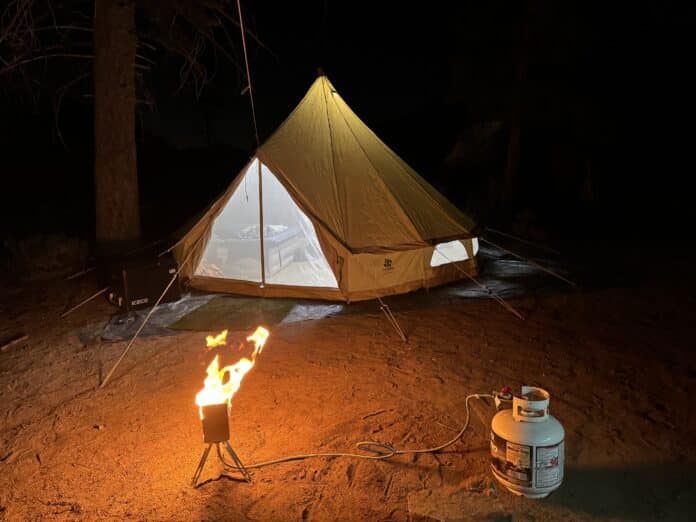
Picture a fall night where wood fires are banned across the forest. You stake three legs, open a valve, and a tall flame climbs within minutes. This Tripod Torch review follows 30 days of putting the compact propane fire pit through real overland trips. The burner stands upright and throws a heat signature far bigger than its size suggests. For overlanders, space is the most valuable commodity in any build, so a unit folding flat into a 10 by 8 by 3 inch bag earns instant interest.
You will appreciate this portable campfire most if you run a tight rig and dislike bulky gear. Compared to an enclosed portable propane fire pit like the Howl R-series, the design skips the heavy bowl and stands the flame upright instead. As a result, the whole kit weighs around 6 pounds and stows in a canvas roll-top bag. At $189.99, it sits in the same price band as other premium pits, so the value comes from the packed size and the heat. To see where it lands against rivals, our roundup of the best portable fire pits for the season adds useful context.
Fire bans now shut down wood fires across many forests through the dry season. Even then, this overland fire pit meets US Forest Service Stage 1 and Stage 2 fire restrictions, because it burns propane and carries an on/off valve. Our fire season camping guide covers where those rules apply. Always confirm local limits first, since land managers set their own.
Tripod Torch Review: Specs at a Glance
Here are the core numbers from 30 days with the kit and from the maker’s published figures.
| Specification | Details |
|---|---|
| Packed dimensions | 10 x 8 x 3 inches (canvas bag) |
| Weight | About 6 pounds with shields |
| Flame height | About 17 inches |
| Radiant heat | Over 1,000°F with shields fitted |
| Fuel | Propane, 3 to 40 lb tanks |
| Burn rate | About 1 lb/hr low to 5 lb/hr high |
| Burn time | 10 to 15 hours per 20 lb tank |
| Materials | Stainless steel and brass |
| Warranty | Lifetime on metal, 90 days on hose |
| Price | $189.99 |
Buy Direct From Tripod Torch
Reclaim Your Cargo Space
The full kit folds into a 10 by 8 by 3 inch bag and ships free in the USA with a lifetime guarantee on metal parts.
Heat to Your Seat: The Flame Runs Hot
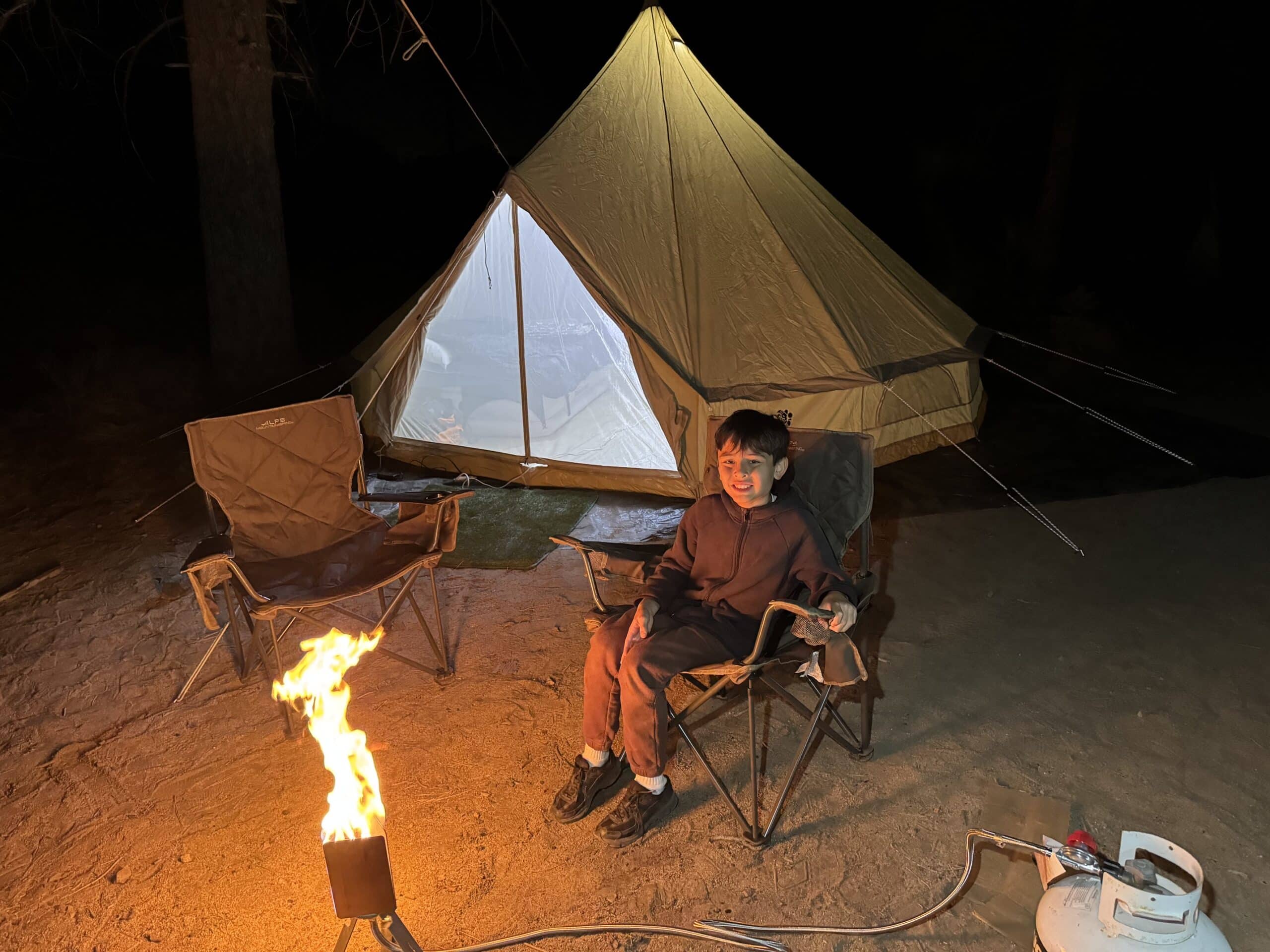
The heat output surprised me first. Unlike a low bowl fire, the vertical burner lifts the flame to roughly 17 inches. As a result, warmth radiates outward toward your chair instead of straight down into a pit. Tripod Torch calls this Heat to Your Seat, and the name fits. With the three shields clipped on, radiant heat climbs past 1,000°F, and you feel it from a normal seating distance.
Similarly, other owners report the same surprise. For example, one camper in a Texas overland group called the flame surprisingly bright even on low. Another buyer on the maker’s site wrote it throws more heat than expected. After a month of nights around it, my notes agree. For a unit this small, the output is enormous, and a single torch warms a four-chair circle with ease.
Packed Size: Why Overlanders Care
Space drives most overland gear decisions, and this is where the Tripod Torch wins outright. The burner, three legs, three shields, three stakes, and the braided hose break down and slide into a flat 10 by 8 by 3 inch bag. For comparison, most enclosed propane pits eat a full milk-crate of room. Because the kit lies flat, it slots behind a drawer system or under a seat with ease.
A Jeep owner on a Wrangler forum summed it up well: all his gear is small, and this fits the same rule. During my testing, the packed footprint stayed my favorite feature of this overland fire pit, second only to the heat. Frequent travelers who count every inch grasp the appeal at once.
Build Quality and Heat Control
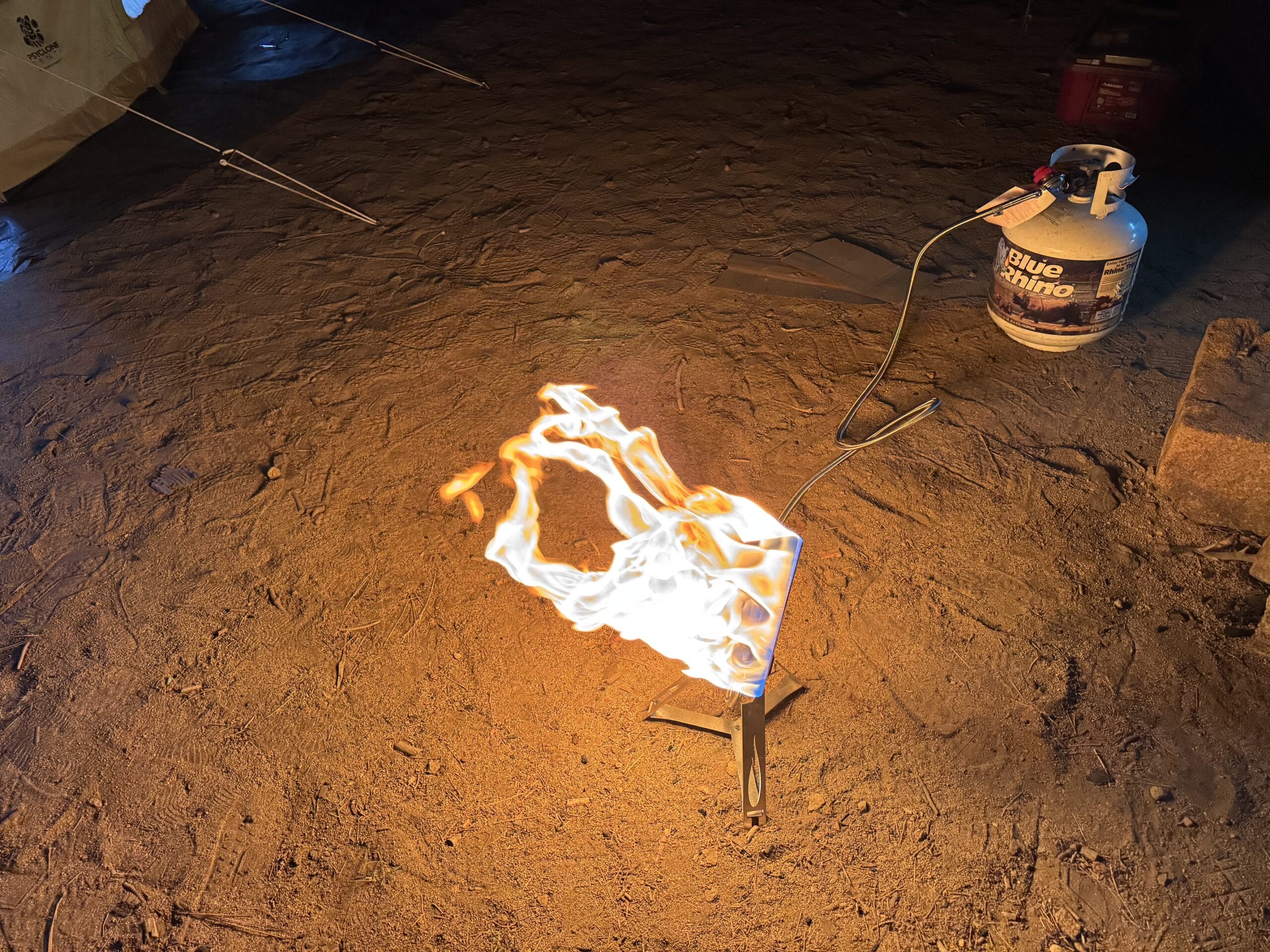
Build quality ran sturdier than I expected for the weight. Specifically, the legs, burner, and shields use stainless steel and brass, and the assembly feels solid once the stakes bite into the ground. Tripod Torch backs the metal parts with a lifetime guarantee, while the regulator hose carries a shorter 90 day warranty.
Control over the flame is wide and easy. The valve runs from a low simmer to a tall column, so you tune the output to the night. On a mild evening, a low setting keeps the burn gentle and sips fuel. When the temperature drops, you open it up and the column roars. This wide range is one reason the unit handles four-season use better than a fixed-output pit.
What Other Reviewers Say
Beyond my own Tripod Torch review, the wider owner consensus leans positive, with a few honest gripes. On the maker’s site, the kit holds a 4.83 out of 5 average across 147 reviews, with 127 five-star ratings. For example, reviewers repeatedly praise the compact pack size, the strong heat, and the made-in-USA build. One owner called it the coolest portable fire he owns, ranking it above his Howl R1 and R4.
Still, the feedback is not all glowing. I did not cut myself during testing, yet enough owners flag finish issues to note here. A June 2026 buyer liked the torch but flagged sharp, unfinished edges on several parts. One long-time camping forum member reported the same and cut himself on a leg edge. Several owners also mention the propane appetite on high settings. These themes shaped what I watched for, and most line up with my month of use.
Propane Use and Running Costs
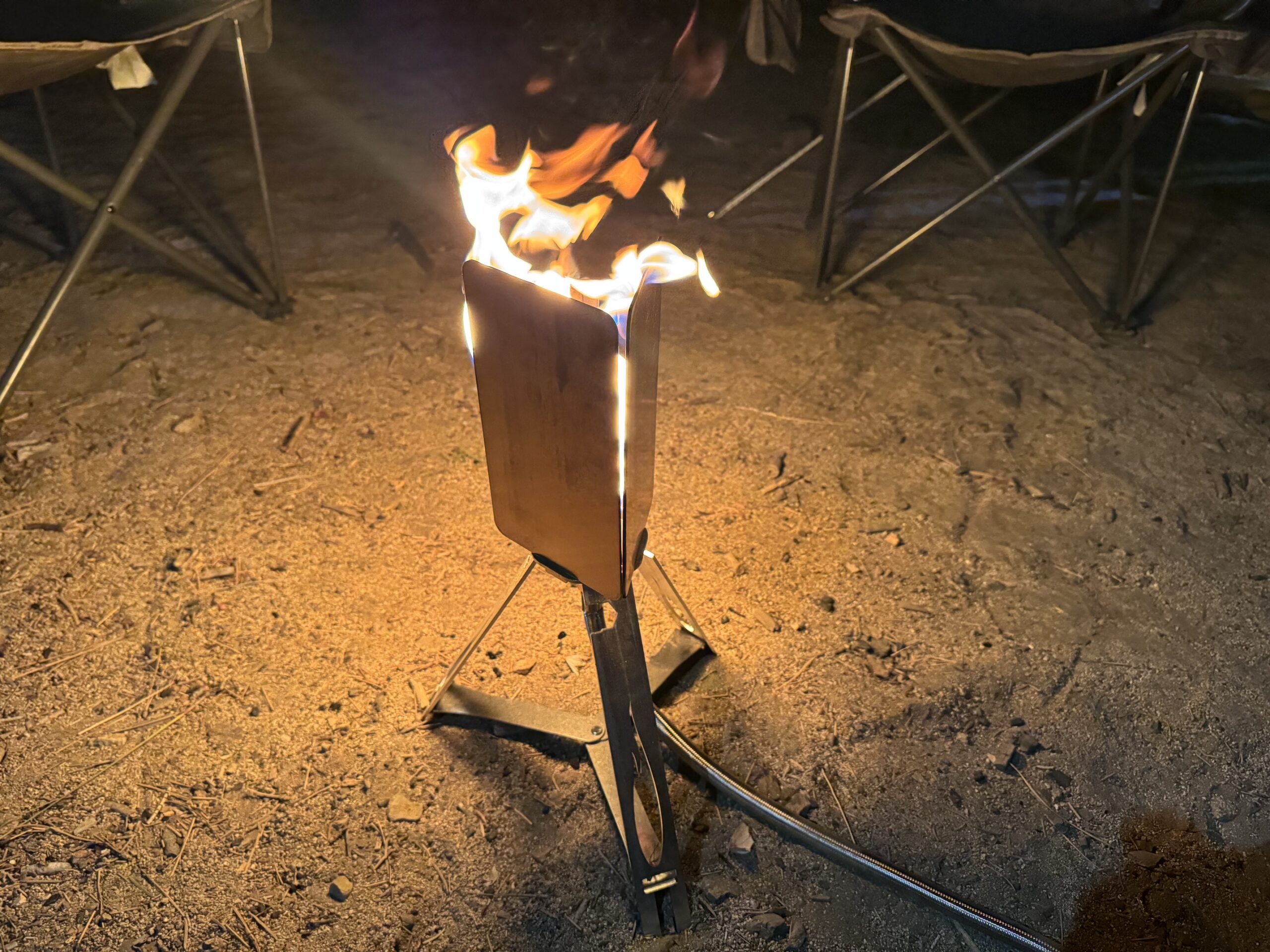
Fuel use is the honest trade-off with any open propane flame. On low, the torch sips roughly 1 pound of propane per hour. At high settings, the rate climbs toward 5 pounds per hour, so a hot night burns through a tank faster. A standard 20 pound tank yields about 10 to 15 hours at a medium flame.
At typical propane prices near $4 per gallon, or about $1 per pound, a low burn of roughly 1 pound per hour costs close to $1 per hour. For most camp evenings, running the torch low gives plenty of warmth and stretches the fuel across several nights. If you crave a roaring column for hours, plan to carry a spare tank. Our guide on how long a propane tank lasts on a fire pit breaks down the math by tank size.
Tripod Torch vs. Howl and Solo Stove
Choosing between this portable propane fire pit, an enclosed pit like the Howl, and a wood-burning Solo Stove comes down to space and purpose. The Howl R-series throws strong radiant heat from a ceramic bed and looks more like a traditional fire. Yet it weighs more and eats cargo room. A Solo Stove delivers real wood ambiance and glowing embers, though it needs fuel, cleanup, and a bigger footprint.
This compact propane fire pit trades ember glow for a tall, instant flame and the smallest pack size of the three. In a space-limited overland build, the torch wins on portability. For a fixed basecamp where room is no concern, an enclosed pit or wood burner adds ambiance the torch does not match. Our portable fire pit buying guide and the Howl R4 six-month review go deeper on those alternatives.
| Feature | Tripod Torch | Howl R-series | Solo Stove |
|---|---|---|---|
| Fuel | Propane | Propane | Wood or pellets |
| Packed size | 10 x 8 x 3 in (smallest) | Bulky bowl | Large cylinder |
| Heat style | Tall vertical flame | Radiant ceramic bed | Wood flame plus embers |
| Fire-ban compliant | Yes (Stage 1 and 2) | Yes | No |
| Best for | Space-tight overland rigs | Fixed basecamp ambiance | Wood-fire purists |
Ready to Buy?
Bring a Fire Anywhere, Even During Bans
Stainless steel and brass, made in the USA, and compliant with US Forest Service Stage 1 and Stage 2 restrictions.
Tripod Torch Review: Pros and Cons
Pros
- Packs flat into a 10 by 8 by 3 inch bag at around 6 pounds
- Radiant heat tops 1,000°F with the three shields fitted
- Vertical flame sends warmth outward, not straight up
- Meets US Forest Service Stage 1 and Stage 2 fire restrictions
- Wide heat control, from a 1 lb/hr simmer to a tall column
- Stainless steel and brass build, lifetime guarantee on metal
- 10 to 15 hours of burn on a single 20 pound tank
- Sturdier in the field than the low weight suggests
Cons
- Propane use climbs to 5 lb/hr on high settings
- No glowing embers or wood-fire ambiance
- Open tall flame needs careful placement and the stakes
Final Verdict
After 30 days, my Tripod Torch review lands on a strong thumbs up. Notably, the biggest strength shows within minutes: this portable campfire delivers heat far beyond its size, and it folds away to almost nothing. For overlanders and van builders who guard every inch of cargo space, this combination is hard to beat.
The torch is not perfect, and a fair review names the gaps. Some units ship with sharp edges, so inspect the parts and dress any rough spots before first use. Heavy propane use on high settings also means you watch your tank on long, cold nights. Anyone chasing the crackle and glowing embers of real wood should look at a Solo Stove instead.
On value, the $189.99 price asks for a premium. Even so, the lifetime guarantee, the USA build, and the daily space savings justify the spend for a frequent traveler who fires up a camp most weekends.
My recommendation is simple. For a space-tight rig, buy the Tripod Torch and run it low for the best fuel economy. At a fixed basecamp with room to spare, an enclosed pit like the Howl R4 gives more ember-style heat. In my own overland setup, this little torch earned a permanent spot, and the heat-to-size ratio is the reason.
Frequently Asked Questions
Is the Tripod Torch worth it?
For overlanders short on space, yes. The Tripod Torch packs flat, throws strong heat, and carries a lifetime guarantee on its metal parts. Owners rate it 4.83 out of 5 across 147 reviews. If wood-fire ambiance matters more than size, weigh a Solo Stove instead.
How much propane does the Tripod Torch use?
On low, it burns about 1 pound of propane per hour. At high settings, use climbs toward 5 pounds per hour. A 20 pound tank lasts 10 to 15 hours at a medium flame, so a low setting stretches your fuel across several evenings.
Is the Tripod Torch fire ban compliant?
In most cases, yes. The torch meets US Forest Service Stage 1 and Stage 2 fire restrictions because it runs on propane and has an on/off valve. Rules vary by location, so confirm with the local land manager before you light up.
How small does the Tripod Torch pack down?
The full kit breaks down into a canvas bag measuring 10 by 8 by 3 inches and weighs around 6 pounds. Its flat shape slides behind a drawer system or under a seat, which is why space-conscious overlanders favor it.
Will the Tripod Torch cook food?
Yes, with the shields. All three shields clip together into a pot stand, so you heat a kettle or pan over the flame. Marshmallow roasting on a stick works easily. For heavy skillet cooking, a dedicated camp stove still serves better.
Where is the Tripod Torch made?
Tripod Torch builds the burner and canvas bag in the USA. The company uses stainless steel and brass for the metal parts and backs them with a lifetime guarantee, while the regulator hose carries a 90 day warranty.