



Quick Facts:
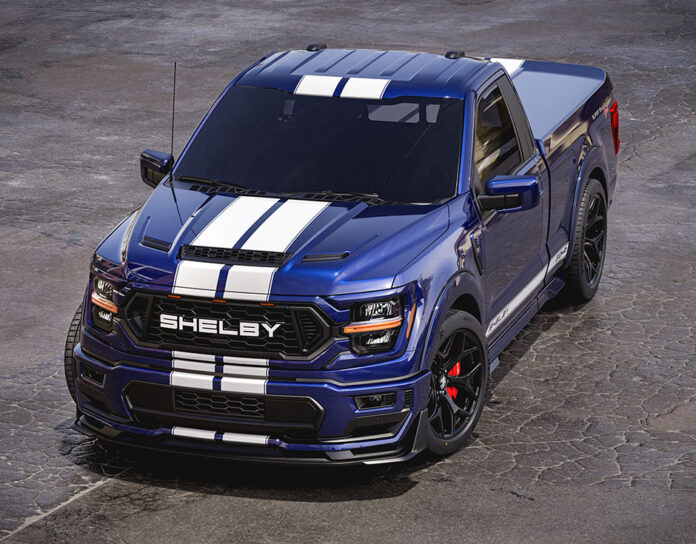
- Vehicle: 2026 Shelby F-150 Super Snake Sport, regular cab
- Price: $115,795 supercharged, including the donor truck
- Power: 400 hp as delivered, 810-plus with the optional blower
- Supercharger: Whipple-based Stage 2, rated on 93 octane
- Donor: Ford F-150 XL 4×4, the only regular cab trim Ford builds
- Suspension: lowered, not lifted
- Off-road content: none
- Build: 500 units, assembled in Bristol, Indiana
8 min read
In This Guide
- What Shelby Announced
- Shelby F-150 Specs and Pricing
- The Shelby F-150 Ships With 400 HP, Not 810
- This Shelby F-150 Has Zero Off-Road Content
- The Real Story Is the Cab
- The Payload Surprise
- What Shelby Does Not Publish
- Against a TRX and a Raptor R, This Is a Different Argument
- The Warranty Question, Answered Carefully
- Frequently Asked Questions
What Shelby Announced
Shelby American revived the two-door full-size pickup on July 30, 2026, and the Shelby F-150 Super Snake Sport is the result. It starts at $115,795 with the supercharger, the donor truck included. Shelby is building 500 of them in Bristol, Indiana.
First, two corrections, and neither is the fault of the outlets repeating them. The 810-plus horsepower figure is an option, not standard equipment. The truck leaves with the stock 400 hp 5.0L unless a buyer pays for the blower. Moreover, Shelby’s own wire release named a Lariat donor. Its site, brochure and self-hosted release all say XL. Since XL is the only regular cab trim Ford offers, a Lariat version cannot exist.
For a 4×4 audience the honest framing is blunt, and it matters because Shelby builds at both ends of the spectrum. Readers cross-shopping its trucks should know the difference. It is a lowered street truck with no off-road content whatsoever, and by Shelby’s own published specifications it is the least off-road-capable Ford-based truck in the company’s 2026 lineup. None of which makes it uninteresting. It is interesting for a completely different reason, and the reason is the cab.
Shelby F-150 Specs and Pricing
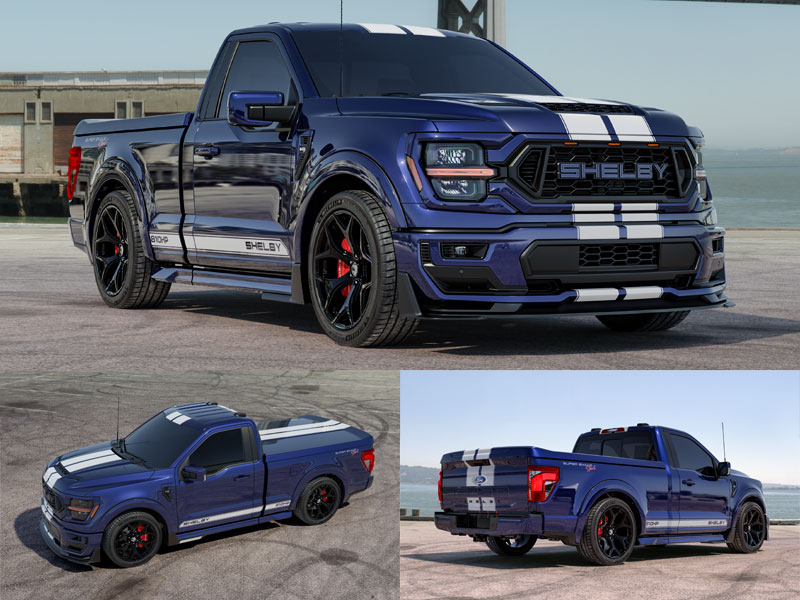
| Specification | Details |
|---|---|
| Price | $115,795 supercharged, donor truck included |
| Donor | Ford F-150 XL 4×4, regular cab |
| Engine as delivered | 5.0L Coyote V8, 400 hp |
| With the blower | 810-plus hp, Whipple-based Stage 2 |
| Fuel requirement | 93 octane for the rating, 91 minimum |
| Suspension | Lowered |
| Wheels | 22-inch |
| Brakes | Oversized Baer rotors, red caliper covers |
| Driveline | Unchanged from stock |
| Production | 500 units |
| Assembly | Bristol, Indiana |
Two rows deserve a closer look. First, the brakes are oversized Baer rotors paired with caliper covers, so the calipers and piston count stay stock. Several outlets have described this as a brake upgrade in the full sense. It is not. Similarly, the driveline is untouched, meaning the axles, driveshaft and differential carry double the factory power on factory parts.
The Shelby F-150 Ships With 400 HP, Not 810
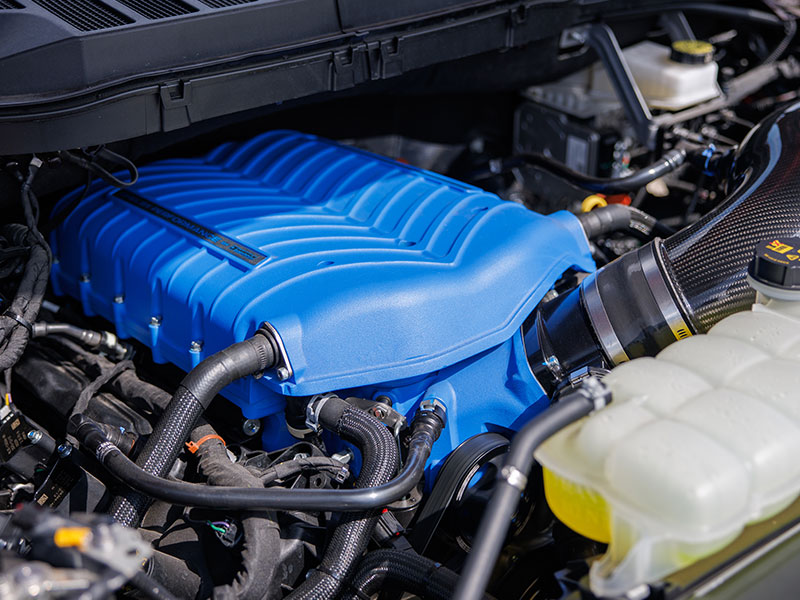
Shelby American sells the supercharger as a separate, post-title purchase. Consequently one of these trucks in a driveway might make 400 hp or 810, and the badge does not tell you which.
The blower is a Whipple-based Stage 2 setup on the Gen 4 Coyote, and the supercharged 5.0L rating assumes 93 octane with a climate adjustment. Ford’s own factory kit for the same supercharged 5.0L makes roughly 700 hp, so Shelby’s package sits meaningfully above it. Our earlier coverage of the F-150 supercharger kit from Ford Performance covers the factory alternative.
The octane requirement carries a trap worth flagging. A stock 5.0L runs happily on 87. Therefore an owner who has always filled with regular is now committed to premium at every fill. Moreover, Ford states failures traced to non-premium fuel in a boosted application are ineligible for warranty repair.
The platform’s ceiling is contested rather than settled. Tim Eichorn of MPR Racing Engines told Engine Builder magazine Ford never designed the first two generations of the engine to make anything over 500 horsepower, pointing at their powder metal connecting rods. Ford has revised the engine since, and it publishes no rod specification for the truck version of the Gen 4. Shelby leaves the short block alone either way, so the buyer inherits the argument along with the horsepower.
This Shelby F-150 Has Zero Off-Road Content
The audit takes one sentence. Specifically: no skid plates, no all-terrain tires, no added locking differential, no transfer case changes. Beyond the hardware, the suspension is lowered rather than lifted, confirmed verbatim across all three Shelby documents.
Several features actively work against trail use. For instance, a front splitter and ground effects hang below the frame line. In addition, 22-inch wheels leave almost no sidewall, and the side-exit exhaust sits exactly where a rock wants to be. None of it is a mark against the truck, which was never sold as an off-roader.
The Shelby F-150 Off-Road package uses the same supercharged engine with actual off-road hardware, while Shelby’s 1,000-hp Baja Raptor sits at the far end. This truck shares an engine with one and a philosophy with neither.
The Real Story Is the Cab
Strip away the horsepower, however, and something more unusual is happening. Shelby chose a regular cab F-150, a body style the industry has spent fifteen years deleting.
Three half-ton nameplates offered a regular cab for 2026, though only two trucks in practice, since the Silverado and Sierra share a platform. Then GM closed order books during the week of April 27, 2026, with regular cab production scheduled to end on June 30. Therefore, as of August 2026, the F-150 XL is the only half-ton regular cab still available to factory-order in the United States.
The rest of the market left earlier. Specifically, Toyota dropped the Tundra regular cab for 2018, while Nissan announced the end of the Titan in August 2023. The regular cab F-150 is now the last of a body style which was once the default shape of an American pickup.
Shelby taking the last one and building 500 performance versions is a strange decision, and a more interesting one than the power figure. Ram has been working a related idea from a different direction with the the Ram 1500 Rumble Bee, though the Ram keeps four doors.
The Payload Surprise
Regular cab trucks have a reputation as payload champions. However, the reputation is half right in a way most coverage gets backwards.
The regular cab payload leader is the eight-foot box 4×2 at 2,440 pounds. It is the highest figure anywhere in the F-150 range. The short box regular cab 4×4, almost surely the Shelby’s donor configuration, posts 1,720 pounds. It carries the lowest payload of any conventional F-150, below every SuperCab and SuperCrew, and 260 pounds under a SuperCrew 4×4. The two-door work truck hauls less than the four-door family truck.
Shelby then adds weight through wheels, brakes and body components. Notably, it publishes no revised payload or GVWR at all. Consequently a buyer expecting work-truck capability from a work-truck cab has the situation exactly inverted. Anyone planning to load one should weigh it and read the door jamb sticker rather than the brochure.
What Shelby Does Not Publish
The absences are as informative as the specs. Specifically, Shelby publishes no torque figure, no boost level, no zero to sixty time for the new truck, no tire size, no rotor diameter, no payload, no GVWR, and no price for the non-supercharged version.
Some of it is normal for a low-volume builder working from a donor truck. A missing torque number on a supercharged V8 stands out, though. So does the absence of pricing for the truck as delivered, since the blower is optional.
Factory programs at similar power levels disclose considerably more. Our coverage of the returning supercharged Ram TRX at 777 hp shows the contrast.
Against a TRX and a Raptor R, This Is a Different Argument
The truck is a straight-line street build on a rare body style, a big power option and a 500-unit cap, and it is aimed squarely at collectors rather than at anyone loading a bed.
The competitive set makes the positioning clearer. A Ram TRX and a Raptor R both arrive with factory warranty coverage, published figures and suspension built to absorb abuse. This costs more than either, publishes less, and trades long-travel suspension for a lowered street setup. What it offers instead is scarcity, since no other builder is turning the last regular cab half-ton into a 500-unit performance run.
Buyers cross-shopping it against a trail truck are in the wrong showroom. Our look at the era of supertrucks covers how the category split into street and desert branches. This one lands firmly on the street side.
The Warranty Question, Answered Carefully
Shelby covers its own work with a three year, 36,000 mile warranty, and says the Ford powertrain warranty remains intact. Its own documentation elsewhere says the modifications might void the factory powertrain warranty. Both are defensible on their own terms, and the distance between them is worth understanding before signing.
Here is the accurate version. The Magnuson-Moss Warranty Act stops a manufacturer from voiding a warranty simply because aftermarket parts are fitted. Instead, the burden sits on the manufacturer to show the part caused the failure. In practice, unrelated systems such as door handles and infotainment are rarely what a denied claim turns on.
Engine failures are the other case entirely. Ford sells its own 700 hp supercharger for this engine and markets it as factory backed. However, Ford’s warranty document states supercharger-caused engine damage is covered by neither the factory warranty nor the Ford Performance warranty, and it caps engine liability at $7,500. A third-party blower sits in a weaker position, not a stronger one.
The fair criticism of Shelby’s language is narrow. “Remains intact” invites a reading in which engine failures stay covered, and on a supercharged application the coverage question is far less settled than the phrase suggests. Anyone spending $115,795 should ask Shelby and the selling dealer for the answer in writing. The same applies to anyone with a stock 5.0L pricing a blower. Such owners far outnumber the 500 people buying this truck.
Frequently Asked Questions
How much is the Shelby F-150 Super Snake Sport?
It starts at $115,795 with the supercharger, and the figure includes the donor F-150. Shelby publishes no price for the truck without the blower, which is a separate post-title purchase, so the entry cost for a non-supercharged example is unknown.
Does the truck come with 810 horsepower?
No. The truck is delivered with the stock 400 hp 5.0L V8, and the 810-plus horsepower comes from an optional Whipple-based Stage 2 supercharger. The rating assumes 93 octane, with 91 as the minimum after the install.
Is the Shelby F-150 any good off-road?
No, and it was never meant to be. It is lowered rather than lifted, runs 22-inch wheels, and adds no skid plates, all-terrain tires or locking differential. A front splitter, ground effects and side-exit exhaust all sit low. Shelby American builds an F-150 Off-Road package for buyers wanting the opposite.
Which F-150 does Shelby start with?
An F-150 XL 4×4 regular cab. XL is the only trim Ford offers in a regular cab for 2026, so any two-door build starts there regardless of the finished price. Some early coverage reported a Lariat donor, which is not possible in this body style.
Is a regular cab half-ton pickup still available?
Only one, as of August 2026. GM closed Silverado and Sierra regular cab order books in April 2026 with production scheduled to end June 30; Toyota dropped the Tundra regular cab for 2018; and Nissan announced the Titan’s end in August 2023. The Ford F-150 XL is the last half-ton regular cab available to factory-order in the United States.
Does a supercharger void the Ford factory warranty?
Not automatically. The Magnuson-Moss Warranty Act prevents a blanket void and requires the manufacturer to show the aftermarket part caused the failure. Engine claims are the real exposure, since Ford’s own documentation excludes supercharger-caused engine damage from both the factory and Ford Performance warranties and caps engine liability at $7,500.