


Quick Facts:
- Topic: Propane fire pit rules under fire restrictions, with examples from five agencies.
- Deciding factor: The land manager’s current order, not the fuel alone.
- Common test: A gas device with an on and off control, kept 3 feet clear of flammable material in three orders we checked.
- Stage 1 fire restrictions: Montana allows LPG devices with an on and off control. Gunnison County allows gas stoves and lanterns.
- Tougher orders: Idaho bans gas campfires in Stage 2. Montana and Central Oregon allow gas devices with an on and off control. Gunnison County allows valve-equipped stoves, grills and lanterns.
- Best for: Campers and overlanders who cross several jurisdictions on one trip.
8 min read
In This Guide
Overview
Propane fire pit rules decide whether you keep a flame or lose your campfire night when a fire ban lands. Several agencies look for a shut-off valve, but the exemption is not universal. For example, Idaho’s Department of Lands bans a “campfire (wood or gas fueled)” under Stage 2. However, Montana’s fire restriction definitions exempt a device fueled solely by LPG with an on and off control.
Because the land manager writes the order, the rule changes when you cross a boundary. A national forest, a BLM river corridor, a state park and a county each issue their own. Because of this, a legal pit at one campsite is not automatically legal at the next. Some states call the order a burn ban, but the wording matters more than the label.
Fire bans already shape how I camp. When a ban prohibits wood stoves, I run a diesel heater in my hot tent instead. A gas fire pit is a similar substitute for an open flame, and it works only where the order allows it.
This guide maps what the orders say and explains why a stove and a fire pit differ. Then it gives you a short routine to follow before you light anything.
Which pit fits your rig depends on size and heat. The Outland Living Firebowl 870 Premium is a 19-inch bowl rated at 58,000 BTU per hour. At 9.25 inches tall, the 21-inch Outland Living Cypress 863 sits lower, with the same rating. Both ship with a 10-foot hose and an adjustable regulator. Meanwhile, the Camco Big Red Campfire is a 13.25-inch tabletop pit rated at 65,000 BTU per hour.
Portable propane fire pits
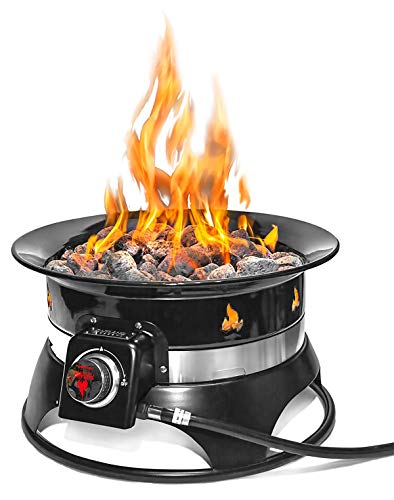
Outland Living Firebowl 870 Premium 19” Auto-Ignition Smokeless Pro…


Camco 13.25 Inch Big Red Campfire Compact Outdoor Portable Tabletop…
Propane Fire Pit Rules by Agency: What Each Order Says
Agencies define the stages differently, so read the order itself. Idaho, Montana and Gunnison County follow one pattern. Stage 1 fire restrictions limit wood campfires to established sites, while Stage 2 bans campfires. Gas devices fall between the two, so the wording decides.
| Agency | Restriction | What the order says about gas devices |
|---|---|---|
| Idaho Department of Lands | Stage 2 | Bans a “campfire (wood or gas fueled)”; stoves fueled solely by LPG stay exempt. |
| Montana FWP | Stage 1 and Stage 2 | Allows a device fueled solely by LPG with an on and off control, with 3 feet cleared around it. |
| Gunnison County, Colorado | Stage 2 | Allows stoves, grills and lanterns with shut-off valves, 3 feet from flammable material. |
| Eldorado National Forest, California | Order in effect Sept. 30 to Nov. 29, 2026 | Allows a portable propane campfire pit with a valid California Campfire Permit and a shut-off valve. |
| Central Oregon federal lands | Stage 2, July 2026 | Allows fire pits with an on and off switch, except on certain BLM river lands. |
These are examples from published orders, not current status for your campsite. Orders expire and change by date. For a news-style look, see how agencies treat propane devices when restrictions lift.
Gunnison County shows how specific the wording gets. Its Stage 2 list names stoves, grills and lanterns with fuel cutoff valves. Each must sit at least 3 feet from flammable material such as grasses or pine needles. However, the list does not name fire pits.
Why a Gas Fire Pit Is Not Always a Stove
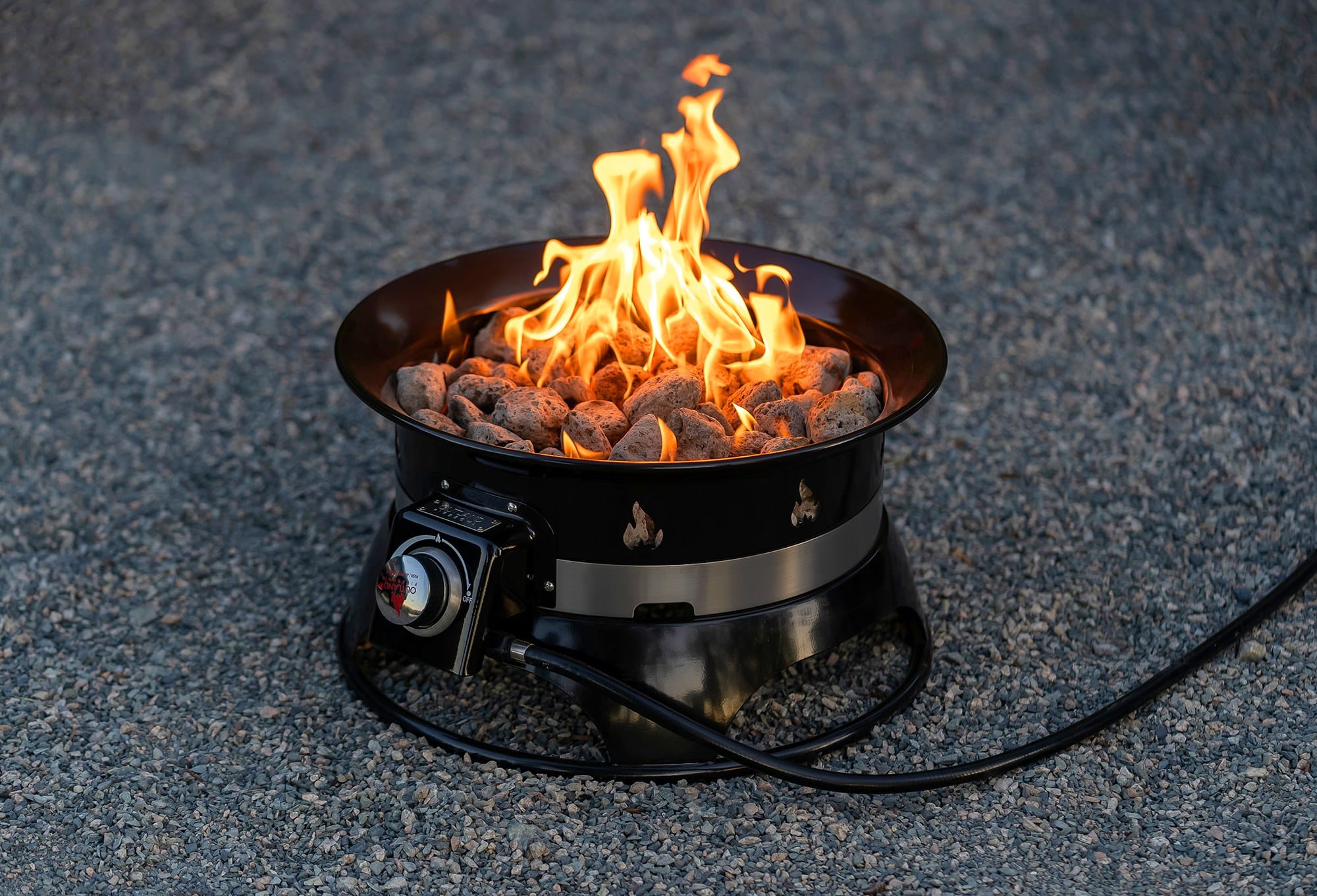
Some orders exempt stoves, lanterns and grills, then say little about a fire pit. Idaho is the clearest case. It exempts stoves fueled by LPG in both stages, yet it bans a “campfire (wood or gas fueled)” in Stage 2. Still, the page does not name gas fire pits. It directs questions to the Fire Warden at the nearest Supervisory Area Office.
Because some orders exempt stoves without naming fire pits, the safe reading is to ask. One commenter in a Rocky Mountain National Park forum said their county banned propane pits in Stage 2 while grills stayed legal. Treat this as an anecdote, not law.
Permits also add another layer. The Eldorado National Forest order, in effect Sept. 30 to Nov. 29, 2026, requires a valid California Campfire Permit. It lets permit holders use a portable propane campfire pit, stove or lantern. The device needs a valve to shut off the fuel and a spot at least 3 feet from flammable materials. After Nov. 29, check the forest’s alerts page for a new order.
Land type matters too. Central Oregon’s July 2026 Stage 2 release allowed fire pits with an on and off switch on federal lands. However, it excluded BLM-administered lands along portions of the Crooked, Deschutes, John Day and White rivers. It also excluded Lake Billy Chinook and Lake Simtustus. BLM river corridor rules there prohibit campfires, charcoal fires or any other open flame.
Manufacturers also add to the confusion. Outland Living calls its Firebowl 870 CSA approved and “safe to use during most fire bans.” A product claim does not equal agency permission, so the order still decides.
Propane Fire Pit Rules vs. a Wood Campfire
A wood campfire loses first. Idaho prohibits wood-fueled stoves in both stages. Its Stage 1 text also says metal fire pans do not count as owner-provided fire structures. A propane flame, by contrast, goes out when you close the valve. It also leaves no coals or ash.
For me, the valve is the real feature. Owners add benefits: no smoke in your clothes, no coals to babysit, no firewood to buy or haul. Those perks explain the appeal of a pit in ban season.
However, the trade-off is fuel. Owners also report a pit burns a lot of propane, and some carry a dedicated second tank. A full 20 lb tank holds roughly 430,000 BTU. As a result, a pit rated at 58,000 BTU per hour empties one in under eight hours on high. Our guide on how long a propane tank lasts covers estimated burn times by tank size.
Check Your Propane Fire Pit Rules Before You Light It
A five-minute check protects your trip, your fine budget and the forest. Follow these steps for every new campsite.
- Name the land manager: national forest, BLM district, state park, county or private campground.
- Find the current order on the agency’s alerts or fire restrictions page, then note the stage and the effective date.
- Read the wording on gas devices. Look for “shut-off valve,” “turned on and off” or “stove fire,” and note the clearance distance.
- Call the ranger district or fire information line when the order does not name fire pits. The Deschutes National Forest lists 1-800-523-4737 for Central Oregon.
- Ask whether a permit applies, such as the California Campfire Permit, and save the date and name of who answered.
Private campgrounds and hosts set their own rules. Instead of relying on the agency order alone, ask at check-in. Our camp cooking fuel comparison covers which fuels stay legal under fire restrictions.
Set Up a Propane Fire Pit Safely
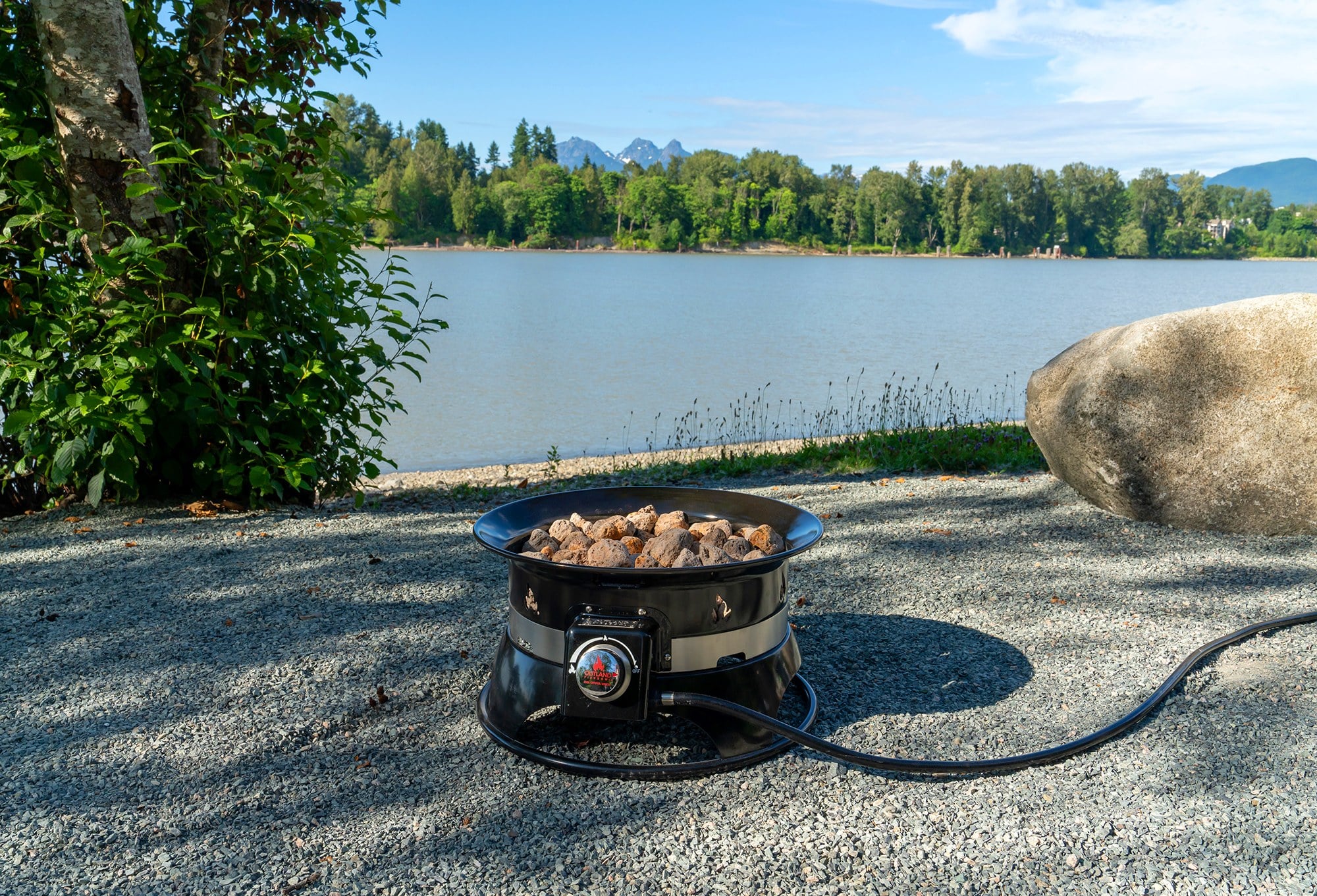
A legal flame still burns. Set the pit on level, bare ground. Keep at least 3 feet clear of grass, needles and gear, the distance the Montana and Eldorado orders require. Also, stand the tank upright on stable ground, as far from the flame as the hose allows. The Outland Firebowl 870 ships with a 10-foot hose and regulator.
Safety note: Run a propane pit outdoors only, never inside a tent, vehicle or camper, because burning propane produces carbon monoxide. Close the valve before you walk away or go to sleep.
Cold and ground heat also deserve a plan. Set a flame-resistant mat under the pit for extra protection over dry ground. Also, test the setup at home first. Cold weather brings a dropping flame and frost on the regulator for some owners. Therefore, confirm your tank and hose work before the trip.
Finally, keep a small extinguisher and a water jug within reach.
Three accessories cover the steps above. The Kidde Basic 110 extinguisher carries a 1-A:10-B:C rating and 2.5 lb of agent, but Kidde sells it for residential, single-use service. Next, the POMOLY Fire Pit Mat measures 39.4 inches square and withstands up to 1,022°F, and its reflective edges show in the dark. Finally, the DOZYANT propane gauge fits 5 to 40 lb tanks with a QCC1 connection. It gives an estimate only, because temperature changes tank pressure.
Fire pit safety and fuel gear


Propane Tank Gauge Level Indicator Leak Detector for BBQ Gas Grill …
What to Look for in a Fire Ban-Friendly Pit
First, check the valve. A real on and off control is the feature the orders above describe, so skip designs without one. Next, check tank size and what ships in the box.
The Outland Firebowl 870 is a useful benchmark. According to its product page, it measures 19 by 19 by 11 inches. It weighs 25 lb with rocks and uses a standard 20 lb tank. Included are a pre-attached hose, a regulator and a carry kit.
Meanwhile, flame quality varies by model. Owners describe the Camco Little Red Campfire as short on heat, and the Outland brand publishes a support page for low flames. Compare heat output, packed size and weight, then match the pit to how you travel. The Tripod Torch is a compact option built around an on and off valve. Our Tripod Torch review covers how it handled 30 days of use.
Final Thoughts
A propane fire pit is a good tool for ban season, but it is not a loophole. It works where the order allows a valve-equipped gas device. However, it fails where the order bans gas campfires or all open flame. Read the wording, ask a person when the wording is silent, and write down the answer.
If you travel across several jurisdictions, build the check into your routine. Pack a spare tank, a fire mat and a small extinguisher, then confirm the rules at each stop. When an order bans every open flame, bring warm layers and an LED lantern instead.
Do the five-minute check, and the evening stays simple. You sit by a steady flame and close the valve when you turn in.
FAQ
Are propane fire pit rules the same for a fire ban and a burn ban?
Agencies and news outlets use the two terms loosely. Ignore the label and read how the order treats gas devices, valves and campfires.
Are propane fire pits allowed during Stage 2 restrictions?
Sometimes. Montana and Central Oregon federal lands allow gas devices with an on and off control in Stage 2. Gunnison County allows valve-equipped stoves, grills and lanterns. Idaho bans a gas-fueled campfire. Always check the current order.
Do propane fire pit rules require a campfire permit?
In some places. The fall 2026 Eldorado National Forest order, which runs through Nov. 29, 2026, requires a valid California Campfire Permit for portable propane campfire pits. Other agencies differ, so ask the local office.
Does a shut-off valve make any propane pit legal?
No. The valve is the usual test, but Idaho bans gas campfires in Stage 2, and BLM river corridors in Central Oregon prohibit open flame.
Is a propane fire pit allowed on BLM land?
It depends on the district. Central Oregon’s Stage 2 release excluded certain BLM river lands, so confirm with the local BLM office before you light it.
How far should a propane fire pit sit from flammable material?
The Montana, Gunnison County and Eldorado orders each cite 3 feet. Some orders use other distances, so follow the one covering your campsite.