


Quick Facts:
- Product type: Hood solar panel, laminated flat to a vehicle-specific hood profile
- Typical output rating: 20W to 150W depending on hood size
- Real-world harvest: Roughly 40 to 60 percent of the rating in strong sun
- Thickness: 3mm on the Lensun panels 4XSolar sells
- Price range: $149 to $695 across 148 vehicle fitments
- Rack space used: None
- Setup time at camp: None
- Best for: Rigs with a loaded roof, or rigs sitting between trips
9 min read
In This Article
- What a Hood Solar Panel Is
- Why the Hood and Not the Roof
- What a Hood Mounted Solar Panel Does While You Are Away
- Does Engine Heat Hurt Hood Solar Panel Output?
- Truck Hood Solar Panel Fitment by Vehicle
- Key Specs at a Glance
- Hood Solar vs. Roof Racks vs. Portable Panels
- Who Should Run One
- Hood Solar Panel FAQ
What a Hood Solar Panel Is

A hood solar panel is a thin, flexible array laminated to one specific hood shape. Instead of bolting a framed module to a rack, you bond a 3mm laminate straight to sheet metal you already own. The panels in the 4XSolar catalog use Grade A PERC monocrystalline cells behind an ETFE front sheet, rated at 23.5 to 25 percent cell efficiency.
Because the laminate is pre-curved, fitment is the whole product. A 4Runner panel will not sit flat on a Tacoma. The catalog therefore carries one laminate per vehicle rather than a universal panel, with 148 fitments spanning 20W to 150W and $149 to $695. Every one comes from Lensun, and 4XSolar resells the line out of Tucson, Arizona.
The idea predates the current overland wave. Marine builders have bonded flexible ETFE panels to sailboat decks for years, where a walkable surface matters more than peak efficiency. Overlanders borrowed the format for a different reason. A large, flat, sun-facing surface sits unused, and a 1 to 3 kg laminate turns it into a charging source.
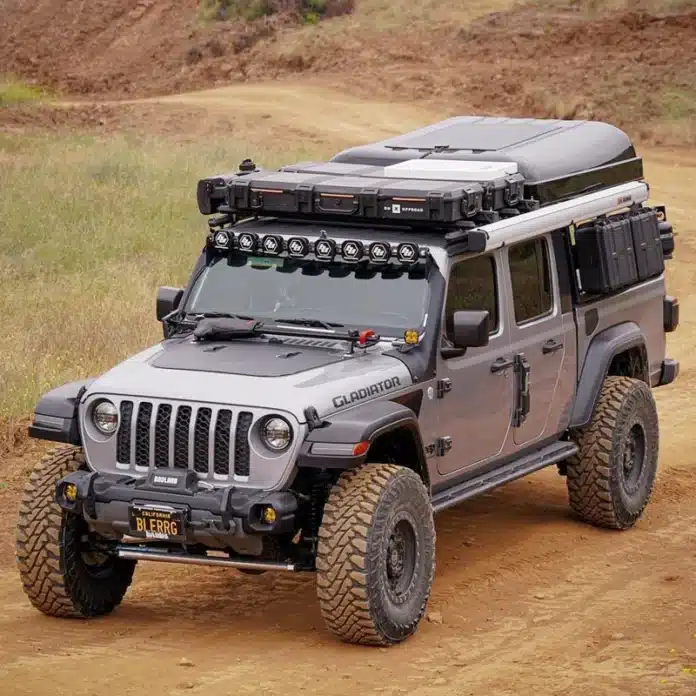
Cell technology is not what separates these from other overland solar panels. Every one is a flexible solar panel using similar mono cells behind similar film. Instead, the difference is the shape, the vinyl underlayer, and the absence of any rack, standoff, or drilling. Our hands-on hood solar panel review shows one installed on a Gladiator.
Why the Hood and Not the Roof
Ask owners why they went to the hood, and the first answer is almost never efficiency. Instead, it is room on the rig. A rooftop tent, MAXTRAX, a spare, an awning, and increasingly a Starlink dish leave nothing for a 100W module. One r/overlanding owner running a 90W panel for a year called it a “great use of space” otherwise going to waste.
Popular Hood Solar Panel Fitments at 4XSolar
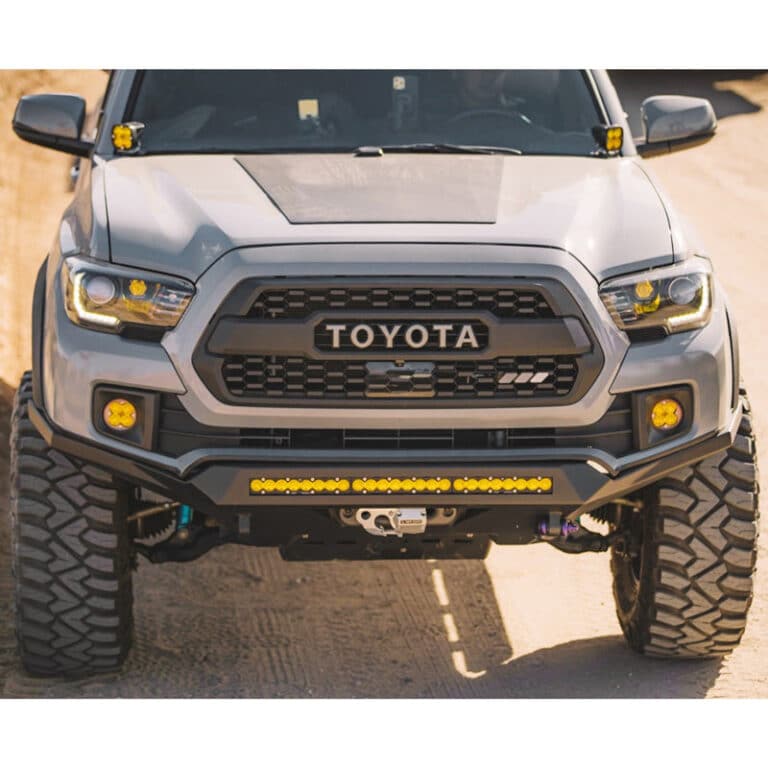
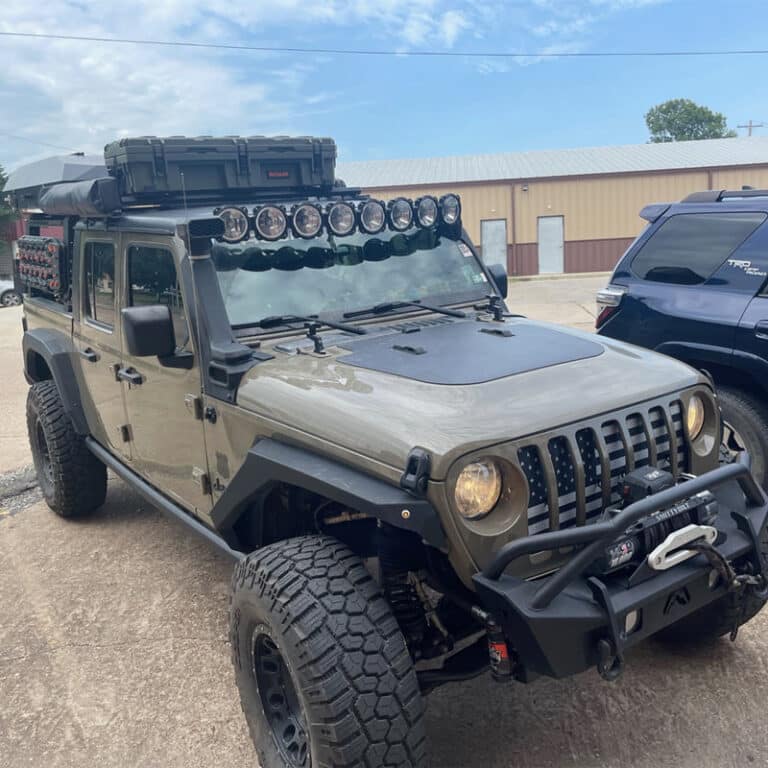
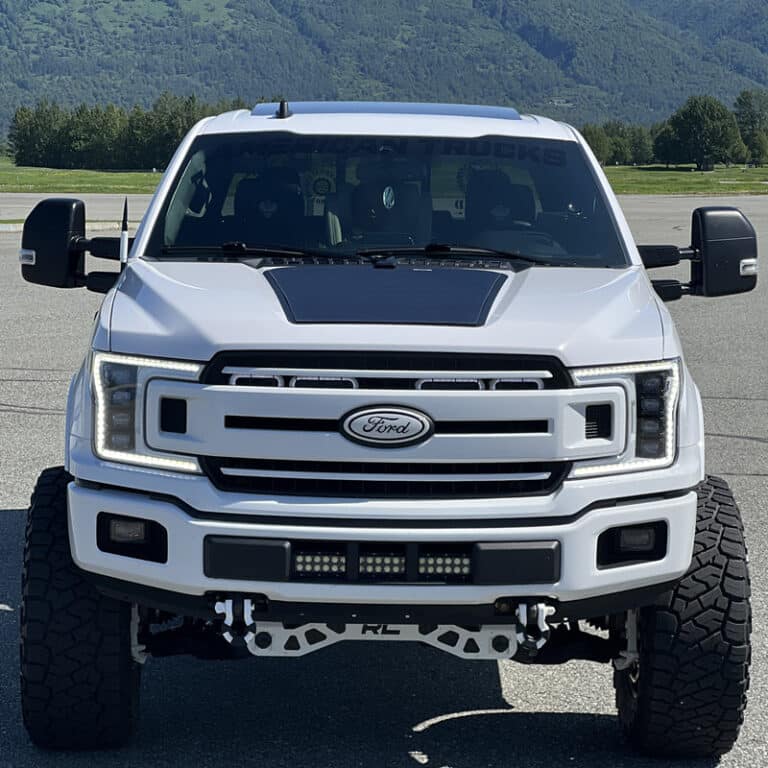
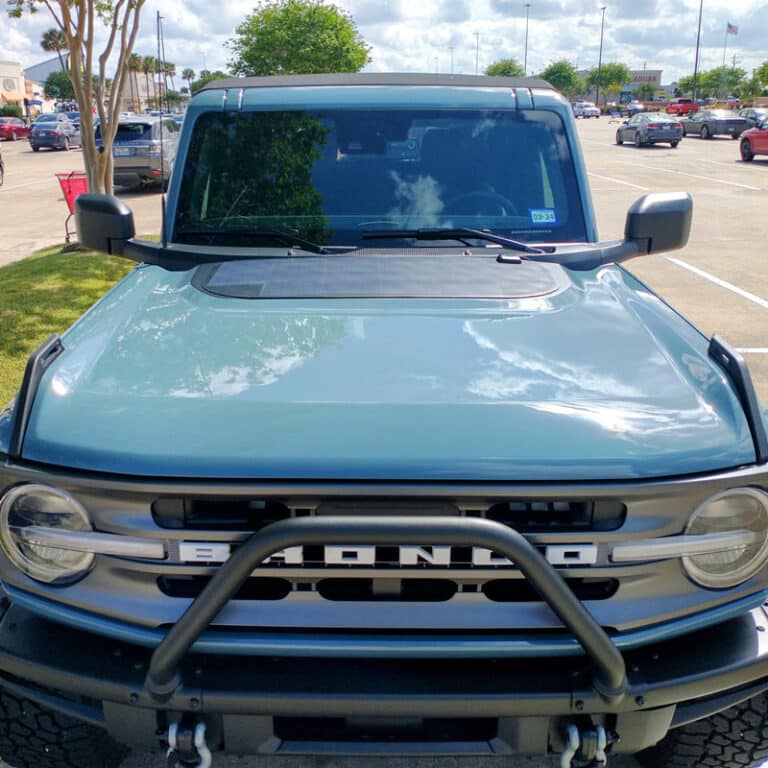

Another owner ran a rooftop tent seasonally, so a permanent roof array made no sense. GearJunkie’s reviewer reached the same conclusion on an LR3, since the roof stays reserved for surfboards, bikes, and a tent. None of these owners argued a hood beats a roof on physics. They argued a hood was free and a roof was not.
Aerodynamics reinforce the point. A 3mm laminate adds no frontal area, no wind noise, and no weight above the roofline. Compared to a framed panel on crossbars, a hood mount changes nothing about how the rig drives.
Glare reduction is a second benefit nobody advertises. A reviewer at Trail Tacoma running a white truck reported the biggest immediate change was hood glare, because the panel covers nearly half the hood. Meanwhile, a 4Runner owner on toyota-4runner.org treated glare reduction as a second justification for the install.
What a Hood Mounted Solar Panel Does While You Are Away
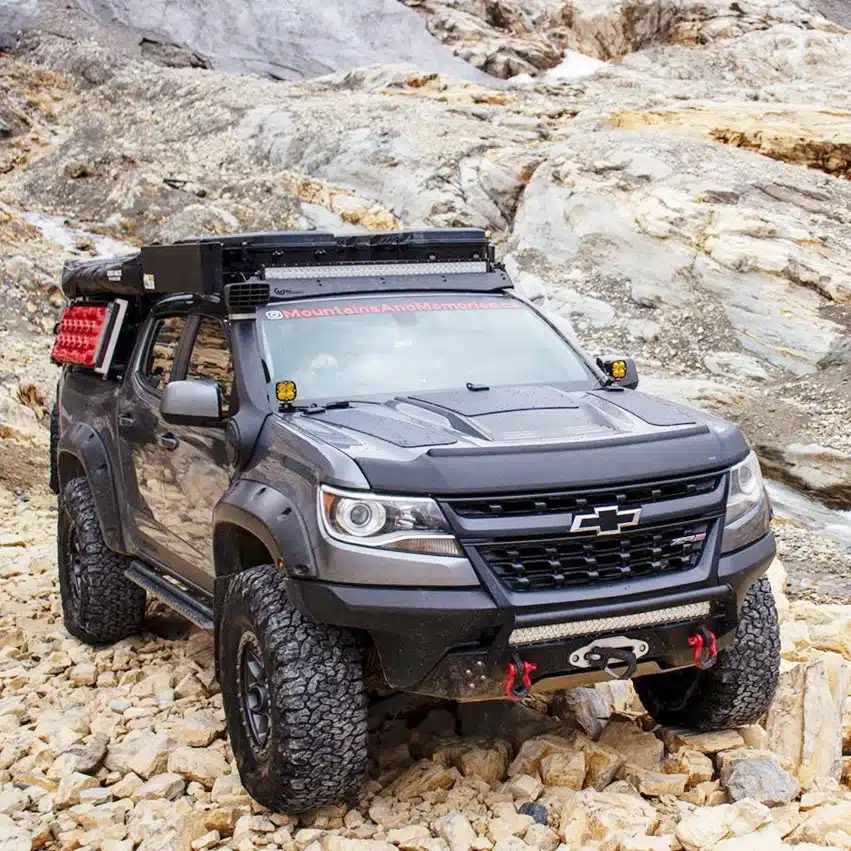
A hood mounted solar panel is a maintainer, not a power plant. One Gladiator owner on a skeptical forum thread called it a slow charger rather than a main power bank. Once you judge it on maintenance duty instead of camp-power duty, the reported results stop looking thin.
The highest-satisfaction group is owners whose rigs sit. A Gladiator owner working from home parks for up to two weeks at a stretch, with the panel holding the starting battery up. Another owner with a parasitic draw from JL power steps calls the dead-battery warnings a problem of the past. An FJ Cruiser owner treats a small hood panel as a battery tender for a rig nobody drives daily.
Fridge duty works too, within limits. One owner ran a 110W Lensun into a dedicated AGM, parked a week in 110-degree Fahrenheit heat with the fridge running, and never killed the battery. Another has run an ARB 50-quart fridge off hood solar for nearly four years. For the downstream side, see our guide to the overlanding battery management system.
Theft is the argument owners raise least and value most. A portable array sitting in the dirt at a trailhead is easy to steal. One r/overlanding poster lost a Goal Zero panel from a truck bed during a 50-mile loop. By contrast, a bonded hood panel stays put whether you are hiking, eating, or sleeping.
Does Engine Heat Hurt Hood Solar Panel Output?
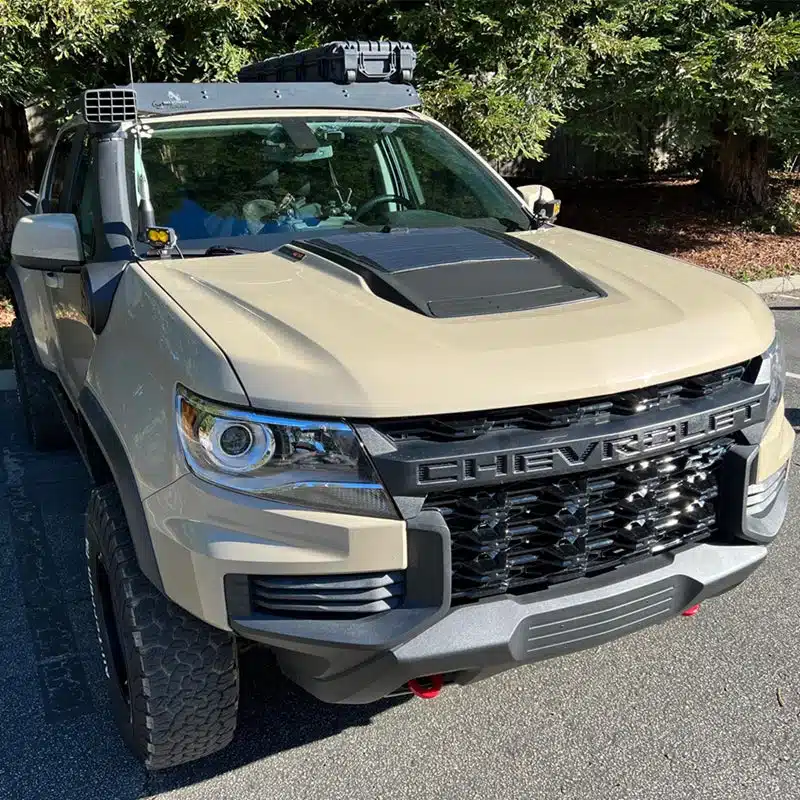
Yes, and every honest answer starts there. Solar modules are rated at a 25-degree Celsius cell temperature under lab conditions. NREL figures put crystalline silicon losses near 0.39 percent per degree Celsius above the 25-degree reference. Because a panel bonded flat to steel gets no air gap, it runs hot. Nameplate wattage is therefore a ceiling nobody reaches.
Field reports bear this out. GearJunkie measured about 40W from a 100W panel on a sunny Oregon April day, then 14W on a drizzly February afternoon. An owner in Yuma, Arizona, running 120W on a GX470 reported a peak in the mid-70W range. In Australia, dual 70W Lensun panels returned roughly 75W. Across the reports, 40 to 60 percent of rating in strong sun is realistic. Our guide on how to size your solar array covers the same derate math.
The best rebuttal came from an Expedition Portal owner who reframed the timing. Engine heat lingers for a few hours after a long alternator charge, precisely when you need solar least. While the rig sits in camp for days after, the engine is cold. One owner measured a black hood near 230 degrees Fahrenheit parked in summer sun, and about 120 degrees while driving, because airflow at speed cools sheet metal.
What Hood Heat Costs Your Paint
Heat also puts paint at risk. One longtime Land Cruiser owner posted photos of clear coat cooking off under a panel bonded straight to the hood. Lensun sells a matching vinyl underlayer as a kit option, while Cascadia 4×4 now mounts on removable clasps with an air gap. Bonding bare panel to bare paint is the mistake to avoid.
No A/B test exists. Nobody has run identical panels on a hood and a roof simultaneously and published the delta. One forum member requested such a test in 2021, and no published result has surfaced since.
Truck Hood Solar Panel Fitment by Vehicle
A truck hood solar panel exists only if somebody tooled a laminate for your hood. Coverage across the 4XSolar catalog is deepest where the overland market sits: 33 Ford fitments, 28 Toyota, 17 Chevrolet, 17 Jeep, and 16 Ram. GMC and Subaru get 7 each, Nissan 6, and Lexus 3.
Toyota owners have the most choice. The 4Runner spans the second through sixth generations, including 35W and 110W options for scooped hoods. Tacoma runs 46W to 110W across four generations, and the 2024 truck gets a 100W panel at $339. Land Cruiser, Prado 250, FJ Cruiser, Hilux, and Tundra are covered too.
Jeep coverage reaches back to the XJ Cherokee with a 140W option. Wrangler owners choose by trim, because a Rubicon 392 hood differs from a standard JL hood. Ford spans Bronco, Ranger, Super Duty, and the F-150 Lightning at 115W. Vans get Sprinter fitments across three generations.
Two gaps deserve mention. First, 139 of the 148 listings carry a truncated description with no spec block, so buyers read wattage off the title. Second, no listing states panel dimensions or a warranty term.
How to Confirm Your Fitment
Match the generation and the hood variant, since a scooped hood takes a different laminate than a flat one. Then ask the seller for panel dimensions and the warranty term in writing before you order, because neither appears on the listings.
Key Specs at a Glance
| Specification | Details |
|---|---|
| Panel thickness | 3mm (0.12 inches) |
| Cell type | Grade A PERC monocrystalline |
| Cell efficiency | 23.5 to 25 percent |
| Front sheet | Premium ETFE film |
| Weight | 1 kg to 3 kg (2 to 7 lb) by wattage |
| Junction box rating | IP68 |
| Mounting | Bonded over vinyl, no drilling |
| Charge controller | Optional 10A waterproof MPPT |
| Fitments offered | 148 across 15 makes |
| Panel dimensions | Not published, ask before ordering |
| Warranty term | Not published, ask before ordering |
Hood Solar vs. Roof Racks vs. Portable Panels
A rigid roof-mounted module beats a flexible solar panel on raw output. Rigid panels tilt, get airflow underneath, and scale past 200W. In exchange, they consume rack space most overlanders have already given to a tent, and they add weight where you least want it.
Portable folding panels win on placement. You aim them at the sun, chase the angle, and park the rig in shade while the panel sits in full light. The cost is a deploy-and-retrieve cycle at every stop, plus a theft risk. For a short town stop or a trailhead hike, most owners will not bother.
Hood solar’s advantage is availability. It uses space nothing else wants, works without a decision from you, and stays put. Still, the trade is real. The panel is fixed flat, heat-derated, and dependent on where you park. Owners camping under heavy tree cover lose most of the benefit, although several note those sites defeat portable panels anyway.
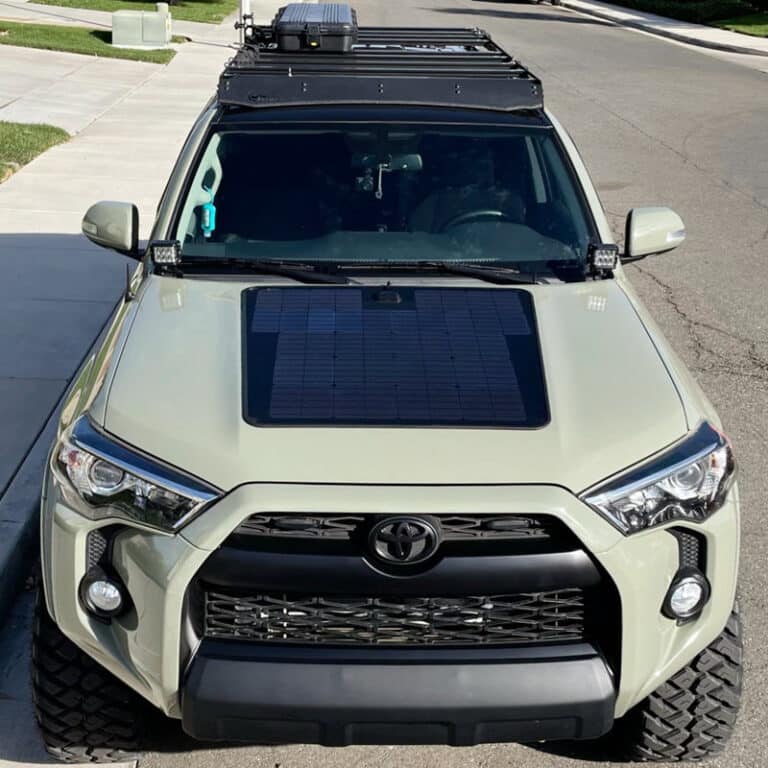
4XSolar Hood Solar Panel Collection
148 Lensun hood panels pre-curved to specific vehicles, spanning 20W to 150W and $149 to $695. Coverage runs across Toyota, Jeep, Ford, Chevrolet, GMC, Ram, Nissan, Lexus, Subaru, Hummer, Mercedes-Benz, Porsche, Dodge, BYD and Ineos. Each panel measures 3mm thick with PERC monocrystalline cells behind ETFE film. A 10A waterproof MPPT controller and a vinyl underlayer are available as kit options. Founded in Tucson by a retired U.S. Air Force pilot.
Find Your FitmentPrice sits in between. Vehicle-specific hood panels cost several times the price of a generic flexible panel of equal wattage. GearJunkie priced Cascadia 4×4 systems from $439 to $839 in 2023, and the current VSS System 2.0 runs $339 to $699 panel-only. The premium buys the curvature match and an install needing no rack and no drilling.
Who Should Run One
Buy one if your rig sits. A weekend truck, a hunting rig, or a work-from-home daily with a parasitic draw is the clearest case. Owners in this group report the highest satisfaction by a wide margin, because holding a battery at full charge is the job a 60W trickle does well.
Buy one if your roof is committed. When a rooftop tent, a spare, and recovery boards own the rack, overland solar panels have nowhere else to go. If you park at trailheads and town lots all day, a panel needing no deployment collects hours a portable array would miss.
Where a Hood Panel Falls Short
Look elsewhere if you need bulk power. A hood panel will not run an inverter, refill a 1,500Wh LiFePO4 station, or replace a properly sized roof array. Owners who drive daily should price a DC-DC charger first, since 30 minutes on a 60A unit moves more energy than a sunny day on a 60W panel. Skeptics raise this point often, and they are correct.
Look elsewhere if you park in shade by habit, and think hard before bonding anything to a hood you care about. If you are bonding a panel directly to paint, order the vinyl underlayer with it and treat it as required rather than optional. If a hood panel does not suit your rig, our roundup of flexible solar panel options covers the alternatives.
Hood Solar Panel FAQ
What does a hood solar panel do?
It converts your hood into a charging surface for a starter or auxiliary battery. Most owners wire it through a small MPPT controller. The panel then holds a battery at full charge while the vehicle sits, and offsets a fridge or parasitic draw during daylight.
Do hood solar panels work, or is it only a trickle charge?
Both descriptions are fair. Field reports put real output near 40 to 60 percent of the nameplate rating in strong sun. A 100W panel therefore delivers roughly 40 to 60W at peak. As a maintainer, it works well. Treated as a primary power source, however, it disappoints.
Will a hood solar panel run a 12V fridge?
Sometimes, with a dedicated house battery in the circuit. For example, one owner reports a 110W Lensun holding an AGM while a fridge ran a full week in 110-degree Fahrenheit heat. In the Pacific Northwest, by contrast, owners report a 90W panel failing to keep up with a fridge drawing about 5 amps. Latitude and season decide the answer.
Will a hood solar panel damage my paint?
Not with the vinyl underlayer installed first. Lensun offers a vehicle-specific vinyl decal as a kit option, and Cascadia 4×4 now mounts its VSS System 2.0 on removable clasps, leaving an air gap. Either way, a panel bonded straight to clear coat has cooked paint in at least one documented case.
Is there a car hood solar panel for my Tacoma or 4Runner?
Yes for both, across multiple generations. Tacoma fitments span the first through fourth generations, from 46W to 110W. The 4Runner spans the second through sixth generations, including separate versions for scooped hoods. Toyota has the deepest coverage of any make.
Do hood solar panels work in shade?
Barely. Output collapses under tree cover, since the panel is fixed to wherever you park. Still, several owners note their shadiest campsites defeated portable panels too, and argue the drive in is when a hood panel does the most work. Our piece on the solar panel bypass diode explains why partial shading hurts output so sharply.