



Quick Facts:
- Product: Star-Batt Plus
- Capacity: 576Wh, six removable 96Wh LiFePO4 modules
- My tested runtime: 27 hours 27 minutes continuous, 8.3% remaining
- Case: Pelican 1450, IP65 rated
- Weight: 22 lbs
- Dimensions: 17 x 13 x 7 inches
- Ports: RJ45 Ethernet passthrough, 65W USB-C PD, 18W USB-A QC 3.0
- Recharge (claimed): AC about 5 hours, solar about 6 hours, vehicle DC about 8 hours
- Price: $1,599, plus a 3% card fee at checkout
- Best for: overlanders and field crews who need a full day online with no grid
9 min read
In This Review
- Overview: What the Star-Batt Plus Is
- Key Specs at a Glance
- Starlink Mini Battery Runtime, Measured
- Build Quality and the Pelican 1450 Case
- Setup Takes Three Steps
- The Display, Ports and Ethernet Passthrough
- Charging Options and Flying With the Packs
- Star-Batt Plus vs. a Portable Power Station
- Final Verdict: Who This Starlink Mini Battery Is For
- Frequently Asked Questions
Overview: What the Star-Batt Plus Is
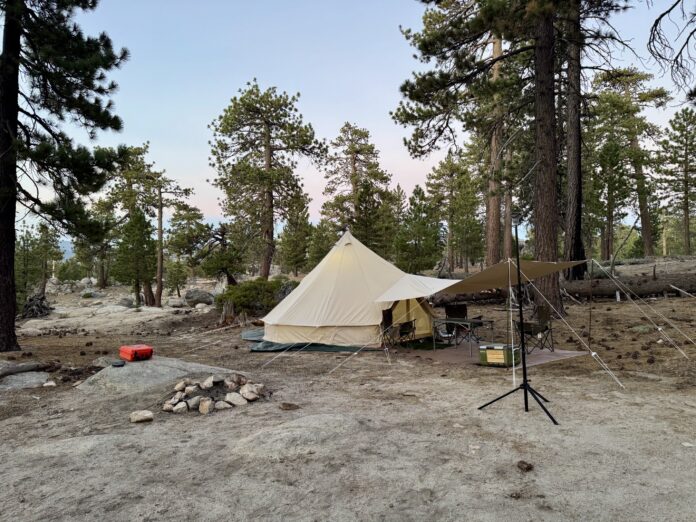
At 1:50 p.m. on Saturday I set camp, pressed one button on the Star-Batt Plus, and walked away from it. It ran until 5:17 p.m. Sunday, when I shut it off with 8.3 percent still on the display. Star-Batt sells this Starlink Mini battery as a full operational day of connectivity inside a hard case. My first weekend with it says the claim survives contact with a real camp.
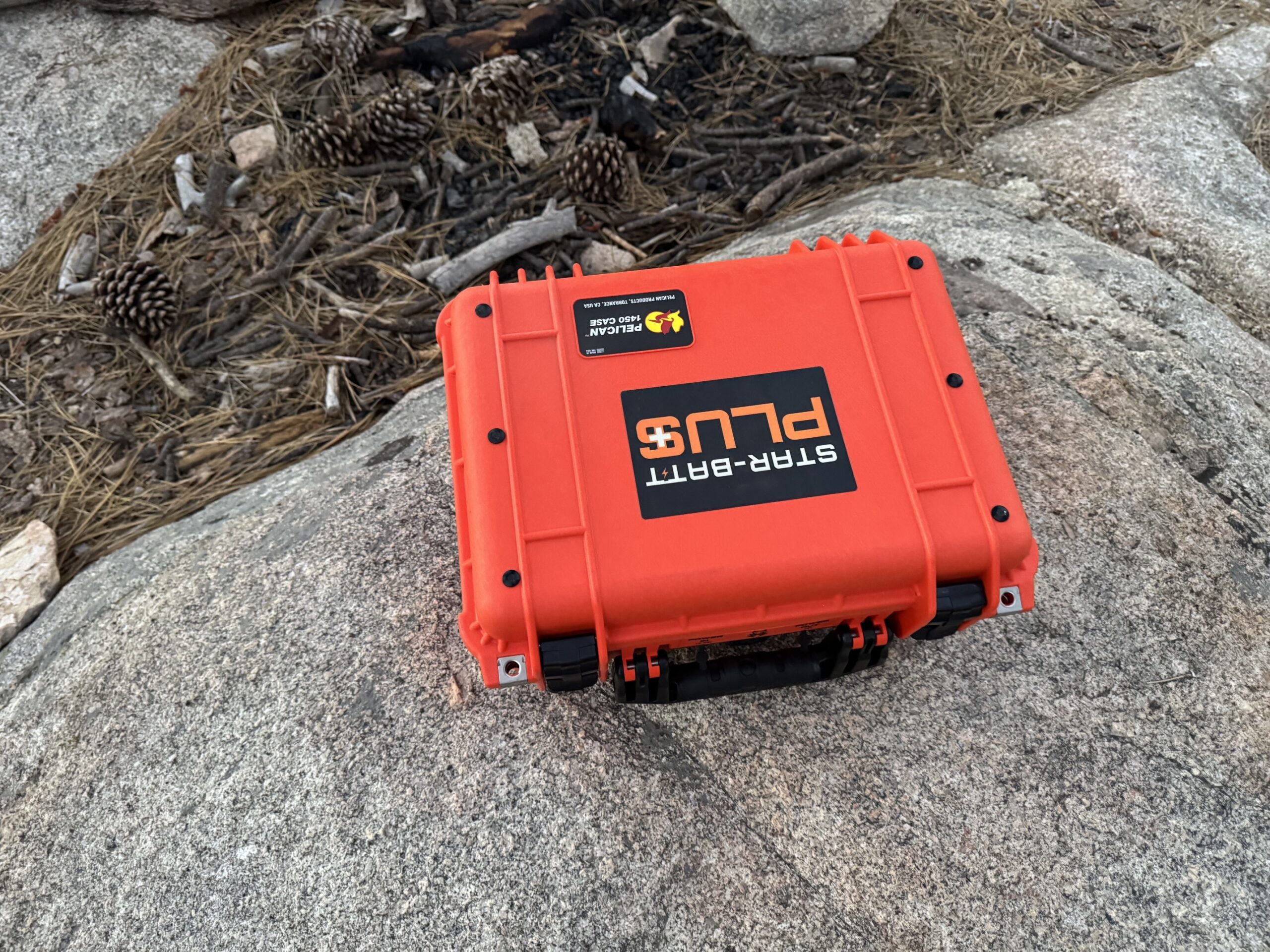
The product is a battery and a protective shell in one. Star-Batt builds it inside a Pelican 1450 shell, seats six removable 96Wh modules beneath an aluminum deck, and mounts the dish in a cradle in the lid. Because the shell is radio transparent, the dish works with the lid latched.
Star-Batt aims this model at first responders and government teams. However, the real audience runs wider than the marketing copy suggests. Anyone parked far from a cell tower fits the brief for a Starlink Mini battery this size. For a wider field of options at other price points, our best Starlink Mini battery picks compare three tiers of off-grid internet.
Key Specs at a Glance
| Specification | Details |
|---|---|
| Battery | 576Wh LiFePO4 battery pack, six removable 96Wh modules |
| Cycle life | 2,000 cycles at 100% depth of discharge, 6,500 at 50% |
| Case | Pelican 1450, IP65, padlock holes, pressure relief valve |
| Output | 240W at 24V, plus 65W USB-C PD and 18W USB-A QC 3.0 |
| Data | RJ45 Ethernet passthrough with waterproof connector |
| Solar input | Up to 160W, 28Voc |
| Operating range | -4F to 122F, charging from 32F to 113F |
| Weight and size | 22 lbs, 17 x 13 x 7 inches |
| Price | $1,599 plus a 3% card fee, waived on bank transfer |
Starlink Mini Battery Runtime, Measured
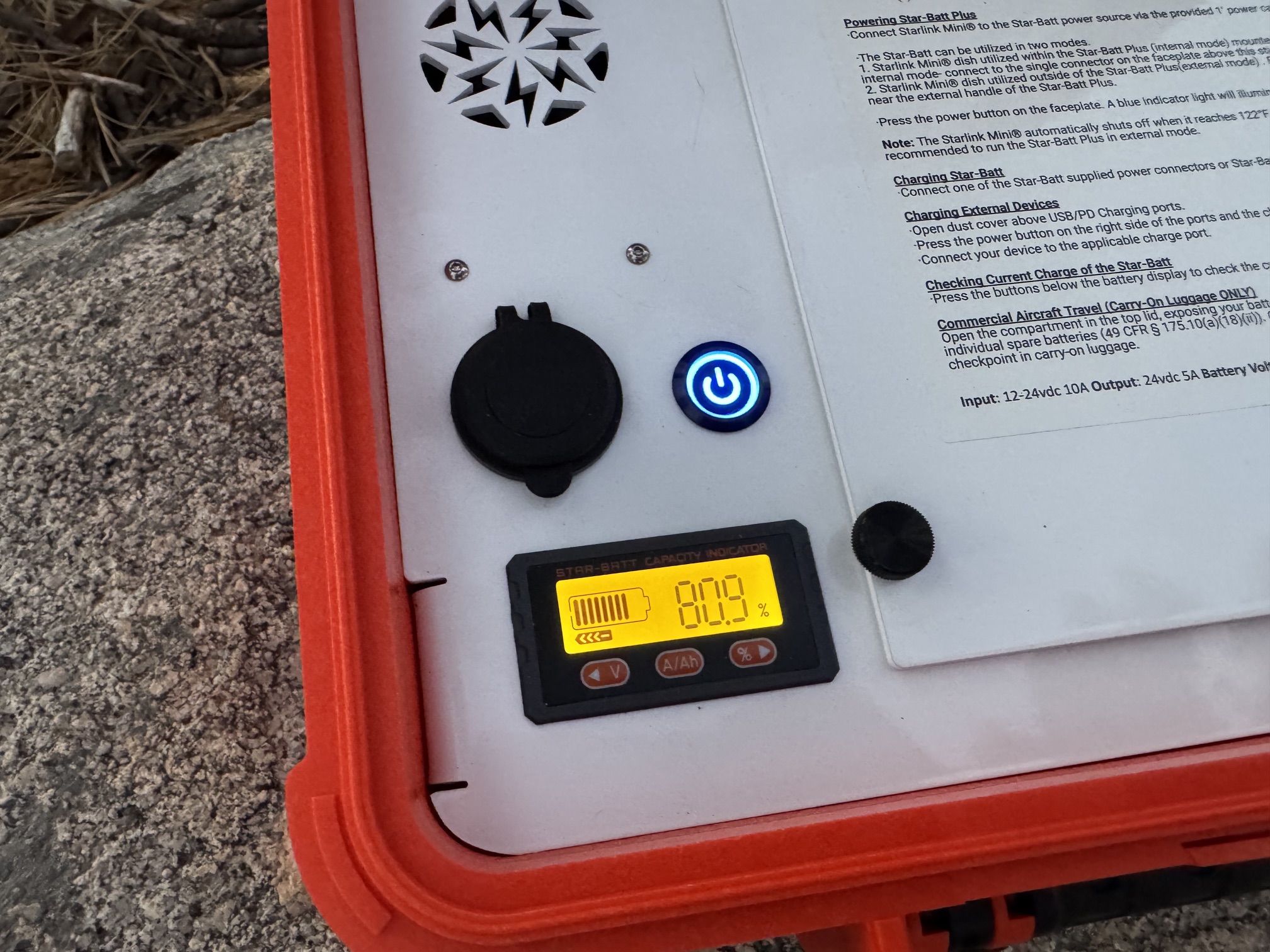
Camp went up Saturday at 1:50 p.m., and I powered the unit down Sunday at 5:17 p.m. Therefore the run covered 27 hours and 27 minutes, continuously, with the dish never switched off once. The display still read 8.3 percent when I ended it, so the pack had more left. Star-Batt advertises over 24 hours of runtime, and my result cleared the claim by roughly three and a half hours.
Arithmetic supports the result. Specifically, 91.7 percent of a 576Wh LiFePO4 battery pack works out to about 528 watt-hours consumed across 27.45 hours. Divide one figure by the other and average draw lands near 19 watts. Starlink rates the Mini at 20 to 40 watts with 15 watts at idle, so a light-use camp sits at the bottom of the published band.
My number lines up with the only comparable independent test I found. DISHYtech ran the sibling Star-Batt Mini, same 576Wh capacity, for 27 hours and 15 minutes in 35- to 45-degree winter weather. Mine went 12 minutes longer in late summer heat, close enough to call the two consistent. For a deeper look at draw figures, see our breakdown of Starlink Mini power consumption.
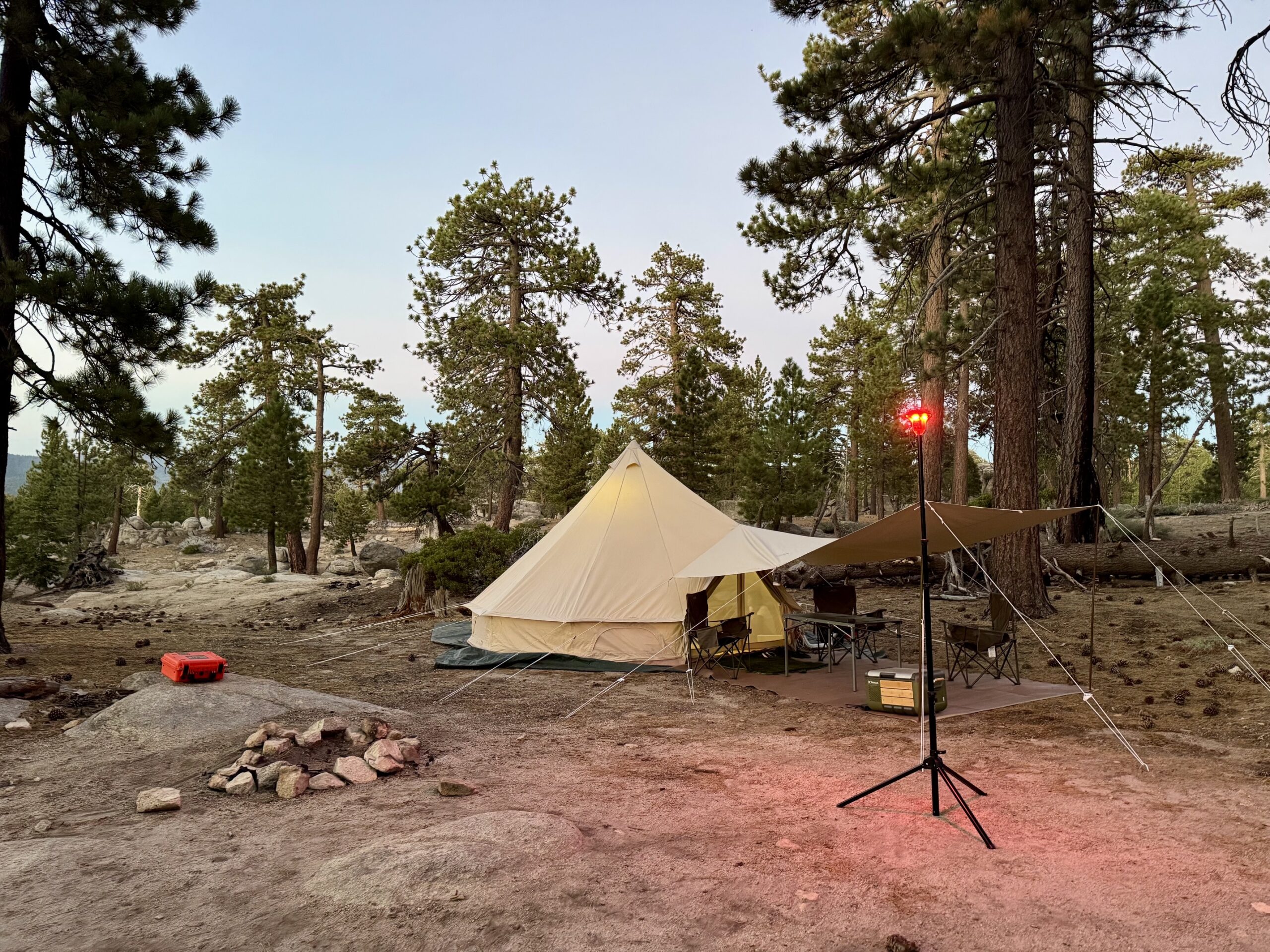
I own the matching 160W panel, and it stayed in its bag all weekend on purpose. Solar input would have blurred the single number I wanted. As a result, this Starlink Mini battery covered the weekend on stored energy alone, topped off at home the night before I left.
Buy Direct From Star-Batt
Star-Batt Plus, 576Wh in a Pelican 1450
Six removable modules, an Ethernet passthrough and a sealed shell. Lead times run three to five weeks.
Build Quality and the Pelican 1450 Case
Fit and finish are what I did not expect at this level. Star-Batt selected the Pelican 1450 case as its foundation, and Pelican published a case study on the partnership. The finished unit carries a Star-Batt IP65 rating, dust-tight and sealed against low-pressure water jets from any direction. Latches close with real tension, while an automatic pressure relief valve equalizes the box after altitude swings. Notably, none of it feels decorative.
Open the lid and an aluminum deck carries every port, the display and the cooling fan. Connectors and glands felt like industrial hardware rather than parts-bin filler. Two padlock holes come pre-drilled through the shell. Compared to a garage-bench battery box, this reads as a finished instrument from the first latch.
Setup Takes Three Steps
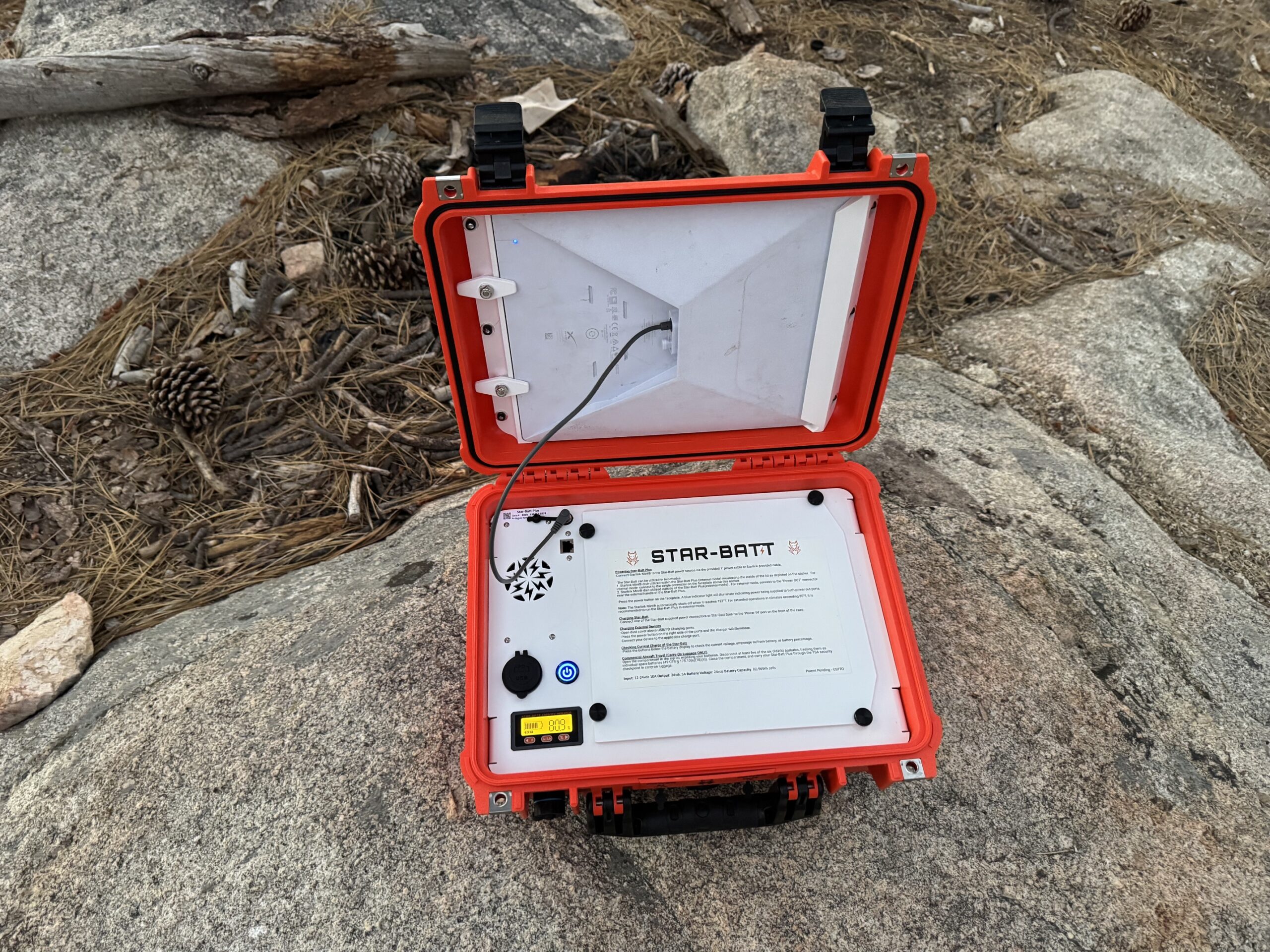
1. Open up two latches.
2. Press the power button.
3. Close it back up.
Deployment took me under a minute at camp. First, flip open the two latches. Next, press the power button. Finally, close the lid.
Nothing else happened. I ran no cable, no inverter, no voltage booster, and I hunted for no barrel connector. Instead the dish rides in its cradle with the power lead already attached, so the case leaves the truck ready to run. Notably, the cradle uses rotating locking tabs, and the Mini drops in or lifts out in seconds.
The Display, Ports and Ethernet Passthrough
A small panel on the deck shows state of charge beside live current draw. Watching amps climb during a call beats guessing from a four-bar icon. For example, every overnight number here came off the display, not a spec sheet.
An RJ45 Ethernet passthrough sits alongside the USB ports. Consequently you hardwire a router or an encrypted radio without opening the shell at all. Two charging outputs finish the deck: a 65W USB-C PD port and an 18W USB-A QC 3.0 port. Both covered phones and a tablet while the dish stayed online. With the lid closed I logged one Speedtest run at 88.71 Mbps down, 14.23 Mbps up and 62 ms idle latency on a Los Angeles server. Treat it as one reading, not a controlled test. Roof mounters should also read our guide to the best magnetic mount for overlanding trucks.
Charging Options and Flying With the Packs
Three inputs feed this Starlink Mini battery, and Star-Batt publishes times for each. Grid power fills it in about five hours at 120W, the 160W panel takes roughly six hours in strong sun, and a vehicle DC line needs about eight. I tested none of those three. Before the trip I charged from the wall and used nothing else.
Air travel separates this model from its sibling. Six 96Wh modules lift out individually, and each one sits under the FAA limit of 100 watt-hours per battery. Leave a single module seated, carry the other five as spares in your carry-on with the terminals protected against short circuit, and the airline compliant battery layout follows the published rule. Spares never go in checked baggage. I have not flown with mine yet, so treat this as the design intent plus owner reports rather than my own result. Meanwhile the sealed 576Wh Star-Batt Mini stays home, because a fixed pack this large fails the same test. Travelers should also see our notes on running the dish in motion.
Ready to Buy?
Six Flyable Modules in a Sealed Shell
Pull the packs for the airport, drop them back in at the trailhead. The dish never leaves its cradle.
Star-Batt Plus vs. a Portable Power Station
Cost per watt-hour tells the blunt version of the story, so here is this Starlink Mini battery beside the obvious alternative.
| Comparison | Star-Batt Plus | EcoFlow River 2 Max |
|---|---|---|
| Capacity | 576Wh | 512Wh |
| Weight | 22 lbs | 13.4 lbs |
| Price | $1,599 | $289 direct |
| Cost per watt-hour | $2.78 | $0.56 |
| Weather sealing | IP65 hard shell | None, indoor rated |
| Dish protection | Cradle plus Ethernet passthrough | Buy a case separately |
Stored energy is not the whole purchase. A power station hands you AC outlets and runs a fridge, a laptop or a light string. However, it arrives bare. You still buy a case, a mount and sometimes a voltage booster, and the dish still sits exposed to rain and dust. This Starlink Mini battery folds the shell, cradle, weather sealing, Ethernet passthrough and a flyable LiFePO4 battery pack into one object.
Pick the power station when you want general-purpose watts at camp and already own protection for the dish. Choose the Plus when the dish is the mission and a sealed grab-and-go box earns its keep. For historical context, see how off-grid power has changed over the past decade.
Pros
- Ran 27 hours 27 minutes continuously with 8.3 percent left, past the 24-hour claim
- Display shows state of charge plus real-time amp draw, so power planning uses numbers
- Cradle with rotating locking tabs seats the dish and releases it in seconds
- Six removable 96Wh modules each sit under the FAA 100 watt-hour carry-on limit
- RJ45 Ethernet passthrough hardwires a router with the shell sealed
- 65W USB-C PD and 18W USB-A QC 3.0 kept phones and a tablet charged
- Three recharge paths, rated at about 5 hours on AC, 6 on solar and 8 on vehicle DC
- Pelican 1450 shell rated IP65, with padlock holes and a pressure relief valve
Cons
- $1,599 sits at the top of the category, and a 3% card fee adds roughly $48
- 22 pounds across a 17 x 13 x 7 inch footprint claims real cargo space
Limits of this Starlink Mini battery test: one weekend, one charge cycle, no solar and no air travel. Durability across a season and real solar output stay open questions.
From experience: I own the 160W panel and left it packed on purpose, because a charging input would have hidden the one number I came for. Build quality is the part I did not see coming. Handling the latches, the deck and the connectors, this feels engineered rather than assembled, and the Pelican 1450 case does more than look tough.
Final Verdict: Who This Starlink Mini Battery Is For
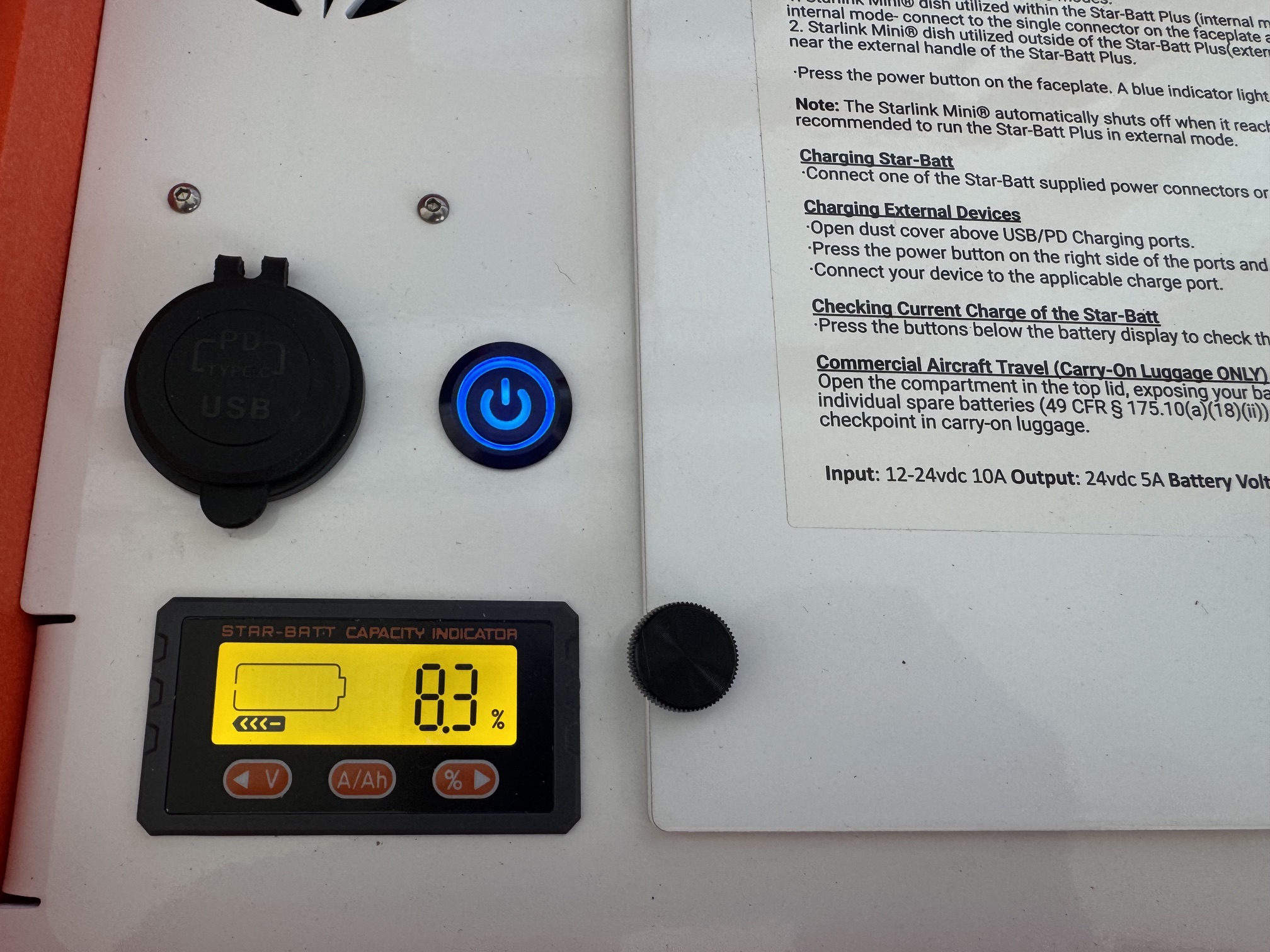
Buy the Plus when a full operational day of connectivity is the whole point of the purchase. My weekend produced 27 hours and 27 minutes on a single charge with 8.3 percent still showing, which settles the headline claim. Field crews and overlanders on multi-day trips get a box they set down and forget.
Weight and price are the honest brakes. Twenty-two pounds asks for a dedicated spot in the rig, while $1,599 asks for a real conversation with yourself. Weekend campers near town find better value in a small power bank and a padded sleeve.
Run the value math. Normalize the EcoFlow to 576 watt-hours and it lands near $325, which puts the premium around $1,275. What the money buys is the IP65 shell, the cradle, the weather sealing, the Ethernet passthrough and six modules you carry through an airport. Price those parts one at a time and the gap narrows, though it never closes. Whether the remainder is worth it depends on how often losing connectivity costs you more than the difference.
Save on Star-Batt Plus
Order Direct From the Maker
Free shipping, a 160W folding panel offered as an add-on, and no card fee when you pay by bank transfer.
Anyone chasing raw watt-hours per dollar should look at an EcoFlow River 2 Max or an Anker Solix C800 instead, then budget for a case and a mount. Everyone else gets a sealed, flyable, one-button source of off-grid internet. My longer verdict on durability follows after a season of trail miles.
Frequently Asked Questions
How long does the Starlink Mini battery last on a full charge?
Mine ran 27 hours and 27 minutes on one charge and still showed 8.3 percent. Star-Batt publishes a figure of over 24 hours. Heavy streaming pulls the number down. However, intermittent use stretches it across several days.
What size Starlink Mini battery do you need for 24 hours off grid?
For a full day of light use, plan on roughly 500 to 600 watt-hours. My weekend averaged about 19 watts, so 576Wh covered 27 hours of off-grid internet. Streaming video or hosting several users pushes average draw higher and shortens the window.
How many watts does a Starlink Mini draw?
Starlink publishes 20 to 40 watts on average with 15 watts at idle. Measured draw across my weekend landed near 19 watts, which reflects light browsing, messaging and weather checks rather than continuous streaming.
Is the Star-Batt Plus designed to fly with you?
Yes, though I have not flown with mine yet. Star-Batt built the airline compliant battery layout around six removable 96Wh modules, and each one falls under the FAA limit of 100 watt-hours per battery. Spares travel in carry-on baggage only, with terminals protected against short circuit, and owner reports describe clearing screening this way. Confirm the details with your carrier before you book.
Does the Starlink Mini overheat inside a closed case?
Mine ran enclosed for over 27 hours in late summer with no thermal shutdown. Above roughly 80 degrees, Star-Batt still recommends mounting the dish outside the shell and powering it through the external DC output port. A cooling fan sits in the deck for the same reason.