


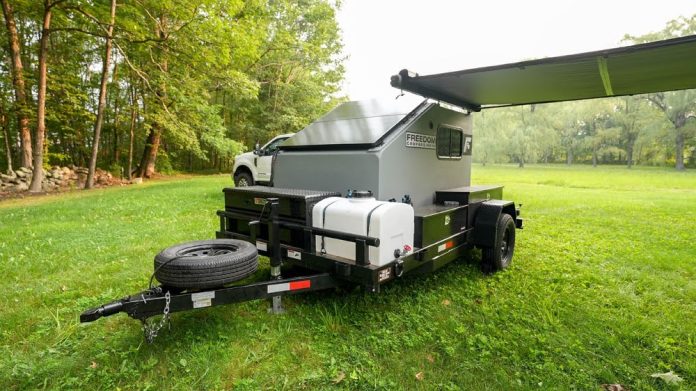

I’ve been camping and overlanding most of my life. Over the decades I’ve slept through every season in nearly every shelter type. Ground tents staked into frozen soil. Rooftop tents in Arizona wind. Truck bed campers loaded for shoulder season camping, and trailers pulled into country where no one comes looking for you.
Every one of those setups taught me something different about what a shelter needs to handle when conditions turn real. The lesson I keep relearning is that the gap between a three-season shelter and a genuinely four-season one is not about marketing copy. It shows up at 2 AM when the temperature drops 30 degrees in four hours and you find out whether your setup was ready for it.
Four-season camping is a different discipline than fair-weather camping, and the shelter is where that difference starts. Wind load, condensation, insulation value, and floor temperature are the variables that separate a shelter that works from one that makes a miserable night. Getting any of them wrong costs you sleep at best and puts you at risk at worst.
This guide covers what a four-season camping shelter needs to handle, how shelter types compare across those variables, and where the Freedom Camper lands as a four-season option. Real temperatures, real specs, real trade-offs.
Quick Facts:
- Topic: Four-season camping shelter requirements and options
- Skill level: All levels – anyone extending their camping season
- Key factors: Insulation, condensation control, wind resistance, floor temperature
- Featured shelter: Freedom Camper truck bed camper – $3,499.99 (sale from $3,599.99)
- Freedom Camper insulation: Four-season rated, all-weather conditions
- Shelter weight: 175 to 270 lbs depending on model
- Warranty: 3-year limited warranty
- Best for: Truck owners who want a weather-tight, insulated four-season camping shelter without building a full camper
9 min read
In This Guide
- Four-Season Camping Overview: What Changes When the Weather Does
- The Four Things Every Four-Season Shelter Must Handle
- Four-Season Shelter Types: How They Compare
- The Freedom Camper as a Four-Season Camping Shelter
- Your Sleep System: What Works with Your Shelter
- Freedom Camper vs. Rooftop Tent: Which Handles Cold Better?
- Pros and Cons of Truck Bed Campers for Four-Season Use
- Final Verdict
- Frequently Asked Questions
Four-Season Camping Overview: What Changes When the Weather Does

Four-season camping describes camping in conditions a three-season shelter wasn’t designed to handle: sustained cold below freezing, heavy snow load, high winds, and rapid temperature swings. It does not mean camping in those conditions every night. It means your shelter is rated and equipped to handle them if they arrive. The difference matters because weather in the backcountry, especially in the West, does not follow the calendar. September nights in Wyoming’s Wind Rivers drop into the teens. October elk camp in Colorado runs into snow regularly. A shelter rated only to 32 degrees F leaves you managing those nights with extra sleeping bags and crossed fingers instead of a system.
The rise of lightweight overlanding has pushed more truck campers into shoulder seasons and winter conditions without always upgrading their shelters accordingly. A rooftop tent that worked great in July becomes a cold, condensation-heavy box in November. A ground tent that served three seasons well starts leaking heat at the seams the moment the temperature drops below 20 degrees F. Understanding what makes a shelter genuinely four-season is the prerequisite to spending money in the right place.
Four-season camping shelter requirements break down into four categories: insulation R-value and thermal mass, condensation and moisture management, structural integrity under wind and snow load, and floor temperature control. Each one matters independently. A shelter with excellent insulation but no condensation management produces a wet sleeping bag by 4 AM. A shelter with great moisture management and no floor insulation drains warmth through the ground all night. The sections below cover each variable with specific numbers and real-world implications for truck campers.
The Four Things Every Four-Season Shelter Must Handle
Insulation: The Temperature Floor That Matters
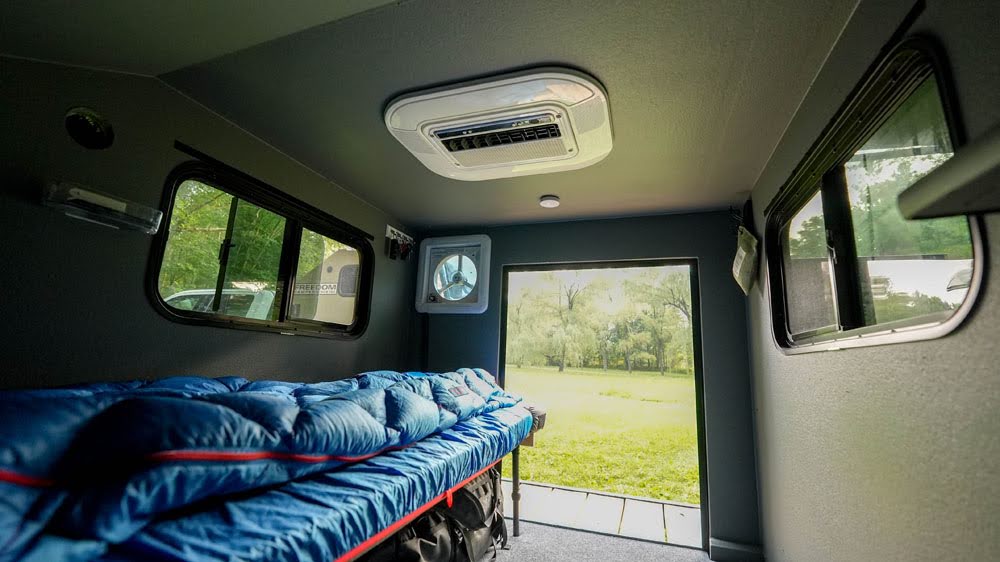
Insulation determines the lowest ambient temperature at which the shelter maintains a livable interior. A three-season tent provides essentially zero thermal insulation – it blocks wind and precipitation but does not retain heat. A four-season shelter adds either structural insulation (foam, proprietary panels, or air gaps) or relies on interior air mass to retain the heat generated by occupants. Purpose-built insulated hard-shells like the Freedom Camper use proprietary wall and ceiling insulation. Interior warmth is maintained independent of occupant body heat – which matters for solo campers and shelters left unoccupied during the day.
The practical metric is comfort temperature rating, not R-value alone. The Freedom Camper is rated for all-weather, four-season use. In practice, its insulation keeps occupants comfortable in the conditions most truck campers and hunters encounter across shoulder seasons and winter. For sustained below-zero conditions, a supplemental heat source (diesel heater, 12-volt electric, or propane) adds meaningful comfort margin. However, the baseline insulation handles conditions down to temperatures most campers in the continental US encounter without supplemental heat.
Condensation: The Variable Most Campers Underestimate
Condensation forms when warm, moist air from occupant breathing contacts a cold surface. In a non-insulated shelter like a tent or basic canopy shell, the interior wall temperature matches the exterior ambient temperature. Every breath creates condensation on the walls and ceiling, which drips onto sleeping gear and accumulates through the night. By morning in a 15-degree-F night, a two-person tent interior collects significant moisture – enough to wet a sleeping bag and reduce its loft and insulation value by morning.
An insulated hard-shell changes this dynamic. Because the interior wall stays warmer than ambient, the temperature differential between exhaled breath and wall surface is smaller. Less condensation forms. The Freedom Camper’s construction addresses this through its insulated wall panels. A 15×30-inch side window and door window provide ventilation options that further reduce moisture buildup when temperatures allow. In a well-insulated shelter, strategic ventilation – cracking the door slightly or opening the window an inch – is often sufficient to manage overnight moisture without sacrificing heat.
Wind and Snow Load: Structural Integrity Under Pressure

Wind load is the variable that destroys shelters not rated for four-season conditions. A three-season tent with flexible poles deflects well in moderate wind but can collapse under sustained high-wind loads above 40 to 50 mph. Four-season tents use stiffer pole systems and lower profiles to resist wind. Hard-shell shelters, including truck bed campers, handle wind load through their rigid construction – there are no poles to flex or fail. A hard-shell bolted to a truck bed does not change shape in the wind.
Snow load is a related concern in true winter camping. A light four-season tent rated for snow accumulation needs periodic clearing to prevent pole stress. A hard-shell truck bed camper has no such requirement. Its roof handles snow accumulation without structural risk. This matters on overnight trips in snowfall – you sleep without waking to clear the tent, and you wake to a structurally intact shelter regardless of overnight accumulation.
Floor Temperature: The Heat Drain Most People Ignore
Ground temperature in winter camping is typically 10 to 30 degrees colder than ambient air temperature. Ground tents put you in direct contact with that cold through whatever pad and bag you carry. Rooftop tents elevate you above ground temperature, but expose the tent floor to ambient air on all sides – nearly as cold. Truck bed campers sit on an insulated floor panel above the bed, adding a meaningful thermal barrier between you and the cold below.
In practice, floor insulation is one of the clearest advantages of a hard-shell truck bed camper for four-season camping. Combined with a sleeping pad rated R-4 or higher, the insulated floor dramatically reduces heat drain from below. Cold defeating a sleeping bag from the ground is the most common failure mode in winter camping.
| Four-Season Variable | Ground Tent | Rooftop Tent | Hard-Shell Camper |
|---|---|---|---|
| Wall insulation | None | Minimal | Proprietary panels |
| Condensation risk | High | Moderate-high | Low-moderate |
| Wind resistance | Moderate (4-season tent) | Moderate | High (rigid shell) |
| Snow load | Must clear | Must clear | No clearing needed |
| Floor cold protection | Pad-dependent | Moderate | Insulated floor panel |
| Setup in weather | Slow, exposed | Moderate | Fast, enclosed |
Four-Season Shelter Types: How They Compare
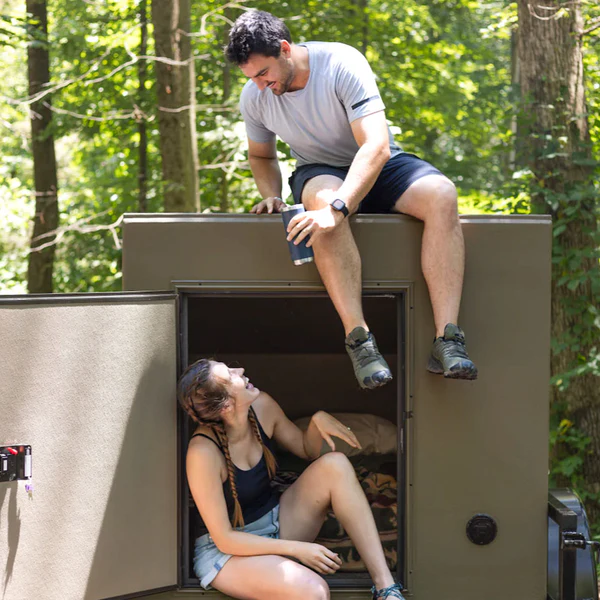
Four-season ground tents are the most affordable entry point, typically costing $300 to $700 for a quality two-person model. They handle wind through stiffer pole systems, but provide no wall insulation and generate condensation throughout the night. They require setup in exposed conditions, which matters at 10 degrees F with wind. In experienced hands with the right sleeping system underneath, they work. For truck campers specifically, they’re a fallback rather than a primary four-season solution.
Rooftop tents range from $900 to $3,500. Hardshell models add a thin insulated mattress platform and slightly better wind resistance than softshells. Neither provides wall insulation comparable to a purpose-built hard-shell camper. In cold conditions, rooftop tent interiors track closely to exterior temperature once the occupant’s body heat dissipates. The elevated position helps with ground cold but adds exposure to wind on all sides. Many rooftop tent users add supplemental insulation layers inside; this works but adds cost and complexity.
Purpose-built insulated hard-shell truck bed campers represent the strongest four-season performance for truck-based camping at a mid-range price point. They provide wall insulation, floor thermal protection, rigid wind resistance, and snow load capacity without the complexity of a full slide-in camper. Traditional slide-in truck campers with kitchens and bathrooms start at $15,000 and run to $50,000 or more – well above the Freedom Camper’s $3,499.99 price point. For our full truck camper vs. teardrop trailer comparison, which covers price, weight, and flexibility trade-offs in detail, see the linked guide.
The Freedom Camper as a Four-Season Camping Shelter

The Freedom Camper addresses all four of the critical four-season variables: insulation, condensation management, wind/snow resistance, and floor temperature. Its proprietary insulation maintains a comfortable interior in all-weather conditions. The rigid hard-shell construction handles wind and snow load without requiring clearing or reinforcement. The insulated floor panel reduces heat drain from below. Ventilation options – a 15×30-inch side window and door window – allow moisture management without surrendering heat.
Four sizes serve different truck platforms. The 48×79 (175 lbs) fits midsize trucks including the Tacoma, Ranger, Maverick, Colorado, Canyon, Frontier, Ridgeline, and Gladiator. Full-size platforms including the F-150, F-250, F-350, Silverado, Sierra, Tundra, and Ram 1500 through 3500 take the 58×79 (185 lbs) and 58×89 (195 lbs). For flatbeds and trailers, the 72×89 at 270 lbs is the right model. Interior height is 48 inches across all models – comfortable for sitting, not standing. Interior length runs 74.5 inches on the 48×79 and 84.5 inches on the 58×89, enough for most adults to sleep flat.
For hunters and overlanders running fall and winter trips, the practical advantage is straightforward. You drive to your site, the shelter is already configured, and setup takes minutes rather than 20 to 30 minutes in cold conditions with gloves on. You also leave the camper at basecamp and drive the trail unburdened, then return to an already-heated interior if you’ve run a supplemental heat source during the day. For the detailed hands-on breakdown, see our Freedom Camper review, which covers real-world performance, sizing, and mounting in detail.
Best Four-Season Shelter for Truck Campers
Freedom Camper: Insulated, Rigid, and Ready for Any Season
Four sizes from 175 to 270 lbs. Built in Missouri. 3-year limited warranty. On sale at $3,499.99 – fits midsize and full-size trucks plus trailers.
Your Sleep System: What Works with Your Shelter

A four-season shelter is the envelope. The sleep system is what determines whether you’re comfortable inside it. Even a well-insulated shelter requires a sleep system matched to your expected low temperature. The standard guidance: choose a sleeping bag rated 10 to 15 degrees F below your expected overnight low. In Wyoming shoulder seasons (September to November), overnight lows regularly reach 15 to 25 degrees F. A bag rated to 0 to 10 degrees F covers that range with margin. Down fills offer better warmth-to-weight ratio at $200 to $500 – REI’s sleeping bag guide covers fill selection in depth. Synthetic fills perform better when wet and cost $100 to $300.
Sleeping pad R-value compounds with shelter floor insulation. In a hard-shell camper with an insulated floor, a pad rated R-3 to R-4 provides sufficient protection for most cold-weather conditions. Foam pads (R-2 to R-4) run $30 to $60. Insulated inflatable pads (R-4 to R-6) run $80 to $250. Together, pad and shelter floor insulation create a thermal barrier from below. A sleeping bag liner adds 10 to 15 degrees F of warmth for $30 to $50 and extends your bag’s effective range across seasons without buying a new bag.
I’ve run the Wind Rivers in October with a 15-degree bag and a foam pad, and the pad is where I’ve been coldest. Supplemental heat in the Freedom Camper extends its comfort range further. The roof’s composite wood panels support solar panel mounts. Pair them with a 12-volt battery to power the optional Freedom Campers ventilation fan or a 12-volt diesel heater. A diesel heater sized for a small space (the Vevor or Webasto units popular in van builds) runs $150 to $600 and handles sustained cold reliably. Combined with the camper’s base insulation, it creates a genuinely comfortable four-season camping setup for extended cold-weather trips.
Build Your Four-Season System
Start with a Shelter That Actually Handles the Cold
The Freedom Camper ships in the lower 48. Two people load it without equipment. Roof panels support solar and accessories. On sale now.
Freedom Camper vs. Rooftop Tent: Which Handles Cold Better?
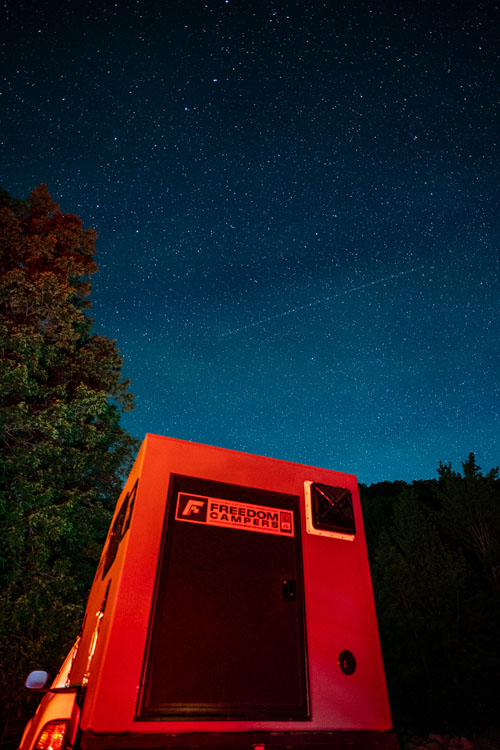
For four-season camping specifically, the Freedom Camper outperforms a rooftop tent across three of the four critical variables. Wall insulation: the Freedom Camper wins clearly – rooftop tents provide little to no wall insulation, and interiors track exterior ambient temperature closely once body heat dissipates. Floor temperature: the Freedom Camper wins – its insulated floor panel sits above the truck bed, while a rooftop tent floor is exposed to ambient cold on all sides. Wind resistance: the Freedom Camper wins – rigid hard-shell construction versus fabric panels stretched over a frame. Condensation: roughly similar at the shelter level, though the Freedom Camper’s warmer interior surface reduces the temperature differential that drives condensation formation.
Rooftop tents do hold real advantages in other areas. They leave the truck bed free for gear. Setup from a packed position takes under two minutes on most hardshell models. At $900 to $1,500 for a quality softshell, they cost less than the Freedom Camper. For three-season camping, they’re an excellent choice. However, for consistent shoulder-season and winter use, the thermal performance gap becomes significant. Users regularly add supplemental insulation to rooftop tents: foam cut-outs on interior walls, insulated platform add-ons. That adds cost and complexity the Freedom Camper’s base construction already accounts for.
The decision point is straightforward. Camp primarily spring through fall and want a fast shelter that leaves your bed open? A quality rooftop tent is the right call. If you extend into true shoulder seasons and winter, or if you hunt in October and November at elevation in the West, the Freedom Camper’s thermal performance justifies its price. At $3,499.99, it sits in the same range as quality hardshell rooftop tents while providing meaningfully better cold-weather performance.
Pros and Cons of Truck Bed Campers for Four-Season Use
Pros
- Proprietary wall and ceiling insulation outperforms tents and rooftop tents in cold conditions
- Insulated floor panel reduces heat drain from below – critical in below-freezing conditions
- Rigid shell handles snow load without clearing and wind without flex or failure
- Fast setup in cold weather – no poles, no staking, no exposed hands at 10 degrees F
- Leave at basecamp while driving the trail; return to a protected, pre-warmed shelter
- Ventilation options (side window, door window) manage moisture without sacrificing heat
- Freedom Camper starts at $3,499.99 – less than many quality hardshell RTTs
- 3-year limited warranty; built in Lamar, Missouri
Cons
- Occupies the truck bed – requires platform build ($100 to $300 DIY) for most models
- 48-inch interior height means sitting, not standing – limited movement inside
- No onboard kitchen or bathroom; camp stove and external cooking required
- Custom freight quote needed for Wyoming and several other Western states
- At very low temperatures (sustained below zero), supplemental heat is recommended
Final Verdict
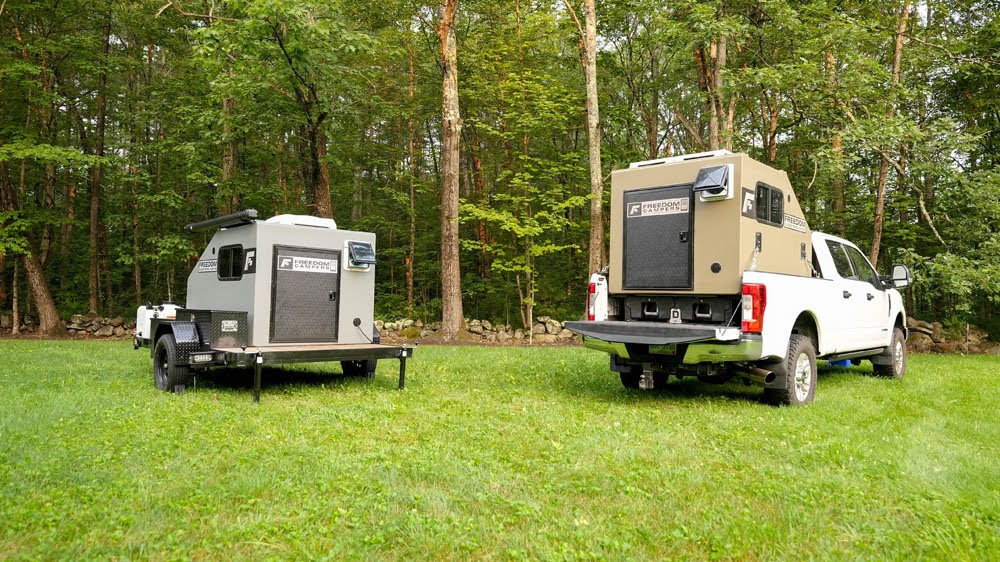
Four-season camping is not about the coldest temperature you’ll ever face. It’s about having a shelter that handles what shoulder seasons and hunting trips in the West regularly deliver. October snow, November wind, September overnight drops to 15 degrees F. Most three-season shelters are not built for those conditions. Most four-season tents handle them adequately but require significant sleep system investment to compensate for absent wall and floor insulation. The Freedom Camper addresses the shelter side with proprietary insulation, a rigid shell, an insulated floor, and four-season rating. Price is $3,499.99 and weight is 175 to 195 lbs depending on the model.
The trade-offs are real and consistent across every review and use case: no kitchen, no bathroom, 48-inch sitting height. For truck campers and hunters who already run a camp stove setup and prioritize access and weather protection over amenities, those trade-offs are the right ones to make. The alternatives at this price – rooftop tents and three-season shelters – don’t close the thermal performance gap. Full slide-in truck campers close it but cost four to ten times as much.
For four-season camping from a pickup truck, the Freedom Camper is the best-value shelter in the category. Order the 48×79 for midsize trucks including the Tacoma, Gladiator, Ranger, and Colorado. Order the 58×89 for full-size platforms including the F-150, Silverado, Tundra, and Ram 1500 through 3500. Register after purchase to activate the 3-year limited warranty.
Ready to Camp All Four Seasons?
Check Today’s Price on the Freedom Camper
Ships direct in the lower 48. Built in the USA. 3-year limited warranty. Register after purchase to activate coverage.
Frequently Asked Questions
What makes a shelter four-season?
A four-season shelter handles four critical variables: wall insulation, condensation management, structural integrity under wind and snow load, and floor temperature protection. Each must be addressed by the shelter’s construction, not only by the sleep system beneath it. A three-season tent addresses none of these adequately. Purpose-built insulated hard-shells like the Freedom Camper address all four.
Can you camp in winter in a truck bed camper?
Yes, with the right camper and sleep system. The Freedom Camper is four-season rated and handles all-weather conditions through its proprietary insulation and rigid hard-shell construction. For sustained temperatures below zero, a supplemental 12-volt diesel heater adds meaningful comfort margin. Combined with a bag rated to 0 to 10 degrees F and an R-4 pad, the Freedom Camper supports comfortable winter camping for most conditions in the continental US.
What temperature rating do I need for four-season camping?
Your sleeping bag should be rated 10 to 15 degrees F below your expected overnight low. For fall and winter camping in the American West, a bag rated to 0 to 10 degrees F covers most conditions with margin. Your shelter adds to that margin: an insulated hard-shell like the Freedom Camper maintains a warmer interior than ambient, which effectively extends your sleeping bag’s rated range in practice. A sleeping bag liner adds another 10 to 15 degrees F for $30 to $50 without replacing the bag.
How do I manage condensation in a four-season camping shelter?
Condensation forms when warm exhaled air contacts cold interior surfaces. In an insulated shelter, interior surfaces stay warmer than ambient, which reduces condensation formation. Ventilation manages what remains: crack the door slightly or open the side window an inch or two to allow moisture-laden air to escape without a significant heat loss. In a tent, the same principle applies but with more condensation to manage because tent walls track exterior temperature closely. A hard-shell camper with insulated walls manages condensation significantly better than any tent in cold conditions.
Is the Freedom Camper good for winter camping?
Yes, for the conditions most hunters and truck campers encounter. Its proprietary insulation is four-season rated, its rigid shell handles snow and wind without structural concern, and its insulated floor panel reduces heat drain from below. The 48-inch interior height limits movement to sitting. Without a supplemental heat source, it handles conditions well above zero comfortably. With a 12-volt diesel heater, it handles sustained below-zero conditions. For a full hands-on assessment, see the Freedom Camper review.
Friendly disclaimer: Our articles may contain affiliate links that support us without costing you more, and sometimes we spice things up with sponsored content—but only for products we truly stand behind!