



Quick Facts:
- The test: Quarter-mile and roll races at roughly 5,280 feet, near 96 degrees F
- Vehicles: Land Rover Defender OCTA, Jeep Wrangler Willys 392, Ford Bronco Raptor, Toyota Land Cruiser
- Surprise entry: 2027 Ram 1500 TRX, 777 horsepower
- Bronco Raptor 0-60: About 7.0 seconds at altitude, 5.6 seconds at low elevation per Car and Driver
- Quickest of the four: Defender OCTA, 13.00-second quarter mile
- Slowest of the four: Land Cruiser, 17.12-second quarter mile
- Price spread: $57,200 to $158,800 before destination
- Source video: The Fast Lane Car, published August 15, 2026
- Best for: Buyers cross-shopping flagship off-road SUVs on straight-line pace
11 min read
In This Article
- How the Bronco Raptor 0-60 Held Up at 5,280 Feet
- Key Specs at a Glance
- How the Four Compare on Paper
- Watch the Full Four-Way Race
- Every Measured Run: 0-60 and Quarter-Mile Results
- Why Thin Air Rewrote the Bronco Raptor 0-60 Time
- The Surprise Fifth Contender: TRX 0-60
- Bolt-Ons for Horsepower and Throttle Response
- What the Bronco Raptor 0-60 Numbers Mean
- Frequently Asked Questions
How the Bronco Raptor 0-60 Held Up at 5,280 Feet
Published Bronco Raptor 0-60 figures come from instrumented tests at low elevation. Plenty of owners live nowhere near it. On August 15, 2026, The Fast Lane Car lined up four flagship off-road SUVs at a Colorado airfield roughly a mile above sea level. The thermometer read near 96 degrees F. Then the Ford ran about 7.0 seconds to 60 mph, against the 5.6 seconds Car and Driver has measured at low elevation.
The field covered a wide span of engineering. Land Rover brought the Defender OCTA and its 626-horsepower twin-turbo V8. Jeep countered with the Wrangler Willys 392 and a naturally aspirated 6.4-liter HEMI. Ford fielded the Bronco Raptor on 37-inch tires, while Toyota showed up with the hybrid four-cylinder Land Cruiser. Prices ranged from $57,200 to $158,800 before destination.
Because every vehicle faced identical air, the session works as a controlled comparison rather than a marketing exercise. The results did not track horsepower in a straight line. Instead, the naturally aspirated Jeep gave up far more of its published pace than any turbocharged rival. For anyone shopping at elevation, no finding here matters more.
Then a fifth vehicle rolled in unannounced. A 777-horsepower Ram 1500 TRX fought the most expensive SUV present to a photo finish, for nearly $59,000 less.
Key Specs at a Glance
Powertrain outputs, transmissions, and base prices come from each manufacturer. Curb weights are independently scaled, since published figures for several of these trucks disagree with scale results by hundreds of pounds. Dimensions and tire sizes come from manufacturer materials where published, and otherwise from Edmunds, Car and Driver, or MotorTrend test data.
| Specification | Defender OCTA | Wrangler Willys 392 | Bronco Raptor | Land Cruiser |
|---|---|---|---|---|
| Engine | 4.4L twin-turbo V8, mild hybrid | 6.4L V8 | 3.0L twin-turbo V6 | 2.4L turbo four, hybrid |
| Horsepower | 626 | 470 | 418 | 326 |
| Torque | 553 lb-ft | 470 lb-ft | 440 lb-ft | 465 lb-ft |
| Transmission | 8-speed automatic | 8-speed automatic | 10-speed automatic | 8-speed automatic |
| Curb weight, measured | 5,982 lb | 5,413 lb | 5,764 lb | 5,557 lb |
| Pounds per horsepower | 9.6 | 11.5 | 13.8 | 17.0 |
| Factory tire | 275/60R20 all-terrain | LT315/70R17, 35 in | LT37x12.50R17 | 265/70R18 |
| Ground clearance | 12.7 in | 11.1 in | 13.1 in | 8.3 in |
| Base MSRP, no destination | $158,800 | $69,995 | $79,995 | $57,200 |
Curb weights: MotorTrend scaled the OCTA and Land Cruiser, Car and Driver the Bronco Raptor. The 5,413-pound Jeep figure is a Rubicon 392, the closest scaled equivalent. Jeep publishes 5,268 pounds for the Willys 392.
How the Four Compare on Paper
The pounds-per-horsepower column in the table above sets up the finishing order. What it hides is the size of each gap, which altitude then widened unevenly.
Defender OCTA 0-60: The Power-to-Weight Winner
Land Rover’s flagship carries a BMW-sourced 4.4-liter twin-turbo V8 rated at 626 horsepower and 553 lb-ft. Dynamic Launch Mode briefly stacks mild-hybrid assist on top for a quoted 590 lb-ft. Against 5,982 pounds on MotorTrend’s scales, the result is 9.6 pounds per horsepower. On the day, it also produced a 4.72-second run to 60 mph, the quickest of the four. Because Land Rover fits 12.7 inches of ground clearance alongside it, the pace costs nothing in off-road hardware. Only the window sticker does, at $158,800 before destination.
Wrangler 392 0-60: Displacement Without Boost
Jeep no longer sells a Rubicon 392. For 2026 the 6.4L 392 HEMI V8 arrives in the Willys 392 at $69,995 and the Moab 392 at $79,995. Both are limited-run models rated at 470 horsepower and 470 lb-ft. Second-best power-to-weight follows at 11.5 pounds per horsepower. Car and Driver recorded a Wrangler 392 0-60 run of 4.0 seconds at low elevation. Because the engine breathes on its own, though, the Jeep had the most to lose once the air thinned.
Bronco Raptor Horsepower: Geared for Dirt, Not Asphalt
Bronco Raptor horsepower comes from a 3.0-liter twin-turbo V6 making 418 horsepower and 440 lb-ft on premium fuel. A 10-speed automatic and 4.70:1 axle gears sit behind it. Ford also chose 37-inch tires and 13.1 inches of clearance for desert running, then accepted the drag-strip cost. Specifically, the Raptor carries the heaviest rotating mass here and 13.8 pounds per horsepower. None of it is an accident. Full Bronco Raptor specs and pricing put the entry point at $79,995.
Land Cruiser: Torque Without Revs
Toyota’s i-FORCE MAX pairs a 2.4-liter turbo four with an electric motor for 326 horsepower and 465 lb-ft. Peak torque lands at 1,700 rpm. While low-rpm pull suits trail work, 5,557 pounds turns 326 horsepower into 17.0 pounds per horsepower, roughly 1.8 times the OCTA’s ratio. Toyota aimed the 250-series at a buyer counting tow ratings and service intervals rather than trap speeds.
Watch the Full Four-Way Race
Credit for this test belongs entirely to The Fast Lane Car, part of TFL Studios in Colorado. The hosts ran the session after roughly a thousand viewers asked for it following an earlier off-road comparison. Across 24 minutes, the video covers each standing-start pairing, three roll races, and the unannounced arrival at the 15-minute mark.
Video: “Too Close To Call…Wrangler 392 vs Defender Octa vs Bronco Raptor vs Land Cruiser Drag Race!” by The Fast Lane Car, published August 15, 2026.
Every Measured Run: 0-60 and Quarter-Mile Results
Here is every measured run from the session, alongside an independently tested figure at low elevation for each vehicle. Low-elevation quarter miles come from MotorTrend for the OCTA and Land Cruiser, and from Car and Driver for the Wrangler 392 and Bronco Raptor.
| Vehicle | 0-60 mph at altitude | Quarter mile at altitude | Quarter mile at low elevation |
|---|---|---|---|
| Defender OCTA | 4.72 sec | 13.00 sec | 12.6 sec (MotorTrend) |
| Wrangler 392 | 6.28 sec | 14.60 sec | 12.8 sec (Car and Driver) |
| Bronco Raptor | 7.0 sec | 15.24 sec | 14.4 sec (Car and Driver) |
| Land Cruiser | 9.7 sec | 17.12 sec | 16.4 sec (MotorTrend) |
The Ford and Toyota 0-60 figures were called out on camera as round numbers rather than measured to two decimals.
Three roll races from 30 mph followed, and the Land Cruiser sat all of them out. In the Ford-versus-Jeep pass, the Bronco Raptor led early on boost. Then the 6.4-liter took the lead back above roughly 75 mph. For the Ford-versus-Toyota pairing in isolation, see our earlier report on the Land Cruiser vs Bronco Raptor quarter mile.
Why Thin Air Rewrote the Bronco Raptor 0-60 Time
Air at 5,280 feet is roughly 15 percent thinner than at sea level under standard conditions. Push the temperature to 96 degrees F, and the deficit reaches about 23 percent. Engines make power by burning fuel with oxygen, so fewer air molecules per intake stroke mean less power. The oxygen fraction itself never changes with altitude, a detail plenty of forum posts get backwards.
Turbochargers blunt the loss. Because a turbo spins faster to reach its target boost pressure, a forced-induction engine recovers much of the missing density before the air reaches the cylinder. Compressor limits and heat prevent full compensation, yet naturally aspirated engines have no recourse at all. Compare the quarter-mile penalties from this session, and the pattern is unmistakable.
| Vehicle | Induction | Quarter-mile penalty at altitude |
|---|---|---|
| Defender OCTA | Twin-turbo V8 | +0.40 sec |
| Land Cruiser | Turbo four, hybrid | +0.72 sec |
| Bronco Raptor | Twin-turbo V6 | +0.84 sec |
| Wrangler 392 | Naturally aspirated V8 | +1.80 sec |
Every turbocharged entry stayed under a second. Meanwhile the Jeep surrendered more than four times the OCTA’s penalty. Bronco Raptor buyers land mid-pattern at +0.84 seconds. An owner in Denver therefore reads a stopwatch well off the published figure and assumes something is broken. Nothing is.
Two caveats belong with the table. First, the low-elevation 392 figure comes from a Rubicon 392 rather than the Willys trim raced here. Second, the four low-elevation runs span two publications and different drivers. Both caveats still leave a spread far too large to dismiss.
The Surprise Fifth Contender: TRX 0-60
Fifteen minutes in, a 2027 Ram 1500 TRX arrived to face the OCTA. Ram revived the supercharged truck after skipping the 2025 and 2026 model years entirely. The new version makes 777 horsepower and 680 lb-ft from a supercharged 6.2-liter HEMI V8. Ram asks $99,995 before a $2,795 destination charge. Our breakdown of the 777-hp Ram 1500 TRX covers launch timing.
Across two head-to-head passes the OCTA ran 13.38 seconds and then 13.31, while the Ram posted 13.47 both times. Its best of the day, a 13.31, came earlier in a separate session before heat soak set in. The finish was close enough to need a replay. TFL logged no TRX 0-60 figure, only quarter-mile passes. Ram’s published TRX 0-60 claim is 3.5 seconds, alongside a 12.2-second quarter.
Note where the Ram lands in the altitude pattern. Losing between 1.1 and 1.3 seconds puts it behind every turbocharged entry, though still ahead of the naturally aspirated Jeep. A supercharger is geared directly to crank speed, so it delivers pressure instantly. However, it never spins up to claw back missing air density the way a turbo does. Physics placed it exactly where it finished.
The OCTA took both head-to-head passes, finishing 0.09 and 0.16 seconds ahead. Against 626 horsepower and $158,800, a 777-horsepower pickup at $99,995 running this close is the session’s sharpest value lesson. The OCTA answers with ground clearance, interior materials, and a chassis built for sustained high-speed dirt work. Straight-line pace alone, though, no longer justifies the gap.
Bolt-Ons for Horsepower and Throttle Response
Two moments in the race point straight at the aftermarket. The Ford’s driver wished aloud for a performance calibration, while the Land Rover’s driver hit a speed limiter tied to his off-road tires. Both problems have parts-counter answers, although the honest gains vary enormously by category.
| Best for Bronco Raptor | Best for Wrangler 392 | Tire Discussed in This Article | |
|---|---|---|---|
| Product | TOP PICK Pedal Commander Throttle Controller (Bronco/Bronco Raptor) Pedal Commander Throttle Controller (Bronco/Bronco Raptor) | 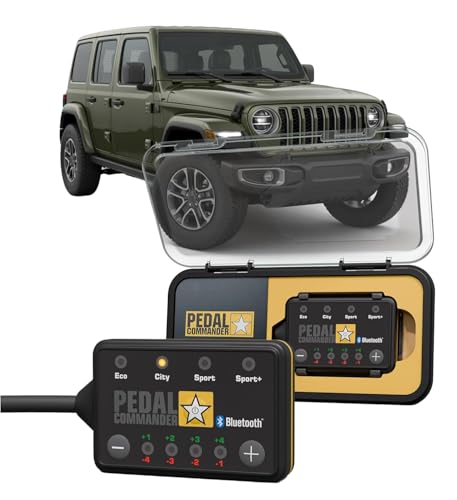 Pedal Commander Throttle Controller (Wrangler JL) Pedal Commander Throttle Controller (Wrangler JL) |  BFGoodrich KO2 37x12.50R17 LR-C BFGoodrich KO2 37x12.50R17 LR-C |
| Category | Throttle Controller | Throttle Controller | All-Terrain Tire |
| Best For | Sharper Bronco Raptor pedal feel | Sharper Wrangler 392 pedal feel | 37-inch KO2 buyers weighing Load Range C |
| Price | $299.99 as of Oct 1, 9:05 pm | $299.99 as of Oct 1, 9:05 pm | |
| Check Price → | Check Price → | Check Price → |
Throttle Controllers Sharpen Response, Not Output
Pedal Commander and Sprint Booster rescale the accelerator pedal’s voltage signal before the ECU reads it. Fuel, spark, and boost remain untouched. Pedal Commander’s own FAQ puts it directly: throttle response controllers “add so much performance to a vehicle but do it without adding horsepower. So the short answer is no.” Budget $299.99 and a two-year warranty. For a heavy SUV with a lazy factory pedal map, the improvement in drivability is real, yet nobody should expect a quicker trap speed.
What a Tuner Adds to Bronco Raptor Horsepower
Ford Performance sells a calibration for the Bronco Raptor under part number M-9603-BR30 at $850. It raises output to 455 horsepower at 5,500 rpm and 536 lb-ft at 3,000 rpm, a gain of 37 horsepower and 96 lb-ft. Dealer installation preserves a three-year, 36,000-mile warranty. Read the emissions fine print first: CARB executive orders D-431-12 and D-431-17 cover 2022 through 2025 vehicles, while the 2026 calibration is sold for non-California vehicles only.
Naturally aspirated engines respond far less. For example, DiabloSport advertises roughly 14 additional rear-wheel horsepower on the 6.4-liter Wrangler 392. Compared to the Ford’s 37, boost pressure clearly does the heavy lifting. Federal enforcement is active here too. Across fiscal years 2020 through 2023, the EPA finalized 172 civil cases carrying $55.5 million in penalties over defeat devices. One major tuner’s parent company settled a case covering roughly 363,000 devices. Buy emissions-legal calibrations only.
Bigger Tires Cost Real Acceleration
The video’s KO2-versus-KO3 argument does not survive the spec sheets. In matching 37×12.50R17 Load Range C, published weights put the KO3 at 66.0 pounds against the KO2’s 63.0. Meanwhile the speed rating drops from S at 112 mph to R at 106 mph. Both carry a 50,000-mile warranty and the 3PMSF severe-snow rating. Notably, BFGoodrich publishes neither per-size weights nor any acceleration claim, so those figures come from third-party sizing data.
Rotating mass matters more than most buyers expect. For instance, a controlled Jalopnik test measured a 0.31-second loss from 32 extra pounds per corner over a 31 to 87 mph pull. Ballast isolated rotational inertia from total weight. Separately, a dyno pull on a Subaru Crosstrek showed 141 wheel horsepower falling to 127 after a swap to larger all-terrains. A compact crossover is no Bronco Raptor, so treat the 14 wheel horsepower as direction rather than a number to apply here. Even as direction, it points at a real fraction of the 37 horsepower the $850 Ford calibration buys. Our best off-road tires compared guide covers the tradeoff by tread pattern.
Speed ratings bite at the top end as well. Land Rover publishes a 130 mph maximum for the OCTA on 22-inch wheels and 119 mph on 20-inch. The 155 mph figure comes from the truck’s launch materials, on lightweight alloys and all-season tires. On camera, however, the driver reported a wall at 112 mph. Notably, 112 mph is the S speed rating of the off-road rubber rather than any figure Land Rover lists.
Intakes: Big Airflow Claims, No Horsepower Claims
S&B’s Bronco Raptor intake runs $379 and claims 41.91 percent more airflow with 99.10 percent filtration efficiency. However, S&B publishes no horsepower figure at all, and marks the part unavailable for shipment to California. For comparison, an independent dyno session on a 411-horsepower naturally aspirated V8 credited its intake with about 9.9 horsepower, or 2.4 percent. Even so, the session recorded it only on top of a supporting tune. Turbocharged engines stand to gain more, since reduced restriction lowers compressor work. No vendor here publishes a number to prove it.
Bolt-Ons Mentioned in This Article
PEDAL COMMANDER for Ford Bronco 2021-2026 Throttle Controller
PEDAL COMMANDER for Jeep Wrangler JL 2018-2026 Throttle Response Co…

K&N High-Flow Original Lifetime Engine Air Filter: Increase Power: …
What the Bronco Raptor 0-60 Numbers Mean
No bolt-on reorders this field, which puts the decision back on the vehicles themselves. For a buyer chasing acceleration above everything, the Defender OCTA delivered it. A Defender OCTA 0-60 of 4.72 seconds and a flat 13.00-second quarter at a mile of elevation are extraordinary for a 5,982-pound SUV on all-terrain tires. Land Rover charges accordingly, and the OCTA still carries 12.7 inches of ground clearance.
The Bronco Raptor 0-60 result tells a different story, and reading it as a loss misses the point. Ford geared this truck for 37-inch tires and high-speed desert work, then accepted the quarter-mile consequence. Anyone cross-shopping on trap speed should look elsewhere; anyone planning to run washboard at 60 mph should not. The $850 Ford Performance calibration closes part of the gap for buyers outside California.
Value sits at both ends of the price ladder, with the Wrangler Willys 392 and the Ram TRX. The Jeep undercuts the OCTA by nearly $89,000 and still ran a 14.60. Meanwhile the TRX finished 0.09 and 0.16 seconds behind the Land Rover across two passes, for nearly $59,000 less. Neither one escapes the altitude tax, though, and the naturally aspirated Jeep pays the most of anyone here at 1.80 seconds.
The Land Cruiser finished last and stays the sensible pick for a different buyer entirely. Toyota engineered the 250-series around durability, 6,000-pound towing, and 23 mpg combined rather than sprint times. Those are the things a decade of ownership puts to the test. A drag strip measures none of them.
Frequently Asked Questions
What is the Bronco Raptor 0-60 time?
Car and Driver measured 5.6 seconds at low elevation, while MotorTrend recorded 6.3 seconds. In this mile-high test the Bronco Raptor 0-60 came in at about 7.0 seconds at roughly 96 degrees F. Ford publishes no official figure of its own.
What’s faster, a Bronco Raptor or a TRX?
The Ram TRX is substantially quicker. Ram claims 3.5 seconds to 60 mph and a 12.2-second quarter mile for the 777-horsepower 2027 truck. At altitude the TRX ran 13.47 seconds, with a 13.31 best earlier the same day, against the Bronco Raptor’s 15.24 in the same conditions.
How much does a 2026 Bronco Raptor cost?
Ford lists the Bronco Raptor at $79,995 before a $1,995 destination charge, for $81,990 delivered. Options push the delivered price higher. By comparison, the Wrangler Willys 392 starts at $69,995 and the Defender OCTA at $158,800.
How much horsepower does a Bronco Raptor have?
The 3.0-liter twin-turbo EcoBoost V6 produces 418 horsepower and 440 lb-ft of torque on premium fuel. Ford Performance’s $850 calibration raises those figures to 455 horsepower and 536 lb-ft on eligible model years.
Do throttle controllers add horsepower?
No. Throttle response controllers only rescale the accelerator pedal signal, leaving fuel, spark, and boost unchanged. Pedal Commander states this directly in its own documentation. The devices sharpen pedal feel without altering engine output.
Why are 0-60 times slower at high altitude?
Thinner air holds fewer oxygen molecules per intake stroke, so engines produce less power. At 5,280 feet the deficit runs about 15 percent, rising to about 23 percent on a hot day. Turbocharged engines recover much of the loss; naturally aspirated engines do not.