


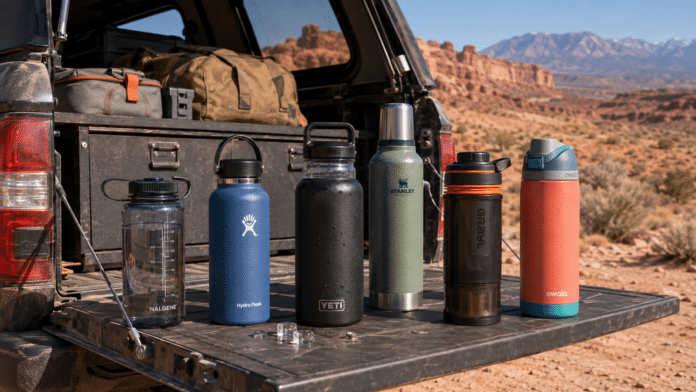

Quick Facts:
- Topic: Insulated bottles for overlanding, camping, and hiking
- Bottles compared: Yeti, Hydro Flask, Stanley, Nalgene, Grayl, Owala
- Best insulated water bottle overall: Yeti Rambler 36 oz
- Best for filtered refills: Grayl GeoPress 24 oz
- Best for kids: Owala FreeSip Insulated
- Price range: $17 to $100
- Best for: Off-road travelers who leave bottles in a hot rig
11 min read
In This Guide
- The Best Insulated Water Bottle for Overlanding, in Brief
- How We Judged Insulation in Vehicle Heat Cycles
- Best Insulated Water Bottle Specs Compared
- Best Insulated Water Bottle for Overland Day Trips
- Best for Hot Weather Camping
- Best for Coffee and Long Temperature Holds
- Best Kid-Friendly Bottle
- Best Filtered Bottle for Remote Refills
- Yeti vs. Hydro Flask vs. Stanley
- Pros and Cons at a Glance
- Final Verdict
- Frequently Asked Questions
The Best Insulated Water Bottle for Overlanding, in Brief
The best insulated water bottle for overlanding holds cold water through a full day of heat, resists dents on washboard roads, and seals tight enough to ride loose in a footwell. Most buyers land on the Yeti Rambler 36 oz because it survives a scorching cab better than the rest. However, your best pick shifts with the job. For example, a filtered Grayl beats any Yeti when your refill comes from a stock tank, and an Owala wins in a kid’s hands.
Six brands anchor this guide: Yeti, Hydro Flask, Stanley, Nalgene, Grayl, and Owala. Each earns a place for a specific reason. Yeti and Hydro Flask lead on raw cold retention. Stanley owns long temperature holds for coffee. Nalgene stays the tough, cheap benchmark, though it skips insulation entirely. Grayl adds field filtering, while Owala offers a leakproof spout built for kids and dusty trails alike.
Price runs from about $17 for a Nalgene to roughly $100 for a Grayl GeoPress. Most insulated stainless bottles sit between $30 and $65. Because overland travel bakes gear inside a parked vehicle, this roundup weighs heat-cycle behavior above marketing claims. Good hydration planning starts here, and our guide to managing water on the trail covers the bigger storage picture.
How We Judged Insulation in Vehicle Heat Cycles
A parked truck in summer sun turns into an oven. Cabin temperatures climb past 130°F within an hour when outside air sits near 90°F, according to National Weather Service heat-safety data. Your bottle rides through this heat swing, then cools again overnight. Therefore a bottle rated for “24 hours cold” on a shelf faces a harder test on the trail.
This guide leans on three inputs. First, published retention ratings straight from each brand, checked against the current product pages. Second, real owner reports from overland and camping forums, including r/overlanding and r/CampingGear, where heat, leaks, and dents come up often. Third, hands-on time with the Stanley, Hydro Flask, and Owala bottles in this lineup. We did not run a controlled lab test, so every retention number below traces to the brand or an owner report, never to an invented figure.
Double-wall vacuum stainless does the heavy lifting against cab heat. Nalgene’s single-wall Tritan cannot slow the swing, so it warms fast in a hot vehicle. Stainless models hold far better, yet the cap design matters as much as the wall. A straw lid loses cold quicker than a sealed screw cap, especially when hot air surrounds the bottle. Desert travelers feel this gap most, and our notes on camping in extreme heat dig deeper into staying cool off-grid.
Best Insulated Water Bottle Specs Compared
The table below lists published specs pulled from each brand’s current product pages. Retention hours reflect maker claims under ideal conditions, not a hot cab. Notably, Yeti publishes no hour rating for its Rambler bottles, so the cell stays honest with a note instead of a guessed number. A shelf rating also misses hot-cab performance, so real-heat owner reports carry more weight here than a number Yeti skips.
| Bottle | Insulation | Cold / Hot Claim | Price |
|---|---|---|---|
| Yeti Rambler 36 oz | Double-wall stainless | No published hours; icy-in-a-hot-car claim | $50 |
| Hydro Flask 32 oz Wide Mouth | Double-wall stainless | 24 hr cold / 12 hr hot | $44.95 |
| Stanley Classic Legendary 1 qt | Double-wall 18/8 stainless | 26 hr cold / 24 hr hot / iced 5 days | $39 |
| Owala FreeSip Insulated 32 oz | Triple-layer stainless | 24 hr cold | From $29.99 |
| Grayl GeoPress 24 oz | None (filter focus) | No insulation; purifies in ~8 sec | $99.95 |
| Nalgene 32 oz Wide Mouth | None (single-wall Tritan) | No insulation; ~6.25 oz empty | $16.99 |
One pattern stands out. Stainless bottles cluster near a 24-hour cold claim. Therefore the real separator becomes cap seal, dent resistance, and hot-car behavior, not the headline hour count. Consequently, the sections below sort each bottle by the job it does best on the trail.
| Top Pick | Best Lightweight | Best for Coffee | Best Kid-Friendly | Best Filtered | |
|---|---|---|---|---|---|
| Product | TOP PICK Yeti Rambler 36 oz Yeti Rambler 36 oz |  Hydro Flask 32 oz Hydro Flask 32 oz |  Stanley Classic 1 qt Stanley Classic 1 qt |  Owala FreeSip 32 oz Owala FreeSip 32 oz | 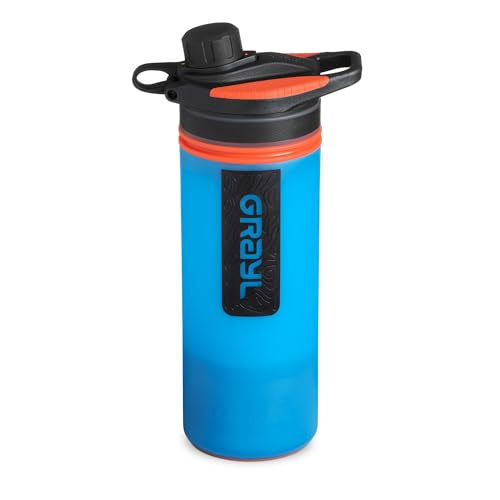 Grayl GeoPress 24 oz Grayl GeoPress 24 oz |
| Rating | ★★★★★ 4.8 22,500 ratings | ★★★★★ 4.8 1,400 ratings | ★★★★★ 4.7 400 ratings | ★★★★★ 4.7 130,500 ratings | ★★★★☆ 4.6 5,300 ratings |
| Cold hours | 24+ (no published hr rating) | 24 hr | 26 hr | 24 hr | No insulation |
| Weight | Solid stainless | 0.97 lb | Heavy stainless | Stainless, 32 oz | Heaviest, no insulation |
| Insulation type | Double-wall stainless | Double-wall stainless | Double-wall stainless | Triple-layer stainless | None (filter only) |
| Price | $55.00 as of Oct 27, 2:31 pm | $44.98 as of Oct 27, 2:31 pm | $34.99 as of Oct 27, 2:31 pm | $99.95 as of Oct 27, 2:31 pm | |
| Check Price → | Check Price → | Check Price → | Check Price → | Check Price → |
Best Insulated Water Bottle for Overland Day Trips
On a single day in the rig, the Yeti Rambler 36 oz stands as the best insulated water bottle in this group. Yeti describes its Ramblers as “nice and icy cold” even when left sitting in your car. Notably, owner reports back the claim more than any rival. The 36 oz size runs $50, weighs in as a solid stainless slug, and shrugs off tailgate drops.
Owners on r/overlanding praise Yeti durability almost without exception. Reports describe bottles shrugging off years of tailgate abuse, and the only steady complaint targets price. Compared to a Hydro Flask, the Rambler trades a little weight for a tougher wall and a cap sealing cleanly against dust. Across a long day of washboard and grit, the trade favors Yeti. The Chug cap also pours one-handed, which helps when your other hand stays on the wheel.
Size strategy matters for day trips. A 36 oz bottle covers most solo outings. Two 26 oz Ramblers at $40 each spread cold water between a driver and passenger. For multi-day trips, pair a daily-drinker bottle with a larger reservoir. Our roundup of best budget water containers shows how to carry bulk water cheaply.
YETI Rambler 36 oz Water Bottle - Stainless Steel - Sea View | Leakproof Chug Cap, BPA-Free, Dishwasher Safe, Double-Wall Vacuum Insulated, 18/8 Kitchen-Grade, Reusable Metal
The stainless slug overland owners trust most for a hot truck cab and a rough tailgate.
- Best cold retention of the lineup in a scorching cab
- Dent resistance owners rate above every rival
- 5-year warranty covers hard trail use
- Chug cap pours one-handed on rough roads
- Costs more upfront than every other bottle in this roundup
Best for Hot Weather Camping
Hot weather punishes weak insulation, so this category rewards thick stainless and a tight cap. For a single scorching afternoon, the Yeti Rambler still leads. Multi-day desert camps, however, favor the Stanley Classic Legendary and its iced-for-5-days rating, since ice survives longer between resupply stops. Both bottles hold cold while a single-wall bottle warms in under an hour.
Real desert use exposes two hidden problems. First, condensation drips off any cold bottle and soaks seat fabric. A flat base and a coaster habit then save your upholstery. Second, a bottle baking in direct sun heats its exterior even while the water stays cold, which surprises first-time desert campers. Because of this, the best water bottle for camping in real heat pairs strong insulation with a shaded storage spot inside the rig.
Hikers face the same math on an exposed ridge. For a hot-weather trek, the best water bottle for hiking balances weight against cold retention. Specifically, a 21 oz to 32 oz insulated stainless bottle hits the sweet spot. A full 40 oz bottle holds more, yet the extra pound wears on your shoulders by mile five. Match the size to the day, and refill at every reliable source.
Best for Coffee and Long Temperature Holds
Long coffee holds call for serious insulation, and the Stanley Classic Legendary wins here. The 1-quart model claims 24 hours hot and 26 hours cold. Similarly, its 2-quart version stretches to 45 hours hot and 40 hours cold, per Stanley’s published ratings. No other bottle in this lineup matches its hot-side endurance.
Cold brew fans get the same benefit in reverse. A Stanley or a Hydro Flask keeps iced coffee cold from a dawn departure through a late lunch, even after hours in a warm cab. The Hydro Flask 32 oz Wide Mouth claims 24 hours cold and 12 hours hot, per Hydro Flask’s product page. Priced at $44.95, it splits the difference for drinkers who switch between hot and iced.
Owner reports add one caution. Stanley’s Classic bottle draws near-legendary durability praise, with some owners citing decades of service. However, the newer Quencher and IceFlow lids attract leak and defect complaints on forums, so stick with the Classic screw-cap bottle for pure retention. A simple cap fails less often than a flip straw under trail vibration.
STANLEY Classic Vacuum Bottle, 1 qt, Hammertone Green | Stainless Steel Insulated Thermal Bottle for Camping and Travel | Keeps Drinks Hot or Cold | Wide-Mouth | Lid Doubles as Cup
The Classic Legendary screw-cap bottle, not the newer straw lids, is the one to buy for retention.
- Claims 24 hours hot and 26 hours cold, longest hot-side hold here
- Iced drinks stay cold up to 5 days per Stanley's rating
- Decades-long durability reputation on the Classic screw cap
- Weighs more than the Hydro Flask and adds bulk to a pack
Best Kid-Friendly Bottle
Kids need a spout they operate one-handed and a seal surviving a dropped backpack. The Owala FreeSip Insulated takes this category, starting at $29.99 with a triple-layer stainless wall and a 24-hour cold claim. Its FreeSip spout lets a child sip through a straw or swig from the same opening. A push-button lock then seals it, so a tumble in the back seat stays dry.
Parents on forums love the leakproof design, though one gripe repeats: the straw and gasket trap mold if you skip a deep clean. Pull the lid apart weekly and air-dry each piece to avoid it. For a full breakdown of the spout, cleaning, and sizing, read our full Owala review. The Stanley IceFlow Flip Straw 30 oz makes a strong runner-up at $40, with a dishwasher-safe body and a 12-hour cold claim.
Heat still applies to kid bottles. A back seat bakes as hot as the front, so an insulated wall keeps a child’s water drinkable instead of lukewarm by noon. Owala and Stanley both clear this bar, while a single-wall bottle fails it fast. Skip the plastic sport bottle for long summer drives.
Owala FreeSip Stainless Steel Water Bottle 32 oz Boneyard | Triple-Layer Insulation | Leak-Proof Lid | BPA-Free, Lead-Free, and Phthalate-Free | 2-in-1 Spout
A leakproof spout built for small hands, with sizing and cleaning tips in our full review.
- FreeSip spout lets a kid sip through a straw or swig from the opening
- Push-button lock keeps a dropped bottle from soaking a backpack
- Triple-layer stainless holds a 24-hour cold claim
- Straw and gasket trap mold without a weekly deep clean
Best Filtered Bottle for Remote Refills
Remote overland routes rarely offer clean taps, so a filtered bottle earns its place. The Grayl GeoPress 24 oz purifies water in about 8 seconds with a press-style cartridge. It removes 99.99% of viruses and 99.9999% of bacteria. Protozoa and particulates drop by 99.9%, alongside many chemicals, heavy metals, and microplastics, per Grayl’s specs. Such coverage handles stock tanks, cloudy creeks, and sketchy spigots alike.
The trade-off comes in two forms. First, the GeoPress runs $99.95, the priciest bottle here by a wide margin. Second, owners note it feels heavy and skips insulation, so your purified water warms up fast in a hot cab. As a result, many overlanders carry a Grayl for refills and a Yeti for cold storage rather than asking one bottle to do both.
Cartridge life shapes the real cost. Grayl rates each GeoPress cartridge for 350 press cycles, or about 65 gallons, before a swap. Plan refills around this budget on a long trip, and pack a spare cartridge for expeditions past a week. On most weekend routes, one cartridge lasts a full season of casual use.
GRAYL GeoPress 24 oz Water Purifier & Water Filter Bottle, Bali Blue | Purifies & Filters Water in 8 Seconds for Hiking, Backpacking, Camping, Survival & Travel, Removes Viruses & Bacteria
Field filtering for water sources a Yeti or Stanley can't make safe to drink.
- Purifies water in about 8 seconds with a press-style cartridge
- Removes 99.99% of viruses and 99.9999% of bacteria per Grayl's specs
- Cartridge lasts about 350 press cycles before a swap
- Runs heavy and skips insulation, so purified water warms up fast
Yeti vs. Hydro Flask vs. Stanley
These three brands dominate overland and camping forums, so a head-to-head helps. Yeti wins dent resistance and hot-cab cold retention, backed by the strongest owner consensus and a 5-year warranty. Hydro Flask matches the cold claim at 24 hours and weighs less at 0.97 lb for the 32 oz. Owners, however, report dents from short drops and occasional lid leaks.
Stanley separates itself on hot drinks and sheer lifespan. Its Classic bottle holds heat longer than either rival and carries a durability reputation few products earn. Yet Stanley’s newer straw lids draw more complaints than its Classic screw cap, so your Stanley experience depends heavily on which lid you choose.
Price sorts the final call. Hydro Flask at $44.95 undercuts the $50 Yeti slightly, while the Stanley Classic 1 qt at $39 costs least of the three. On a hot rig and rough roads, Yeti justifies its premium. Stanley leads for coffee and long heat holds. Hydro Flask splits the middle, lighter and a little cheaper.
Hydro Flask Water Bottle
The 32 oz Wide Mouth trades a little dent resistance for real weight savings on a long hike.
- Weighs only 0.97 lb, lightest stainless bottle in this roundup
- Matches the 24-hour cold claim of heavier rivals
- Wide mouth cap fits ice cubes for fast refills
- Dents from short drops more easily than the Yeti, per owner reports
Pros and Cons at a Glance
Pros
- Yeti Rambler resists dents and holds cold in a hot cab better than rivals
- Stanley Classic 1 qt claims 24 hours hot and 26 hours cold
- Hydro Flask 32 oz weighs only 0.97 lb at $44.95
- Owala FreeSip starts at $29.99 with a leakproof, kid-friendly spout
- Grayl GeoPress purifies questionable water in about 8 seconds
- Nalgene 32 oz costs $16.99 and shrugs off nearly any abuse
Cons
- Yeti Rambler carries the highest stainless price near $50
- Hydro Flask dents from short drops, per owner reports
- Stanley’s newer straw lids draw leak complaints
- Owala straw and gasket trap mold without weekly cleaning
- Grayl GeoPress runs $99.95 and skips insulation
- Nalgene offers no insulation and warms fast in heat
Final Verdict
The best insulated water bottle for most overlanders is the Yeti Rambler 36 oz. It holds cold through a baking cab, resists the dents rough roads hand out, and seals against dust with a one-handed pour cap. Owner consensus across overland forums backs it, and the 5-year warranty covers hard use. The only real knock is the $50 price.
Your trade-offs point elsewhere in three cases. For long hot-drink holds and legendary lifespan, the Stanley Classic 1 qt leads at $39. A lighter carry points to the Hydro Flask 32 oz, which saves weight at $44.95 though it dents more easily. On the tightest budget, the Nalgene 32 oz at $16.99 wins on toughness, as long as you accept zero insulation.

Nalgene Wide Mouth Water Bottle | BPA Free Material
The tough, cheap benchmark bottle, honest about skipping insulation entirely.
- Virtually indestructible Tritan survives drops on trails and tailgates
- Wide mouth opening simplifies filling, cleaning, and adding ice
- Cheapest bottle in this roundup
- No insulation, so it warms fast in a hot cab or under direct sun
Value depends on your terrain and refill plan. Remote routes with sketchy water justify the $99.95 Grayl GeoPress, since clean water outranks cold water when the source looks murky. Families gain most from the $29.99 Owala FreeSip, because a leakproof spout and a washable body matter more than a few extra retention hours.
Pick the Yeti Rambler for a do-it-all hot-climate bottle, and add a Grayl if your water sources look unreliable. This two-bottle kit covers cold storage and safe refills without asking a single bottle to master both. For a lighter or cheaper setup, the Hydro Flask and Nalgene make honest substitutes.
Related Reading
Frequently Asked Questions
How long do insulated water bottles keep water cold?
Most quality stainless bottles claim about 24 hours cold under ideal conditions. Stanley rates its Classic 1 qt at 26 hours, and its 2 qt at 40 hours. Real trail results run shorter, especially in a hot cab, so treat the shelf rating as a best case rather than a guarantee.
Will an insulated water bottle keep water cold in a hot car?
Yes, a double-wall stainless bottle holds cold far longer than a single-wall bottle in a hot car. Yeti specifically claims its Rambler stays icy “when left sitting in your car.” The water stays cold even when the bottle’s outside surface heats up, though a shaded spot in the rig helps.
What is the best water bottle for hiking in hot weather?
The best water bottle for hiking in heat balances weight against cold retention. A 21 oz to 32 oz insulated stainless bottle, like a Hydro Flask or Yeti, hits the balance. Larger 40 oz bottles hold more water but add close to a pound, which wears on you over long miles.
What size water bottle is best for camping and overlanding?
For a day in the rig, a 32 oz to 36 oz bottle covers one person. The best water bottle for camping trips often pairs a personal insulated bottle with a larger bulk water container for cooking and cleanup. Two 26 oz bottles also split cold water neatly between a driver and passenger.
Are insulated water bottles safe to leave in a hot vehicle?
Stainless insulated bottles handle a hot vehicle safely and keep water cold inside. Avoid leaving single-wall plastic bottles in prolonged heat, since some plastics degrade faster under repeated high temperatures. A stainless bottle with a sealed cap poses no such worry on a hot dashboard.
Should I choose a filtered or insulated bottle for overlanding?
Choose based on your water sources. A filtered Grayl makes sense when refills come from creeks or tanks, while an insulated Yeti or Stanley wins when you carry clean water and want it cold. Many overlanders pack both, using the Grayl for safe refills and the Yeti for cold storage.
Gear mentioned in this guide