



Quick Facts:
- Product: MORRFlate Braided Quad+ 4-Tire Hose Kit (off-road tire inflation system)
- Type: Manifold and braided hose kit for four-tire deflate and inflate, no built-in compressor
- Fits: Wheelbase up to 155 inches (Quad+); other sizes cover 100, 125, and 200 inches
- Air source: ARB and Power Tank connect directly; Viair, Smittybilt, and Warn need an adapter
- Gauge: Backlit digital, 1 to 150 psi, 0.1 psi precision, read from one central manifold
- Re-inflation: All four tires fill at once from a single hookup
- Warranty: Lifetime on the hoses
- Price: About $215 to $295 depending on wheelbase size
- Best for: Drivers who air down often and want a faster trailhead routine
8 min read
In This Guide
- Why a Fast Inflation System Changes Your Day
- Off-Road Tire Pressure Chart by Terrain
- How to Air Down Properly Before the Trail
- How the Morrflate Quad Kit Off-Road Tire Inflation System Works
- Choosing the Right Quad Kit for Your Wheelbase
- Off-Road Tire Inflation System vs. One Tire at a Time
- Final Verdict
- Frequently Asked Questions
Why a Fast Inflation System Changes Your Day
An off-road tire inflation system solves the second half of airing down: getting all four tires back to highway pressure quickly when the trail ends. Airing down earns most of the attention, yet the slow part comes afterward. After a long day in the dirt, nobody wants to crouch at each wheel with a single hose, working slowly around the truck before the drive home.
You air down so the tire spreads into a longer, wider footprint. As a result, the footprint floats over sand, wraps around rock, and bites through snow and mud. Lower pressure also softens the ride and protects the trail surface. Because the gains are real, many drivers air down on every outing. However, the cleanup step still bottlenecks the trailhead.
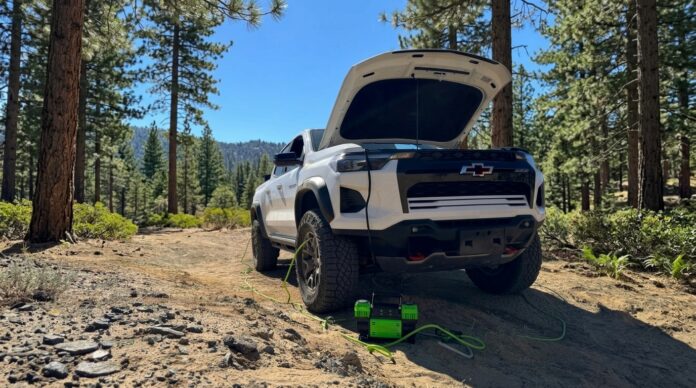
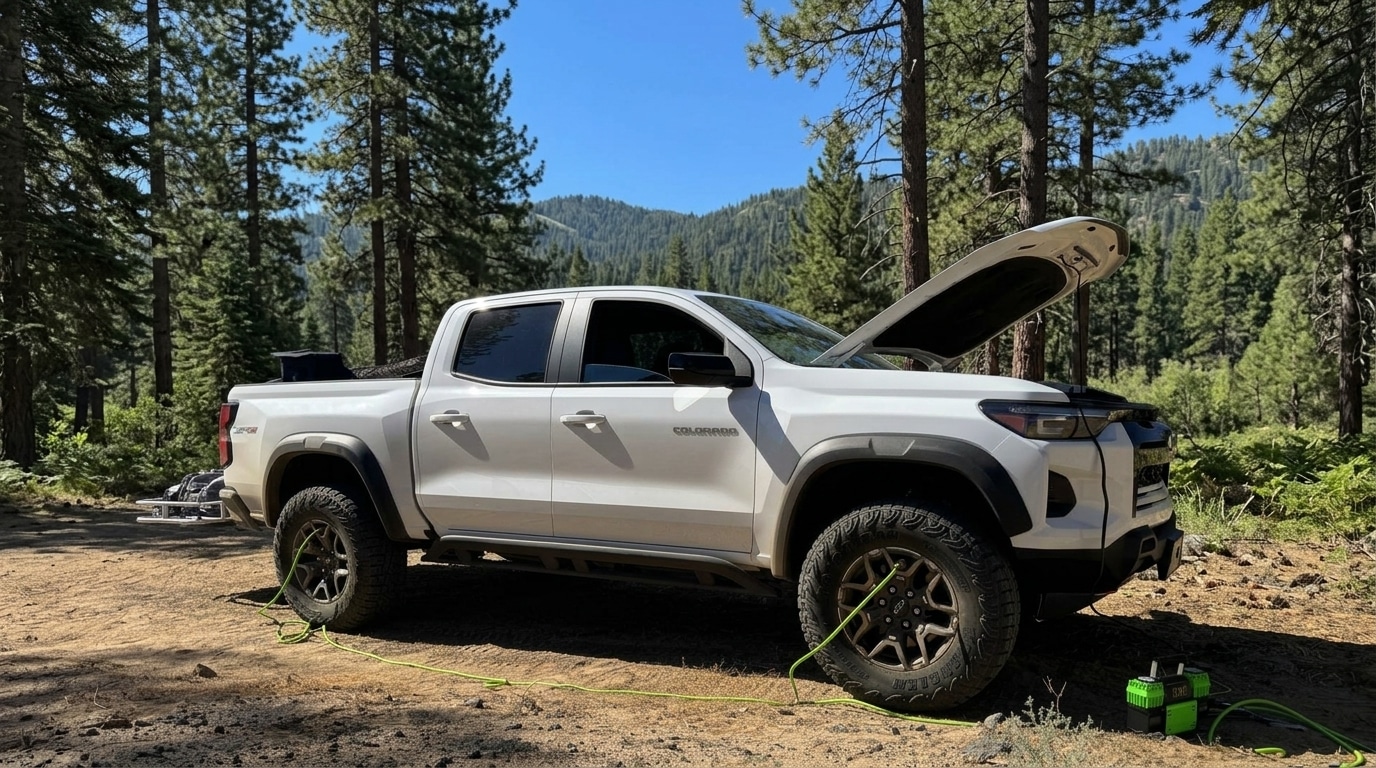
I have run this routine on a Jeep Gladiator, a Chevy Colorado ZR2, a Ford Bronco, and several Dodge pickups. From the soft washes of Anza-Borrego to the snow lines above Big Bear and the forest roads near the Grand Canyon North Rim, the pattern repeats. First, airing down takes a few minutes. Then airing back up, one tire at a time, eats far longer. Instead of accepting the slow math, a four-tire kit closes the gap. For readers building a rig, our overland truck accessories guide ranks where air tools fit in the priority list.
Off-Road Tire Pressure Chart by Terrain
Start with a target, not a guess. The off-road tire pressure chart below gives non-beadlock starting points for the four terrains drivers ask about most. Because the right number shifts with tire size, weight, and speed, treat these as ranges. For instance, heavier rigs and bigger tires need a touch more air for the same footprint.
| Terrain | Starting PSI (non-beadlock) | Why this range |
|---|---|---|
| Sand | 8 to 12 (10 to 12 for most rigs) | Maximum flotation keeps you on top of soft sand instead of digging in. |
| Rock | 15 to 18 | The tire conforms around edges for grip while keeping clearance and sidewall protection. |
| Snow | 18 to 22 packed; 12 to 15 deep powder | Packed snow rewards tread bite; deep powder rewards flotation, so the target splits. |
| Mud | 12 to 15 (toward 18 over a firm base) | Lower floats over bottomless bog; higher lets tread cut to a firm layer underneath. |
How Low Is Too Low
One hard limit governs all four numbers. On standard wheels, air pressure alone holds the tire bead against the rim. Therefore, dropping too low unseats the bead, especially during hard cornering, which dumps a tire off the wheel mid-trail. These off-road tire pressure references explain the bead-seating limit in detail, and exact safe numbers vary by tire and rig. However, beadlock wheels clamp the bead mechanically and allow far lower pressures, so the ranges above assume standard wheels.
For the full reasoning behind each terrain, including contact-patch math and the 25 percent starting rule, see our complete airing-down PSI-by-terrain guide. The right tire pressure for snow deserves extra care, because ice and packed powder behave differently than fresh drifts.

MORRFlate TenSix Off Road Air Compressor, 12 Volt Heavy Duty Tire Inflator | 10.6 CFM 150 PSI, Dual Cylinder Portable Offroad Air Compressor, 12V 90 Amp, 80% Duty Cycle, 4x4 Truck Overlanding, 4 Tire
FAST 10.6 CFM INFLATION: Air up a set of 35″ tires in under 5 minutes when used with the MORRFlate multi-tire inflation and deflation kits.
- 10.6 CFM dual-cylinder output
- Fills four 35-inch tires in about 5 minutes
- Inflates and deflates four tires at once with the kit
- Overkill for a single daily driver staying on pavement
How to Air Down Properly Before the Trail
Air down at the trailhead, before the terrain turns soft. Doing it early means you reach the first obstacle already floating. Moreover, a repeatable routine beats guesswork every time.
First, read your highway pressure on the door-jamb placard. Next, pick a terrain target from the chart above. Then deflate in stages and check often, because overshooting wastes air and time. Finally, note the number you settled on, so re-inflation later becomes a single known target.
A dedicated tire deflator speeds this step far more than pressing a valve core with a key. For example, automatic deflators stop themselves at a preset, while manual versions read pressure as you bleed. Our roundup of the best tire deflators for overlanding compares both styles. Likewise, the step-by-step in our how to air down tires for off-road guide covers technique in depth.
Two cautions matter on every trip. First, keep cornering gentle while aired down, since low pressure plus a hard turn unseats a bead. Also keep speed reasonable, because low pressure builds heat fast, and a rolling tire at speed wants more air to stay safe.
How the Morrflate Quad Kit Off-Road Tire Inflation System Works

The Morrflate Quad Kit is a hose kit, not a compressor. Instead, it uses a central manifold, four braided hoses, four air chucks, and one backlit digital gauge. You connect all four chucks to the valve stems, then deflate, inflate, or equalize every tire from a single point. Because one gauge reads the whole set, you stop guessing whether the rear tires match the fronts.
The braided hoses use an 800-denier nylon jacket rated to a 1600 psi burst, and they lay flat instead of holding coils. Moreover, the gauge reads from 1 to 150 psi at 0.1 psi precision, so your terrain target lands exactly. This multi-tire inflation layout also equalizes uneven tires and pulls air from a spare when needed.
Quad Kit Specs at a Glance
| Specification | Details |
|---|---|
| Hoses | 800D braided nylon, 1600 psi burst, lay-flat, no memory |
| Gauge | Backlit digital, 1 to 150 psi, 0.1 psi precision |
| Tires at once | Four (Mega Quad covers four to six) |
| Air source | ARB and Power Tank direct; others via adapter |
| Weight | Roughly 5 to 6 pounds with the storage bag |
| Warranty | Lifetime on the hoses |
One detail trips up first-time buyers. The kit needs a separate air source. For example, ARB compressors and Power Tank bottles connect straight to the included coupler, while Viair, Smittybilt, and Warn units need a Morrflate adapter sold separately. Many drivers therefore pair the kit with a high-output portable unit like the Morrflate portable air compressor, which feeds all four hoses from one source.
Choosing the Right Quad Kit for Your Wheelbase

Morrflate sizes the Quad family by wheelbase, because the hoses must reach all four corners from a center hookup. Therefore, pick the size by measuring your truck, not by guessing. A kit too short will not reach the rear tires on a long pickup.
Four sizes cover most rigs. First, the Quad Compact reaches up to 100 inches. Next, the standard Quad reaches up to 125 inches, which suits a Wrangler. Then the Quad+ reaches up to 155 inches and fits most full-size and dual-cab trucks. Finally, the Mega Quad stretches to 200 inches for vans and dually setups.
My Gladiator runs a 137-inch wheelbase, so the Quad+ matches it and the full-size pickups in the rotation. Similarly, shorter rigs like a two-door Wrangler do fine on the standard Quad. When in doubt, size up, since extra hose length costs nothing on a shorter truck.
Off-Road Tire Inflation System vs. One Tire at a Time
The old method works, yet it costs you time and consistency. With a single hose, you inflate one tire, walk to the next, and repeat twice more. As a result, errors creep in, because tires rarely land at the same pressure when filled separately.
A four-tire kit changes the math. Because all four hoses fill together off one source, the air-up runs in roughly the time of a single tire on the old setup. However, real-world results vary with compressor output and tire size, so treat any time claim as a ballpark rather than a promise. Still, the workflow gain is the point: one hookup, one gauge, four matched tires. This multi-tire inflation approach removes the guesswork of matching pressures by hand.
Consistency matters as much as speed. Notably, matched pressures keep handling predictable on the drive home and protect tread from uneven wear. For drivers who leave pavement once a year, a basic deflator and a single hose stay reasonable. For anyone airing down most weekends, however, the four-tire kit earns its place in the bed.
Final Verdict
The Morrflate Quad Kit suits drivers who air down often and value a quick, repeatable trailhead routine. Above all, its strength is consistency: one manifold and one gauge bring every tire to the same target. As a result, frequent off-roaders feel the payoff on the first trip home.
The trade-offs are honest. For instance, you still need a separate air source, and non-ARB compressors require an adapter, which adds a small cost and a setup step. In contrast, occasional trail users who air down once or twice a year will find a single hose and a good deflator enough.
On value, the kit lands around $215 to $295 by size, with a lifetime hose warranty behind it. Because the tool earns its keep on both ends of every trip, the price spreads across years of use. Moreover, the 800-denier braided hoses resist kinks and abrasion through repeated field cycles.
My recommendation is simple. Pair the Quad+ with a strong portable compressor (Read my review on the Morrflate Ten Six Compressor) and a quality tire deflator, and both your air-down and air-up steps shrink to minutes. However, if you want a built-in compressor instead of a separate source, look at an all-in-one onboard unit, though you give up the four-tire manifold which makes this system worth owning.
MORRFlate TenSix Off Road Air Compressor, 12 Volt Heavy Duty Tire Inflator | 10.6 CFM 150 PSI, Dual Cylinder Portable Offroad Air Compressor, 12V 90 Amp, 80% Duty Cycle, 4x4 Truck Overlanding, 4 Tire
FAST 10.6 CFM INFLATION: Air up a set of 35″ tires in under 5 minutes when used with the MORRFlate multi-tire inflation and deflation kits.
- 10.6 CFM dual-cylinder output
- Fills four 35-inch tires in about 5 minutes
- Inflates and deflates four tires at once with the kit
- Overkill for a single daily driver staying on pavement
Frequently Asked Questions
How much should I air down tires for off-roading?
Start from the terrain chart above: roughly 8 to 12 psi for sand, 15 to 18 for rock, 18 to 22 for packed snow, and 12 to 15 for mud, all on standard wheels. However, adjust for tire size and vehicle weight, and never drop low enough to unseat the bead in a corner.
What tire pressure works best for snow?
The right tire pressure for snow depends on the snow type. For packed snow and ice, 18 to 22 psi helps the tread bite. However, deep powder rewards lower pressure near 12 to 15 psi, much like sand. Cold air also lowers your reading, so check tires after they sit overnight.
Do I need a compressor with the Morrflate Quad Kit?
Yes. The kit is a hose-and-manifold system with no built-in compressor. For example, ARB and Power Tank sources connect directly, while Viair, Smittybilt, and Warn units need a Morrflate adapter. Therefore, pair it with a high-output portable compressor for the fastest air-up.
Is a four-tire kit faster than a single hose?
For re-inflation, yes, because all four tires fill at once from one source rather than one after another. A deflator still speeds the air-down step. Used together, both ends of the trip shrink to a few minutes.
Will the Morrflate Quad Kit fit my truck?
Measure your wheelbase first. The standard Quad reaches 125 inches, while the Quad+ reaches 155 inches for most full-size trucks, and the Mega Quad reaches 200 inches for vans and duallies. When between sizes, choose the longer kit.
Should I re-inflate before driving on the highway?
Always. Aired-down tires build heat at highway speed and handle poorly, which risks damage or failure. Therefore, bring every tire back to the door-jamb pressure before pavement. A four-tire off-road tire inflation system makes the final step quick.