


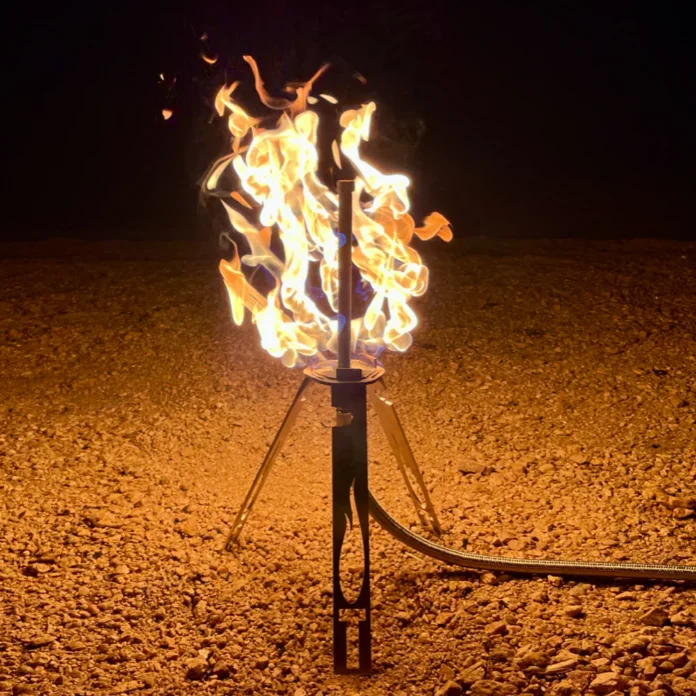

Quick Facts:
- Topic: How long a propane tank lasts on a fire pit
- Quick answer: A 20 lb tank runs about 8 to 15 hours
- 20 lb tank holds: Roughly 4.7 gallons, about 430,000 BTU
- Biggest variable: Fire pit BTU rating and flame level
- Worked example: Tripod Torch, 10 to 15 hours per 20 lb tank
- Fuel use: About 1 to 2 lbs of propane per hour on medium
- Best for: Campers and overlanders choosing a portable propane fire pit
8 min read
In This Guide
How Long Does a Propane Tank Last on a Fire Pit? The Short Answer
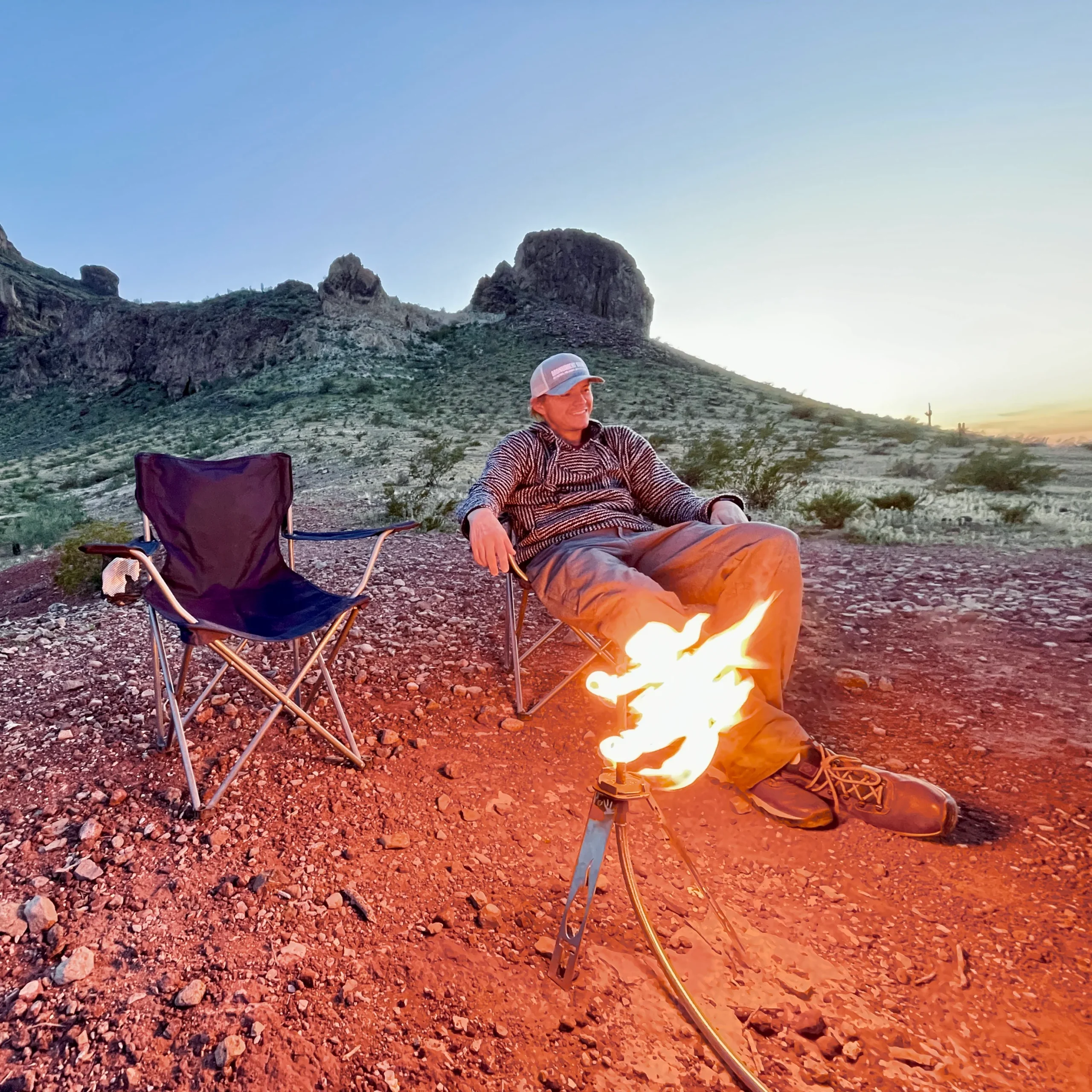
Summer camping season is kicking off, and because the kids are out of school, more families are loading up the truck. My son’s last day is Friday, so I know he is coming out with me a lot more as we jump into summer. One question keeps coming up around the campfire: how long does a propane tank last on a fire pit? With more fire rings going in, and with more campers leaning toward propane, people want a straight answer before they pack.
Here is the short version. A standard 20 lb propane tank runs a fire pit for roughly 8 to 15 hours. However, your real number depends on two things: the BTU rating of the pit and how high you run the flame. For example, a high-output pit drains a tank in a single evening, while an efficient burner stretches the same tank across a long weekend.
More campers lean on propane because fire bans keep spreading across the West. If you want the legal picture, our guide to 2026 fire restrictions breaks down where wood fires are off the table.
Why Every Fire Pit Burns Propane Differently
Here is the catch: there are a huge number of fire pits out there, and each one slurps down propane at a different rate. A big triple-burner like the Howl R4, for instance, drains a tank far faster than a small, efficient burner. For the purpose of this article, we will use the Tripod Torch as our example, since it is lightweight and burns efficiently.
I have a number of friends who own this compact propane campfire system. In addition, I have seen these guys at the Overland Expos for the last handful of years, and there is always a swarm of people around the booth. People love these things. Above all, the maker publishes a clear burn rate, so the numbers below are easy to check.
Propane Tank Sizes and What They Hold
Before you work out burn time, look at how much fuel each tank holds. Propane carries about 91,500 BTU per gallon, according to U.S. Department of Energy fuel data. A 20 lb tank holds roughly 4.7 gallons, so it stores about 430,000 BTU of usable energy. Smaller bottles hold proportionally less. The table below shows the common sizes campers carry, from 1 lb green bottles up to the 20 lb tank.
| Tank Size | Propane (gallons) | Usable Energy | Typical Fire Pit Run Time |
|---|---|---|---|
| 1 lb bottle | ~0.24 gallons | ~21,600 BTU | 45 minutes to 1.5 hours |
| 5 lb tank | ~1.2 gallons | ~107,000 BTU | 2.5 to 5 hours |
| 10 lb tank | ~2.4 gallons | ~216,000 BTU | 4 to 7.5 hours |
| 20 lb tank | ~4.7 gallons | ~430,000 BTU | 8 to 15 hours |
Run-time ranges in the table assume a fire pit drawing 25,000 to 55,000 BTU per hour, which covers most portable models. Notably, the gallons of propane in a 20 lb tank give you the most fire per refill. For this reason, vehicle-based campers favor the 20 lb size over smaller bottles.
Made in the USA
Meet the Tripod Torch
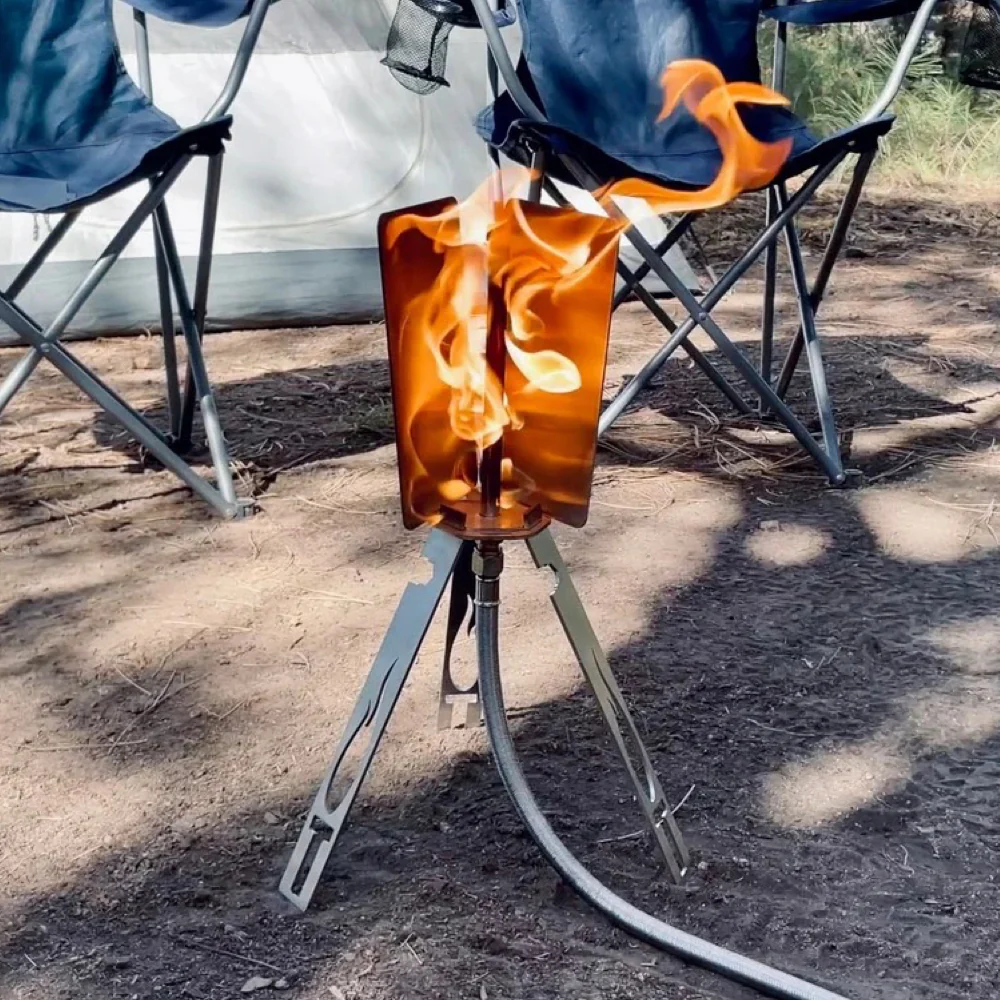
The Tripod Torch packs to the size of a hardcover book and sips about 1 to 2 lbs of propane per hour. See the full kit on the official site.
How Long Does a Propane Tank Last? The 20 lb Tank
So how long will a 20 lb tank last on a fire pit? For the tank most overlanders carry, plan on 8 to 15 hours of burn time. A pit running near 50,000 BTU per hour empties the tank in about 8 to 9 hours. In contrast, an efficient pit near 25,000 BTU per hour stretches past 12 hours. Therefore, one tank covers two or three evenings for most campers.
What about the 10 lb tank? Since it holds roughly half the propane of a 20 lb tank, it delivers about half the runtime. On an efficient pit like the Tripod Torch, plan on 5 to 7 hours per fill. For a weekend trip with short evening fires, a single 10 lb tank often does the job. Still, the 20 lb tank remains the better value per refill.
What Changes Your Real Burn Time
Three factors move your burn time more than anything else. Understanding them helps you plan fuel for any trip, whether you run a quick overnighter or a week in the backcountry.
Flame Level
Flame level is the biggest lever. Running on high burns two to three times the propane of a low setting. For long, low ambiance fires, keep the flame down, and your tank lasts far longer. However, for fast heat on a cold night, run it high and accept the shorter burn.
Wind and Cold
Wind steals heat and pushes people to crank the flame, which drains fuel faster. Cold weather also lowers tank pressure, since propane vaporizes slower in the cold. As a result, a frigid night cuts your effective runtime. Keeping the tank off frozen ground helps it hold pressure.
Pit BTU Rating
The BTU rating of the pit sets the baseline. A 60,000 BTU pit throws serious heat, yet it drinks fuel. An efficient unit near 25,000 to 40,000 BTU per hour trades a little heat for hours of extra burn. For a deeper look, our portable fire pit buying guide walks through how to weigh heat against fuel use.
A few habits stretch every tank. First, shield the flame from wind. Next, run a medium flame and turn the pit off between rounds of marshmallows. Finally, pack the right campfire accessories, like a windscreen and a quality hose, so no heat goes to waste. These habits matter most for propane fire pit camping, where every refill means a drive to town.
A Worked Example: The Tripod Torch
The Tripod Torch makes the math concrete. On a medium flame, it burns about 1 to 2 lbs of propane per hour. Since a 20 lb tank holds 20 lbs of fuel, the company rates it at roughly 10 to 15 hours per tank. My friends who run them report similar numbers on real trips.
At 6 lbs for the full kit, it packs to the size of a hardcover book. For overlanders counting cargo space, a portable propane fire pit this small is a strong pick. The vertical burner sends heat outward to your seat, instead of straight up. For weekend trips, one 20 lb tank covers every evening fire with room to spare.
Fire-Ban Compliant
A Campfire You Bring With You
Propane means an on/off valve and Stage 1 and 2 fire-ban compliance in most areas. Check local rules, then see the Tripod Torch.
Efficient vs High-Output Fire Pits
Efficient and high-output pits answer the burn-time question in opposite ways. A high-output pit, near 55,000 to 65,000 BTU per hour, delivers blast-furnace heat for cold camps. However, it empties a 20 lb tank in 7 to 9 hours.
An efficient pit like the Tripod Torch sits lower, near 25,000 to 40,000 BTU per hour. As a result, it stretches a tank past 12 hours while still warming a small group. For most campers and overlanders, the efficient portable propane fire pit wins on fuel cost and pack size. If you camp in deep cold often, the high-output option earns its fuel bill. Our roundup of the best portable fire pits compares both styles side by side.
| Factor | Efficient (Tripod Torch) | High-Output (Howl R4) |
|---|---|---|
| Heat output | ~25,000 to 40,000 BTU/hr | ~62,000 BTU/hr |
| Runtime per 20 lb tank | 10 to 15 hours | About 6.5 hours on high |
| Packed size and weight | Book-sized, 6 lbs | Larger, about 34 lbs |
| Best for | Summer trips and fuel economy | Cold camps and fast heat |
Final Verdict
So what is the real answer for a 20 lb tank? Plan on 8 to 15 hours, and lean on the efficient end if you pick a low-BTU burner. For most campers, one tank covers a full weekend of evening fires.
The trade-off is simple. High-output pits buy you heat at the cost of fuel, while efficient pits buy you hours at the cost of peak warmth. Therefore, choose based on your climate and how much cargo room you have.
On value, a compact portable propane fire pit like the Tripod Torch keeps refills rare, which matters when the nearest propane fill is an hour away. Fewer refills also mean lower cost across a season of propane fire pit camping.
If you want a fuel-sipping option for summer trips, the Tripod Torch is an easy recommendation. However, if you need maximum heat for winter camps, look at a higher-BTU pit like the Howl R4 instead. Either way, match the BTU rating to your trips, and you will never guess at burn time again.
Ready for Fire Season
Get Your Tripod Torch
Free shipping in the USA and a lifetime guarantee on the torch. See current details on the official site.
Frequently Asked Questions
How long does a propane tank last on a fire pit?
A 20 lb propane tank runs a fire pit for about 8 to 15 hours. The exact number depends on the pit’s BTU rating and your flame level. Efficient pits reach the high end of the range.
How long does a 1 lb propane tank last?
A 1 lb green bottle holds about 21,600 BTU, so it lasts roughly 45 minutes to 1.5 hours on a fire pit. For backpackers, it works for a short evening fire. For longer trips, a 20 lb tank is far more efficient.
How long does a 10 lb propane tank last on a fire pit?
A 10 lb tank holds about half the fuel of a 20 lb tank. Therefore, it runs roughly 5 to 7 hours on an efficient pit like the Tripod Torch. A single 10 lb tank suits a short weekend trip.
How much propane does a fire pit use per hour?
Most portable fire pits burn 1 to 3 lbs of propane per hour. The Tripod Torch sits near 1 to 2 lbs per hour on a medium flame. Higher BTU pits burn more fuel for more heat.
How many gallons of propane are in a 20 lb tank?
A full 20 lb tank holds about 4.7 gallons of propane. Since propane carries about 91,500 BTU per gallon, the gallons of propane in a 20 lb tank store close to 430,000 BTU. This is why the 20 lb size is the camping standard.
How do you make a propane tank last longer?
Run a medium flame instead of high, and shield the pit from wind. Also turn the burner off between uses. For propane fire pit camping, these habits add hours and cut refills.