


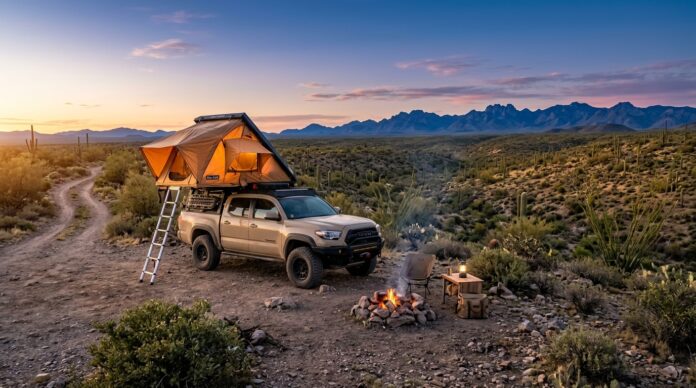

Quick Facts:
- Topic: How to find free camping on US public land
- Skill level: Beginner to intermediate
- Time required: 30 to 60 minutes of planning, up to 14 days on site
- Tools needed: Mapping app, offline GPS, water storage, portable power
- Permits: None for most federal dispersed sites; Arizona State Trust Land requires a $15 yearly permit
- Cost: $0 a night on BLM and USFS dispersed sites
- Best for: Overlanders, 4WD owners, and dispersed campers chasing solitude
10 min read
Affiliate disclosure: this article contains Amazon affiliate links. If you buy through them, 4wdTalk earns a small commission at no extra cost to you.
In This Guide
- How to Find Free Camping in the U.S.: An Overview
- Free Camping Quick Reference
- Federal Land Options for Overlanders
- State Land Options for Boondockers
- Apps and Maps to Find Free Camping Spots
- The Rules: Stay Limits and Setbacks
- Free vs Paid Campgrounds: What You Trade
- Pros and Cons of Off-Grid Stays
- Final Verdict: How to Find Free Camping the Right Way
- Frequently Asked Questions
How to Find Free Camping in the U.S.: An Overview
Learning how to find free camping on public land opens up roughly 245 million acres of BLM territory. Add another 193 million acres of National Forest where dispersed boondocking is also legal. For a deeper look at the rules and site-finding workflow, see our Dispersed Camping for Overlanders pillar guide. Most overlanders learn this the hard way after burning $40 a night at a developed campground next to a generator-running RV. Instead, you should know how to find free camping spots before you leave the pavement.
Free camping in this article means dispersed sites on federal or state public land at zero cost. It also includes a handful of low-cost reservable options like US Army Corps of Engineers sites, and overnight options through programs like Harvest Hosts. However, free camping near me searches usually mean dispersed BLM or USFS land, so the focus here lands there first.
I have dispersed camped from Big Bear and Joshua Tree out to Arizona BLM and Anza-Borrego in California — a full rundown of spots is in our guide to free dispersed camping in Southern California. Every one of those trips ran $0 in camping fees. The cost showed up elsewhere, specifically in water hauling, power, waste management, and the time spent vetting a site before driving in.
For this reason, the workflow matters more than the spot itself. First, you confirm the land is legal for dispersed use. Next, you cross-check satellite imagery against a road-status map. Then you arrive with a backup plan because the best spots fill on Friday afternoons.
Free Camping Quick Reference
Different agencies manage different lands with different rules. Here is the at-a-glance breakdown of where free camping is allowed, what it costs, and what to expect.
| Type | Managing Agency | Cost | Typical Stay Limit |
|---|---|---|---|
| Dispersed BLM | Bureau of Land Management | $0 | 14 days in any 28-day period |
| Dispersed USFS | US Forest Service | $0 | 14 days (varies by forest) |
| USACE Campgrounds | Army Corps of Engineers | Low-cost reservable | 14 days |
| State Forest Dispersed | State agencies | $0 to low-cost | Varies by state |
| AZ State Trust Land | Arizona State Land Dept | $15 yearly permit | 14 days per year total |
| Harvest Hosts | Private membership | $99 yearly | 1 night per host |
Power For Off-Grid Camping
Top-Rated Portable Power Stations
A portable battery turns any free site into a working basecamp. Jackery, EcoFlow, and Bluetti models keep your fridge, lights, and devices running for the full 14-day stay limit.
Federal Land Options for Overlanders
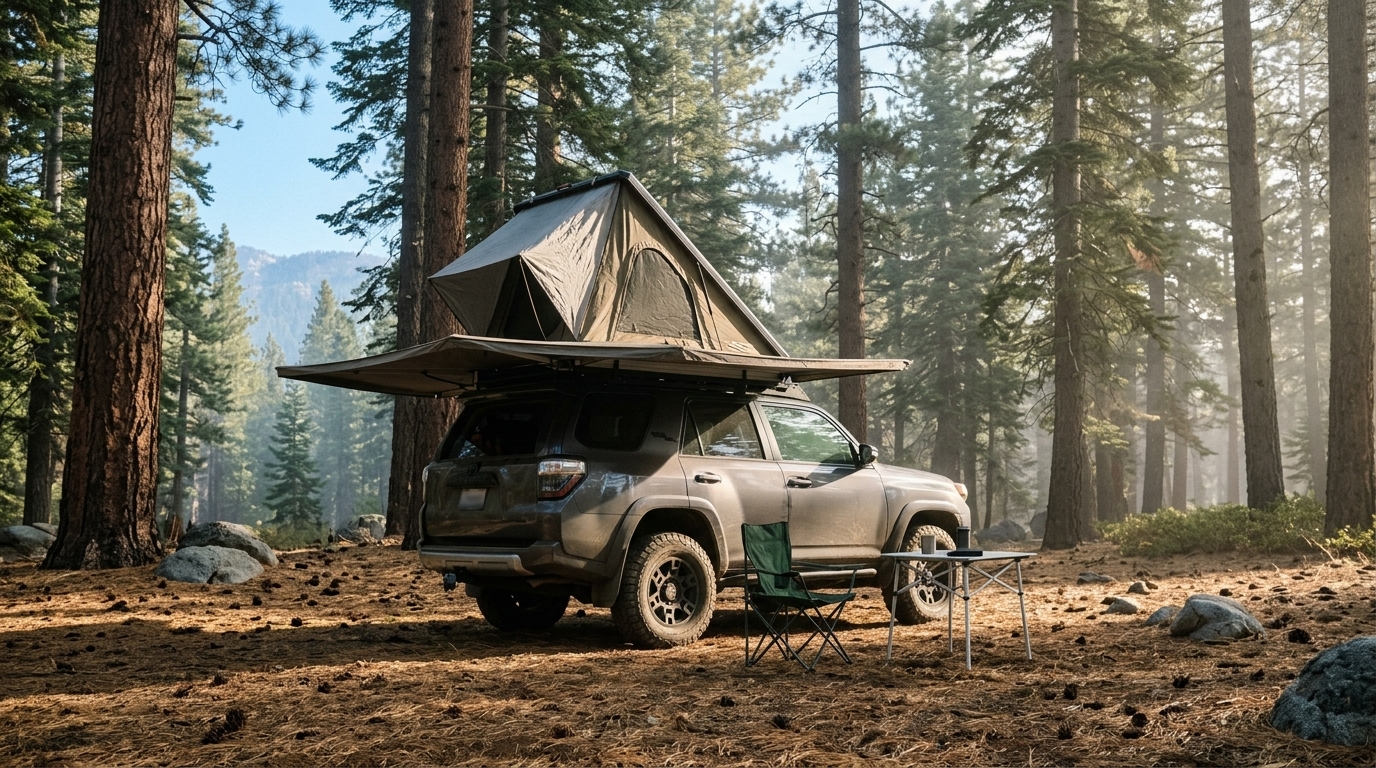
Federal agencies manage the largest pool of free public-land camping in the country. However, the rules vary by agency, and so does the type of access a 4WD truck or overland rig will get.
Bureau of Land Management (BLM)
The Bureau of Land Management oversees about 245 million acres across 12 western states. Dispersed use is allowed on most BLM land outside of developed recreation areas. Stay limits run 14 days in any 28-day period, after which you must relocate at least 25 miles, although some state field offices set the bar at 30. Long Term Visitor Areas in Arizona and California allow longer winter stays for a permit fee, often around $180 for the season. On BLM south of Joshua Tree and out in Anza-Borrego, I have rolled in late on a Friday and still scored open sites a quarter-mile from the nearest neighbor.
US Forest Service (USFS)
National Forests cover 193 million acres, and dispersed use is legal on most of them. The USFS allows vehicles to drive up to 150 feet off a designated route to reach a dispersed site. You must use a Motor Vehicle Use Map (MVUM) to confirm which roads are open. Stay limits hover around 14 days, although Mt. Hood resets at 14 consecutive with a 28-day yearly cap, and Apache-Sitgreaves runs 14 days in 30. Up in the Big Bear area of the San Bernardino National Forest, I have used dispersed pull-offs along forest roads. At those elevations, you wake up to thin air and zero cell signal. For a state-by-state example of USFS dispersed use, our guide to free dispersed camping in Colorado walks through 12 sites accessible by 4×4.
US Army Corps of Engineers (USACE)
USACE operates more than 400 lake and river projects with 94,565 campsites across 41,188 miles of shoreline. Sites are reservable through Recreation.gov and run low-cost rather than free, usually $14 to $26 a night. Although not truly free camping, USACE delivers waterfront access at half what most state parks charge for similar lakefront sites.
National Park Service (NPS)
National Park backcountry camping is rarely free and usually requires a permit. However, BLM and USFS terrain often borders parks, giving overlanders a free dispersed option right outside the park boundary. For example, the public land north of Joshua Tree National Park is widely used by visitors who want a free basecamp.
State Land Options for Boondockers

State agencies manage a smaller pool of free camping, although coverage varies widely. Some states open millions of acres to dispersed use. Others restrict free camping to specific Wildlife Management Areas or state trust lands.
State Forests and Wildlife Areas
Pennsylvania, Michigan, Minnesota, and New York have strong state forest dispersed-use programs. In contrast, California limits most state-managed land to developed campgrounds. Wildlife Management Areas in states like Texas and Florida sometimes allow dispersed hunter-style camping during specific seasons.
State Trust Lands
Arizona State Trust Land covers around 9.2 million acres, although recreational use requires a permit. Individual permits run $15 a year and family permits run $20 a year, with a cap of 14 total days a year statewide. By contrast, New Mexico’s $35 annual State Trust permit does not authorize general recreational camping. The NM permit covers only hunting-related camping with the proper hunting licenses, so check each state’s rules before crossing the line.
Apps and Maps to Find Free Camping Spots
Finding the right app is the fastest way to learn how to find free camping spots in unfamiliar country. No single app covers every type of land, so most overlanders run two or three in combination. Here is the current pricing and coverage for the apps to know as of mid-2026.
| App | Pricing | Coverage | Best For |
|---|---|---|---|
| The Dyrt PRO | $59.99/yr | 5,000+ staff-verified free sites | Offline maps and trip planning |
| iOverlander | Free (1 state); Pro $59.99/yr | Crowd-sourced global database | Detailed overlander reports |
| Campendium | Free tier + paid Roadpass | User-reviewed BLM and USFS sites | Cell signal reports |
| onX Offroad | Premium $34.99/yr; Elite $99.99/yr | Public/private boundaries + MVUM | Verifying land ownership |
| FreeCampsites.net | Free (web only) | Sites $12 a night or less | Quick budget filtering |
| Allstays Camp & RV | $34.99/yr | 37,000+ campgrounds offline | No-signal navigation |
Notably, the FreeRoam app shut down in 2024 and is no longer a viable option. Some forum posts still recommend it. Ignore those. Likewise, Cabela’s and Bass Pro overnight RV parking has been rolled back at most locations as of 2025. Walmart and Cracker Barrel stays now depend entirely on store-level policy. Always call ahead.
For verifying public-land boundaries on the ground, I lean on onX Offroad Elite. It draws private-property boundaries cleanly, which keeps you off someone’s ranch. For deeper navigation context, see our guide on best off-road GPS and navigation apps.
The Rules: Stay Limits and Setbacks
Free camping is legal, although it is regulated. Three rules cover almost every situation you will run into on federal land.
The 14-Day Stay Limit
Both BLM and USFS dispersed sites enforce a 14-day stay limit in most areas. After 14 days, BLM rules require you to move at least 25 miles. USFS rules vary by forest, with most resetting after a 28-day window or capping yearly stays at 28 days total per forest.
The 200-Foot Water Setback
BLM and USFS rules require campsites and waste catholes to sit at least 200 feet from lakes, rivers, and streams. Catholes themselves should run 6 to 8 inches deep. Following this protects water sources for downstream campers and wildlife.
The 150-Foot Off-Road Limit
On National Forest land, USFS rules permit vehicles to drive up to 150 feet off a designated route to reach a dispersed site. Past 150 feet, you risk a citation. Before driving in, cross-check the Motor Vehicle Use Map for the forest you are in — our walkthrough on how to read MVUMs and find legal dispersed campsites covers exactly that. Each forest publishes its own MVUM and they are not interchangeable. For the etiquette layer attached to this access, read our Leave No Trace camping rules.
Water Storage For Free Camping
Pack 1 Gallon Per Person Per Day
Free dispersed sites have no spigots. Hard-sided jerry cans and food-safe collapsible containers built for vehicle transport keep you stocked through a 14-day stay.
Free vs Paid Campgrounds: What You Trade
Paid campgrounds run $20 to $50 a night for a developed site with hookups, water, bathrooms, and a host on call. Free dispersed sites give you none of those, although they trade those amenities for solitude, dark skies, and zero reservation pressure. For overlanders running solar and a fridge, the trade often makes sense.
On my last trip out to Arizona BLM, we paid $0 for a four-night stay with 360-degree desert views and a Milky Way overhead. The catch: we hauled in 20 gallons of water, ran a portable power station to keep the fridge cold, and packed every scrap out. Compare it to a $35 state-park loop two hours away with a hot shower and a flush toilet. Knowing how to find free camping spots matched to your rig saves both money and frustration, although the right answer depends on the trip.
Pros and Cons of Off-Grid Stays
Pros
- $0 a night on most BLM and USFS dispersed land
- No reservations, no rangers checking in at 8am
- Far darker skies than developed campgrounds offer
- More space between you and the next rig, often a quarter-mile or more
- 14-day stays let you build a real basecamp
- Solitude paid campgrounds cannot match
Cons
- No bathrooms, so you pack out your waste with a wag bag or cathole
- No electrical hookups, so one of the best portable batteries is required for fridges and lights
- No potable water, so you haul 1 gallon per person per day minimum
- Weak or nonexistent cell signal at most sites
- Fire bans during high-risk months shut down campfires — check 2026 fire restrictions for camping and overlanding before you head out
- Self-rescue mindset required if your rig breaks down
Final Verdict: How to Find Free Camping the Right Way

Knowing how to find free camping on US public land comes down to three habits. First, identify the managing agency, whether BLM, USFS, USACE, or a state trust. Second, verify the site on a satellite map and an MVUM before you commit a long drive. Third, arrive prepared for zero hookups, including water, power, and waste handling.
Overlanders, dispersed campers, and budget travelers will get the most from this approach. Conversely, families with young kids and RVers who need hookups should weigh whether the cost savings outweigh the trade-offs. A $40-a-night state-park loop with showers sometimes wins on practicality.
For tooling, onX Offroad Elite plus The Dyrt PRO covers most of what an overlander needs in the western US. Combined yearly cost lands at around $160, under one paid campground night a month. Add iOverlander Pro for trips crossing into Mexico or Canada, which brings the total to roughly $220.
Look at the kind of camping you do most often and pick the option closest to your style. If true solitude is the goal, our guide on how to find secluded camping spots goes deeper on that search. For 4WD owners chasing solitude on weekends, BLM dispersed pays for itself in the first trip. For new campers or larger families, a Corps of Engineers reservable site at $20 a night with water access often beats both a state park and a dispersed spot. Either way, see our guide on how to pick a safe dispersed campsite before you arrive.
Frequently Asked Questions
Is dispersed camping free?
Yes, dispersed use on BLM and US Forest Service land is free in the vast majority of cases. Some long-term zones in Arizona and California, called Long Term Visitor Areas, charge a permit fee for winter stays, although day-to-day dispersed use stays at $0 a night.
How long can you stay at a dispersed camping site?
BLM dispersed sites cap stays at 14 days in any 28-day period, after which you must move at least 25 miles away. USFS rules vary by forest, although 14 days is the typical limit. Always check the specific forest’s website before a long stay.
Where can I camp for free?
Free dispersed camping is widely available on BLM land in 12 western states and on most National Forests across the US. Some state forests, Wildlife Management Areas, and US Army Corps of Engineers projects also offer free or near-free options. For free dispersed camping spots specifically, the apps in the resources table above filter free camping near me results by land agency.
Is boondocking legal?
Boondocking is legal on most federal dispersed land, including BLM and USFS. Outside those areas, legality depends on local rules. Overnight parking in a Walmart lot, for instance, depends entirely on store-level policy and is increasingly restricted in cities with bans on overnight parking.
What is the 200-foot rule for camping?
The 200-foot rule requires dispersed campers to set up at least 200 feet from any lake, river, or stream. The rule covers tent placement, vehicle parking, and waste catholes. Following it protects water sources for wildlife and downstream campers.
What is the 3-3-3 rule when camping?
The 3-3-3 rule is a road-trip pacing guideline: drive no more than 300 miles a day, arrive by 3pm, and stay at least 3 nights at each location. While not a legal rule, it helps overlanders avoid fatigue and gives them daylight to scout a free dispersed site before sunset.