


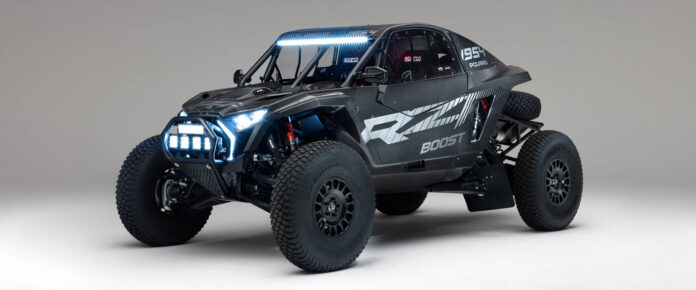
Quick Facts:
- Vehicle: 2027 Polaris RZR Pro R Factory Boost race machine.
- Engine: Turbocharged ProStar Fury 2.0L four-cylinder, up to 400 hp.
- Wheelbase: 111 inches, stretched 6.5 inches by Polaris.
- Fuel cell: 45 gallons, with range beyond 200 miles.
- Body: Full carbon fiber.
- Price: Starts at $200,000 MSRP.
- Order window: First window closes Feb. 15, 2027, with orders through SCI Distribution.
- Race debut: 2027 King of the Hammers.
7 min read
In This Article
Overview
Desert racers lose time every time they pull into the pits. Polaris says the Pro R Factory Boost reduces pit stops with a 45-gallon fuel cell, which extends range beyond 200 miles. RZR Factory Racing and Polaris revealed the race machine on Oct. 30, 2026. The reveal took place at Camp RZR in the Glamis Imperial Sand Dunes.
Power comes from a turbocharged ProStar Fury 2.0L four-cylinder rated at up to 400 horsepower. According to the Polaris release, the company designed the vehicle for desert racing and builds it in Roseau, Minnesota. The Factory Boost also joins the Gen 2 RZR Pro R Factory instead of replacing it. Racers now choose between two Polaris platforms.
Pricing points to teams and well-funded racers, since it starts at $200,000 MSRP. Polaris is also selling it in limited quantities through an exclusive distributor. For most riders, the production model is the closer match. Our 2027 Polaris off-road lineup coverage includes the production RZR Pro R Boost, the model this race machine builds on.
The big fuel cell shows how much range planning matters on long runs. Owners of everyday UTVs and 4WDs face the same math on a smaller scale. A steel Eagle UI50FS safety container, the RotopaX 2 Gallon Gasoline Pack and a battery-powered transfer pump cover carrying fuel and filling the tank.
Fuel containers and transfer gear

Eagle 5 Gallon Type I Red Safety Gas Can for Gasoline | Flame Arrester

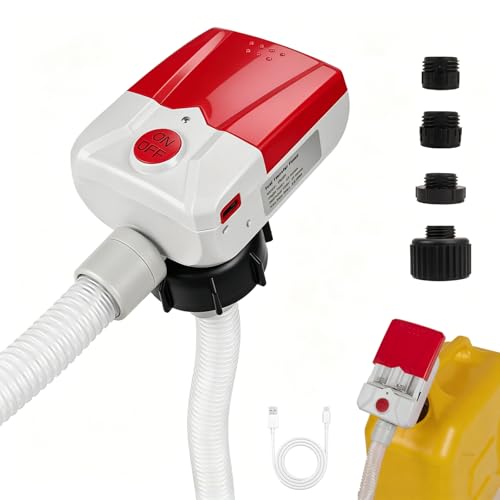
Fuel Transfer Pump with Auto-Stop | 3.8 GPM 51‘’Long Hose Battery o…
Key Facts at a Glance
| Item | Detail |
|---|---|
| Reveal | Oct. 30, 2026, at the Glamis Imperial Sand Dunes |
| Engine | Turbocharged ProStar Fury 2.0L four-cylinder, up to 400 hp |
| Wheelbase and width | 111 inches and 74 inches |
| Estimated dry weight | 2,700 lb |
| Fuel cell | 45 gallons, range beyond 200 miles |
| Tires and wheels | 35-inch BFGoodrich KR2 tires on Method 407 wheels |
| Electronics | MoTeC M150 ECU with dual power distribution modules |
| Shocks | 3-inch internal bypass DYNAMIX DV Live Valve |
| Race rules | Listed as SCORE, AORC and Ultra 4 legal |
| Price | From $200,000 MSRP |
| First order window | Closes Feb. 15, 2027 |
What the Pro R Factory Boost Changes for Long Desert Races
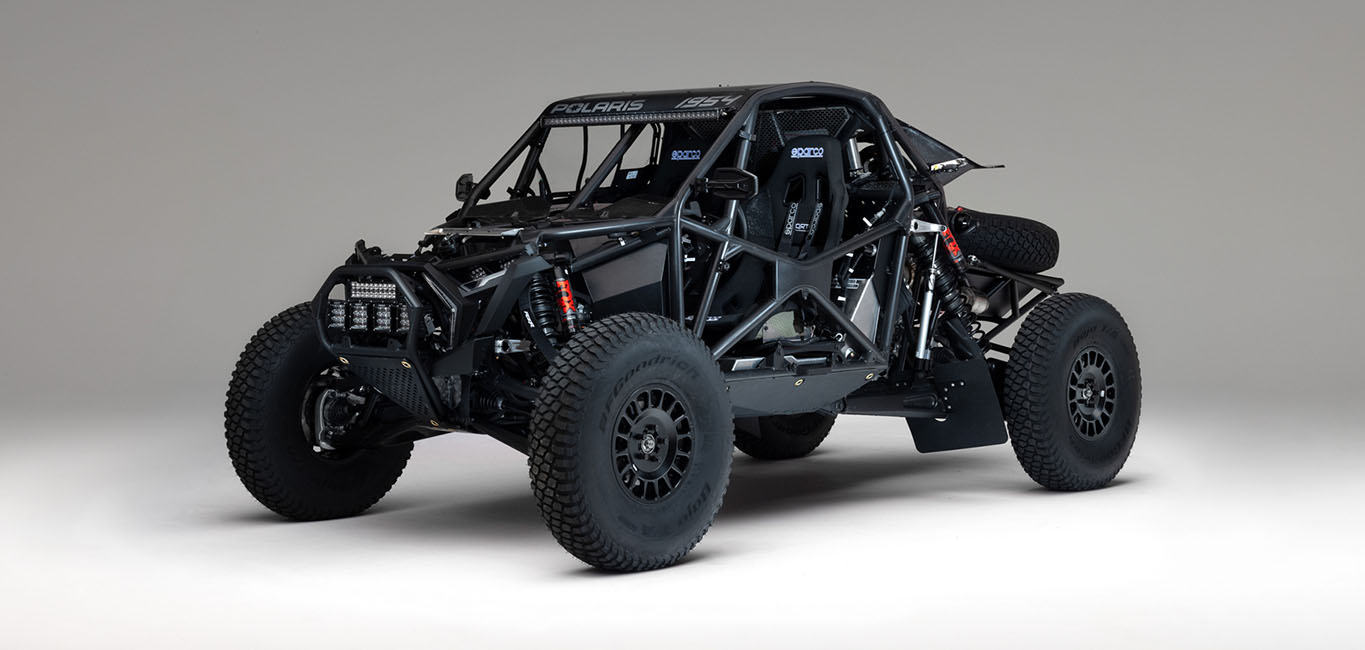
Polaris focused on stability, durability and range. A Geiser-built chassis stretches the wheelbase 6.5 inches to 111 inches. Larger tubing across key structural members also adds stiffness for higher speeds, according to Polaris.
The cockpit also grows. Polaris describes a cab two inches wider, which gives the driver and navigator more room. The roll cage is new, while the rolled-roof profile sits 0.5 inches lower.
Fuel is the biggest change. The 45-gallon cell increases capacity over the previous-generation RZR Pro R Factory’s 34-gallon system, which adds 11 gallons. Polaris says the extra capacity extends range beyond 200 miles and reduces pit stops.
The body changed too. Full carbon fiber panels and an arched roofline reduce weight and improve aerodynamic efficiency at high speeds, according to Polaris. Polaris engineers also used computational fluid dynamics to model airflow above 100 mph. The results shaped the cage and the redesigned rear body. A carbon fiber front propshaft also carries less rotating weight.
Power, Cooling, Electronics, Suspension and Tires
The turbo four-cylinder is rated at up to 400 horsepower. According to the Polaris model page, the figure depends on drive mode. Polaris also uses rear-mounted cooling, with dual 500-watt radiator fans and triple intercooler fans to help manage heat.
Electronics get an upgrade too. A MoTeC M150 ECU runs the car, and a second power distribution module is new compared with the Gen 2 RZR Pro R Factory. Factory wiring also supports navigation, radio, helmet pumpers and a roof light bar. Provisions for a front-mounted Starlink system support team communication.
Next, the suspension uses 3-inch internal bypass DYNAMIX DV Live Valve shocks with upgraded 1-inch shafts. Polaris says the DYNAMIX DVS system manages 12 suspension channels in real time. A FOX steering damper is also standard to absorb large impacts at speed.
For tires, Polaris specifies 35-inch BFGoodrich KR2s on Method 407 wheels. An optional Rock Package adds quarter-inch UHMW skid plates and reinforced high-clearance suspension parts. It also includes a front bumper with an integrated winch for rock races.
Factory Boost vs. the Gen 2 Pro R Factory
Polaris says the Factory Boost joins the Gen 2 RZR Pro R Factory and does not replace it. Since both stay on sale, racers pick the platform matching their performance needs and racing goals.
Two upgrades are stated outright. First, the fuel cell grows from 34 gallons to 45 gallons. Next, the electronics gain a second power distribution module. Polaris also describes a wheelbase stretched 6.5 inches to 111 inches, a cab two inches wider and a full carbon fiber body, but it does not say what baseline those changes are measured from.
The production RZR Pro R Boost is a different vehicle. According to Polaris, the Factory Boost builds on the production model’s foundation while using proven components and lessons from the Gen 2 RZR Pro R Factory. Our lineup coverage lists 275 horsepower for the production model, while the race machine makes up to 400 horsepower.
How to Order and Where It Races First
Orders run through SCI Distribution, LLC, an exclusive distributor of the RZR Pro R Factory and the RZR Pro R Factory Boost. The company is based in San Diego, California. Polaris builds the vehicle, while SCI manages sales and post-sale customer support.
The first order window closes Feb. 15, 2027, and Polaris is offering limited quantities at $200,000 MSRP. According to the Polaris model page, SCI is positioned to offer spare parts packages, customization and upfit packages, vehicle maintenance procedures, pre-race shake-down procedures, and driver and navigator training.
Racing is next. RZR Factory Racing will debut the car at the 2027 King of the Hammers, where it will compete in multiple races. To understand the terrain around the event, read the Johnson Valley section of our California trails guide.
What This Means for You
If you race, the useful number on the Pro R Factory Boost is range. Polaris says the 45-gallon cell reaches beyond 200 miles. Divide 200 miles by 45 gallons and you get about 4.4 miles per gallon. Because Polaris says the range is beyond 200 miles, the real figure is at least about 4.4 miles per gallon, assuming the whole cell is usable. For example, at the same burn rate, the previous-generation 34-gallon cell would cover at least about 151 miles. Treat both figures as simple arithmetic, not Polaris claims, because fuel use changes with terrain and pace.
Before you order, ask SCI Distribution about spare parts, shake-down procedures and training. Ask which drive mode delivers the full 400 horsepower. The car is listed as SCORE, AORC and Ultra 4 legal, so verify class rules with your series. Check lead times early, since the first window closes Feb. 15, 2027.
If you ride for fun, a $200,000 race machine costs more than most budgets allow. Instead, the production Pro R Boost is the version offered in Camp RZR demos. Dirt Wheels says Camp RZR runs Oct. 30 and 31 at Glamis. Heading to the dunes yourself? Our sand driving techniques guide covers the basics of sand driving.
Sand and dust blow around Glamis. An ILM Model 128S helmet, 100% Strata 2 goggles and Fox Racing Main goggles protect head and eyes.
Helmets and goggles for dune days

ILM Adult Dirt Bike Helmets Motocross ATV Dirtbike BMX MX Offroad F…


If you follow racing, watch the King of the Hammers debut. Early results will show how the larger fuel cell and up to 400 horsepower perform in competition. Polaris has not published how many stops the larger cell saves per course, so race results will give the first real evidence.
Final Thoughts
The Pro R Factory Boost targets a familiar racing problem: time lost in the pits. Polaris ties the 45-gallon fuel cell to fewer stops, and the longer wheelbase and wider cab to stability and driver room.
At $200,000 with limited quantities, it fits teams and well-funded racers. Racers who want a different platform still have the Gen 2 RZR Pro R Factory, which stays on sale. Casual riders will find the production model the closer match.
If you are among the buyers, talk to SCI early and compare the full spec sheets for both Factory cars. Other readers should follow how it performs at the 2027 King of the Hammers. Polaris says the car builds on the production model and carries proven components and lessons from the Gen 2 RZR Pro R Factory, so the results will show how this combination holds up.
FAQ
How much horsepower does the Pro R Factory Boost make?
Polaris lists up to 400 horsepower from the turbocharged ProStar Fury 2.0L four-cylinder. However, the model page notes the figure depends on drive mode.
How far does the Pro R Factory Boost fuel cell go?
Polaris says the 45-gallon cell extends range beyond 200 miles for desert racing. It increases capacity over the previous-generation RZR Pro R Factory’s 34-gallon system. Fuel use changes with terrain and pace.
How much does the Pro R Factory Boost cost?
It starts at $200,000 US MSRP. Polaris says the price excludes destination and handling fees, tax, title, license and registration. Orders also go through SCI Distribution.
When does the order window close?
The first order window closes Feb. 15, 2027. Polaris is also selling limited quantities through SCI Distribution, LLC.
Does the Factory Boost replace the Gen 2 Pro R Factory?
No. Polaris says the Factory Boost joins the lineup, while the Gen 2 RZR Pro R Factory stays available for purchase.
How is the Factory Boost different from the RZR Pro R Boost?
The Factory Boost is a purpose-built race machine with up to 400 horsepower, a 111-inch wheelbase and a 45-gallon fuel cell. In contrast, the RZR Pro R Boost is the production model, which our lineup coverage lists at 275 horsepower.