


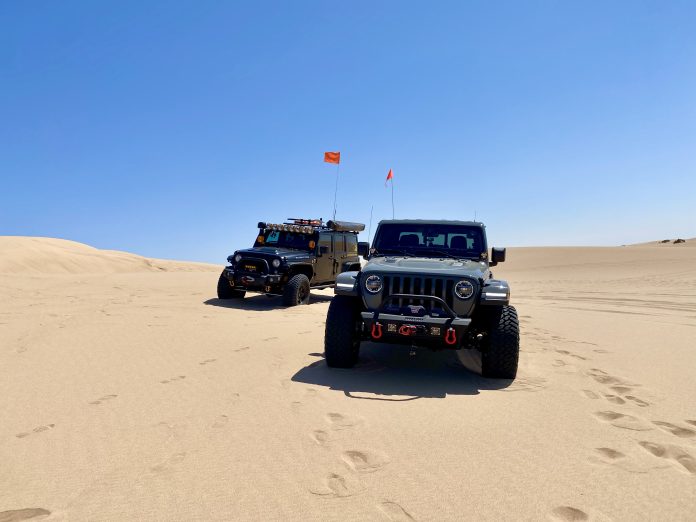

Sand Driving Techniques: The Complete 4WD Guide
Quick Verdict: Successful sand driving techniques come down to three fundamentals: air down your tires to 15-18 PSI (or 12-15 PSI in soft dunes), maintain steady momentum without spinning, and select the right 4WD mode for the conditions. I’ve tested these principles across hundreds of miles at Glamis Imperial Sand Dunes and Pismo Beach in both a Jeep Gladiator Rubicon on 37s and a 2025 Chevy Colorado ZR2 on 33s. This guide covers everything from tire pressure charts to e-locker strategy to recovery when things go wrong.
Last updated: March 2026 | 10 min read
In This Guide
- Sand Driving Overview: Why Sand Is Different
- Sand Driving Tire Pressure: The Single Most Important Step
- Which 4WD Mode to Use in Sand
- Momentum and Throttle Control on Sand
- Hard-Packed vs Soft Sand: Adjusting Your Approach
- Using E-Lockers and Diff Locks in Sand
- Sand Driving Recovery: Getting Unstuck
- Essential Gear Checklist for Sand Driving
- Pros and Cons of Sand Driving in a 4WD
- Final Verdict
- Frequently Asked Questions
Sand Driving Overview: Why Sand Is Different
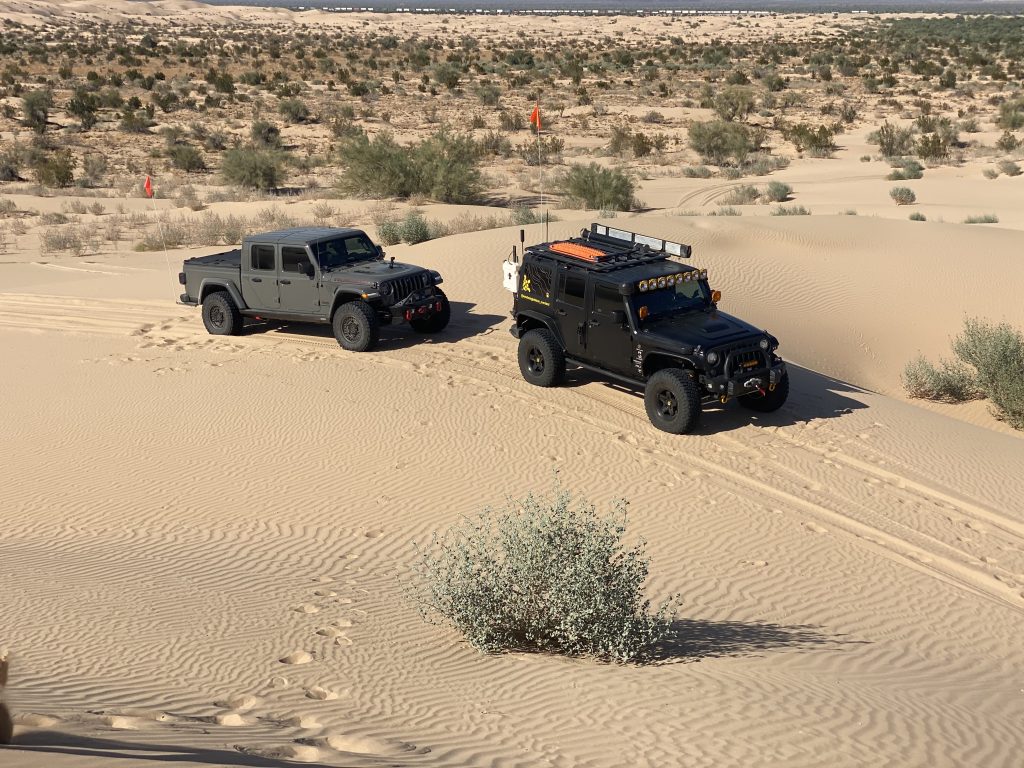
Sand behaves differently from every other off-road surface. On rocks or dirt, your tires grip solid material. In sand, your tires float on top of loose particles or sink into them. Therefore, mastering sand driving techniques starts with understanding this fundamental difference: you need flotation, not grip. Learning how to drive 4×4 in sand requires a different mindset from trail or rock driving.
Specifically, wider tires at lower pressure create a larger contact patch, spreading your vehicle’s weight across more surface area. This is why a Jeep Gladiator Rubicon on 37-inch tires at 15 PSI handles Glamis dunes with relative ease, while a stock truck on highway-pressure all-terrains digs in and stalls within 50 feet. I’ve experienced both scenarios firsthand.
The good news: off-road sand driving is one of the most forgiving disciplines once you understand the basics. Unlike rock crawling, mistakes in sand rarely damage your vehicle. The worst outcome is getting stuck, and proper recovery methods get you moving again in minutes. This guide covers the complete process, from tire pressure settings to recovery gear selection to advanced dune techniques.
Sand Driving Tire Pressure: The Single Most Important Step
Airing down is the single highest-impact sand driving technique. Reducing your tire pressure from highway levels (32-35 PSI) to sand levels (12-18 PSI) transforms your vehicle’s performance. Lower pressure increases the tire’s footprint by 30-50%, which distributes weight over a larger area and prevents the tire from digging into soft sand.
Here is a pressure reference chart based on real-world testing:
| Sand Condition | Recommended PSI | Notes |
|---|---|---|
| Hard-packed beach sand | 18-22 PSI | Near the waterline; moderate airing down is enough |
| Loose beach sand (dry, above tide line) | 15-18 PSI | Standard sand driving pressure for most vehicles |
| Soft desert dunes (Glamis, Imperial) | 12-15 PSI | Deeper sand requires more flotation |
| Emergency (severely stuck) | 8-10 PSI | Temporary only; risk of debeading below 10 PSI; drive under 5 mph |
On my Gladiator with 37-inch tires, I run 15 PSI at Glamis and 18 PSI at Pismo Beach. The Colorado ZR2 on 33s performs best at 16 PSI in loose sand. Notably, heavier vehicles need slightly lower pressure than lighter ones because the additional weight already compresses the tire more. For a deeper look at the science behind these numbers, read our guide to how tire pressure affects traction and ride quality.
Featured on MORRFlate
Air Down All 4 Tires in Under 5 Minutes. Air Back Up at the Trailhead.
The MORRFlate TenSix deflates and inflates all four tires simultaneously. I use it before and after every sand run on my Gladiator.
Which 4WD Mode to Use in Sand
Selecting the right transfer case setting ranks as the second most important sand driving technique after tire pressure. Knowing how to drive 4×4 in sand means understanding your transfer case modes. Here is how to decide:
4-High (4H): Use 4-High for most beach and dune driving. This mode sends power to all four wheels at a higher gear ratio, giving you the traction and speed needed to maintain momentum. At Pismo Beach and along most coastal sand routes, 4H handles 90% of conditions. Keep your speed between 15-35 mph in 4H for best results.
4-Low (4L): Switch to 4-Low when climbing steep dune faces, crossing deep ruts, or driving through extremely soft sand at walking speed. The lower gear ratio multiplies torque, so your engine works less hard at low speeds. At Glamis, I use 4L for climbing the steeper bowl sections where the Gladiator needs maximum torque at 5-10 mph. The ZR2’s 4L setting is equally effective in deep washes.
2-High (2H): Avoid 2-High in sand entirely. Even hard-packed beach sand near the waterline benefits from 4WD engagement. Running 2H on sand increases the chance of digging in with only the rear wheels, especially when accelerating from a stop.
Momentum and Throttle Control on Sand

Momentum is your best friend in off-road sand conditions. Once your vehicle starts rolling, maintaining steady forward motion requires less energy than starting from a complete stop. Because of this, the momentum principle guides every throttle input you make when driving on sand.
Instead, apply throttle smoothly and progressively. Sudden acceleration causes wheel spin, which digs the tires deeper instead of pushing you forward. If you feel the tires start to slip, ease off slightly rather than adding more throttle. The goal is to keep the tires rotating at a speed close to your ground speed.
When approaching a soft section or dune face, build speed gradually on firmer ground before entering. Conversely, if you need to stop in soft sand, try to stop on a downhill slope or firm patch. Starting again on a flat section of soft sand is the most common way drivers get stuck. If you must stop in deep sand, turn your wheels straight before shutting down. Turning the front wheels creates a wall of sand the tires must push through when you restart.
Featured on MORRFlate
Sand Driving Starts with Proper Tire Pressure. Get It Right Every Time.
The MORRFlate TenSix digital gauge reads to 0.5 PSI accuracy. Set all four tires to your exact target pressure, then inflate back to highway spec when you leave.
Hard-Packed vs Soft Sand: Adjusting Your Approach
Not all sand is equal. Hard-packed beach sand near the waterline behaves almost like a dirt road. Your tires sit on top with minimal sinking, and you maintain traction easily at moderate speeds. Beach driving tips for hard-packed areas are simple: stay in 4H, keep 18-22 PSI, and watch the tide schedule.
Soft, dry sand above the tide line or in desert dunes is a different challenge entirely. Your tires sink 2-4 inches with every revolution, and the vehicle constantly fights resistance. In soft sand, drop to 12-15 PSI and prioritize momentum above all else. Speed should stay between 10-25 mph depending on visibility and terrain shape. Going too fast in soft sand risks losing control on crests; going too slow means stalling and digging in.
In contrast, wet sand after rain or between tides offers surprisingly good traction. Because the moisture binds the particles together, these conditions create a firmer surface. However, salty beach water corrodes undercarriage components, so rinse your vehicle thoroughly after any coastal sand driving session. Pay special attention to brake rotors, frame joints, and any exposed electrical connectors. Beach driving tips for wet sand: drive below the high-tide line for the firmest surface, but time your route so incoming tides do not cut off your exit.
Once you understand these terrain differences, the next question is whether your differential setup matches the conditions. Soft dunes and uneven surfaces expose one weakness in open differentials: they send power to the wheel with the least traction. E-lockers solve this problem directly.
Using E-Lockers and Diff Locks in Sand

Electronic lockers change your sand driving techniques significantly. When engaged, an e-locker forces both wheels on an axle to spin at the same speed, preventing one wheel from spinning freely while the other sits idle. Specifically, this matters in sand because one tire often has less traction than the other due to uneven surface density.
On my Gladiator Rubicon, the front and rear e-lockers are both valuable in deep dunes. I engage the rear locker for all soft sand driving and add the front locker for steep dune climbs or when momentum drops below 5 mph. The Colorado ZR2’s rear e-locker alone provides a noticeable improvement on soft sand versus running open differentials.
However, disengage front lockers before making sharp turns. Locked front axles on sand resist turning and create excessive stress on steering components. Instead, for gradual sweeping turns at speed, the rear locker alone provides plenty of traction while allowing the front wheels to rotate at different speeds through the turn. Also, avoid engaging or disengaging lockers while the wheels are spinning. Stop briefly, engage, then proceed.
Sand Driving Recovery: Getting Unstuck
Every sand driver gets stuck eventually. At Glamis, I average one recovery per full day of dune driving, and most take under 10 minutes. Sand driving recovery follows a simple escalation sequence: reduce pressure, clear sand, reverse, use traction boards, and finally call for a tow. The key is acting quickly before the vehicle settles deeper. Stop accelerating immediately when you feel forward momentum fading. Continued throttle only digs the tires deeper and buries the frame rails.
Step-by-Step Self Recovery
Start by reducing tire pressure another 2-3 PSI below your current setting. If you were at 15 PSI, drop to 12 PSI. Next, clear sand from in front of all four tires using a shovel or your hands. Then, try reversing slowly in the tracks you already created. Your existing tire tracks provide a harder surface than the untouched sand beside them.
If reversing fails, place traction boards under the drive wheels. Maxtrax and similar boards give the tires a solid surface to grip. Push each board firmly under the tire tread. Next, accelerate gently. Once moving, maintain momentum and drive at least 50 feet past the stuck point before stopping on firmer ground.
When You Need a Tow
If self-recovery fails, use a kinetic recovery rope (not a static tow strap). Kinetic ropes stretch 20-30% under load, which generates a pulling force multiplied by the rope’s elasticity. This snatch effect pulls the stuck vehicle free without slamming the recovery vehicle’s drivetrain. Connect to rated recovery points only. For more on proper recovery gear technique, see our detailed walkthrough.
Essential Gear Checklist for Sand Driving
| Item | Why You Need It | Price Range |
|---|---|---|
| Portable air compressor (MORRFlate TenSix or similar) | Inflate tires back to highway pressure after sand driving | $150-$400 |
| Tire deflator or digital gauge | Set accurate PSI; guessing leads to debeading or poor performance | $15-$60 |
| Traction boards (Maxtrax or equivalent) | Primary self-recovery tool for sand; replaces shoveling in most cases | $150-$300 |
| Collapsible shovel | Clear sand from around tires when deeply stuck | $20-$50 |
| Kinetic recovery rope (20+ ft) | Stretches under load for smooth snatch recovery; never use a static strap | $80-$200 |
| Extra water (1 gallon per person minimum) | Desert sand driving in heat; dehydration risk is real | $0 (bring from home) |
Pros and Cons of Sand Driving in a 4WD
After three years of regular sand runs on both the Gladiator and ZR2, these are the trade-offs I’ve found worth knowing before your first trip:
Pros
- Low risk of vehicle damage compared to rock crawling or mud bogging. I’ve never bent a component in sand, while one rock crawl cost me a tie rod end.
- Beginner-friendly: recoveries are simple with traction boards and 10 minutes of effort
- Wide-open terrain with fewer obstacles than trail driving, making it ideal for learning throttle control
- Builds momentum management and sand driving techniques transferable to mud, snow, and washboard dirt roads
- Beach and dune areas are accessible in most states without permits (check local rules)
Cons
- Sand infiltrates every crevice: expect 1-2 hours of cleanup on air filters, brakes, interior, and engine bay after a full day
- Saltwater exposure at beaches corrodes undercarriage components. My ZR2 brake rotors showed surface rust within 48 hours of a Pismo run without rinsing.
- Requires a portable air compressor. You drive on 12-18 PSI and must reinflate to 32+ PSI before the highway.
- Overheating risk: deep sand at low speeds in 4L strains cooling systems, especially with automatic transmissions on hot days (watch your temp gauge)
- Getting stuck is inevitable, even for experienced drivers. Budget 15-30 minutes per recovery.
Final Verdict

Overall, sand driving techniques are among the most rewarding off-road skills to develop. The learning curve is short, the risk to your vehicle is low, and the terrain is accessible from coastal beaches to inland dunes. After hundreds of miles across Glamis and Pismo, I’m convinced sand is the best starting point for new off-road enthusiasts.
The most effective sand driving techniques come down to two things: tire pressure and momentum. Air down to 15-18 PSI for general off-road sand (12-15 PSI for deep dunes), engage 4-High, and keep steady throttle through soft sections. If you have e-lockers, engage the rear locker for all soft sand and add the front for steep climbs only.
For vehicles like the Gladiator Rubicon with 37s and dual e-lockers, sand is where the platform excels. Wide tires, low pressure capability, and locking differentials make it a natural dune runner. Meanwhile, the Colorado ZR2 on 33s performs well with its rear e-locker and Multimatic DSSV dampers, though it works harder in deep sand due to the narrower tire footprint. Both vehicles benefit from a reliable air compressor like the MORRFlate TenSix for quick inflation at the end of every run.
Finally, before your first sand trip, invest in traction boards, a shovel, and a kinetic recovery rope. Pack extra water. Tell someone your route. Then go drive. Sand driving is the most fun you’ll have at 15 mph.
Frequently Asked Questions
What tire pressure should I use driving on sand?
For most beach and dune sand driving, reduce your sand driving tire pressure to 15-18 PSI. In deep, soft desert dunes like Glamis, drop to 12-15 PSI. Hard-packed wet sand near the waterline only needs 18-22 PSI. Heavier vehicles benefit from slightly lower pressure because their weight already compresses the tire. Always carry a compressor to reinflate before driving on pavement.
Should I use 4-High or 4-Low in sand?
Use 4-High for 90% of sand driving, including beaches and moderate dunes. Switch to 4-Low only for steep dune climbs, deep sand at walking speed (under 10 mph), or when you need maximum torque at minimal speed. Avoid 2-High entirely on sand because it limits traction to the rear wheels only.
How do I recover a vehicle stuck in sand?
First, stop accelerating. Lower tire pressure another 2-3 PSI below your current setting. Clear sand from in front of all four tires. Try reversing in your existing tracks. If the vehicle stays stuck, place traction boards under the drive wheels and accelerate gently. For deeper situations, a kinetic recovery rope with a second vehicle provides the most effective sand driving recovery method.
Should I use lockers when driving in sand?
Yes, engage your rear locker for all soft sand driving. The rear locker ensures both rear wheels push equally, preventing one from spinning freely while the other sits idle. Add the front locker only for steep dune climbs or when you’ve lost momentum in deep sand. Disengage front lockers before making sharp turns to avoid steering bind.
What is the difference between driving on soft sand and hard-packed sand?
Hard-packed sand near the waterline or wet after rain supports your vehicle’s weight well. You maintain traction at moderate speeds with minimal effort. Soft, dry sand above the tide line or in desert dunes causes the tires to sink 2-4 inches, requiring lower pressure (12-15 PSI), more momentum, and constant throttle management. Beach driving tips for hard-packed areas focus on speed and tide timing; soft sand driving techniques center on pressure and momentum. These sand driving techniques apply whether you are at Glamis, Pismo, or any coastal access point.
What gear should I bring for sand driving?
Essential gear for sand driving techniques includes a portable air compressor (for reinflating after), traction boards (for self-recovery), a collapsible shovel, a kinetic recovery rope, a tire pressure gauge, and extra water. A flag on a tall pole is required at many dune areas for visibility over crests. Budget $300-$600 for a complete sand recovery kit.