


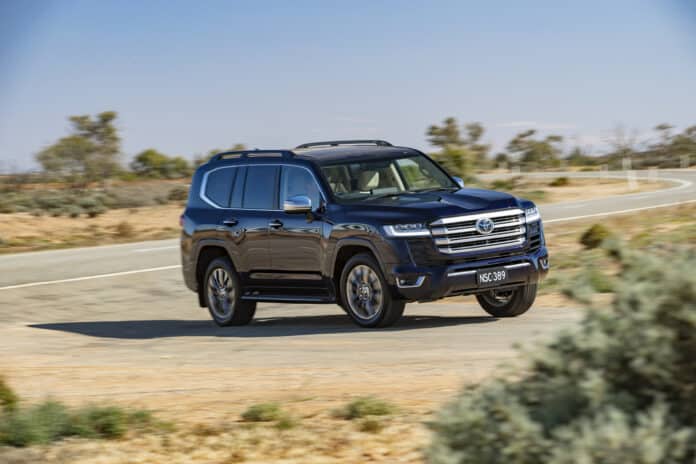

Quick Facts:
- Vehicle: 2027 Toyota Land Cruiser 300 hybrid (Japan market)
- Debut: September 16, 2026
- Powertrain: i-Force Max twin-turbo 3.5L V6 plus one electric motor
- Output: 457 hp and 583 lb-ft combined
- Fuel capacity: 18.0 gallons, down from 21.1
- Added weight: 375 lbs over the gasoline V6 it replaces
- Wading depth: 27.6 inches, unchanged
- Hybrid trims: ZX and GR Sport
- US availability: None announced
- Best for: Readers tracking where the Land Cruiser platform goes next
8 min read
In This Article
- The Land Cruiser 300 Hybrid Lands September 16
- Land Cruiser 300 Specs at a Glance
- What the i-Force Max Hybrid System Changes
- The Diesel Range Gets a Cheaper Door
- What the Land Cruiser 300 Hybrid Costs Overland Drivers
- Building Range Back Into a Land Cruiser
- How It Compares to the US Land Cruiser
- Final Verdict
- Frequently Asked Questions
The Land Cruiser 300 Hybrid Lands September 16
The land cruiser 300 hybrid reaches its home market on September 16. It arrives as the most powerful Land Cruiser Toyota has sold. Japanese outlet Creative Trend reports the automaker will drop the non-electrified gasoline V6 completely, according to Carscoops. In its place sits the i-Force Max hybrid system borrowed from the Lexus LX700h. Meanwhile the 3.3-liter twin-turbo diesel carries over. It also picks up a cheaper entry trim below the existing lineup.
Japan is the last major market to receive the 2027 Land Cruiser 300. Buyers in the Middle East, Eastern Europe, and Australia got access earlier this year. The 300 Series launched back in 2021. Because it received only modest infotainment work in early 2025, this counts as its most substantial revision so far.
For American readers, the frustrating part stays unchanged. Toyota sells no version of the 300 Series in the United States. Nothing in this announcement suggests a change either. Instead, the news matters as a signal. Toyota is committing its flagship body-on-frame platform to hybrid power while keeping diesel alive. The engineering trade-offs it accepted tell you where heavy overland vehicles head next.
The land cruiser 300 specs below cover both powertrains. Read them as a preview of what filters down to smaller Toyota 4x4s over the next generation.
Land Cruiser 300 Specs at a Glance
| Specification | Details |
|---|---|
| Hybrid powertrain | Twin-turbo 3.5L V6 plus single electric motor |
| Combined output | 457 hp (336 kW), 583 lb-ft (790 Nm) |
| Motor location | Inside the ten-speed automatic |
| Diesel option | Twin-turbo 3.3L V6, 304 hp, 516 lb-ft |
| Fuel capacity (hybrid) | 18.0 gallons (68 L), down from 21.1 (80 L) |
| Weight change | Plus 375 lbs (170 kg) |
| Wading depth | 27.6 inches (700 mm), retained |
| Hybrid trims | ZX and GR Sport, seven seats standard |
| Hybrid ZX price | ¥9,801,000 (about $61,400) |
| Top Pick | Best Premium | Best Compact | |
|---|---|---|---|
| Product | TOP PICK RotopaX 4 Gallon Pack RotopaX 4 Gallon Pack |  Wavian 20L NATO Can Wavian 20L NATO Can |  RotopaX 3 Gallon Pack RotopaX 3 Gallon Pack |
| Capacity | 4.0 gal | 5.3 gal | 3.0 gal |
| Material | Roto-molded HDPE | Military-grade steel | Roto-molded HDPE |
| Profile | 34 x 13.5 x 3 in | Upright, needs holder | 16 x 15 x 4.5 in |
| Price | $135.67 as of Sep 13, 2:38 pm | $134.99 as of Sep 13, 6:26 pm | $114.95 as of Sep 13, 6:26 pm |
| Check Price → | Check Price → | Check Price → |
What the i-Force Max Hybrid System Changes
The i-Force Max hybrid setup pairs a twin-turbo 3.5-liter V6 with one electric motor. Toyota mounts the motor inside the ten-speed automatic gearbox. Combined output reaches 457 hp and 583 lb-ft of torque. Both figures top anything Toyota has previously fitted to a Land Cruiser.
Torque delivery matters more than headline horsepower on rough ground. Because the motor sits in the transmission rather than on an axle, it fills the gap below turbo spool. Low-speed crawling gets smoother as a result. Throttle response also sharpens in the range where a heavy wagon needs it most.
Australian-market LandCruiser 300 Hybrid, 0-100 km/h and POV drive. Same i-Force Max powertrain arriving in Japan.
Both hybrid trims upgrade to electric power steering. Toyota Safety Sense adds Proactive Driving Assist alongside it. Standard equipment includes a 12.3-inch instrument cluster and a matching infotainment display. Buyers also get a head-up display, JBL audio, heated and ventilated seats, and a 100V 1,500W AC outlet.
Trim splits are simple as well. The flagship ZX takes a redesigned lower front bumper with new intakes and 20-inch alloys. Meanwhile the GR Sport keeps its rugged bodykit, matte gray 18-inch wheels, dual differential locks, and E-KDSS suspension.
The Diesel Range Gets a Cheaper Door
Toyota did not kill diesel to make room for the hybrid. Instead, the 3.3-liter twin-turbo V6 carries over at 304 hp and 516 lb-ft. A new GX trim also slots in as the cheapest way into a 2027 Land Cruiser 300. Leaked Japanese pricing puts the GX diesel at ¥6,300,800, or roughly $39,500.
Equipment on the GX stays deliberately plain, because Toyota built it to a price. Buyers get five seats, fabric upholstery, and 18-inch alloys. Screens shrink to a 7-inch cluster and an 8-inch infotainment display, with six speakers. Electric power steering stays exclusive to the hybrid, so the diesel keeps the older hydraulic setup.
Similarly, diesel buyers stepping up to ZX or GR Sport still get five seats rather than seven. Notably, the diesel ZX retains the previous exterior treatment. The restyled front end therefore stays hybrid-only. Therefore Toyota has drawn a visible line between the two powertrains, and it costs real money to cross.
What the Land Cruiser 300 Hybrid Costs Overland Drivers
Two numbers define the trade-off. First, the battery sits under the cargo area. It forces fuel capacity down from 21.1 gallons to 18.0. Second, the hybrid system adds 170 kg, or 375 lbs, over the gasoline V6 it replaces.
Losing 3.1 gallons matters more than the percentage suggests. On a rig averaging 15 mpg loaded, those gallons represent roughly 46 miles of reserve. Remote touring gets planned around exactly this kind of margin. Owners will therefore refill jerry cans more often or shorten legs between fuel stops.
The weight penalty compounds the problem. Adding 375 lbs before any gear goes aboard eats into payload. It also raises tire load requirements and increases the odds of digging in on soft sand. Anyone building a heavy tourer should read up on recovery gear for a heavier rig first.
Notably, Toyota did protect the 27.6-inch wading depth. Waterproofing the battery pack preserved it, which suggests the engineering team took the off-road brief seriously.
Building Range Back Into a Land Cruiser
Any owner facing a smaller tank solves the problem the same way. The badge makes no difference here, 300 Series or 250. External fuel storage restores the lost margin, and mounted containers beat loose cans for safety and packing efficiency. Two sizing rules apply. Match capacity to the longest fuel gap on your route, then mount the container where it does not raise the center of gravity more than necessary.
Fuel Packs Versus Steel Jerry Cans
For instance, flat-profile packs suit rear panels, bed racks, and swing-outs because they sit close to the body. Traditional steel jerry cans hold more per unit and survive decades of abuse. However, they need a dedicated holder, and they sit taller. Owners already carrying rooftop loads should keep the heavier option low, and Land Cruiser winch mounting follows the same weight-distribution logic at the other end of the vehicle.
Capacity math is worth doing before you buy. For example, a 4-gallon pack restores most of what the hybrid battery took away. Two 20-liter steel cans add about 10.6 gallons instead, which extends a 15 mpg rig by roughly 160 miles. Consequently, the right choice depends on whether you tour remote country or simply want a buffer for closed fuel stations.
Mounting location decides the rest. Rear swing-outs and bed racks keep mass low and behind the axle. In contrast, roof mounting raises the center of gravity on a wagon already carrying 375 lbs of new hardware. Similarly, fuel stored inside the cabin creates a fume problem no vent solves properly. Likewise, confirm any container you buy carries EPA and CARB compliance before you fuel up in California.
Running a Fridge Off a Hybrid Land Cruiser
Power storage deserves equal attention. The hybrid’s 100V 1,500W outlet handles a compressor fridge at camp. Even so, a parked vehicle running accessories still drains a starter battery. For this reason, most long-range builds pair a fridge with a second deep-cycle battery. Capacity planning starts with honest trip length. Our guide to sizing an overland fridge covers the 40L versus 55L versus 75L decision.

ICECO APL55 Dual Zone Portable Refrigerator Freezer Bluetooth Controlled, 55 Liter 12v refrigerator with SECOP Compressor, DC 12/24V, AC 110-240V, for Truck, Car and Home, -4℉~68℉ (Black)
A 55-liter dual-zone fridge sized for week-long trips without an ice run.
- Dual-zone divider runs fridge and freezer at once
- SECOP compressor holds temperature at up to 40 degrees of tilt
- Bluetooth app control from inside the cab
- Five-year compressor warranty
- At 63 lbs it needs proper strapping in the cargo area
- Larger footprint than a 35L unit in a packed wagon
How It Compares to the US Land Cruiser
The 300 Series and the Land Cruiser sold in America share a name and little else. American buyers get the 250 Series. It uses the smaller TNGA-F variant and a 2.4-liter turbocharged four-cylinder producing 326 hp. The Japanese flagship runs a V6 making 457 hp. It also rides on a longer wheelbase and seats seven on hybrid trims.
Price separates them further. The hybrid ZX converts to roughly $61,400. Meanwhile the HEV GR Sport tops the range near $63,900. Both sit well above the US 250 Series. Anyone weighing the American options should compare the Land Cruiser sold in the US against its 4Runner sibling. Those two overlap far more than either overlaps the 300.
Capability tells a similar story. The GR Sport keeps dual differential locks and E-KDSS suspension. American showrooms offer neither at any price. Toyota does keep feeding the US market, though. For instance, the 2027 Land Cruiser Trailhunter shows the direction domestic trims take.
Final Verdict
The land cruiser 300 hybrid suits a specific buyer. Picture someone in Japan, Australia, or the Gulf. They want maximum output from a body-on-frame wagon, and they accept a fuel penalty to get it. Its biggest strength is torque delivery. Filling the turbo lag gap with an electric motor makes a heavy wagon feel far more responsive at low speed.
The trade-offs land squarely on long-distance touring. Losing 3.1 gallons of tank while gaining 375 lbs works against the Land Cruiser core use case. Owners planning multi-day remote trips give up real margin. In addition, they pay roughly $14,800 more than the discontinued gasoline ZX.
On value, however, the diesel GX makes the stronger argument. Starting near $39,500 with 304 hp, it delivers the range story most buyers associate with the badge. Spending an additional $22,000 for the hybrid buys acceleration and equipment rather than capability.
For American readers, the practical recommendation stays the same as last year. Look at the 250 Series Land Cruiser or the 4Runner. Both use the smaller four-cylinder, and both sit in US showrooms today. Watch the 300 Series for one reason only. Whatever Toyota validates on the flagship tends to reach the rest of the lineup within a generation.
Frequently Asked Questions
Is the Land Cruiser 300 hybrid coming to the US?
No. Toyota has announced no plans to sell the 300 Series in the United States, and the hybrid update covers Japan, the Middle East, Eastern Europe, and Australia. American buyers get the smaller 250 Series instead.
How much power does the Land Cruiser 300 hybrid make?
Combined output reaches 457 hp (336 kW) and 583 lb-ft (790 Nm) of torque. Those numbers come from a twin-turbo 3.5-liter V6 paired with one electric motor. They represent the highest figures of any Land Cruiser to date.
Does the Land Cruiser 300 hybrid still wade 700 mm?
Yes. Toyota waterproofed the battery pack to retain the 700 mm rating, which equals 27.6 inches. Wading capability therefore matches the outgoing gasoline model despite the added electrical hardware.
How much fuel capacity does the Land Cruiser 300 hybrid lose?
Capacity drops from 80 liters to 68 liters, or from 21.1 gallons to 18.0. The battery mounted under the cargo area causes the reduction, costing roughly 3.1 gallons of usable range.
Is the diesel Land Cruiser 300 cheaper than the hybrid?
Considerably. Leaked Japanese pricing places the entry GX diesel at ¥6,300,800 (about $39,500). Meanwhile the hybrid ZX is expected near ¥9,801,000 (about $61,400). The diesel GR Sport tops out around ¥9,150,900, still below the cheapest hybrid.