



Quick Facts:
- Topic: The three Jeep traditions every owner runs into
- Traditions covered: Rubber ducks, the Jeep wave, hidden Easter eggs
- Oldest: The Jeep wave, with roots in WWII Willys drivers
- Newest: Duck Duck Jeep, started in 2020
- First Easter egg: 1997 Wrangler TJ, designed by Michael Santoro
- Community size: Ducking groups reached about 500,000 members by 2022
- Best for: New and curious Jeep owners
7 min read
In This Guide
Jeep Traditions Most New Owners Notice First
Buy a Jeep and you inherit a set of rituals no dealer explains. Three Jeep traditions stand out, and each one puzzles new owners at first. People leave rubber ducks on parked Wranglers. Drivers trade a quick two-finger wave on the road. Designers hide tiny Easter eggs in the bodywork. Together, these habits mark you as part of a community built around one boxy off-roader.
Outsiders find the whole scene odd, and plenty of first-time buyers do too. The pull runs deep, though. I no longer own a Jeep, yet I still catch myself waving at every one I pass. Once you learn the backstory, the behavior makes sense. Soon you do it without thinking.
Below, you get the documented origin of each ritual. You also learn the etiquette behind it. Specifically, you find out what earns a wave, the etiquette behind handing off a duck, and where the eggs hide on your own rig.
The Three Traditions at a Glance
These Jeep traditions started decades apart, yet they share one purpose. Each signals respect between owners of the same vehicle. Here is the short version before the full stories.
| Tradition | First Appeared | Where It Came From | How You Take Part |
|---|---|---|---|
| Duck Duck Jeep | 2020 | Allison Parliament, Ontario, Canada | Leave a rubber duck on another Jeep with a kind note |
| The Jeep Wave | 1940s to 1970s | WWII Willys drivers and early off-road culture | Wave first when your Jeep is newer, cleaner, or less modified |
| Hidden Easter Eggs | 1997 | Designer Michael Santoro, Wrangler TJ | Hunt your own Jeep for molded shapes and silhouettes |
Duck Duck Jeep: The Rubber Duck Tradition
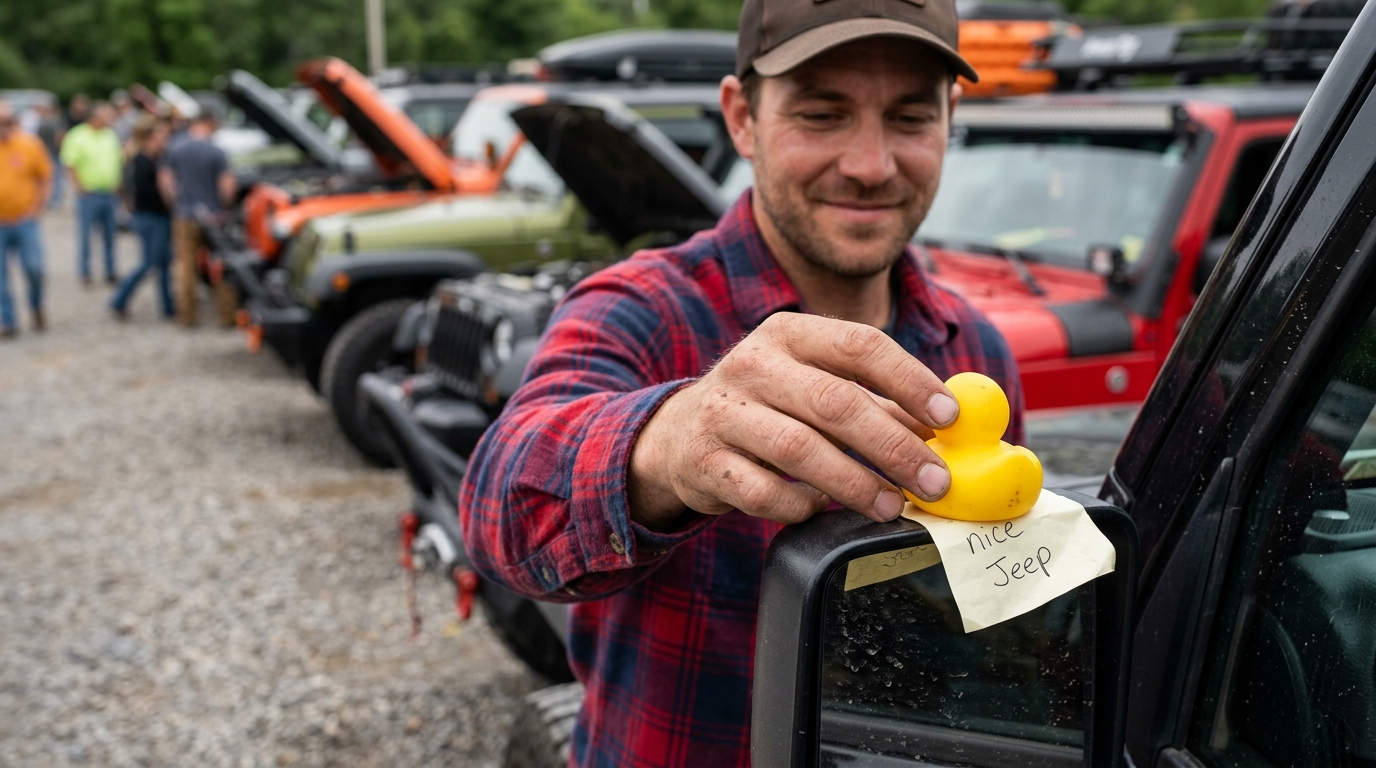
Ducking works in one simple move. You leave a rubber duck on another owner’s parked Jeep, usually with a short, kind note. The duck is a free gift, so finding one means a stranger admired your rig. As traditions go, Duck Duck Jeep is also the newest, and its origin is oddly specific.
In July 2020, a Canadian woman named Allison Parliament had a rough encounter in a store parking lot in Ontario. She wanted to answer it with something kind. So she grabbed a rubber duck, wrote “nice Jeep” on it with a marker, and set it on a nearby Wrangler.
The owner watched her do it. He suggested she post about the moment online. Her post spread fast, and the hashtag #DuckDuckJeep took off. Within two years, the ducking Facebook groups counted about 500,000 members. Stellantis, the company behind Jeep, leaned in. It parked the World’s Largest Rubber Duck outside the 2022 Detroit auto show.
Why do Jeeps have ducks beyond the joke? Because owners turned the gag into real charity. Duck-themed fundraisers have supported veterans, hearing centers, and St. Jude Children’s Research Hospital. BFGoodrich pledged ten cents to Parliament’s “Ducking for Teachers” campaign for every sweepstakes entry. Parliament died unexpectedly in June 2024. Still, the tradition she sparked keeps spreading.
The Etiquette of Ducking
Jeep ducking carries a few unwritten rules. Owners treat it as a small act of kindness, never a bid for attention. They leave a short note or tag so the recipient understands the gesture. Self-ducking is discouraged, since most owners see it as missing the point. Many purists reserve the practice for Wranglers, though plenty of people now duck any model they pass.
The Jeep Wave and Its Unwritten Rules

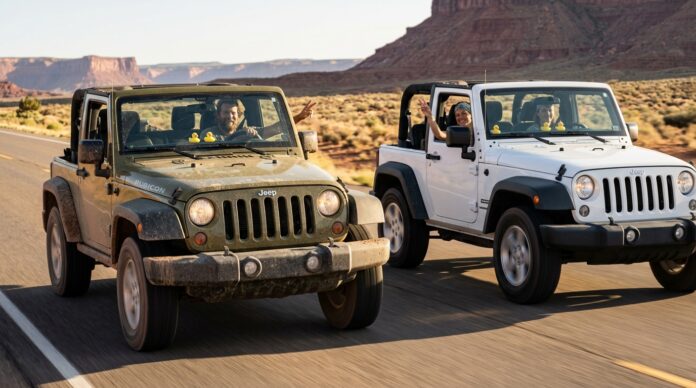
The Jeep wave is the oldest of the three rituals, and its exact birthday stays unclear. Most accounts point to three overlapping theories. One says WWII soldiers waved while driving Willys MB Jeeps on patrol. Another credits returning veterans who bought early CJ models. The most popular version places the wave in the 1960s and 1970s. Back then, off-road culture grew, and drivers of a rare vehicle greeted each other as kindred spirits.
However the wave began, it now runs on a loose hierarchy. Knowing the Jeep wave rules keeps you from looking like a rookie. The core idea stays simple: the lesser Jeep waves first. A clean daily driver defers to a muddy trail rig. A new model defers to a vintage one. Respect climbs with age, modifications, and visible trail use.
Who Waves First
Four guidelines shape the order. First, respect your elders, because an original Willys or a classic CJ outranks a fresh Wrangler. Second, reward the build, since winches, snorkels, and oversized tires raise a Jeep’s standing. Third, honor the mud, as a rig fresh off the trail beats one straight from the car wash. Finally, accept the model matters, so a rock-ready Wrangler sits above a city-bound Grand Cherokee.
Do not take a missed wave personally. Some drivers focus on traffic, while others simply never spot you. The ritual rewards consistency, not scorekeeping. Wave anyway, and let the next owner decide whether to answer.
The wave itself stays easy. Most drivers lift two or four fingers off the wheel. Others raise a full hand above the windshield. Jeep liked the gesture enough to name its owner program the Jeep Wave. Still, the roadside version asks nothing of you except a wave back when someone greets you first. If you drive a modern model, study the 2026 Jeep Wrangler compared to the Toyota 4Runner to see why Wranglers still earn the most enthusiastic waves.
Hidden Easter Eggs: A 1997 Secret
Jeep Easter eggs hide in plain sight, and they began with one designer on a tight budget. These eggs are small shapes molded into the body, glass, and trim. In 1996, Chrysler handed designer Michael Santoro the 1997 Wrangler TJ. Most of the body carried over from the previous model. The redesign budget sat near $150 million, which Santoro called “coffee money” by car-industry standards.
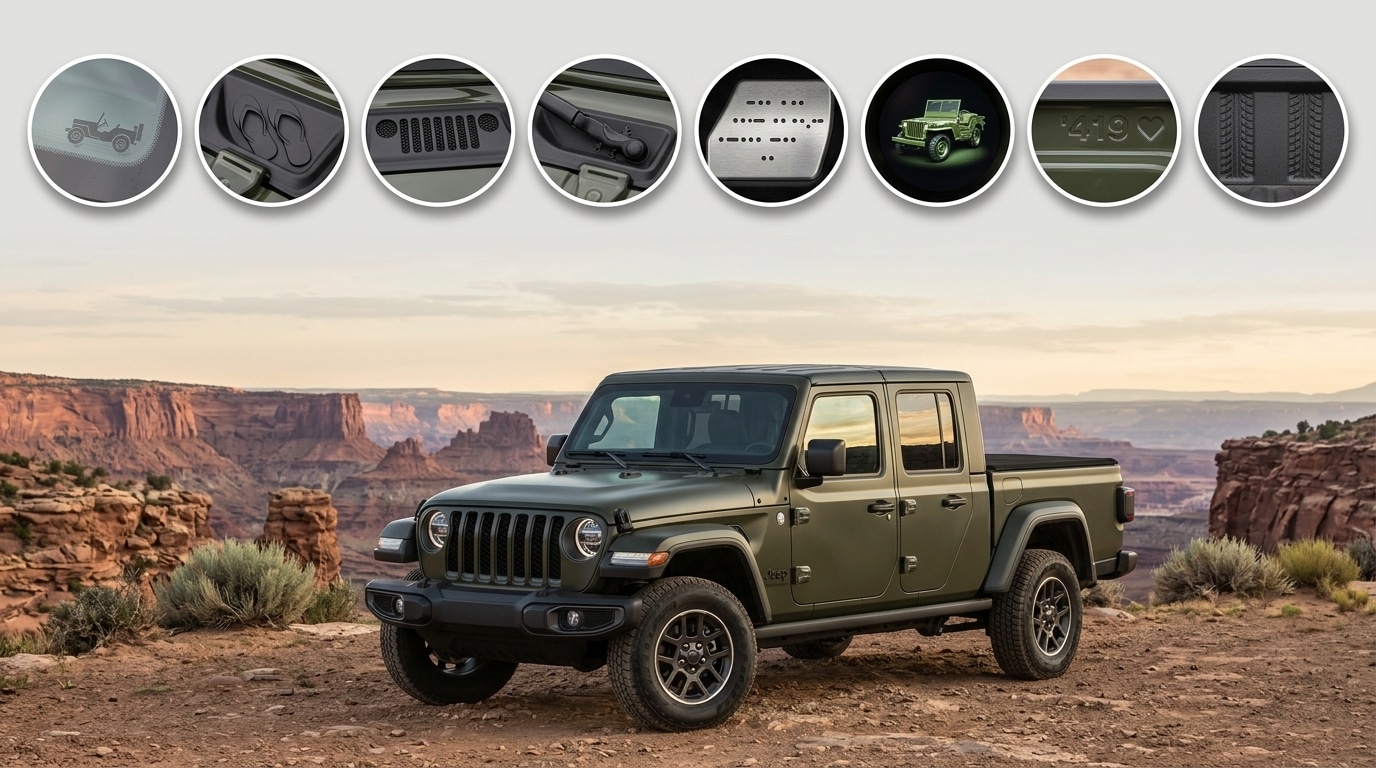
Working with the few panels he controlled, Santoro repeated Jeep’s seven-slot grille shape inside the cowl vent. Before his change, the vent held plain slots with no identity. After it, the cowl quietly echoed the brand’s face. Many owners point to this detail as the first Jeep Easter egg. For years, nobody noticed.
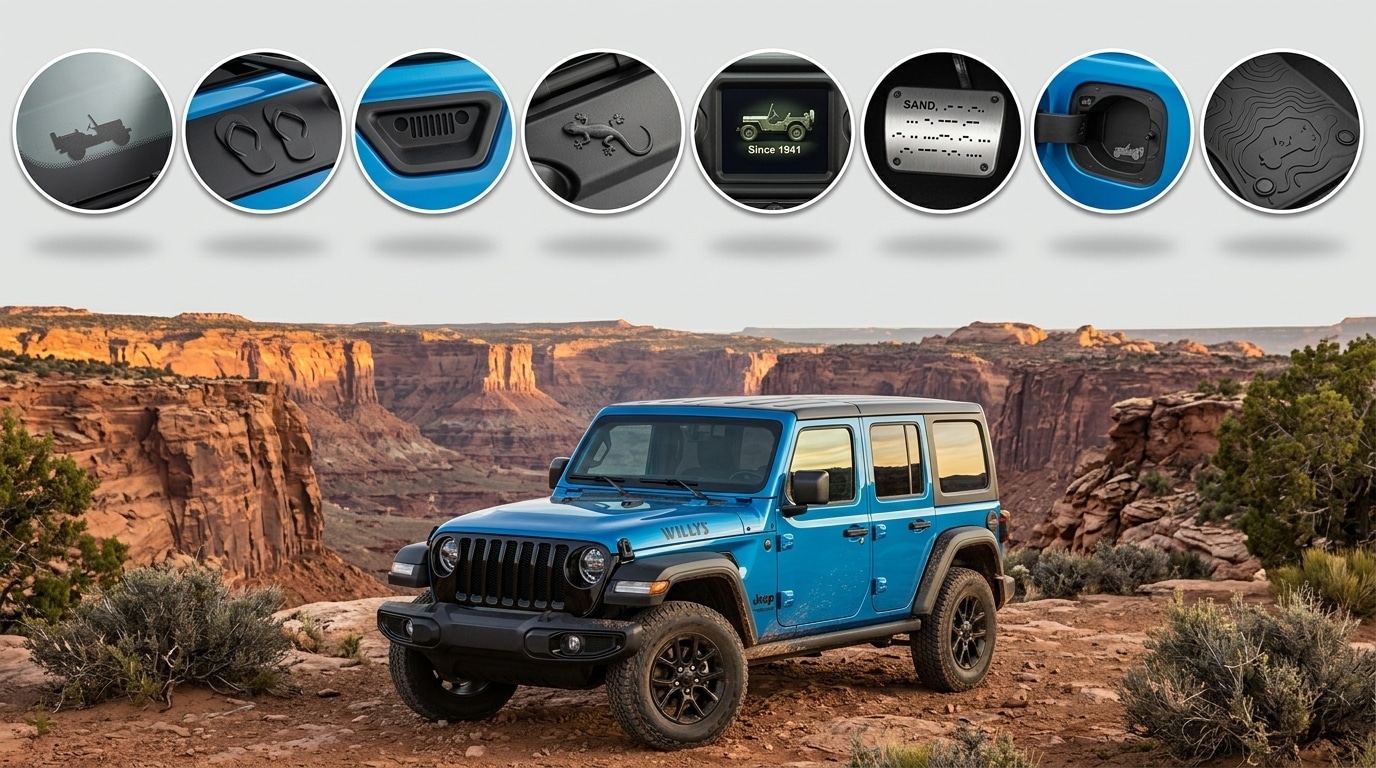
What started as one signature grew into a company habit. Later models added a small lizard, a spider, a Tyrannosaurus, and a tiny 1940s Willys silhouette climbing the windshield glass. Designers now tuck Jeep Easter eggs into headlights, storage cubbies, cowl panels, and infotainment screens. Because every Jeep hides a few, owners treat each new vehicle as a scavenger hunt. Then they trade discoveries online.
Some eggs honor the brand’s history. On startup, many Jeeps flash “Since 1941” on the instrument cluster, a nod to the first military Jeep. Compass and Renegade models hide a Loch Ness monster, while several dashboards carry Morse code spelling “Sand, Snow, Rivers, Rocks.” Part of the fun comes from comparing finds with other owners, since no two model years hide the same set.
How the Tradition Spread Beyond Jeep
The ducking idea proved popular enough for other brands to copy it. Subaru owners launched a “Moo Moo Subaru” group in 2023 and placed rubber cows on each other’s cars. Within six months, the group reached 36,000 members. Mini drivers adopted ducking too. Some Chevrolet owners started “sharking” with plastic sharks. Bronco and Toyota fans tried “buck buck Bronco” and “yoda yoda Toyota.”
None of these copycats match the scale of the original. Still, they show how one Jeep tradition reshaped car culture across brands. The wave and the Easter eggs stayed Jeep-only, while the ducks jumped the fence. For owners, this reach is a quiet point of pride.
Jeep Traditions in Practice
None of these Jeep traditions require permission, and owners take part in different ways. Those who duck keep a few rubber ducks in the console, pick a Jeep they admire, and leave one with a friendly note. They avoid ducking their own rig, since self-ducking misses the point. With the wave, the lesser Jeep tends to go first, while most drivers return any wave they receive.
Not every owner embraces ducking, however. Some find the gesture puzzling, and many stay lukewarm on it. The Easter eggs draw wider interest, since the hunt costs nothing and reveals real design history. Owners scan the cowl, the windshield corners, the headlight housings, the cargo area, and the speaker grilles on each new Jeep. Together, the ducks, the wave, and the eggs show how a vehicle becomes a community, whether or not you join in on all three.
Frequently Asked Questions

Why do Jeep owners put rubber ducks on other Jeeps?
Owners duck other Jeeps as a random act of kindness. The Duck Duck Jeep tradition began in 2020 when Allison Parliament wrote “nice Jeep” on a rubber duck and left it on a Wrangler after a bad day. Her viral post turned the gesture into a nationwide habit, often tied to charity fundraisers.
What are the Jeep wave rules and who waves first?
The unwritten Jeep wave rules say the lesser Jeep waves first. A newer, cleaner, or less modified Jeep greets an older, muddier, or more built one. Respect rises with a model’s age, its off-road modifications, and visible evidence of real trail use.
Where are the hidden Easter eggs on a Jeep?
Jeep Easter eggs hide on the windshield glass, inside the cowl vent, around the headlights, in storage cubbies, on speaker grilles, and within infotainment screens. Common designs include lizards, spiders, a compass, flip-flops, and a small Willys silhouette climbing the windshield.
Do you duck your own Jeep?
No, ducking your own Jeep breaks the etiquette. The point is to surprise another owner with a small act of kindness, so a duck on your own vehicle defeats the purpose. Owners keep ducks ready for other Jeeps instead.
Are these Jeep traditions only for Wranglers?
Not officially, though Wranglers sit at the center of all three. Many purists reserve ducking and the strongest waves for Wranglers, while Easter eggs appear across the entire Jeep lineup. In practice, every Jeep model takes part to some degree.
Who started the Duck Duck Jeep trend?
Allison Parliament started it in July 2020 in Ontario, Canada. After an unpleasant parking-lot encounter, she left a marked rubber duck on a Wrangler and posted about it. The idea spread across North America, and she became known in the community as the Mother Ducker. She died in June 2024.