



Quick Facts:
- Topic: Ford Super Duty Army truck prototypes for the Infantry Squad Vehicle Heavy program, shortened to ISV-H
- Ford’s entry: Three prototypes built on the F-Series Super Duty
- Rivals: GM Defense with a Chevrolet Silverado 3500 HD, plus BC Customs of Utah
- Headline requirement: 60 kW of continuous high-voltage DC power
- Deadline: Prototypes due March 30, 2027
- Contract value: Not released by the Army
- Best for: Truck owners tracking where heavy-duty pickup engineering goes next
8 min read
In This Article
- What Ford Won, and What Most Coverage Got Wrong
- Key Facts at a Glance
- Why Ford Left Defense in 1990 and Wants Back In
- Inside the Infantry Squad Vehicle Heavy Program
- The Army’s Shopping List: 60 kW, Six Seats, 250 Miles
- Ford’s Power Gap: 2 kW Today, 60 kW Wanted
- GM’s Head Start With the Chevy Silverado HD
- Ford Super Duty Army Truck vs. Silverado 3500 HD
- Where the Ford Super Duty Army Truck Race Stands
- Frequently Asked Questions
What Ford Won, and What Most Coverage Got Wrong
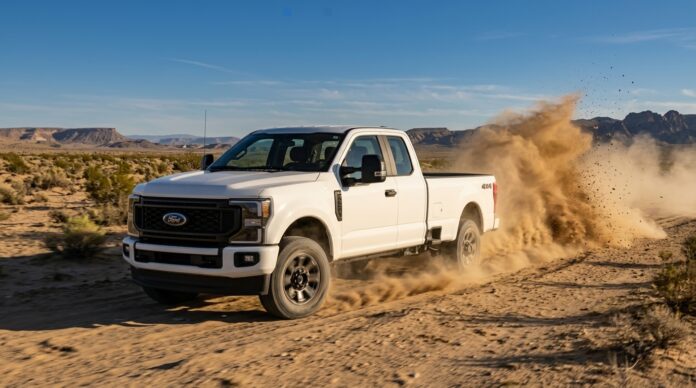
The Army wants a pickup delivering 60 kW of continuous high-voltage DC power in the field, and the Ford Super Duty Army truck prototypes are Ford’s entry. Ford confirmed the U.S. Defense Department award on July 27, 2026, covering three prototype trucks for testing. Spokesman Dave Tovar told the Detroit News the F-Series Super Duty makes “an ideal platform for military use.”
Ford does not own this race, though. The Army handed out three awards on June 30, 2026, not one. GM Defense and BC Customs LLC, a family-owned off-road builder in Utah, each won the same deal Ford did. Because every vendor delivers three trucks, nine prototypes head to testing.
Most coverage framed the news as a two-way Detroit brawl. Several outlets left BC Customs out of the headline entirely. Reporting from Breaking Defense confirms all three entries sit at the prototype stage, so nobody holds a production win yet.
For a truck audience, the flag-waving matters less than the engineering brief. No retail heavy-duty pickup comes close to the power output the Army has asked for. Meanwhile the delivery deadline lands in March 2027, which gives Ford roughly eight months to show hardware.
Key Facts at a Glance
| Item | Detail |
|---|---|
| Program | ISV-Heavy, run by the U.S. Army |
| Winners | Ford, GM Defense, BC Customs LLC |
| Award mechanism | Other Transaction Agreements, June 30, 2026 |
| Prototypes | Nine total, three per vendor |
| Delivery due | March 30, 2027 |
| Testing agency | Army Test and Evaluation Command |
| Fleet target | 606 vehicles |
| Crew size | Six soldiers, down from nine on the base ISV |
| Power target | 60 kW of high-voltage DC, 15 kW of 28V DC, 4.8 kW of 120V AC |
| Range target | 250 miles on three-quarters of a tank |
| Armor | None fitted, although add-on kits stay possible |
| Ford platform | F-Series Super Duty |
| GM platform | Chevrolet Silverado 3500 HD, diesel-electric hybrid |
Why Ford Left Defense in 1990 and Wants Back In
Ford built military hardware long before it built Super Duty pickups. During World War I the company supplied ambulances and engines. Ford’s corporate history says its plants turned out 277,896 vehicles in 1942, a figure most closely tied to its production of the Ford GPW jeep. Meanwhile, Willow Run finished a B-24 bomber every 63 minutes at its 1944 peak. The plant turned out 8,685 Liberators in all, from a wartime total above 18,000.
Then the company walked away. Ford sold Ford Aerospace in 1990 and largely exited defense work. The unit now sits inside Lockheed Martin, the same firm GM partnered with in June 2026. Since 1990, Ford has supplied police fleets and export Rangers instead of an Army tactical truck program, which is why several outlets call this a 36-year hiatus.
Ford’s return runs broader than one contract. In June 2026 the company showed tactical and utility vehicles at Eurosatory in Paris, the largest land defense exhibition in the world. CEO Jim Farley has described defense as a less cyclical business worth entering. Ford also sells a Ford Super Duty Proud to Honor package to civilian buyers, although a trim badge and a defense contract are separate matters.
Inside the Infantry Squad Vehicle Heavy Program
The heavy program grew out of a truck already in service. Since 2020, GM Defense has supplied the Army with the M1301 Infantry Squad Vehicle. The nine-seat runabout rides on the Chevrolet Colorado ZR2 with roughly 90% commercial parts. Soldiers move fast in it. They cannot power much with it.
ISV-H answers the second problem. It carries six soldiers instead of nine and rides on a heavy-duty commercial frame. Military Times puts the weight increase at roughly 9,000 pounds over the base truck. Notably, “heavy” describes the chassis rather than armor. The vehicle ships unarmored, although the design allows add-on protection kits later.
The Army published its commercial solutions opening in March 2026 and closed the white-paper phase on April 13, 2026. Then awards followed on June 30, months earlier than acquisition officials had signaled to lawmakers. Consequently, the three winners now work against a compressed schedule.
BC Customs, the third name on the list
BC Customs LLC builds off-road vehicles in Utah, and it beat far larger defense suppliers for a seat at this table. The company did not respond to a request for comment, so its base platform stays unknown. For anyone who follows small-shop truck builders, a family-owned outfit standing alongside two Detroit giants is the most surprising detail in the whole award.
The Army’s Shopping List: 60 kW, Six Seats, 250 Miles
The requirement list explains why this program exists. Specifically, the Army wants a truck delivering 60 kW of continuous high-voltage DC power, plus 15 kW of 28V DC and 4.8 kW of 120V AC. Those figures come straight from the service’s contracting notice. Jesse Tolleson, a senior Army acquisition official, calls mobile electrical power a “critical capability gap.”
Sixty kilowatts runs a command post, charges drone fleets, and feeds counter-drone gear in the field. Compared to a generator trailer, a truck doing the same work saves fuel, crew and towed weight. Therefore the power spec, not the payload spec, drives the whole design.
Mobility targets round out the brief. Each truck needs soft-soil capability and 250 miles of range on three-quarters of a tank. Six seats replace nine. Any 4×4 owner who has watched a loaded rig sag at the rear knows the tension between weight and capability. Our guide to payload capacity and GVWR covers the same math, because the Army applies it to a battlefield truck.
Ford’s Power Gap: 2 kW Today, 60 kW Wanted
Ford’s showroom hardware sits nowhere near the Army’s brief. The 2026 Super Duty offers Pro Power Onboard rated at up to 2 kW of 120V AC, according to Ford’s own configurator. Measured against the Army’s 4.8 kW AC line alone, the retail truck falls short by more than half. The 60 kW high-voltage DC line is the harder problem, because no retail Super Duty produces high-voltage DC at all.
Sixty kilowatts roughly matches a towable diesel generator set, enough to run a small command post while charging a flight of drones. Moreover, Detroit News reported the current Super Duty lacks the bidirectional charging Ford built into the F-150 Hybrid. The truck carries no high-voltage architecture to scale up. Ford has not announced a powertrain for its Super Duty prototypes. Some form of electrification looks close to unavoidable, although the company has stayed quiet.
None of this rules Ford out. For example, the Super Duty brings a 6.7L Power Stroke diesel making 500 horsepower and 1,200 lb-ft in high-output form. It tows up to 30,000 pounds with a conventional hitch. Ford Pro adds global service and parts support. Our review of the F-250 Super Duty covers the chassis strengths Ford leans on. However, building 60 kW into it is a clean-sheet job.
GM’s Head Start With the Chevy Silverado HD
GM Defense arrives with homework already done. Its entry is a militarized Chevy Silverado HD, specifically the Silverado 3500 HD, running a diesel-electric hybrid powertrain. GM describes the truck as a mobile energy source able to operate in silent mode, which cuts acoustic and thermal signatures.
Silent drive and silent watch matter more than horsepower in this competition. A hybrid should also give GM a head start toward the 60 kW target, because the traction battery and generator already exist. GM Defense has field-tested a heavy prototype with the 4th Infantry Division, so soldiers have handled the concept.
Incumbency helps in other ways. GM Defense expects around $700 million in revenue during 2026. Moreover, GM CEO Mary Barra has pointed to a $1 billion Army order for 10,000 Colorado-based light utility vehicles. The program sits apart from ISV-H. Our Colorado ZR2 long-term review covers the civilian truck underneath the fleet. In June 2026, GM also partnered with Lockheed Martin, which deepens its defense bench further.
Ford Super Duty Army Truck vs. Silverado 3500 HD
The two Detroit entries start from different places. Ford brings the stronger commercial chassis and the wider service footprint, while GM brings a running hybrid prototype and six years of Army delivery history. Compared side by side, Ford competes on hardware and GM competes on readiness.
| Factor | Ford | GM Defense |
|---|---|---|
| Base truck | F-Series Super Duty | Chevrolet Silverado 3500 HD |
| Announced powertrain | Not disclosed | Diesel-electric hybrid |
| Onboard power today | 2 kW Pro Power Onboard on the retail truck | Hybrid prototype with silent drive and silent watch |
| Army delivery record | None since 1990 | ISV since 2020, roughly 1,100 fielded |
| Defense partner | None announced | Lockheed Martin, June 2026 |
| Prototype status | In development | Field-tested with 4th Infantry Division |
Read the table as a snapshot, not a verdict. Ford has kept its powertrain plans private, which is normal this early. Meanwhile, the Army has not disclosed the dollar value of any of the three awards, so nobody outside the program knows the budget behind each build.
Where the Ford Super Duty Army Truck Race Stands
This Army tactical truck competition is a prototype contest, not a production win, and treating it as more overstates the news. Three vendors deliver nine trucks by March 30, 2027. Army Test and Evaluation Command then runs operational assessments before anyone talks about 606 production vehicles.
GM enters as the favorite on evidence rather than sentiment. Its hybrid Silverado 3500 HD already exists, soldiers have driven it, and its ISV fleet gives the Army six years of maintenance data. In contrast, Ford enters with the better base chassis and no public answer to the 60 kW question.
BC Customs deserves attention out of proportion to its size. The Army used an Other Transaction Agreement here, a contracting tool built for speed, and small builders tend to move quickly. A Utah shop landing an upset would be the best truck story of 2027.
For readers, the number worth watching stays 60 kW. Whichever company solves high-output exportable power on a heavy-duty pickup chassis will own technology with obvious civilian value, from job sites to expedition rigs. If Ford answers the brief with its Super Duty prototypes, the technology has a plausible path into the truck sitting on a dealer lot.
4wdTalk will update this article when the ISV-H prototypes arrive in March 2027, and again when Army Test and Evaluation Command releases its assessment.
Frequently Asked Questions
Does the military use Ford trucks?
Yes, though mostly outside front-line tactical roles. Governments run Ford Rangers for military transport, and Ford Police Interceptor Explorers serve law enforcement fleets worldwide. The Super Duty prototypes represent Ford’s first serious run at a U.S. Army tactical truck program since 1990.
How much does an Infantry Squad Vehicle cost?
The base ISV works out to roughly $330,000 per truck, based on the Army’s 2020 contract of $214.3 million for 649 vehicles. The Army has not released pricing for ISV-H prototypes, so treat any figure attached to the Ford or GM builds as speculation.
Is the Ford Super Duty better than the Silverado for military use?
Neither truck has proven itself in this role yet. Ford offers more diesel torque and a larger service network, while GM offers a working hybrid drivetrain and a delivery record with the Army. The Army’s test results will settle the question with data instead of brand loyalty.
Is the ISV replacing the Humvee?
No. Congressional Research Service documents place the ISV alongside the JLTV and the HMMWV inside the Army’s light tactical vehicle fleet. The ISV fills a mobility niche where heavier vehicles work poorly, so it supplements the Humvee rather than replacing it.
Is the Infantry Squad Vehicle available to civilians?
No. GM Defense builds the ISV for government buyers, including allied militaries such as Canada, and the trucks carry military-specific hardware such as rollover protection and airlift tie-downs. The closest retail equivalent stays the Chevrolet Colorado ZR2 the ISV derives from.