


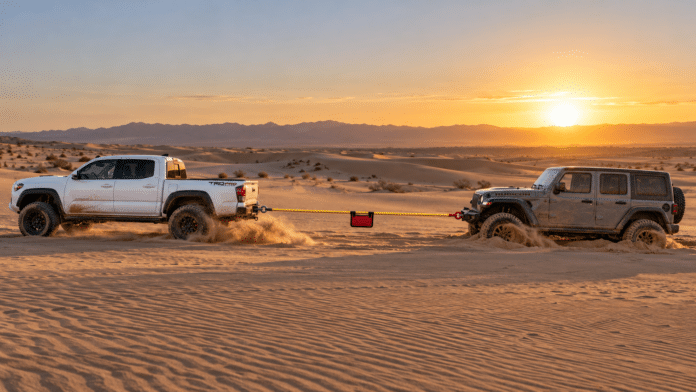
Quick Facts:
- Kinetic rope stretch: Up to 30% of its length, per Factor 55 and Saber.
- Snatch strap stretch: About 20%, per ARB and Harbor Freight strap listings.
- Rope build: Double-braided nylon with spliced eyes.
- Strap build: Flat woven nylon webbing with sewn loops.
- Sizing rules: Brands recommend 2 to 6 times vehicle weight, usually the lighter vehicle’s.
- Price range: About $105 to $225 for a 7/8-inch kinetic rope; $75 to $135 for an ARB snatch strap.
- Rope fits best: Deep sand, snow, and mud, plus frequent recoveries.
- Strap fits best: Budget kits, tight storage, and occasional pulls.
- Never pair with: A tow ball or a hooked tow strap.
12 min read
In This Guide
- Overview: Two Tools, One Job
- How a Kinetic Rope and a Snatch Strap Store Energy
- Kinetic Rope vs Snatch Strap: Side by Side
- What Size Kinetic Rope Do You Need?
- Shackles and Recovery Points: The Weakest Link
- How to Run a Safe Kinetic Recovery
- Care, Inspection, and When to Retire a Line
- Final Thoughts
- Frequently Asked Questions
Overview: Two Tools, One Job
A kinetic rope stretches farther and pulls softer than a snatch strap, but it costs more to own. Factor 55 rates its ropes for up to 30% stretch. In contrast, a typical snatch strap stretches about 20%. Both pull a stuck vehicle free with stored energy. Each one stretches as the recovery vehicle rolls away, then snaps back and tugs the stuck rig out.
Both tools belong to the same family, so the choice comes down to how you wheel. If you drive deep sand, soft snow, or sticky mud, the extra stretch earns its keep. On the other hand, a strap rolls up small and costs less, which suits a first recovery kit. Plenty of forum regulars end up carrying both: a rope for stuck vehicles and a static tow strap for towing.
Because both lines store real energy, the gear around them matters as much as the line itself. A rope pulled from a tow ball or a bolt-on tie-down turns metal into a projectile. This guide also covers sizing, shackles, rated points, and care, because those details decide whether a recovery goes smoothly.
I’ve built my own rigs over the years, and for me, the hardware matters more than the brand of line. Owners on Expedition Portal, Overland Bound, and the Bronco and Raptor forums agree on one point. Failures start at hitch balls and weak recovery points far more often than at the rope. If you’re still deciding between a line and a winch, read our breakdown of a snatch strap versus a winch first.
How a Kinetic Rope and a Snatch Strap Store Energy
Both tools work like a rubber band between two vehicles. The recovery vehicle builds a little momentum with some slack in the line. Next, the line tightens and stretches, storing the energy. Finally, the line contracts and transfers the pull to the stuck vehicle, which rolls free without a hard jolt.
Inside a Kinetic Recovery Rope
A kinetic recovery rope uses double-braided nylon: a braided core inside a braided cover. Bubba Rope, for instance, builds its lines from 100% double-braided nylon with spliced and seized eyes. Saber uses Nylon 66 and rates its ropes for about 30% stretch. As a result, the rope stretches farther and recovers more gently than flat webbing of similar strength.
The round profile also helps with wear. A rope has no flat edge to nick, so a small scuff does not cut across the whole load path. Similarly, spliced eyes spread the load through the braid instead of relying on a row of stitches. Pirate4x4 and Expedition Portal members credit both details for a longer service life under repeated pulls.
Inside a Snatch Strap
A snatch strap is flat woven nylon webbing with a sewn loop at each end. The weave limits stretch to roughly 20%, so the pull feels firmer. Harbor Freight’s 3-inch by 30-foot Badland strap lists a 30,000 lb break strength and 20% stretch. Its 10,000 lb figure is a working load, not a breaking strength. However, sewn loops remain the weak point, and a nicked edge means the strap is done.
Straps still earn a place in plenty of kits. They roll tight and carry a lower price than a branded rope. For instance, ARB lists its snatch straps between $74.95 and $134.95, depending on rating. Our guide to tree saver straps and snatch straps covers where each strap type fits.
Recovery Strap vs Tow Strap: The Costly Mix-Up
The recovery strap vs tow strap confusion causes more damage than any brand choice. A tow strap is usually low-stretch polyester, and many come with metal hooks on each end. Because it barely stretches, a tow strap shock-loads both vehicles when you snatch with it. Worse, a hook or a broken strap end turns into a missile under load.
Threads on Tacoma World describe budget “recovery straps” sold as snatch straps, which turn out to be static polyester tow straps. Therefore, read the label for material and stretch before you buy. If a listing skips the stretch figure, treat it as a tow strap and use it only for steady towing on flat ground.
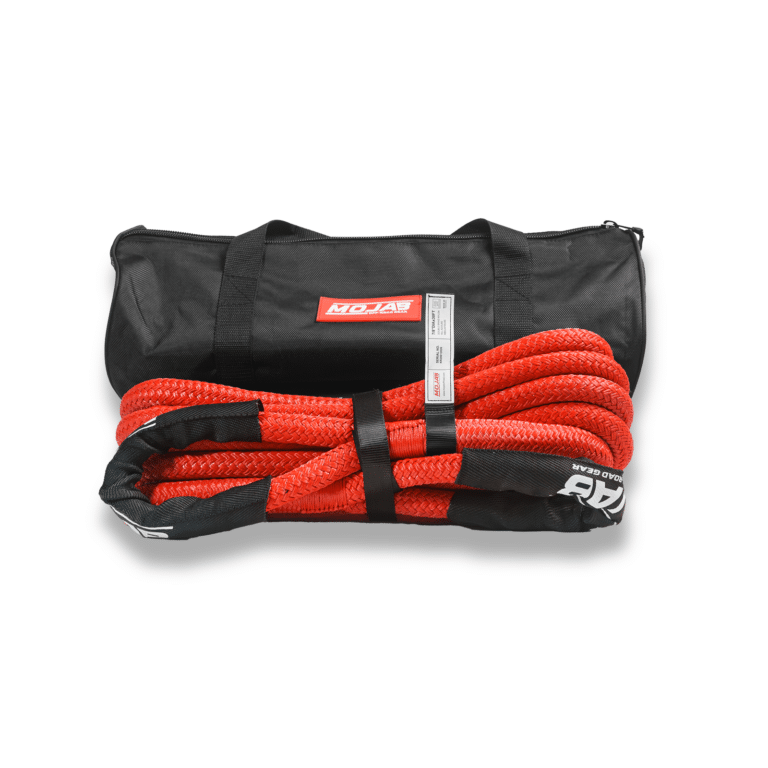
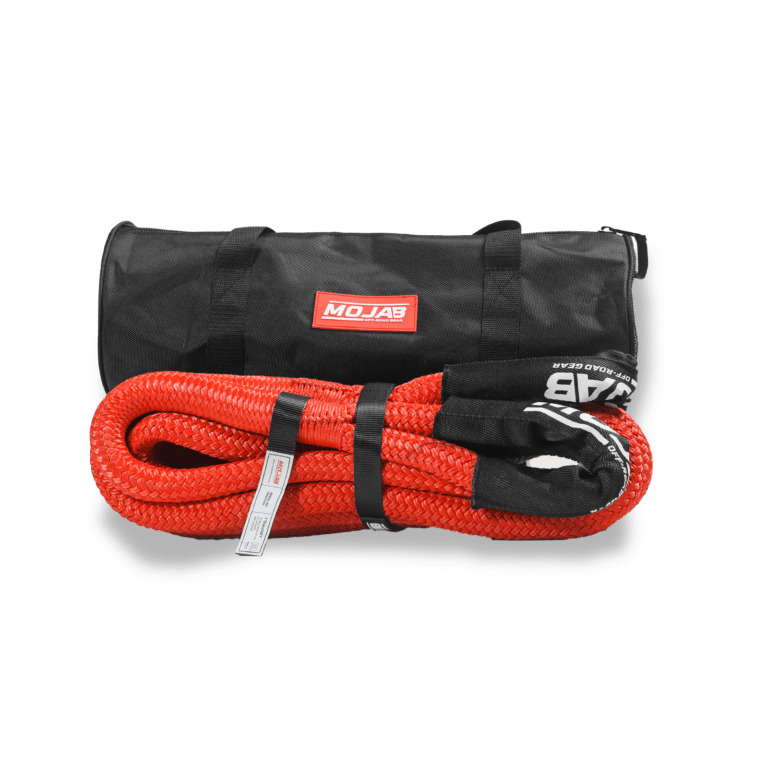
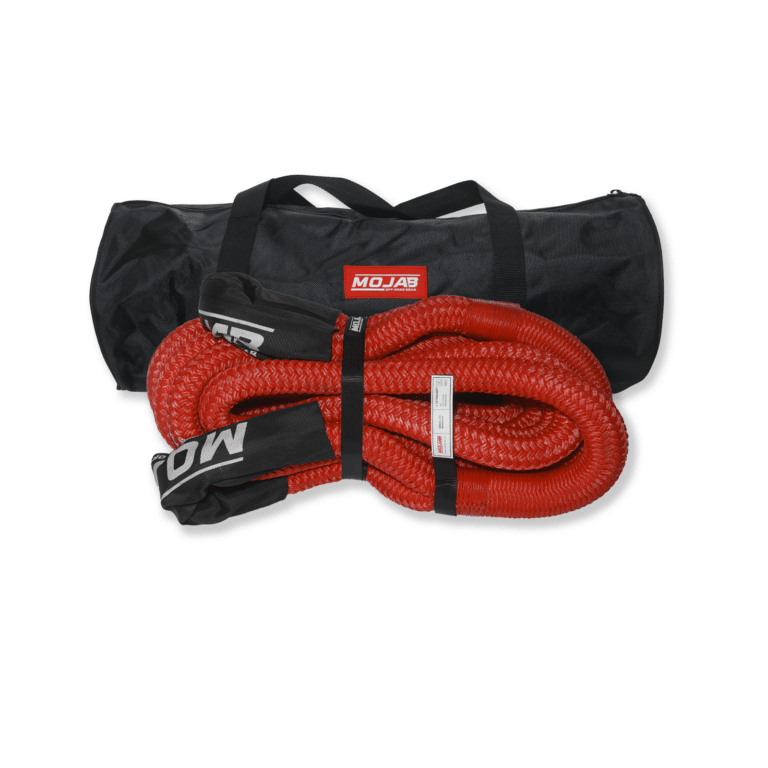
A true kinetic rope lists both figures on the page. For example, 4xSolar lists nylon 6.6 and 30% stretch for its MOJAB 7/8-inch rope. MOJAB also comes in 1-inch and 1-1/2-inch sizes, and the size chart below shows where each one fits.
MOJAB Kinetic Ropes at 4xSolar

Kinetic Rope vs Snatch Strap: Side by Side
The table below lines up the differences owners and manufacturers point to most. Stretch and price drive most buying decisions, while storage and wear decide how the line holds up over a few seasons.
| Factor | Kinetic Rope | Snatch Strap |
|---|---|---|
| Stretch | Up to 30% | About 20% |
| Construction | Double-braided nylon, spliced eyes | Woven nylon webbing, sewn loops |
| Feel of the pull | Softer, gradual tug | Firmer, sharper tug |
| Typical price | About $105 to $225 for 7/8-inch ropes | $74.95 to $134.95 (ARB) |
| Storage | Bulky coil, usually in a bag | Rolls flat and tight |
| Weak point | Grit, UV, and worn eyes | Sewn loops and nicked edges |
| Best terrain | Deep sand, snow, and mud | Light stucks and occasional use |
Where Each Line Wins and Loses
The softer pull is the theme owners raise most often. On IH8MUD and Tacoma World, people who carry both describe the rope as clearly easier on vehicles and recovery points. If I were building a recovery bag from scratch, the kinetic rope would be the first line I’d buy, mostly for the gentler pull owners keep pointing to.
Price is the main argument against the rope. A mid-size rope from Rhino USA runs $104.90 for 7/8 inch by 20 feet, while ARB’s lighter strap sells for $74.95. Some forum regulars also call kinetic ropes marked-up double-braid boat line. Storage counts against the rope too, especially in a packed rig. A coiled 30-foot rope takes more space than a rolled strap.
Durability splits the other way. Straps lose stretch after repeated pulls, and their sewn loops wear first. In contrast, owners credit ropes with longer life thanks to spliced eyes and no exposed edges. Still, a rope needs more care, which the care section below covers. In short, the rope suits frequent pulls in soft ground. The strap suits a tight budget, a packed rig, and light stucks.
For measured numbers, Project Farm tested seven kinetic ropes, including Bubba Rope and Rhino USA. The video tracks stretch under load, lasting stretch, and wear after 25 pulls.
What Size Kinetic Rope Do You Need?
Sizing starts with one number: the minimum breaking strength printed on the line. Every brand ties this figure to vehicle weight, yet they disagree on the multiplier. Saber recommends 2 to 3 times gross vehicle mass. Australia’s mandatory recovery strap standard requires the same 2x to 3x guidance on strap labels. Bubba Rope suggests 3 to 4 times the weight of the vehicle being recovered. Factor 55 goes higher, at 4 to 6 times the gross vehicle weight rating (GVWR) for typical trucks and SUVs.
Why the Rules Disagree, and Which One to Follow
The spread comes down to a trade-off between margin and stretch. A heavier line adds a safety margin, although an oversized line stretches less under the same load. As a result, an oversized line pulls harder and loses the soft tug you paid for. Several forums carry one repeated warning: don’t oversize. Also, Factor 55 and Saber both say to size the line to the lighter of the two vehicles.
Use your loaded weight, not the brochure curb weight. A rooftop tent, water, and a fridge push an overland rig closer to its GVWR. Our guide to payload capacity and GVWR covers the math. For most readers, aim for a rating between 3 and 4 times GVWR. This band matches Bubba Rope’s rule and sits between the Saber and Factor 55 ranges. It also keeps useful stretch.
Kinetic Rope Size Chart by Vehicle Weight
The chart below applies each brand’s multiplier to common vehicle weights. Then the right column lists a published rope inside at least one brand’s range. On the lightest and heaviest rows, the example rates above the 3x to 4x band, so weigh those rows against the oversizing warning.
| Lighter Vehicle GVWR | 2x to 3x (Saber) | 3x to 4x (Bubba Rope) | 4x to 6x (Factor 55) | Example Rope Rating |
|---|---|---|---|---|
| 3,500 lb | 7,000 to 10,500 lb | 10,500 to 14,000 lb | 14,000 to 21,000 lb | 3/4 in Bubba Renegade, 19,000 lb |
| 5,000 lb | 10,000 to 15,000 lb | 15,000 to 20,000 lb | 20,000 to 30,000 lb | 3/4 in Bubba Renegade, 19,000 lb |
| 6,500 lb | 13,000 to 19,500 lb | 19,500 to 26,000 lb | 26,000 to 39,000 lb | 7/8 in MOJAB, 24,700 lb |
| 8,500 lb | 17,000 to 25,500 lb | 25,500 to 34,000 lb | 34,000 to 51,000 lb | 7/8 in Bubba, 28,600 lb |
| 11,000 lb | 22,000 to 33,000 lb | 33,000 to 44,000 lb | 44,000 to 66,000 lb | 1-1/4 in Bubba, 52,300 lb |
Brand Picks by Vehicle and Diameter
Bubba Rope’s own examples land near or above the top of its 3x to 4x rule. The company points a Jeep Wrangler at roughly 4,000 to 5,000 lb toward its 19,000 lb Renegade. Similarly, it suggests the 28,600 lb Original Bubba for half-ton pickups near 6,000 lb. Factor 55 states its picks by diameter instead. It lists 7/8 inch for Jeeps, mid-size trucks, and SUVs. Then it moves to 1 inch for full-size trucks and 1.5 inches for HD trucks, vans, and RVs.
No US Standard Backs the Rating
One caution applies to every number above. Bubba Rope notes there is no official working load limit for kinetic recovery ropes, and we found no US federal standard for them. Consequently, the rating on the bag is the maker’s own claim. Bubba says it tests its breaking strengths under Cordage Institute 1500 methods, so look for a brand listing a test method next to the number.
Shackles and Recovery Points: The Weakest Link
Owners report the line is rarely the first part to break. Bronco6G and Ford Raptor owners blame hitch balls, receiver crossmembers, and weak tow hooks for most failures. Our guide to rated vs unrated recovery points walks through the numbers behind those labels.
Safety note: Never attach a kinetic rope or snatch strap to a tow ball, a tie-down loop, or a suspension part. A failed ball or hook leaves the vehicle at line speed. Use only rated recovery points or a rated receiver shackle mount.
Soft Shackles Fit Kinetic Lines Best
A soft shackle pairs naturally with a kinetic line. It weighs a fraction of a steel bow shackle, so far less mass flies if something lets go. Most forum builds run soft shackles on both ends of a rope recovery. For the full trade-off, see our comparison of soft vs steel shackles.
Two connection rules prevent most hardware failures. First, never join two lines with a steel shackle, because a failure throws the shackle between the vehicles. Instead, connect them with a soft shackle or pass one loop through the other. Second, match every soft shackle and mount to at least the rating of the line it holds.
For a 7/8-inch or 1-inch rope, a 3/8-inch soft shackle pair keeps the rating chain intact. 4xSolar’s MOJAB set lists a 32,000 lb minimum breaking strength, which matches or beats both ropes.
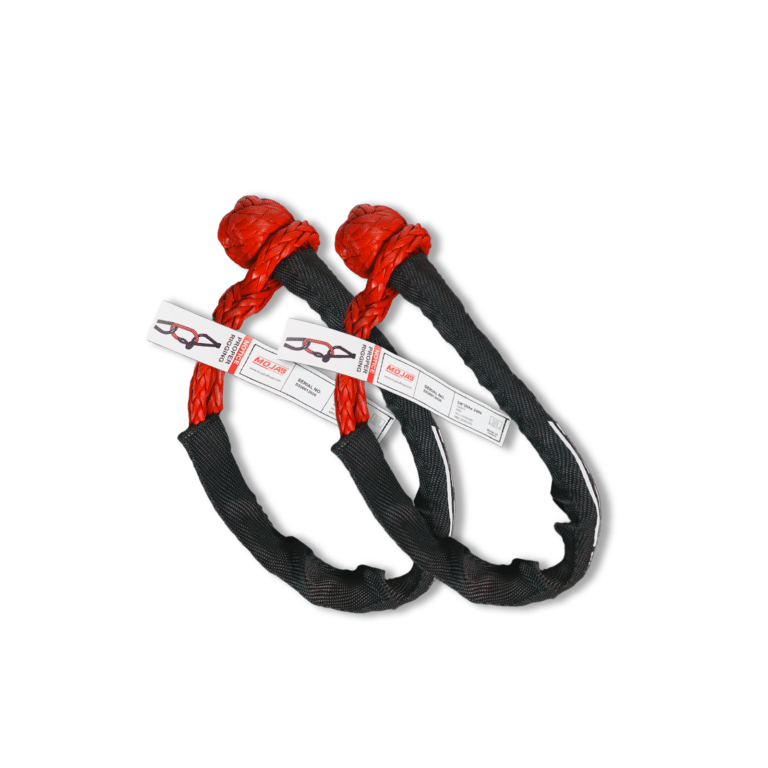
MOJAB 3/8 in x 24 in Soft Shackles (Set of 2)
A pair of 3/8-inch UHMWPE soft shackles rated to 32,000 lb, sized to match a mid-size kinetic rope.
- 32,000 lb minimum breaking strength, above the 7/8-inch rope rating
- Protective sleeve and storage bag included
- Lifetime warranty
- Undersized for 1-1/2-inch ropes; heavy rigs need the 1/2-inch set
How to Run a Safe Kinetic Recovery
A good kinetic recovery looks slow and boring. The line does the work, so the driver’s job is a gentle, straight pull. Many owners on Expedition Portal and Overland Bound favor a short, gentle run-up over speed. TJM says distance matters more than speed. For a full walkthrough of the process, see our guide on how to safely recover a 4WD.
Rig the Line Before Anyone Moves
Start at the stuck vehicle. First, dig out the tires and clear anything blocking the path out. Next, attach the line to a rated point on each vehicle with soft shackles or a rated receiver mount. Then lay the line straight between the vehicles, with a small loop of slack on the ground.
Before the pull, agree on signals and clear the area. Everyone not driving stays well away from both vehicles and the line’s path. Also, put the stuck vehicle in low range, point the wheels straight, and have the driver ready to ease onto the throttle as the line tightens.
Safety note: A stretched line stores enough energy to send a broken shackle or recovery point through a windshield. Keep bystanders clear of the line, never stand over it, and stop the recovery if you see fraying or a shifting mount.
Make the Pull, Then Rest the Line
The recovery driver rolls forward gently and lets the line stretch. If the first tug falls short, back up, reset the slack, and try again with a little more momentum. Australia’s ACCC and TJM both recommend draping a damper or heavy jacket over the midpoint, although owners split on how much it helps.
Repeated pulls heat and tire the fibers. ARB advises resting a strap between pulls so it recovers its length and capacity, and owners follow the same habit with ropes. If a vehicle stays stuck after several tries, stop snatching. Instead, dig further, lay traction boards, or use a winch.
Roger Vickery from ARB walks through a full snatch strap recovery in the video below. The same rigging and slow-pull habits carry over to a kinetic rope.
Care, Inspection, and When to Retire a Line
Care is where the kinetic rope demands more attention. The main trade-off I’d flag is the cleanup after a muddy weekend, since grit works into the braid and cuts fibers from the inside. Owners on JLwranglerforums and IH8MUD flag dirt, sun exposure, and uncoated eyes as threats to rope life.
Clean, Dry, and Store
Rinse a muddy or sandy line with fresh water after the trip. Then let it dry completely before bagging it, because trapped moisture and grit speed up wear. Bubba Rope notes standard nylon rope loses up to 10% of its strength after extended immersion in water. Finally, store the line out of direct sun and away from fuel, battery acid, and sharp tools.
Inspect Before Every Trip
Run the full length through your hands before each trip. Look for cuts, crushed or glazed sections, hard spots, and heavy fuzzing on the cover. In particular, check the eyes, since they take the most abrasion against shackles and mounts. For straps, check the sewn loops and both edges for nicks or torn stitching.
Know When to Replace It
Bubba Rope gives no retirement count. It says overloads, sun, water, and abrasion shorten rope life. Retire any line after a major shock load, visible core damage, or a cut through the cover. Also, retire a strap with a nicked edge or loose stitching. A replacement costs far less than a damaged tailgate or a trip to the hospital.
Final Thoughts
In sand, snow, or deep mud, a kinetic rope is the better pick. The softer pull protects both vehicles, and owners report the spliced eyes outlast sewn loops. For an overland rig loaded close to its GVWR, a rope sized at 3 to 4 times the lighter vehicle’s weight covers most recoveries.
The trade-offs are real, though. A rope costs more, takes more space, and asks for cleaning and drying after a dirty trip. Wheel a few times a year and rarely sink deep? A quality snatch strap still handles most light stucks. Pick one from a brand listing stretch and test methods.
On my own rigs, I’d spend on the system before the line. Rated recovery points, a rated receiver mount, and a pair of soft shackles matter more than the logo on the bag. Get those right first, then pick the line your terrain calls for. If budget allows, carry both: a kinetic rope for stuck vehicles and a static tow strap for the slow tow home. Whichever line you pick, take the pull slow and keep your crew clear.
Frequently Asked Questions
Is a kinetic rope better than a snatch strap?
For deep sand, snow, and mud, most owners prefer a kinetic rope because it stretches up to 30% and pulls more gently. A snatch strap stretches about 20% and costs less. Both work when rigged to rated points with proper shackles.
What size kinetic rope do I need?
Brands recommend a minimum breaking strength of 2 to 6 times vehicle weight, usually the lighter vehicle’s. A rating of 3 to 4 times your rig’s loaded weight matches Bubba Rope’s rule. This band sits between the Saber and Factor 55 ranges. For a 5,000 lb rig, look for roughly 15,000 to 20,000 lb.
Is a 20-foot or 30-foot kinetic rope better?
Owners treat 30 feet as the default length. A longer line gives more options, such as doubling it back or rigging a bridle. Meanwhile, a 20-foot rope stores smaller and works as a second line. Some owners carry one of each.
Is it safe to tow with a kinetic rope?
Only for a short, slow trail tow, where the stretch softens jerks. On longer tows, the stretch lets the towed vehicle surge forward and back. A static tow strap or tow bar suits highway and long-distance towing better.
How long does a kinetic rope last?
Bubba Rope gives no retirement count, so condition decides. Retire any rope with core damage, a deep cut, glazed sections, or a history of a major shock load.
Do you need a damper on a kinetic rope?
Australia’s ACCC and TJM both recommend a damper, though owners disagree on its value. Draped over the midpoint, a damper or heavy jacket helps limit rebound if the line breaks. Rated points and soft shackles still do more for safety than any damper.