


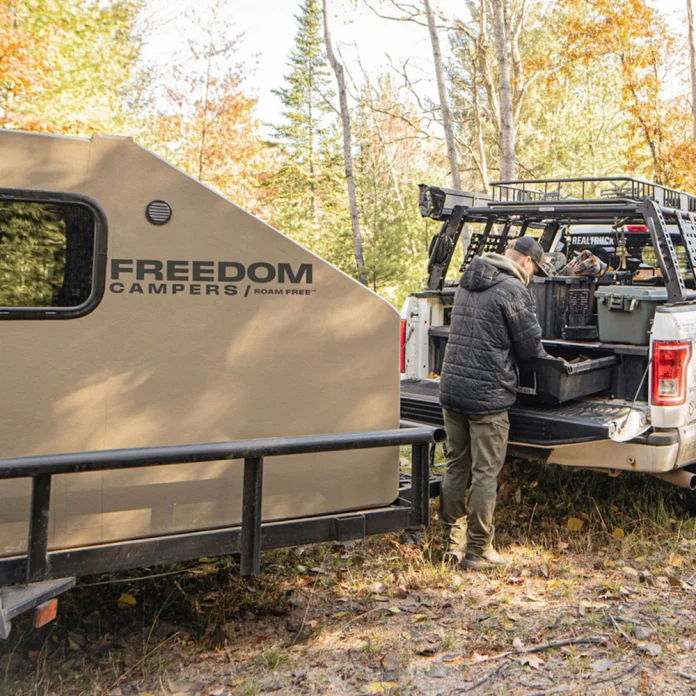

I’ve been camping and overlanding most of my life. Over the decades I’ve slept in ground tents, strapped into rooftop tents in Wyoming wind, loaded truck bed campers before elk season, and pulled trailers into country where cell service is a rumor. Every shelter type taught me something, but the one shift that changed how I camp more than any other was learning to separate my sleeping quarters from my truck. The moment I stopped having to choose between sleeping comfortably and driving the trail unloaded, everything got better. I found better lines, I went deeper, and I came back to a camp already set up and waiting for me.
A leave-behind basecamp is not a complicated concept, but most people either build theirs wrong or never build one at all. The core idea is simple: your shelter stays at camp while your truck runs the trails, scouts the ridge, or hauls firewood down the mountain. When you get back, camp is already done. No setup in the dark, no rain-fly wrestling in the wind, no choosing between your truck’s payload and your comfort. This guide covers how to set up a basecamp you can leave behind. That means the right trailer, the right shelter, site configuration, what to leave at camp, and why the Freedom Campers trailer setup is the most practical approach in the mid-range price bracket. The rise of lightweight overlanding has made this kind of setup more accessible than ever, and this is the moment to build it right.
Quick Facts:
- Topic: How to build an overlanding basecamp you can detach from your truck and leave at the site
- Core concept: Shelter on a utility trailer; truck runs unencumbered while basecamp stays put
- Featured shelter: Freedom Campers trailer setup – Trailer Camper starts at $3,499.99 with Trailer Mounting Kit ($39.99 separately, or buy the Trailer Camper variant)
- Trailer Mounting Kit: $39.99 (adds to existing camper body)
- Best model for trailers: 72×89 (270 lbs, 85L x 68W x 48H interior) or 58×89 (195 lbs) on a 5×8 trailer
- Warranty: 3-year limited warranty
- Made in: Lamar, Missouri
- Best for: Hunters, overlanders, and truck campers who want a fixed basecamp they can drive away from
9 min read
In This Guide
- Basecamp Setup Overview: Why Leave-Behind Changes Everything
- Choosing the Right Trailer for Your Basecamp
- The Freedom Campers Trailer Setup: Best Shelter for Leave-Behind Basecamps
- Site Configuration: How to Set Up Camp Before You Leave
- What Stays at Camp and What Goes with the Truck
- Leave-Behind Basecamp vs. Other Camp Setups
- Pros and Cons of a Leave-Behind Basecamp Setup
- Final Verdict
- Frequently Asked Questions
Basecamp Setup Overview: Why Leave-Behind Changes Everything
Most overlanding setups are built around the truck. Shelter mounts to the bed or the roof rack. Gear stacks into the bed alongside it. The whole rig travels together, which means every mile of trail you want to run happens with a loaded truck. That’s fine for fire roads and casual forest routes. It becomes a real constraint on technical terrain, narrow canyon tracks, shelf roads, or any line where weight and clearance matter. A 400-lb rooftop tent changes your center of gravity. A 1,500-lb slide-in camper turns a capable truck into an overloaded one. The truck that could have run the trail easily now stays on the easier path.
A leave-behind basecamp setup inverts that logic. Your shelter stays at a designated site while your truck runs the terrain exactly as its manufacturer intended. That might be a trailer at a pullout, a dispersed campsite, or an established hunt camp. You pull out light and return to a camp already configured. Sleeping, shelter, cooking, and water are waiting. The truck carries only what it needs for the day: recovery gear, fuel, food, and the people going. This is a different relationship with the land, and it opens access to places and experiences that stay-together setups can’t reach.
The prerequisites for a functional leave-behind basecamp break into four categories: a suitable trailer, a shelter secure enough to leave unattended, a site selection framework, and a system for what stays versus what goes. Each section below covers one. Each section below covers one of those elements with specific guidance and real equipment recommendations.
Choosing the Right Trailer for Your Basecamp
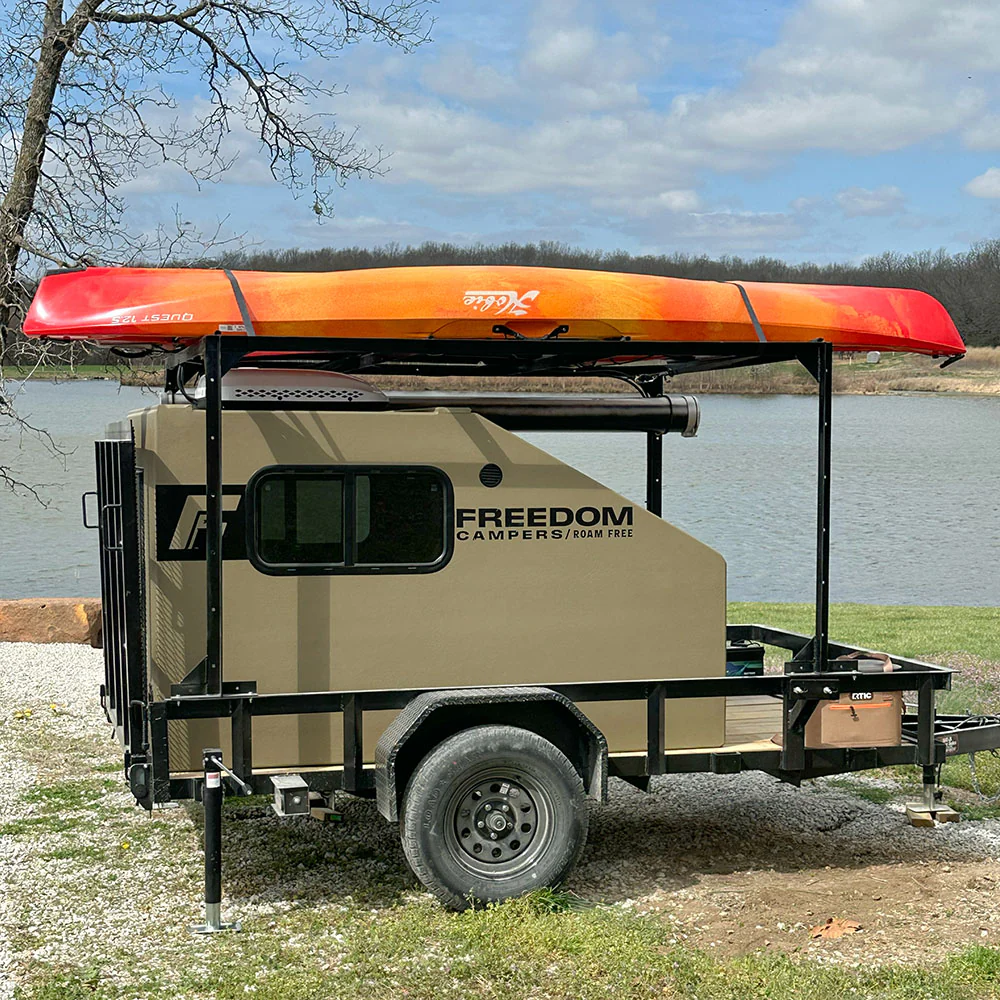
The trailer is the platform your shelter rides on, and it determines how the whole basecamp setup functions. For a leave-behind system, the trailer needs to do three things well. First, provide a stable, level mounting surface for the shelter. Second, stay lightweight enough to move with a standard ball hitch. Third, fit the access roads on the way into your sites. A heavy, wide trailer that works fine on maintained roads becomes a problem on two-track dirt paths or canyon approaches where clearance matters.
Standard utility trailers in the 5×8 to 6×10 foot range are the sweet spot for most leave-behind basecamp setups. A 5×8 utility trailer typically weighs 500 to 800 lbs empty, handles gross weights of 1,500 to 2,000 lbs, and fits through the gate openings and two-track corridors that define backcountry access. The Freedom Campers 58×89 model at 195 lbs fits a standard 5×8 trailer with room for secured gear on the sides. The 72×89 model at 270 lbs is designed for flatbeds and utility trailers with widths greater than 72.5 inches. Its interior runs 85 inches long by 68 inches wide – wide enough for a queen-size sleeping arrangement.
For the most accessible basecamp setup, consider a flatbed utility trailer over an enclosed trailer. Flatbeds give you a clear, flat mounting surface for the Freedom Campers Trailer Mounting Kit, allow easy hardware inspection, and keep overall trailer weight lower than an enclosed box trailer. Look for trailers with a 2-inch ball hitch coupler, safety chains, working brake lights, and either wood or steel decking with existing bolt-through points. Pressure-treated lumber decking accepts the Trailer Mounting Kit’s six floor plates and hardware without modification in most cases.
The Freedom Campers Trailer Setup: Best Shelter for Leave-Behind Basecamps
The Freedom Campers shelter is the strongest value in the leave-behind basecamp shelter category for several reasons. First, it’s built to stay put. The Trailer Mounting Kit – six metal floor plates with associated hardware – bolts the camper body to the trailer deck in a semi-permanent or permanent configuration. Once mounted, the camper does not shift, bounce, or require re-leveling after your truck disconnects. It sits at camp the same way you left it. Second, it’s insulated for four seasons through proprietary wall, ceiling, and floor panel insulation, which means camp is livable when you return whether you’ve been gone two hours or two days.
The camper body is the same unit sold as the truck bed version. Only the mounting kit in the box differs between the two variants. Opting for the Trailer Camper means the Trailer Mounting Kit ships with it; buying it separately runs $39.99. For an existing Freedom Campers truck bed owner who also wants a trailer-based basecamp setup, adding the Trailer Mounting Kit means one camper body serves both configurations. Interior dimensions on the 72×89 are 85 inches long by 68 inches wide by 48 inches high. Sitting height, not standing – the consistent trade-off across all Freedom Campers models in exchange for their lightweight, insulated construction.
The roof features two composite wood panels that serve as mounting points for solar panels, racks, or awnings. For a basecamp that stays at site for multiple days, mount a 100-watt solar panel to the roof. Paired with a 100Ah lithium battery bank, it provides lights, device charging, and power for the optional 12-volt ventilation fan. Ventilation is important in a leave-behind shelter – the 15×30-inch side window and door window allow moisture management in both occupied and unoccupied conditions. For the full hands-on assessment, the Freedom Camper review covers real-world performance and sizing in detail. For a direct comparison of the shelter format against alternatives including teardrop trailers, the truck camper vs. teardrop trailer comparison breaks down the price, weight, and flexibility trade-offs.
Best Shelter for a Leave-Behind Basecamp
Freedom Campers: Mount It, Leave It, Come Back to Camp
Trailer Mounting Kit bolts the camper body to any utility trailer. Four-season insulation. Built in Missouri. 3-year limited warranty. Starts at $3,499.99.
Site Configuration: How to Set Up Camp Before You Leave
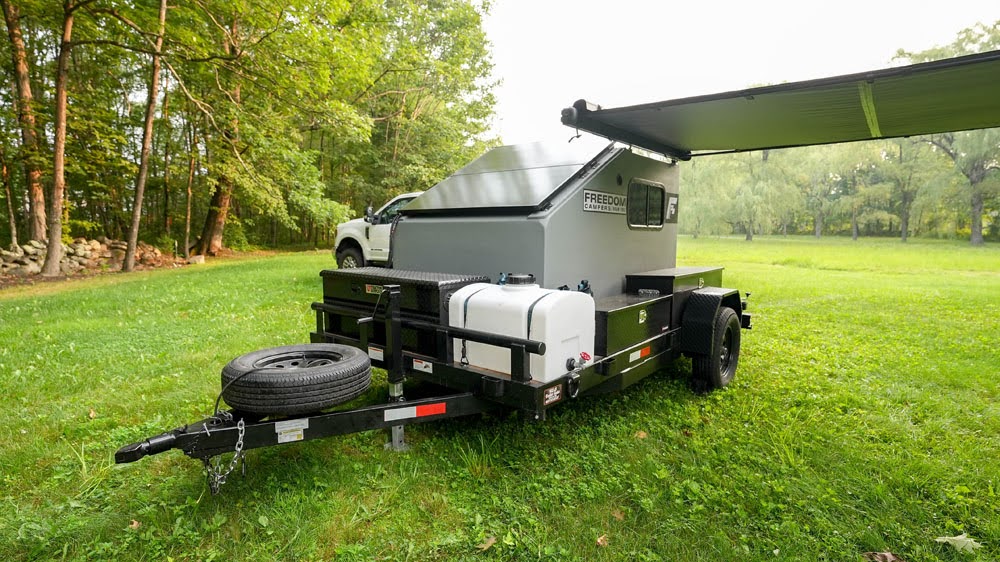
Site selection for a leave-behind basecamp requires more thought than site selection for a sleep-and-go camp. You’ll be away from the site for hours, potentially overnight, and the camp needs to be safe, weather-appropriate, and organized enough that you’re not reorganizing it by headlamp when you return. The checklist before you unhitch and drive off is worth building and repeating on every trip.
Level Your Trailer Before Unhitching
Level your trailer before disconnecting from the truck. A trailer left on sloping ground shifts stress onto its frame over time and creates an uncomfortable sleeping surface. Use leveling blocks under the trailer tires on the low side before unhitching. Most utility trailers use standard 2×6 wood blocks or rubber leveling pads rated for 3,500 to 5,000 lbs. Set the trailer’s tongue jack to provide additional support once the truck disconnects. The camper should be stable before you walk away – push on the corners to confirm no wobble or flex.
Secure the Site and the Camper
Lock the trailer hitch coupler with a coupler lock ($20 to $40) before leaving. At dispersed sites in bear country, secure food and scented items inside the camper or in a bear canister. The camper is not rated as a bear-proof container. See the USDA Forest Service bear guidance for site-specific protocols. At hunt camps, mark the site with flagging or a flag on a pole visible from the trail approach. Before driving out on multi-day operations, note your site coordinates on your GPS or phone. Even experienced overlanders have confused their own dispersed camp with another site after a long day.
Pre-Configure Your Sleep Setup
Make your bed before you leave. This sounds trivial but is one of the practical advantages of a leave-behind basecamp that most people underestimate. Returning to a configured sleeping setup after a long day on the trail is the difference between a comfortable return and a 20-minute fumble in the dark. Sleeping bag spread, pad inflated, headlamp set – it takes five minutes before you leave. Pull down the window ventilation to a crack for moisture management while you’re away. If the day’s temperatures are forecast to drop, close the ventilation before you go rather than managing it on return.
What Stays at Camp and What Goes with the Truck
The leave-behind basecamp system only works if you’ve thought through the split carefully. What stays at camp should be everything you don’t need on the trail but will need when you return. What goes with the truck is everything required for safety and the day’s specific activity.
What Stays at the Basecamp
Sleep system (sleeping bag, pad, pillow) stays at camp unless overnight temperatures require bringing a redundant layer. Camp kitchen gear stays at camp: stove, fuel, cookware, food for dinner and breakfast. Water supply stays at camp – jerry cans, water filter, and cooking water. Extra layers and camp clothing stay at camp. The solar panel and battery system power the camper throughout the day even while you’re away. Chairs, any shelter extensions like awnings, and non-essential gear remain at the basecamp site. The Freedom Campers 72×89 provides an interior floor of 85 by 68 inches – enough to organize all of this systematically without stacking.
What Goes with the Truck
Recovery gear always travels with the truck: traction boards, kinetic rope, high-lift jack, shovel. Navigation tools go: GPS device, downloaded offline maps, communication device (InReach or GMRS radio). Emergency kit and first aid go. The day’s food and water go. Camera gear goes if applicable. Personal identification and emergency contact information go. The truck leaves carrying only what it needs for the day’s terrain and activity – no shelter, no camp kitchen, no sleeping system. That weight reduction and payload clarity is the core advantage of the leave-behind basecamp concept.
Your Shelter Stays. Your Truck Runs Free.
Freedom Campers on a Trailer: The Leave-Behind That Works
72×89 model: 85L x 68W x 48H interior. Four-season insulation. Two people load it. Ships in the lower 48. 3-year warranty.
Leave-Behind Basecamp vs. Other Camp Setups
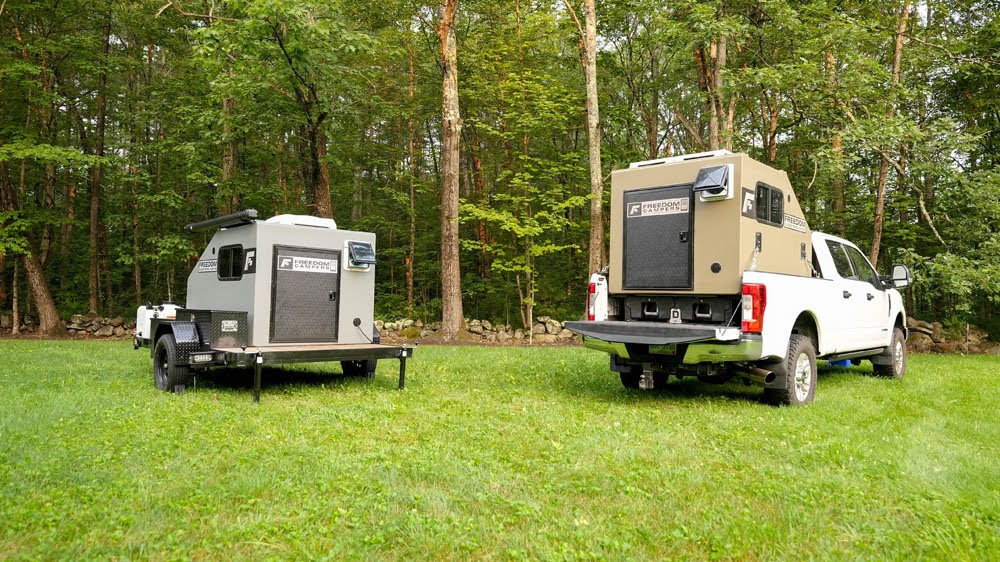
The leave-behind basecamp is not the right approach for every trip. It works best for multi-day stays at a single site. Hunting setups, where camp is a return point and the truck goes to work each morning, are a natural fit. Overlanding routes where one or two base sites anchor multiple day runs also suit this approach. It works less well for one-night stops or routes where you’re moving camp every day, since the trailer adds tow time and setup steps that a portable truck-mounted shelter doesn’t.
Compared to a rooftop tent on the truck, the leave-behind trailer basecamp wins on sleeping space, weather protection, and the ability to run the trail unloaded. A rooftop tent stays on the truck everywhere the truck goes – which is convenient for moving camp but means the truck is always carrying it on technical terrain. A teardrop trailer is closer in concept to the leave-behind setup and can also be unhitched at camp. However, quality teardrop trailers start at $8,000 to $20,000, and most are wider and heavier than a utility trailer carrying a Freedom Campers shelter. For a detailed breakdown, see our truck camper vs. teardrop trailer comparison.
The Freedom Campers trailer setup sits in a price position most alternatives can’t match. The camper body starts at $3,499.99. Add a standard utility trailer ($600 to $1,200 used) and the Trailer Mounting Kit ($39.99) and you have a complete leave-behind basecamp for $4,200 to $4,800. A purpose-built overland trailer with similar shelter capacity – think Patriot Campers or similar expedition-grade units – starts at $12,000 to $20,000. The gap is significant, and for most hunters and weekend overlanders, the Freedom Campers approach does the same job at a fraction of the cost.
Pros and Cons of a Leave-Behind Basecamp Setup
Pros
- Truck runs the trail unloaded – better capability, better fuel economy, better access
- Return to a configured camp – no dark setup, no rain-fly wrestling after a long day
- Freedom Campers four-season insulation keeps shelter livable while you’re away
- 72×89 model provides 85L x 68W inches of interior floor – room for two people and all camp gear
- Trailer setup costs $4,200 to $4,800 complete vs. $12,000 to $20,000 for purpose-built overland trailers
- Trailer Mounting Kit ($39.99) allows the same camper body to swap between truck bed and trailer
- Solar panels mount to roof composite panels – basecamp can run power systems while you’re away
- Freedom Campers 3-year limited warranty; built in Lamar, Missouri
Cons
- Trailer adds tow time and access limitations on narrow two-track roads
- 48-inch interior height means sitting, not standing – not for those who need to dress upright
- No onboard kitchen or bathroom – camp stove and external setup required
- Site selection requires more care when camp stays unsupervised for hours
- Custom freight quote needed for Wyoming and several other Western states
Final Verdict

A leave-behind basecamp is one of those overlanding setups that seems obvious once you’ve tried it and baffling in retrospect that you did anything else. Separating your shelter from your truck turns your rig back into the capable, unloaded platform it was designed to be. You run better terrain, you go further in a day, and you return to something instead of arriving at nothing and starting setup in the dark. The Freedom Campers trailer setup makes this approach accessible at a price point that doesn’t require a second mortgage on the truck.
For hunters and overlanders running multi-day operations from a fixed site, the setup is nearly ideal. Park the trailer at your designated site on day one. Level it, secure it, configure the sleep setup, and drive away with a truck that handles exactly as it should. The Freedom Campers 72×89 on a flatbed utility trailer is the right choice for two-person basecamps where interior room matters. The 58×89 (195 lbs) on a standard 5×8 trailer works for tighter sites and two-person sleeping with gear stored alongside on the trailer deck. Both provide the four-season insulation, rigid shell, and ventilation options that make a leave-behind shelter worth leaving behind – the shelter should be as functional without you as it is with you.
The total cost for a functional leave-behind basecamp using the Freedom Campers system: camper body starting at $3,499.99, Trailer Mounting Kit at $39.99, and a used utility trailer at $600 to $1,200. Accessories like a solar panel and small lithium battery add $350 to $600 for multi-day power. The complete system runs $4,200 to $5,400, against $12,000 to $20,000 for purpose-built overland trailers that do the same job. Register the camper after purchase to activate the 3-year limited warranty.
Ready to Build Your Basecamp?
Check Today’s Price on the Freedom Campers Trailer Setup
Ships direct in the lower 48. 3-year limited warranty. Register after purchase to activate. Trailer Mounting Kit available for $39.99.
Frequently Asked Questions
How do you set up a basecamp for overlanding?
A functional overlanding basecamp setup needs four things: a stable platform, a shelter that stays secure and livable when unattended, a safe and level site, and a system for what stays versus what goes with the truck. A utility trailer handles the platform. The Freedom Campers shelter handles the rest. The Freedom Campers trailer setup covers the shelter and platform elements. Level the trailer before unhitching, secure food in bear country, pre-configure your sleep setup, crack the ventilation window for moisture management, and drive away with only what you need for the day.
Can you leave a camper at camp and drive away with your truck?
Yes, and this is the core advantage of a trailer-based basecamp setup. The Freedom Campers shelter mounts to a utility trailer via the Trailer Mounting Kit ($39.99). Once secured, you unhitch your truck from the trailer at camp and drive the trail unloaded. The shelter remains at the site – insulated, weatherproof, and configured – until you return. This is the same approach hunters use for spike camps and overlanders use for multi-day base operations from a fixed site.
What makes a good overlanding basecamp?
A good overlanding basecamp needs five things. First, weather-tight shelter that stays functional while unoccupied. Second, a secure mounting system that keeps the shelter stable. Third, pre-configured sleeping and cooking gear so return setup is minimal. Fourth, power for lights and device charging on multi-day operations. Fifth, a site with flat ground to level a trailer and access for your truck to depart and return independently. The Freedom Campers trailer setup addresses most of these with a single product at a mid-range price point.
How do I use a utility trailer as a basecamp?
Mount the Freedom Campers shelter to the trailer deck using the Trailer Mounting Kit – six metal floor plates and associated hardware that bolt through the trailer decking. Level the trailer at your site before unhitching. Secure the hitch coupler with a lock. Pre-configure the sleep setup inside the camper. Set up solar panels on the roof composite panels if running a multi-day power system. Organize camp gear on the trailer deck alongside the camper. Then unhitch your truck and drive. The trailer stays until you return and reconnect for departure.
What is the best shelter for a leave-behind basecamp?
For truck campers and overlanders in the mid-range price bracket, the Freedom Campers trailer setup is the strongest option. The camper body starts at $3,499.99, provides four-season insulation, and mounts securely via the $39.99 Trailer Mounting Kit. For the most interior room, the 72×89 delivers 85 inches long by 68 inches wide – enough for a queen-size sleeping arrangement and organized gear storage. On tighter sites, the 58×89 (195 lbs) on a 5×8 trailer is the right choice. Both options leave a complete, livable, insulated shelter at camp while your truck runs free.
Just so you know, some of the cool stuff we mention comes with affiliate links, meaning we earn a commission if you buy (no extra charge to you!). Plus, we occasionally feature sponsored content, but rest assured, we only shout out products we genuinely stand behind.”