


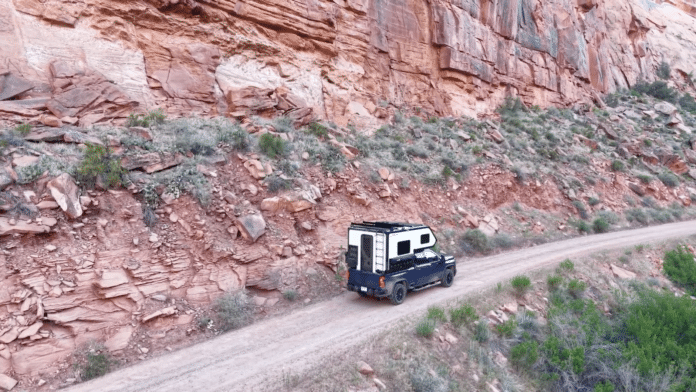

I’ve spent a good amount of time overlanding and off-roading over the years, and truck camper payload is the question I hear pretty frequently from readers cross-shopping their first hard-side rig. My own trucks taught me early lessons: a truck’s advertised towing number reveals almost nothing about what it safely carries in the bed. Payload, not towing capacity, is the number deciding whether a hard-side truck camper fits your truck.
This guide is for overlanders shopping for a truck and camper together, as well as current truck owners wondering if their rig handles a hard-side unit. I’ll walk through real payload math using published GVWR figures, then apply this math to the Iron Peak Apex 6.5 and Apex 8.0 as concrete examples. Whether you drive a compact daily driver truck, a dedicated one-ton expedition truck, or something in between, this article shows exactly where the payload line falls.
Quick Facts:
- Topic: Matching truck class to hard-side truck camper payload
- Key number: Payload capacity, not towing capacity, decides camper fit
- Half-ton trucks: Typical payload 1,500 to 2,300 lbs, tight for most hard-side campers
- Three-quarter-ton and up: Typical payload 2,500 to 4,000+ lbs, the safer match
- Example camper: Iron Peak Apex 6.5 (1,560 lbs dry) and Apex 8.0 (1,780 lbs dry)
- Don’t forget: Water, gear, passengers, and options all count against payload
- Best for: Overlanders shopping for a truck and camper as a matched pair
8 min read
In This Guide
- Truck Class Payload at a Glance
- How to Do the Payload Math Yourself
- Half-Ton Trucks: What Fits in Practice
- Three-Quarter-Ton and One-Ton: The Safer Match
- Bed Length Changes the Equation Too
- Half-Ton vs. Three-Quarter-Ton: Which Should You Buy?
- Pros and Cons of Each Truck Class
- Final Verdict
- Frequently Asked Questions
Truck Class Payload at a Glance
| Truck Class | Typical Payload | Fits Apex 6.5 (1,560 lbs dry) | Fits Apex 8.0 (1,780 lbs dry) |
|---|---|---|---|
| Half-ton (F-150, Silverado 1500, Ram 1500) | 1,500 to 2,300 lbs | Tight, check your build sheet | Rarely enough margin |
| Three-quarter-ton (F-250, Silverado 2500HD, Ram 2500) | 2,500 to 3,500 lbs | Comfortable margin | Comfortable margin |
| One-ton (F-350, Silverado 3500HD, Ram 3500) | 3,500 to 4,000+ lbs | Large margin | Large margin |
How to Do the Payload Math Yourself
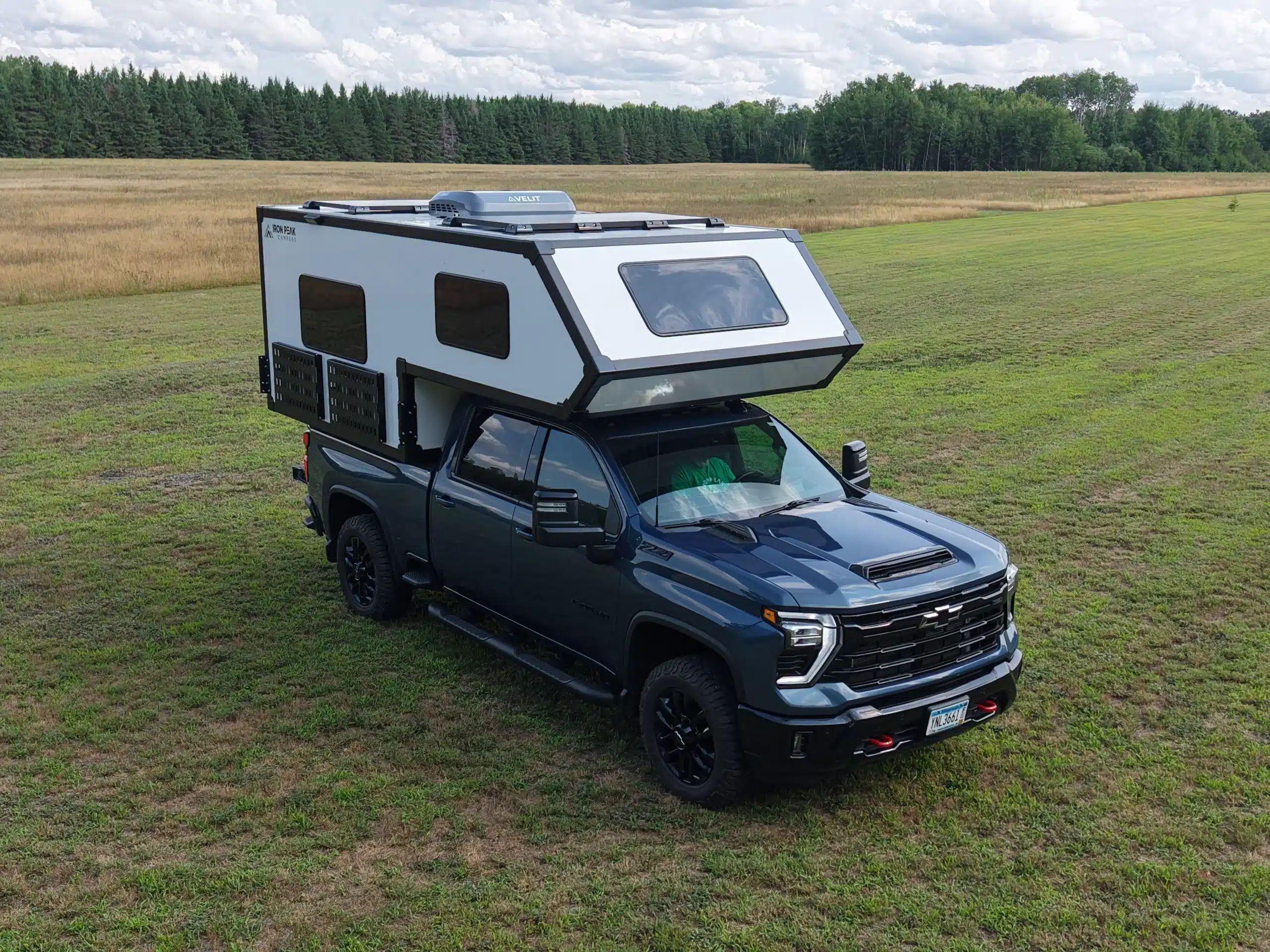
Payload capacity is the maximum weight your truck safely carries in the cab and bed combined, including passengers, gear, fuel, and any installed camper. Every truck has this number stamped on a yellow sticker inside the driver door jamb, and it varies widely even within the same model based on cab size, bed length, and drivetrain.
Start with your truck’s payload rating from this door sticker, since advertised brochure numbers reflect a base configuration your specific truck likely does not match. Subtract passenger weight, then subtract fuel and gear you plan to carry daily. What remains is your real camper budget, and it needs room for the camper’s dry weight plus a full water tank, propane, and personal gear once loaded.
Iron Peak lists the Apex 6.5 at 1,560 pounds dry and the Apex 8.0 at 1,780 pounds dry, both figures excluding jacks. Add roughly 170 pounds for a full 20-gallon fresh water tank, then add clothing, food, and camp gear. A realistic loaded weight often runs 300 to 500 pounds over the dry figure, so budget accordingly before you check your truck’s payload sticker.
Half-Ton Trucks: What Fits in Practice
Half-ton trucks such as the F-150, Silverado 1500, and Ram 1500 typically carry 1,500 to 2,300 pounds of payload, though the exact figure swings widely by trim and configuration. A base work truck with a regular cab often rates near the top of this range, while a loaded crew cab with four-wheel drive and a bigger engine often lands near the bottom.
The Apex 6.5 at 1,560 pounds dry technically fits inside many half-ton payload ratings on paper. However, once you add water, propane, and gear, the loaded weight often climbs past 1,900 pounds, leaving little margin for passengers and daily cargo. The Apex 8.0 at 1,780 pounds dry pushes this math even tighter, and few half-ton configurations carry it comfortably once fully loaded.
Notably, this is not a knock on half-ton trucks. Rather, it means half-ton owners need to check their exact door sticker number, not a brochure figure, before assuming a hard-side camper fits. Our first look at the Iron Peak Apex truck camper covers both models side by side if you want the full dry weight and dimension breakdown before running your own numbers.
Three-Quarter-Ton and One-Ton: The Safer Match
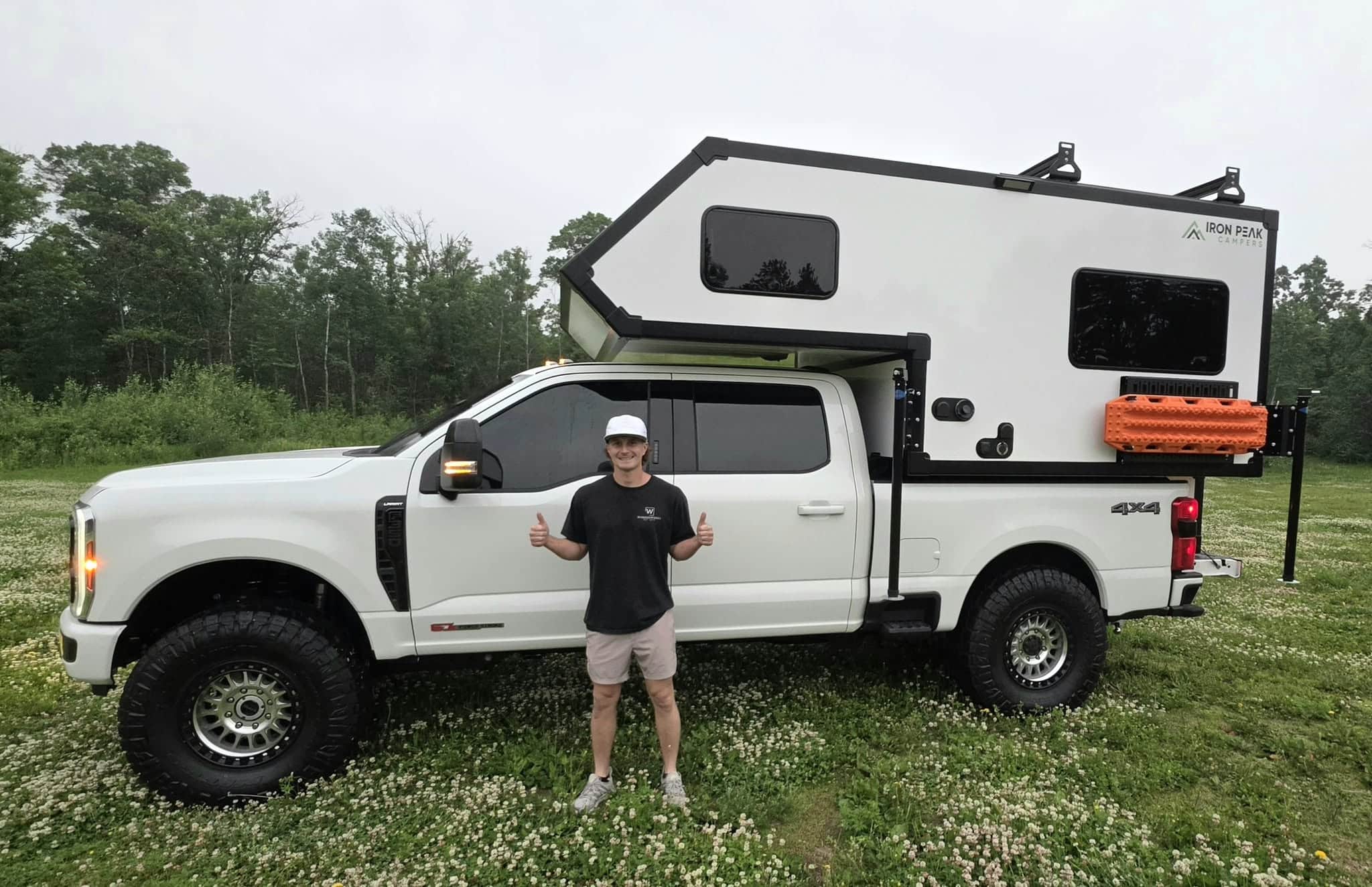
Three-quarter-ton trucks like the F-250, Silverado 2500HD, and Ram 2500 typically carry 2,500 to 3,500 pounds of payload, which gives real breathing room for either Apex model plus water, gear, and passengers. This class is where most hard-side truck camper owners land, since the margin absorbs the weight creep happening once you pack for a trip.
One-ton trucks push the number higher still, often into the 3,500 to 4,000-plus pound range. For overlanders planning to add a roof rack, spare tire carrier, or a second battery to their camper build, this extra margin matters. Consequently, buyers building a dedicated expedition rig around a long-bed camper like the Apex 8.0 often choose three-quarter-ton or one-ton trucks specifically to avoid payload stress later.
Bed Length Changes the Equation Too
Payload is not the only fit question. Bed length determines which Apex model physically works with your truck, independent of weight. The Apex 8.0 needs an 8-foot long bed, or a 6.5-foot short bed with the tailgate down, while the Apex 6.5 fits a 6.5-foot short bed with the tailgate closed.
Since long-bed configurations often pair with larger cabs and heavier drivetrains, trucks physically fitting the Apex 8.0 frequently carry higher payload ratings by default. Short-bed half-ton trucks, by contrast, often combine the tightest bed dimensions with the lowest payload numbers in their lineup, which compounds the fit challenge for this class.
Half-Ton vs. Three-Quarter-Ton: Which Should You Buy?
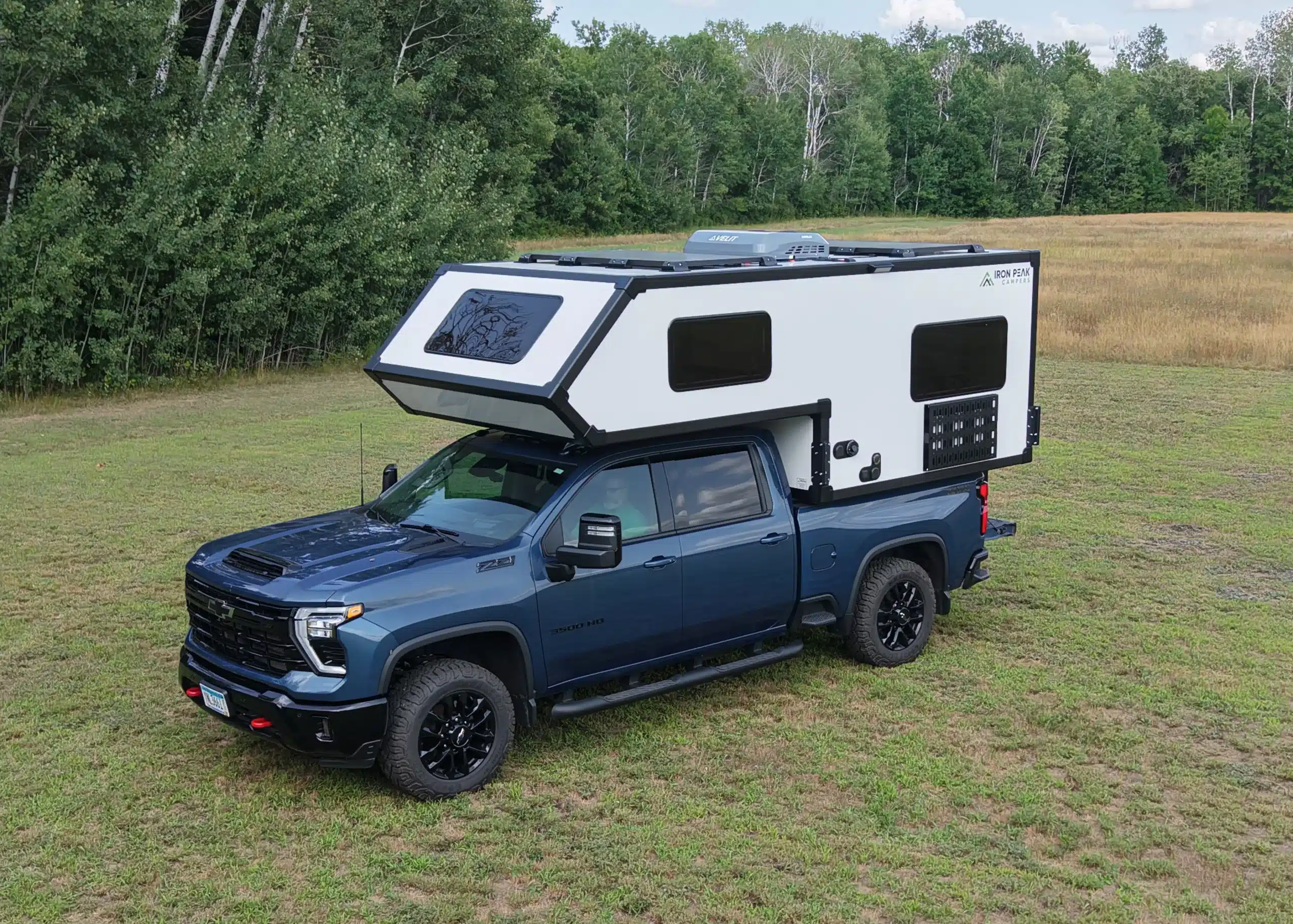
The choice comes down to how you use the truck outside of camping. A half-ton offers a smoother ride, better fuel economy, and easier daily driving, but it demands careful payload math and often limits you to the lighter Apex 6.5 with a conservative gear list. Many half-ton owners who make this work choose upgraded suspension and closely track every pound they add.
A three-quarter-ton or one-ton truck rides stiffer unloaded and costs more at the pump, yet it removes payload as a daily worry. For buyers building a dedicated overland rig rather than a daily commuter, the heavier truck class pairs more predictably with either Apex model, water tank full, gear loaded, and passengers aboard.
Pros and Cons of Each Truck Class
Pros
- Half-ton trucks offer better fuel economy and a smoother daily ride
- Three-quarter-ton trucks carry 2,500 to 3,500 lbs, comfortable for either Apex model
- One-ton trucks add margin for roof racks, spare carriers, and extra batteries
- The door jamb sticker gives an exact, truck-specific payload number
- Longer beds often pair with higher factory payload ratings
Cons
- Half-ton payload often runs 1,500 to 2,300 lbs, tight once water and gear load in
- Brochure payload figures rarely match a specific truck’s build
- Heavier trucks cost more upfront and at the pump
- Short beds with low payload ratings compound the fit problem for the Apex 8.0
Final Verdict
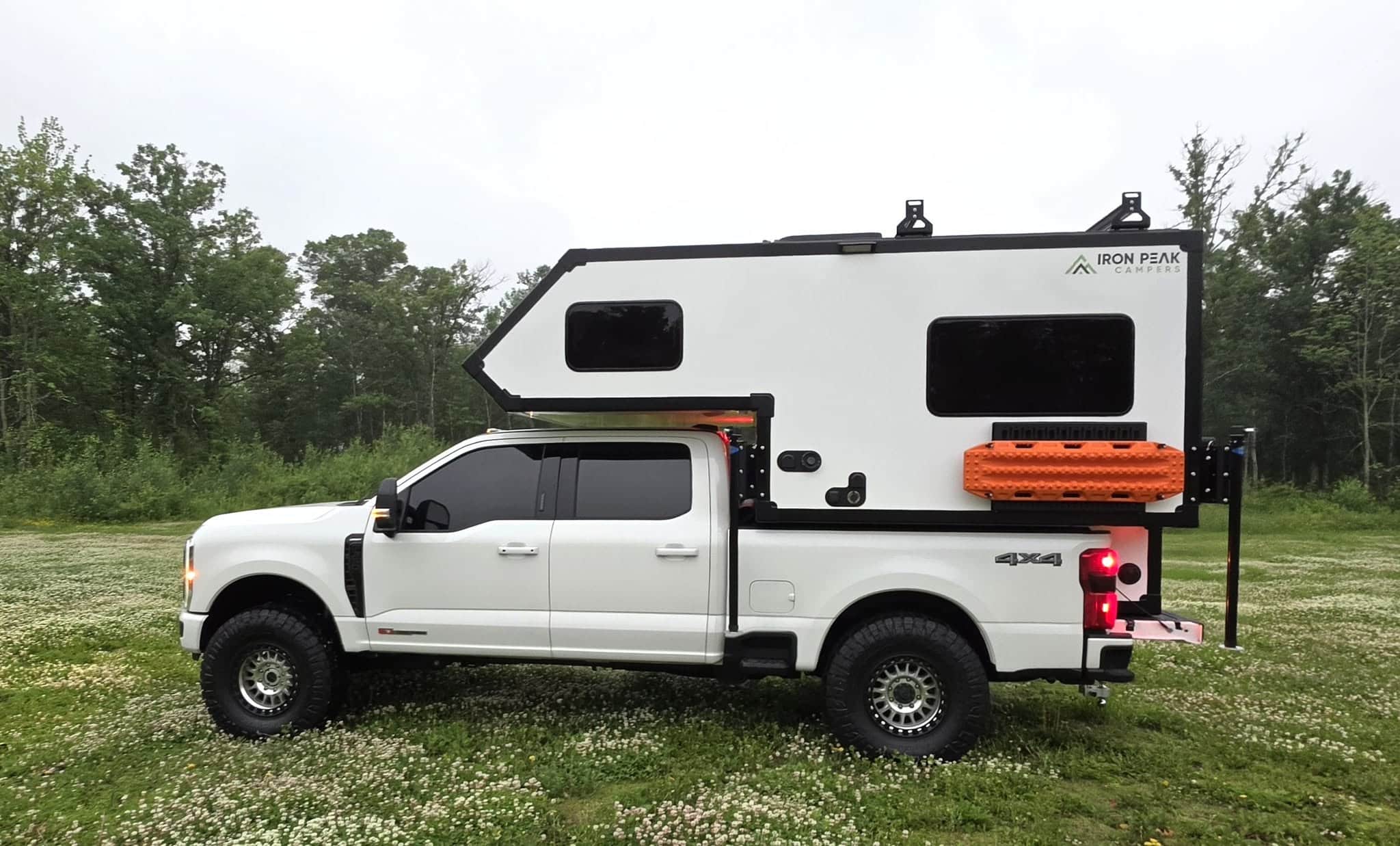
Matching a hard-side truck camper to the right truck starts and ends with the payload sticker in your driver door jamb, not the brochure or the towing number. The Apex 6.5 at 1,560 pounds dry and the Apex 8.0 at 1,780 pounds dry both fit comfortably on three-quarter-ton and one-ton trucks, with real margin left for water, gear, and passengers.
Half-ton owners handle this trade-off successfully, but the trade-off is real. You need to verify your exact payload number, choose the lighter Apex 6.5 over the 8.0, and track every pound of gear you add after the camper goes on. Buyers who skip this step risk overloading a truck looking capable on paper but falling short once the water tank fills and the cooler goes in.
Value here is about avoiding a mismatched purchase rather than saving money upfront. A truck struggling under payload wears its tires, brakes, and suspension faster, and it handles worse on the exact rough roads overlanders seek out. Buying the right truck class the first time costs less than upgrading later.
We recommend three-quarter-ton or one-ton trucks for buyers building a dedicated rig around either Apex model. Half-ton owners with the Apex 6.5 and a strict gear list make it work, but should confirm their exact payload number before ordering.
Ready to Buy?
Check Today’s Price on the Apex 8.0
Every Apex ships hand-built in the USA with a lifetime plus 2-year warranty and a published dry weight for accurate payload planning.
Frequently Asked Questions
What truck do I need for the Iron Peak Apex 8.0?
The Apex 8.0 fits full-size trucks with an 8-foot long bed, or a 6.5-foot short bed with the tailgate down. A three-quarter-ton or one-ton truck gives the most reliable payload margin once water, gear, and passengers load in.
Is payload capacity or towing capacity more important for a truck camper?
Payload capacity matters far more, since the camper sits directly on the truck frame rather than being towed. A truck with strong towing numbers still overloads easily if its payload rating falls short of the camper’s loaded weight.
Where do I find my truck’s exact payload rating?
Look for the yellow certification sticker inside the driver door jamb. It lists your specific truck’s payload capacity based on its actual cab, bed, and drivetrain configuration, which often differs from advertised brochure figures.
Does a half-ton truck carry a hard-side truck camper?
Some half-ton trucks carry the lighter Apex 6.5 within their payload rating, though the margin runs tight once water and gear load in. Buyers should verify their exact door sticker number and track gear weight closely rather than relying on general half-ton assumptions.
How much extra weight should I budget beyond a camper’s dry weight?
Plan for 300 to 500 pounds beyond dry weight to cover a full water tank, propane, and personal gear. A camper listed at 1,780 pounds dry, such as the Apex 8.0, often loads out closer to 2,100 to 2,300 pounds on a real trip.
Friendly disclaimer: Our articles may contain affiliate links that support us without costing you more, and sometimes we spice things up with sponsored content—but only for products we truly stand behind!