


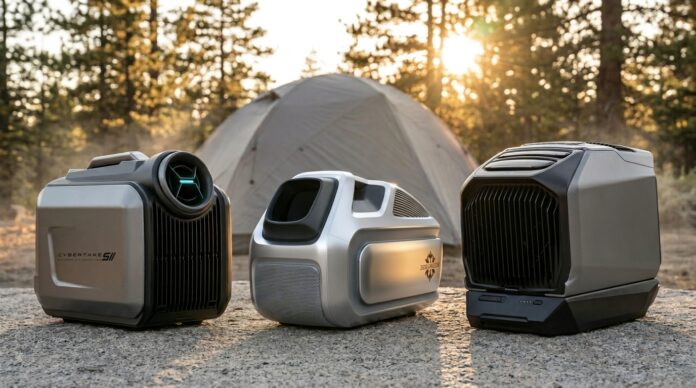

Quick Facts:
- Category: Portable camping air conditioners (battery-ready)
- Units tested: EcoFlow Wave 3, Zero Breeze Mark 3, CyberTake S2 Pro
- Lightest: Zero Breeze Mark 3 at 22 lb
- Most cooling: EcoFlow Wave 3 at 6,100 BTU
- Quietest low setting: CyberTake S2 Pro at 40 dB
- Best app: EcoFlow Wave 3
- Price range: $779 to $1,399 for the AC unit, before batteries
- Best for: Tent, rooftop tent, van, and truck camping in summer heat
9 min read
In This Review
- Camping Air Conditioner Overview
- Key Specs at a Glance
- EcoFlow Wave 3: Best App and Most Cooling
- Zero Breeze Mark 3: Lightest and Most Portable
- CyberTake S2 Pro: The Value Newcomer
- Which Camping Air Conditioner Should You Buy?
- Portable Camping AC: Pros and Cons
- Final Verdict
- Frequently Asked Questions
| Most Cooling | Lightest | Best Value | |
|---|---|---|---|
| Product |  EcoFlow Wave 3 EcoFlow Wave 3 |  Zero Breeze Mark 3 Zero Breeze Mark 3 | TOP PICK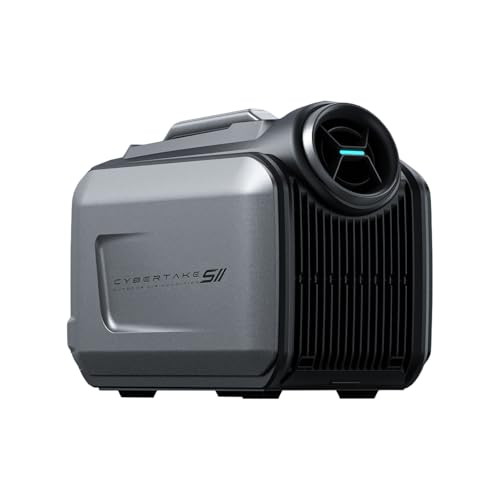 CyberTake S2 Pro CyberTake S2 Pro |
| Rating | ★★★☆☆ 3.6 100 ratings | ★★★☆☆ 2.7 9 ratings | ★★★★☆ 4.1 32 ratings |
| Cooling BTU | 6100 | 5280 | 5100 |
| Weight | 33.7 lb | 22 lb | 25.57 lb |
| Noise (low) | 44 dB | 46 dB | 40 dB |
| Price | $1,398.00 as of Oct 22, 6:30 pm | $779.00 as of Oct 22, 6:30 pm | |
| Check Price → | Check Price → | Check Price → |
Camping Air Conditioner Overview: Real Cooling for Tents and Rigs
A good camping air conditioner turns a sweltering tent into a place where you sleep through the night. For 2026, three units lead the pack: the EcoFlow Wave 3, the Zero Breeze Mark 3, and the CyberTake S2 Pro. I have run all three in the field, and each one wins for a different camper.
These are battery-ready, off-grid machines, not box-store window units. Every model uses R290 refrigerant, carries an IPX4 splash rating, and runs on a power station or an add-on battery. Because none ships with a battery in the base price, budget for power before you buy.
Who needs one? Tent campers in hot climates, rooftop-tent owners, van lifers, and truck-camper families all benefit. For the BTU-and-square-footage math, see our portable AC buying guide for camping. Below, however, you get the head-to-head field results.
Price matters too. As of June 2026, you pay between $779 and $1,399 for the AC unit alone, and far more once you stack batteries. Therefore the right pick depends on your priority: cooling power, pack weight, app control, or budget.
Key Specs at a Glance
Before the deep dives, here is how the three camping air conditioners stack up side by side. Every number below comes from the manufacturer spec sheets, verified in June 2026.
| Spec | EcoFlow Wave 3 | Zero Breeze Mark 3 | CyberTake S2 Pro |
|---|---|---|---|
| Cooling | 6,100 BTU | 5,280 BTU | 5,100 BTU |
| Heating | 6,800 BTU | 5,800 BTU (supplementary) | 6,100 BTU (auxiliary) |
| Weight (AC unit) | 33.7 lb | 22 lb (lightest) | 25.57 lb |
| Noise (low setting) | 44 dB | 46 dB | 40 dB |
| Built-in battery | No (add-on) | No (add-on) | No (power station) |
| App | EcoFlow Oasis (Wi-Fi + BT) | Mark 3 app (beta) | Fourth Space (BT) |
| Warranty | 2 years | 1 year | 1 year unit |
| Price (AC unit) | $899 direct | $1,299 direct | $849 direct / $779 Amazon |
EF ECOFLOW WAVE 3 Portable Air Conditioner with Add-on Battery | 1800W/6100 BTU Cooling and 2000W/6800 BTU Heating, 1000W Fast Charging in 75 mins, 8H Wireless Running, APP Control
The most cooling and heating output in this test, paired with the smartest companion app of the three.
- Most cooling and heating output: 6,100 and 6,800 BTU
- Best app of the three, with Auto and Sleep modes
- Quiet 44 dB Sleep setting
- Two-year warranty, the longest here
- Heaviest unit here at 33.7 lb
- No battery included, so you must budget for an add-on
EcoFlow Wave 3: Best App and Most Cooling
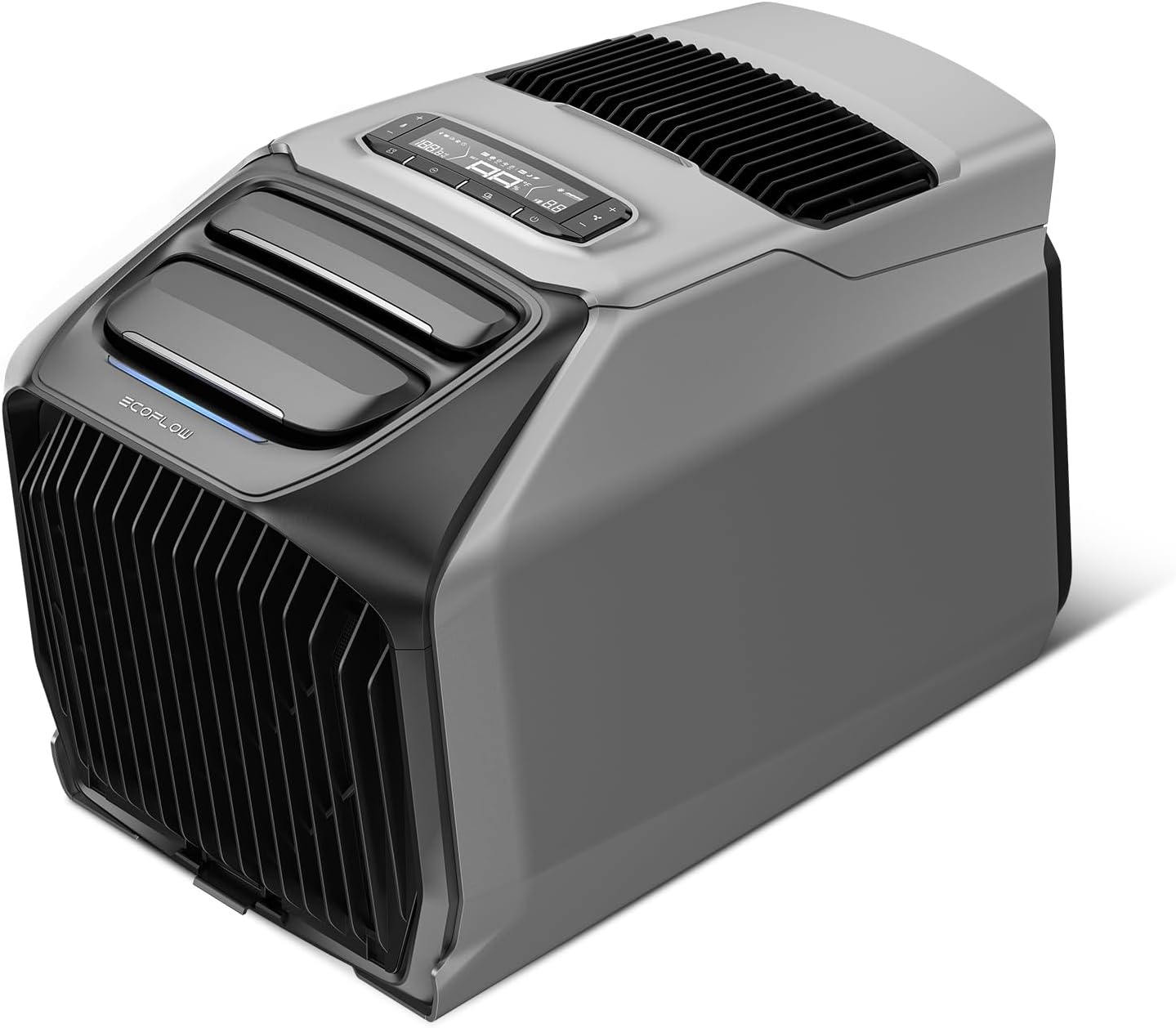
The EcoFlow Wave 3 hits hardest on raw output. It delivers 6,100 BTU of cooling and 6,800 BTU of heat, the highest numbers in this test. As a result, it warms a cold morning camp or chills a hot afternoon tent faster than the other two.
I have run EcoFlow gear for several years and watched the Wave line mature. Notably, the standout upgrade is software. The EcoFlow Oasis app is hands-down my favorite of the three, with smooth controls, smart Auto and Sleep modes, and water-drain alerts. For more background on the prior generation, see our hands-on EcoFlow Wave review.
Camping AC Cooling and Noise
In Sleep mode the Wave 3 drops to 44 dB, quiet enough for tent sleeping. On high it climbs near 58 dB, louder but stronger. Its rated 6,100 BTU leads this group, and reviewers report it cools a small room quickly. EcoFlow also publishes its specs openly, so check the ratings yourself on EcoFlow’s product page before buying.
Battery and Weight Trade-offs
Two drawbacks stand out. First, the Wave 3 weighs 33.7 lb, the heaviest unit here. Second, it carries no built-in battery, and the 1,024 Wh add-on runs $699 to $899. On a hot day the battery lasts roughly two hours on high, though up to eight hours on the lowest setting.
Pros
- Most cooling and heating output: 6,100 and 6,800 BTU
- Best app of the three, with Auto and Sleep modes
- Quiet 44 dB Sleep setting
- Two-year warranty, the longest here
Cons
- Heaviest unit at 33.7 lb
- No battery included; add-on costs $699 to $899
- Roughly two hours of runtime on high
- Water tank needs manual draining
Zero Breeze Mark 3: Lightest and Most Portable
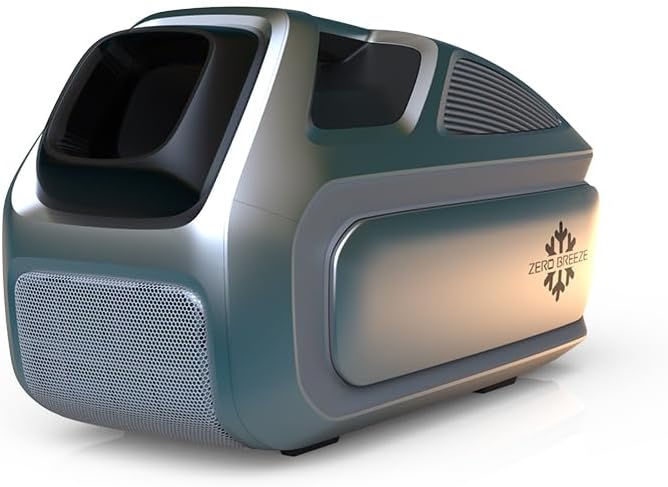
The Zero Breeze Mark 3 wins on weight. At 22 lb it is the lightest unit here, and the size advantage is why I keep reaching for it. When you move camp often, those pounds matter. After years of testing Zero Breeze, the Mark 3 feels like the most refined version yet.
Cooling output sits at 5,280 BTU, strong for the weight class. The Mark 3 also adds a 5,800 BTU supplementary heat mode for shoulder-season trips above 50°F. Our older Zero Breeze Mark II review shows how far the platform has come.
Off-Grid Camping AC Power
This unit was built for off-grid camping. The detachable 1,022 Wh battery clips on directly, recharges to 80% in about two hours, and doubles as a power bank. In addition, you run it from solar, a 12V car socket, or AC. In Sleep mode one battery lasts five to seven hours at a measured 46 dB, quieter than light rain.
Where It Falls Short
Runtime is the catch. Specifically, one battery struggles to cover a full night on cooler modes, and extra packs add real cost. A two-battery kit runs about $2,499. Some owners also report modest cooling in extreme heat, settling only a few degrees below the outside temperature. For a small tent in dry heat, though, it performs well.
Pros
- Lightest unit here at 22 lb
- Best cooling output per pound: 5,280 BTU
- Detachable battery doubles as a power bank
- Quiet 46 dB Sleep mode; fast two-hour recharge
Cons
- One battery lasts only five to seven hours on Sleep
- Heat mode is supplementary, not a primary heater
- Expensive once you add batteries (around $2,499 for two)
- Cooling fades in extreme ambient heat
Zero Breeze Mark 3 Portable Air Conditioner – 5280 BTU High Power, Lightweight, Battery-Ready, for Camping, RV, Truck, Outdoor Use
The lightest camping air conditioner in this test, with a detachable battery you can carry anywhere.
- Lightest unit here at 22 lb
- Best cooling output per pound: 5,280 BTU
- Detachable battery doubles as a power bank
- Quiet 46 dB Sleep mode with a fast two-hour recharge
- One battery lasts only five to seven hours on Sleep
- Cooling fades in extreme ambient heat
CyberTake S2 Pro: The Value Newcomer
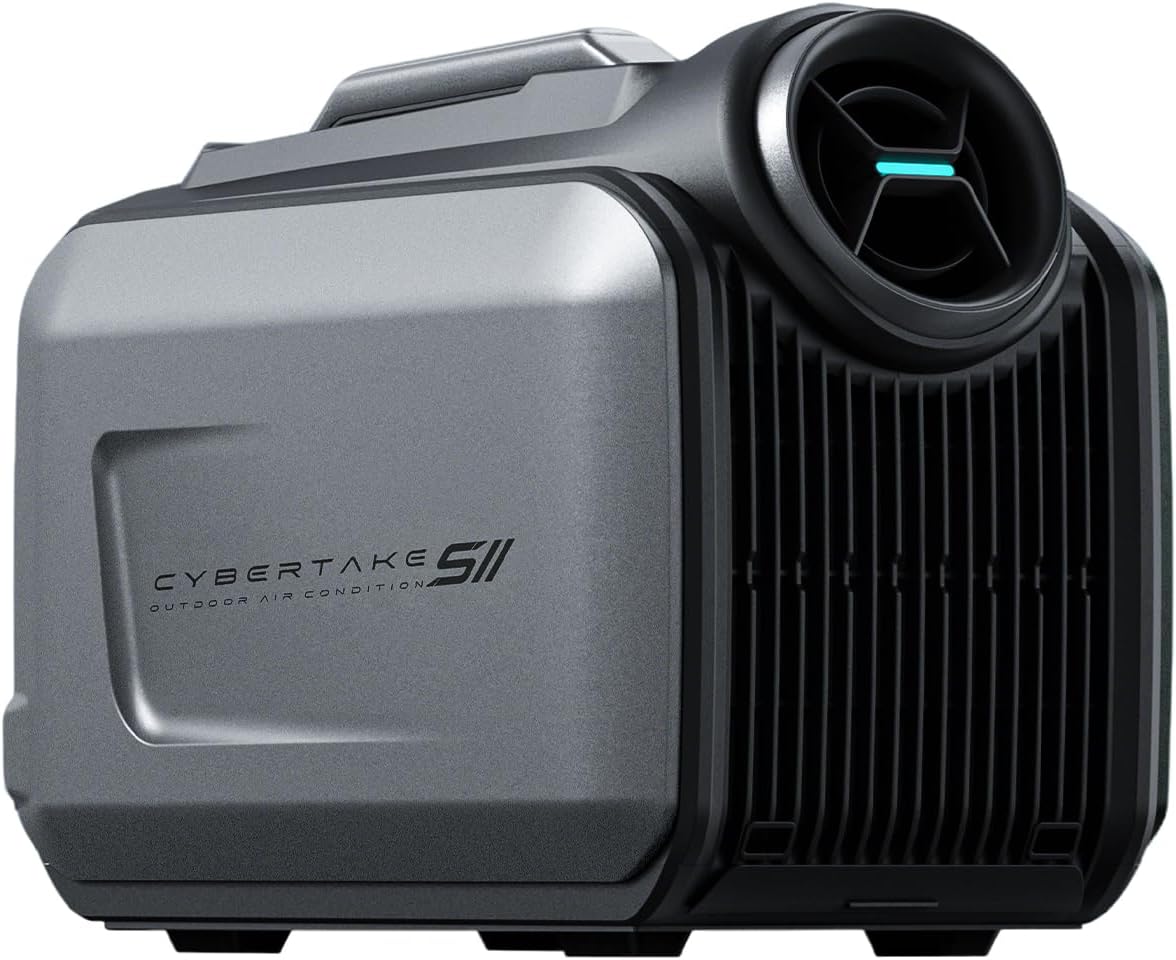
The CyberTake S2 Pro is the newcomer, and after two months of testing it does exactly what you want from a portable AC. Notably, it cools fast, runs quiet, and sips power. For the money, it is the easiest unit here to recommend. Our full long-term CyberTake S2 Pro review covers the field results.
Specifically, it puts out 5,100 BTU of cooling and 6,100 BTU of auxiliary heat through a true dual-hose design. A Panasonic inverter compressor cycles smoothly with no harsh on-off jolt. On the low fan setting it measures 40 dB, the quietest reading in this group.
Efficiency and Build
Efficiency is the headline. In ECO+ sleep mode, the S2 Pro draws about 100W and stretches to roughly 10 hours of runtime per kilowatt-hour. The aluminum-alloy chassis feels rugged, and the molded soft case is excellent. Meanwhile, the Fourth Space app handles temperature, modes, and a 24-hour timer over Bluetooth.
One Real Gripe
My only complaint is power. The S2 Pro offers no built-in battery and no optional battery like the other two. Therefore you pair it with a power station, ideally 1,500 Wh or larger. For most overlanders this is a minor issue, since they already carry a power station. Still, a battery option would round out the package.
Pros
- Quietest low setting in the test at 40 dB
- Most efficient: about 10 hours per kilowatt-hour in ECO+
- Panasonic inverter compressor and rugged build
- Lowest entry price: $849 direct or $779 on Amazon
Cons
- No battery option of any kind; needs a power station
- Coverage tops out around 129 sq ft
- Power brick warms up under sustained MAX loads
- Remote control sold separately at $69.99
Which Camping Air Conditioner Should You Buy?
Three differences decide which camping air conditioner fits you: cooling power, weight, and battery handling. The EcoFlow Wave 3 leads on output and software, so it suits campers who want the strongest tent air conditioner and the best app. However, you pay for it in pounds and in battery cost.
The Zero Breeze Mark 3 answers the opposite need. Because it weighs only 22 lb and clips to a travel battery, it is the best portable air conditioner for camping when you move often or pack light. Meanwhile the CyberTake S2 Pro splits the difference. It runs the quietest, draws the least power, and costs the least up front, which makes it a smart portable AC for tent setups paired with a power station you already own.
On value, the math favors CyberTake. As a result, you get real cooling for $779 to $849, then add a power station you likely carry anyway. For sizing help, our general portable AC buying guide covers BTU and power draw.
Portable Camping AC: Pros and Cons
Before you spend four figures, weigh what this whole class of gear does well and where it frustrates owners. These points apply to every battery-ready camping air conditioner, not one model alone.
Pros
- Real compressor cooling, not a swamp-cooler mist
- Off-grid power through batteries, solar, or 12V
- Quiet sleep modes between 40 and 46 dB
- Many add heat for shoulder-season trips
- Compact enough for tents and rooftop tents
Cons
- No battery in the base price on any model
- Runtime on high often lasts only two to three hours
- Premium pricing across the category
- Small coverage area, roughly 100 to 150 sq ft
Final Verdict
No single camping air conditioner wins for everyone, because each one targets a different camper. If you want the most cooling and the smartest controls, the EcoFlow Wave 3 earns the nod. Its app and its 6,100 BTU output lead the field, and the two-year warranty adds peace of mind for heavy users.
If weight rules your packing list, the Zero Breeze Mark 3 is the answer. At 22 lb with a clip-on battery, it travels easier than anything here. The trade-off is runtime, so plan on a second battery for full nights in real heat.
Finally, for value and everyday camping, the CyberTake S2 Pro is the one I reach for most. It runs quiet at 40 dB, sips power, and costs the least to get started. The missing battery option is a small knock, yet most overlanders already pack a power station, which makes the gap easy to live with.
Pick by your priority. For power, choose the Wave 3; for portability, the Mark 3; for value, the S2 Pro. Any of the three turns a hot tent into a comfortable one, so match the unit to your trips and your power setup.
Cybertake S2 Pro Portable Camping Air Conditioner, Tent AC with 5100 BTU Cooling and 6100 BTU Heating, 8 Hours on 1kWh, 3-Way Power(48V DC, 12-24V Vehicle, 100V-240V Wall), Ideal for Tent, Camping, RV
The quietest and most efficient unit in this test, and the one I reach for most on everyday trips.
- Quietest low setting in the test at 40 dB
- Most efficient: about 10 hours per kilowatt-hour in ECO+
- Panasonic inverter compressor and rugged build
- Lowest entry price of the three
- No battery option of any kind; needs a power station
- Coverage tops out around 129 sq ft
Frequently Asked Questions
Do portable air conditioners need to be drained?
Most do, though the amount varies. The EcoFlow Wave 3 collects condensate in a tank you empty by hand or through a drain hose. The Zero Breeze Mark 3 and CyberTake S2 Pro use active condensate systems, so they need less attention during a trip.
How do you air condition a tent off-grid?
You pair a camping air conditioner with a portable power station or an add-on battery. For a full night, plan on 1,500 Wh or more, since cooling on high often draws 500 to 700 watts.
How many BTU do you need for a tent air conditioner?
A camping air conditioner with 5,000 to 6,000 BTU works well for a small two-person to four-person tent. All three units here land in this range. Larger family tents above 150 sq ft push past what this class of portable AC for tent use handles comfortably.
How much does a camping air conditioner cost?
The AC unit alone runs $779 to $1,399 as of June 2026. In addition, batteries add hundreds more. A complete off-grid kit with a battery often lands between $1,500 and $2,500.
What is the best portable air conditioner for camping?
It depends on your priority. The EcoFlow Wave 3 leads on cooling and app control, the Zero Breeze Mark 3 wins on weight, and the CyberTake S2 Pro offers the best value and the quietest low setting. Match the unit to how you camp.
Are battery-powered tent air conditioners worth it?
For hot-climate campers, a camping air conditioner earns its keep. A battery-powered unit lets you sleep in comfort far from any hookup. For summer heat, real compressor cooling changes the trip.