


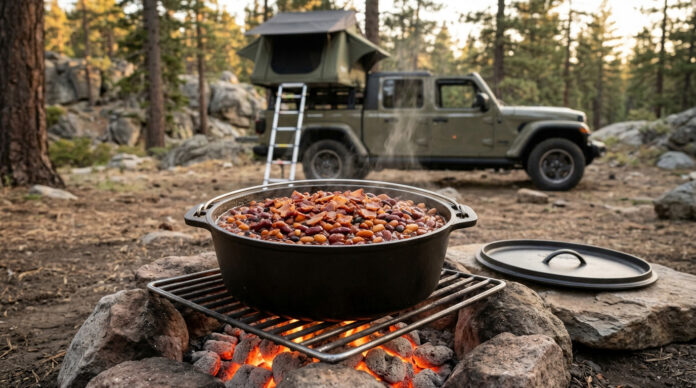

Quick Verdict: Dutch oven cowboy beans feeds 8 overlanders with 6 strips of bacon, 1 pound of ground beef, diced onion, 4 types of beans (kidney, pinto, navy, black), BBQ sauce, and brown sugar. First, render the bacon and brown the beef. Next, simmer with beans and BBQ sauce. Finally, cook 90 minutes at 325F on 12 top and 11 bottom briquettes in a 12-inch Lodge Camp Dutch Oven. Smoky, sweet, meaty side dish or standalone meal.
Save this recipe for your next trip.
Last updated: April 2026 | Prep: 15 min | Cook: 90 min | Serves: 8
Written by Alex Schult
Editor in Chief of 4wdTalk.com. 15+ years of off-road and overlanding experience with 1,000+ hours on the trail.
We tested this recipe on actual overland trips. Amazon affiliate links support 4wdTalk.com at no extra cost to you.
In This Recipe
Why This Recipe Works for Overlanders
Dutch oven cowboy beans straddle the side-dish and main-course line, which makes them the most versatile recipe in the base camp playbook. First, 4 different beans (kidney, pinto, navy, black) deliver a mix of textures and starches, which produces a finished dish which beats any single-bean pot. Second, the bacon and ground beef add enough protein (22 grams per serving) to make these beans a stand-alone meal when paired with cornbread. Third, leftovers thicken overnight in the cooler into a nearly-scoopable consistency which transforms into chili dog toppings the next day.
On a March Big Bear trip at 6,750 feet with 6 guys, I cooked these Dutch oven cowboy beans as the side dish to a rib night. Specifically, I rendered 6 strips of bacon, browned 1 pound of 80/20 ground beef, then simmered with all 4 bean tins and 1 cup of Sweet Baby Ray’s BBQ sauce on 12 top and 11 bottom briquettes at 325F for 90 minutes. Moreover, the ground beef hit 165F internal per USDA ground beef safety guidance, and the bacon contributed 3 tablespoons of smoky fat which carried the flavor base forward.
This recipe is part of our dutch oven camping recipes collection. For a classic chili pairing, see the Dutch Oven Chili. Both spokes roll up to our camp cooking for overlanders guide.
Equipment You Need
- Lodge 12-inch Camp Dutch Oven (6 quart): holds 4 tins of beans plus meat and sauce
- Charcoal chimney starter: lights 30 briquettes in 15 minutes
- Kingsford Original briquettes: steady 325F across the 90-minute simmer
- Lid lifter, 12-inch minimum: for 20-minute stir checks
- Long-handled wooden spoon: for stirring without scraping seasoning
- Chef knife: for dicing onion and bacon
- Long-handled tongs, 16-inch: Cuisinart 16-inch tongs for coal placement
- Heat-resistant gloves rated 932F: RAPICCA gloves for safe handling
- Manual opener: for 4 bean tins
- Fine-mesh strainer: for draining and rinsing beans
The Workhorse
Lodge 12-Inch Camp Dutch Oven, 6 Quart
Pre-seasoned cast iron with flanged lid holds 4 bean tins (60 ounces total), 1 pound ground beef, 6 strips of bacon, and 1 cup of BBQ sauce with 1-inch headroom for the simmer.
Ingredients
Serves 8
- 6 strips thick-cut bacon, diced into 1/2-inch pieces
- 1 pound 80/20 ground beef
- 1 large yellow onion, diced
- 3 garlic cloves, minced
- 1 tin (15 oz) dark red kidney beans, drained and rinsed
- 1 tin (15 oz) pinto beans, drained and rinsed
- 1 tin (15 oz) navy beans, drained and rinsed
- 1 tin (15 oz) black beans, drained and rinsed
- 1 tin (15 oz) baked beans, NOT drained (adds sweetness and liquid)
- 1 cup BBQ sauce (Sweet Baby Ray’s Original or Stubb’s Original)
- 1/2 cup dark brown sugar, packed
- 2 tablespoons yellow mustard
- 2 tablespoons apple cider vinegar
- 1 tablespoon Worcestershire sauce
- 1 teaspoon smoked paprika
- 1/2 teaspoon kosher salt
- 1/2 teaspoon cracked black pepper
- 1/4 teaspoon cayenne pepper (optional for heat)
Step-by-Step Instructions
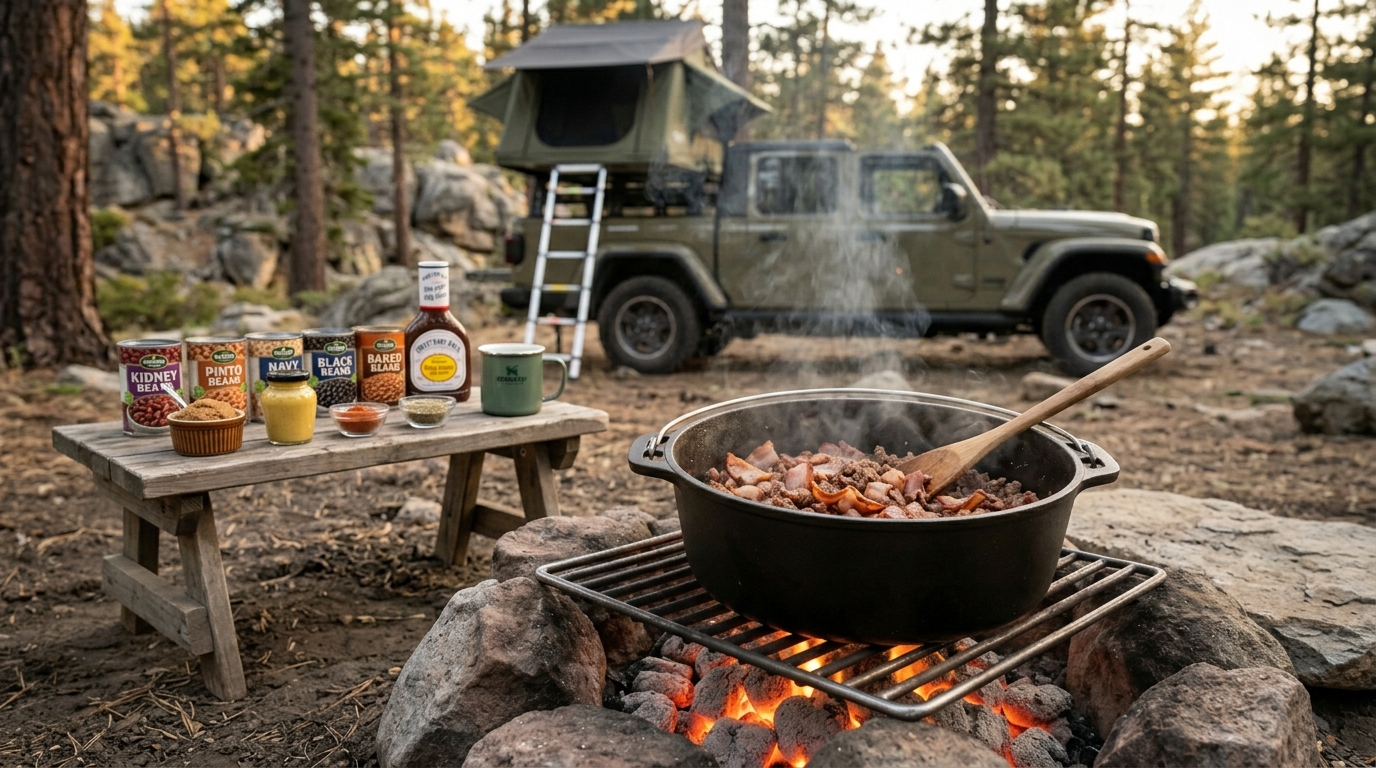
- Light the briquettes: Load 30 Kingsford briquettes into a chimney over newspaper. Wait 15 to 20 minutes until they coat with gray ash and glow orange-red. Meanwhile, dice bacon, onion, and garlic; drain and rinse 4 tins of beans.
- Render the bacon: Place the Lodge 12-inch Dutch oven on 15 lit briquettes spread flat. Add diced bacon and cook 6 to 8 minutes, stirring occasionally, until crisp. Specifically, reserve 3 tablespoons of rendered fat in the Dutch oven and transfer the cooked bacon to a plate.
- Brown the ground beef: Add 1 pound of 80/20 ground beef to the bacon fat. Break into crumbles with a wooden spoon. Cook 6 to 8 minutes to 160F internal per USDA ground beef safety guidance, with no pink visible. Afterward, leave beef and fat in the Dutch oven.
- Saute the aromatics: Add diced onion to the Dutch oven with beef. Cook 4 to 5 minutes until translucent. Next, add minced garlic and stir 45 seconds until fragrant.
- Add the beans and sauce: Pour in all 5 bean tins (4 drained and rinsed, 1 baked beans with liquid). Then add 1 cup BBQ sauce, 1/2 cup dark brown sugar, 2 tablespoons yellow mustard, 2 tablespoons cider vinegar, and 1 tablespoon Worcestershire.
- Add seasoning and cooked bacon: Stir in smoked paprika, salt, black pepper, and cayenne if using. Finally, return the cooked bacon to the Dutch oven and stir once to distribute evenly.
- Switch to simmer coals: Using tongs and gloves, rearrange the coals. Specifically, keep 11 briquettes underneath and place 12 fresh lit briquettes on the flanged lid in a ring with 1 in the center. This holds 325F.
- Simmer 60 minutes covered: Cover and simmer at 325F for 60 minutes. Stir every 20 minutes because beans settle to the bottom quickly with the sugar sauce. Additionally, add 10 fresh lit briquettes from a second chimney batch at the 30-minute mark.
- Simmer 30 minutes uncovered: After 60 minutes, remove the lid. Continue simmering 30 more minutes uncovered to thicken the sauce to a coating consistency. Moreover, the uncovered simmer caramelizes the brown sugar and BBQ sauce into a glossy lacquer.
- Check consistency: At the 90-minute mark total, the sauce should coat the beans thickly with no soupy pooling. If still soupy, simmer 10 more minutes uncovered. Alternatively, if too thick, add 1/4 cup of water or additional BBQ sauce.
- Taste and adjust: Taste the beans. Adjust with more salt, brown sugar (for sweetness), or cider vinegar (for tang) to balance. Specifically, cowboy beans should taste smoky-sweet with a mild acid backbone.
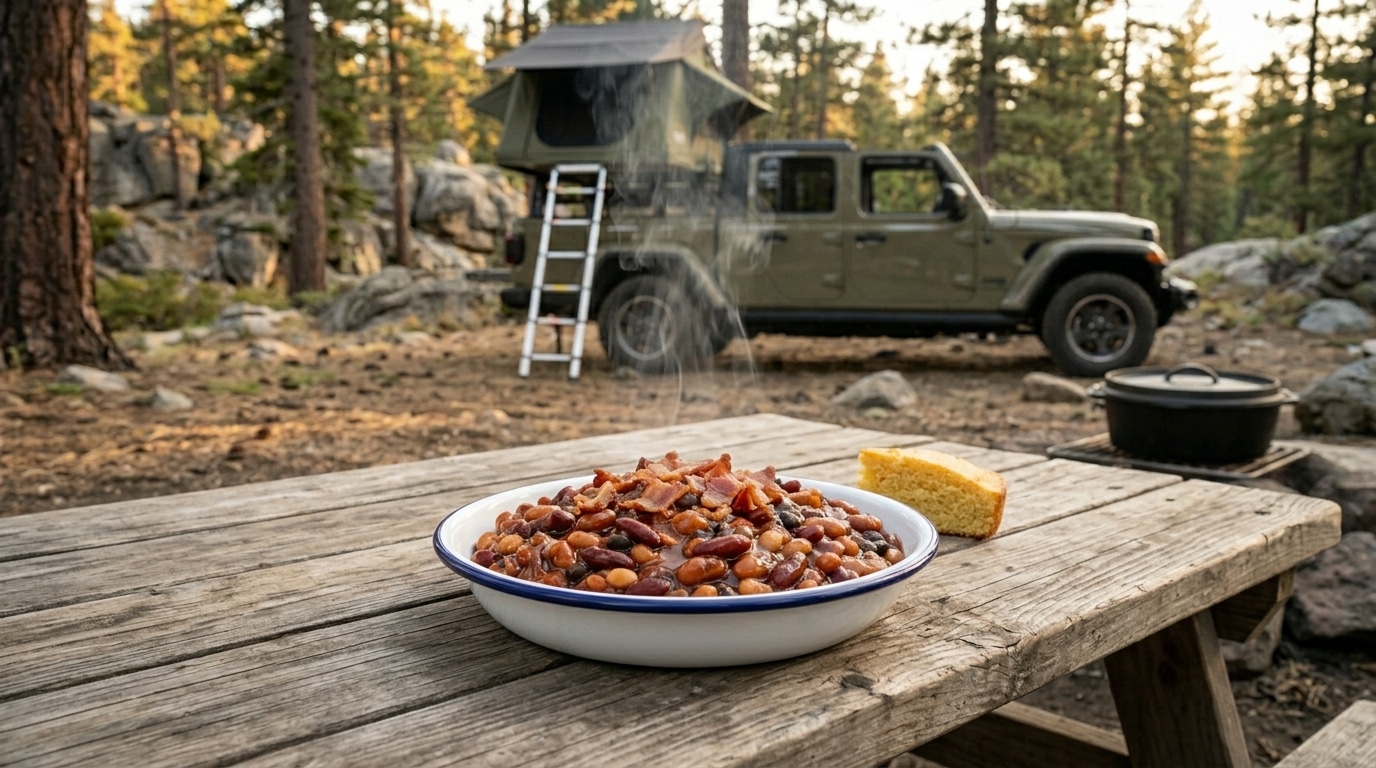
- Rest and serve: Remove the Dutch oven from the coals with gloves. Rest 5 minutes uncovered so the sauce tightens further. Finally, spoon into enamel bowls or serve family-style alongside ribs, brisket, or burgers with cornbread on the side.
Briquette Math for 325F Simmer
A 12-inch Dutch oven at 325F for a bean simmer needs 23 briquettes total in a 1-to-1 ratio: 12 top and 11 bottom. Specifically, the balanced ratio holds 325F steady through the 90-minute simmer without scorching the sugar-heavy sauce on the cast iron bottom.
Lodge briquette counts for 325F simmer (1-to-1 ratio):
- 8-inch (2 quart): 7 top / 7 bottom
- 10-inch (4 quart): 10 top / 10 bottom
- 12-inch (6 quart): 12 top / 11 bottom
- 14-inch (8 quart): 15 top / 14 bottom
Altitude slows bean simmer because water boils below 212F. Therefore, above 5,000 feet, add 1 top and 1 bottom briquette and extend simmer by 15 minutes. Above 7,500 feet, add 2 top and 2 bottom and extend by 25 minutes. On the Big Bear trip at 6,750 feet, the standard 90-minute simmer ran 105 minutes with 13 top and 12 bottom before the sauce thickened to cowboy-beans consistency. Additionally, stir every 15 minutes at altitude instead of 20 because thinner air slows convection.
Field Tips for 4-Bean Balance
Four beans beat two beans every time. Specifically, each bean type contributes a different texture and starch release profile: kidney holds structure, pinto breaks down softly, navy releases the most starch to thicken the sauce, and black beans add visual contrast and earthy notes. Moreover, swap one bean for another and the dish flattens; use all 4 for the fullest cowboy-beans profile.
Keep one tin of baked beans in the mix. Specifically, baked beans ship pre-sweetened with molasses and tomato sauce which bonds the drained beans into a cohesive dish. Without the baked beans tin, the other 4 bean types sit loose in the BBQ sauce rather than melded. Additionally, the liquid from the baked beans provides roughly 1/3 cup of natural braise liquid which tightens into sauce.
Bacon renders fat faster than you expect at altitude. Consequently, at elevations above 7,500 feet, render bacon on 12 briquettes instead of 15 to prevent burning before the fat fully releases. Moreover, thick-cut bacon (Applegate or Wright brand) delivers more fat per strip than standard-cut, which multiplies the smoky flavor across the beans.
Variations and Substitutions
- Smoked brisket version: Replace ground beef with 1 pound of shredded smoked brisket (from a previous smoker cook). Adds pronounced smoke flavor and turns the beans into a pulled-meat feature dish.
- Pulled pork version: Swap ground beef for 1 pound of leftover pulled pork. Add 1 tablespoon of liquid smoke to amplify the barbecue notes. Classic Memphis-style bean profile.
- Vegetarian: Omit bacon and ground beef. Add 2 tablespoons olive oil for aromatic saute. Increase smoked paprika to 2 teaspoons to compensate for lost bacon smoke.
- Spicier version: Double the cayenne to 1/2 teaspoon and add 2 diced fresh jalapenos during the aromatics. Moreover, swap standard BBQ sauce for spicy BBQ (Stubb’s Hickory Bourbon Spicy).
- Molasses-heavy: Replace 1/4 cup brown sugar with 1/4 cup blackstrap molasses. Produces a darker, deeper bean profile which leans toward Boston baked beans style.
- Maple bourbon: Swap brown sugar for 1/3 cup pure maple syrup and add 2 tablespoons bourbon during the last 30 minutes of simmer. Elegant profile which pairs with brisket.
- Scaled for 4 people: Use a Lodge 10-inch Camp Dutch Oven. Halve everything (3 strips bacon, 1/2 pound beef, 2 bean tins plus baked beans). Simmer on 10 top and 10 bottom for 75 minutes.
- Scaled for 12 people: Use a 14-inch Lodge Camp Dutch Oven. Increase ingredients by 1.5x. Simmer on 15 top and 14 bottom for 110 minutes.
Essential Tool
Camp Chef 12-Inch Dutch Oven Lid Lifter
Hooked steel end pulls the flanged lid off cleanly for the 20-minute stir checks across the 90-minute simmer. Additionally, the 12-inch reach keeps hands safely away from 12 lit top briquettes during coal refresh.
Storage and Leftovers
Leftover Dutch oven cowboy beans hold safely in a cooler below 40F for up to 4 days per USDA food safety guidelines. Reheat in the Dutch oven on 8 bottom briquettes for 15 minutes, stirring every 4 minutes to prevent sticking. Alternatively, warm single portions in a cast iron skillet over medium-low heat for 8 minutes with 2 tablespoons of water to loosen the sauce.
For chili dog toppings on day 2, spoon warm leftover beans across grilled hot dogs in buns, then top with shredded cheddar and diced onion. Moreover, leftover beans freeze cleanly in 1-quart ziplock bags for up to 3 months per USDA guidance, and flat-frozen bags double as cooler ice blocks for the next overland trip. Day-2 beans taste noticeably better than day-1 because the sauce thickens and the flavors marry overnight.
Frequently Asked Questions
How many briquettes for Dutch oven cowboy beans at 325F?
A 12-inch Lodge Camp Dutch Oven at 325F uses 12 briquettes on the lid and 11 underneath in a 1-to-1 ratio. Moreover, a 10-inch Dutch oven needs 10 top and 10 bottom. The balanced ratio holds steady heat through the 90-minute simmer without scorching the sugar-heavy BBQ sauce on the cast iron bottom.
Do I need all 4 bean types?
Yes, 4 beans deliver the full cowboy-beans profile. Specifically, kidney holds structure, pinto breaks down softly, navy releases starch to thicken, and black beans add earthy notes. Swap one for another and the dish flattens. However, in a pinch, 3 beans work; drop the black beans first if forced to cut one.
What BBQ sauce works best?
Sweet Baby Ray’s Original or Stubb’s Original Hickory Bourbon deliver the right smoky-sweet balance. Specifically, tangy vinegar-forward Carolina-style sauces throw off the balance because the brown sugar and baked beans already contribute sweetness. Alternatively, mix 2 BBQ sauces together for a layered profile.
Do I drain the baked beans tin?
No, leave the baked beans tin undrained because the molasses-tomato liquid contributes roughly 1/3 cup of natural braise liquid which helps thicken the sauce. Specifically, draining the baked beans produces a drier final dish. Drain and rinse only the 4 other bean types (kidney, pinto, navy, black).
Why does my cowboy beans sauce break or burn?
Sauce burns when bottom briquette count exceeds 12 or stirring intervals stretch past 25 minutes. Specifically, the brown sugar and BBQ sauce sugars caramelize fast against hot cast iron. Instead, keep bottom coals at 11 and stir every 20 minutes with a wooden spoon which reaches the Dutch oven bottom cleanly.
What temperature is safe for the ground beef?
USDA food safety specifies 160F internal for ground beef. The initial brown hits 160F within 6 to 8 minutes. Moreover, the 90-minute 325F simmer holds the beans above 175F the entire time, exceeding USDA minimums by 15F. An instant-read thermometer in the ground beef during browning confirms doneness.
Are cowboy beans a side dish or a main course?
Both, depending on portion size. Specifically, a 1/2-cup serving alongside ribs, brisket, or burgers makes cowboy beans a side dish. Alternatively, a 1 1/2-cup serving with cornbread and a green salad turns it into a stand-alone meal. Each 1/2-cup serving delivers roughly 22 grams of protein.
Does Dutch oven cowboy beans work at high altitude?
Yes, this recipe performs well above 5,000 feet with tweaks. Specifically, add 1 top and 1 bottom briquette and extend simmer by 15 minutes between 5,000 and 7,500 feet; add 2 top and 2 bottom and extend 25 minutes above 7,500 feet. Additionally, stir every 15 minutes instead of 20 because thinner air slows convection in the Dutch oven.
You Might Also Like
- Dutch Oven Chili (classic bean-and-meat sibling)
- Dutch Oven Ribs (primary cowboy beans pairing)
- Dutch Oven Cornbread (cowboy beans companion)
- Return to the full Dutch Oven Camping Recipes collection
- Pair with Dutch Oven Pot Roast