


Quick Facts:
- Topic: Off-road snorkel buying guide
- Price range: $224 to $750, depending on brand and vehicle
- Fitment: Vehicle-specific; no brand covers every platform
- Fording benefit: Raises the intake to roof height, not a guarantee against hydrolock
- Horsepower claim: Marketing says yes, dyno tests and owner forums say no on a stock engine
- Install cost: $300 to $700 professional, 3 to 5 hours DIY for an experienced installer
- Best for: Overlanders who ford water regularly or drive dusty terrain often
8 min read
In This Guide
- Off-Road Snorkel Buying Guide: What a Snorkel Actually Does
- Snorkel vs Raised Air Intake
- Off-Road Snorkel Brands Compared
- Water Fording Depth With Snorkel
- Does a Snorkel Increase Horsepower?
- Dust Filtration in the Desert
- Off-Road Snorkel Installation Cost: DIY vs Professional
- Off-Road Snorkel Buying Guide: Choosing the Right Kit
- FAQ
Off-Road Snorkel Buying Guide: What a Snorkel Actually Does
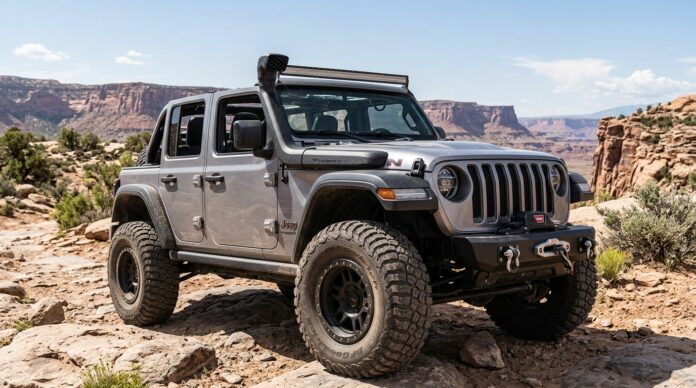
An off-road snorkel buying guide starts with one honest fact. A snorkel raises your engine’s air intake from the fender or hood to roof height. Notably, this single change drives every benefit and every myth tied to this part. Our full explainer on what a snorkel does covers the mechanics in more depth if you want the fuller picture before you shop.
Two jobs matter most: deeper water fording and cleaner air in dusty terrain. A snorkel does not meaningfully boost horsepower on a stock engine, despite decades of marketing copy suggesting otherwise. It also does not turn your rig into a submarine. Differentials, transfer cases, and low-mounted electrical connectors stay equally vulnerable to water, before or after installation.
Prices run from $224 to $750 depending on brand and vehicle. Fitment matters more than most buyers expect, since no single brand covers every platform. This guide compares six real kits by price, fitment, material, and design. It then walks through fording depth, the horsepower question, dust filtration, and install cost to help you decide if one earns a spot on your rig.
Snorkel vs Raised Air Intake
These two terms get used interchangeably, and this habit causes real confusion. A raised air intake simply moves the entry point higher, often to A-pillar or hood height, using tubing with partial seals. It resists splashes and shallow puddles. However, it was never built for submersion.
A true snorkel seals every joint from the roof-level intake head down to the airbox. Specifically, clamps, seams, and drain points are all engineered to stay watertight. This is what allows operation through partial or full submersion. Buyers who assume “raised intake” and “snorkel” mean the same protection level risk a costly surprise at their first deep crossing.
Direction matters too. A forward-facing head creates a mild ram-air effect at highway speed, pushing slightly more air volume into the engine. A rearward-facing head cuts dust ingestion in convoy driving instead, at the cost of the ram effect. Neither direction is universally correct. Instead, match it to whichever you drive more: dusty trails or highway miles between trailheads.
Safety note: A poorly sealed snorkel, whether from a rushed DIY install or a cut-rate shop job, fails exactly when you need it most. Sealing quality, not the part itself, determines whether you get the protection you paid for.
Off-Road Snorkel Brands Compared
Finding the best off-road snorkel kit starts with narrowing six brands. Together, they cover most of the off-road snorkel market for popular overlanding platforms. Fitment varies sharply. AEV builds exclusively for Jeep, while Mishimoto Borne fits only the Ford Bronco. ARB Safari and TJM Airtec cover the widest range of vehicles.
| Brand | Price (USD) | Fitment | Material |
|---|---|---|---|
| ARB Safari (RSPEC/VSPEC) | $224 to $700 | Jeep JL, Toyota 4Runner, Ford Ranger | UV-stable polyethylene, stainless hardware |
| ARB Safari Armax | $650 to $750 | Toyota Land Cruiser, 4Runner, Tacoma | Same polyethylene, stainless hardware |
| AEV Snorkel Kit | $440 to $599 | Jeep JL Wrangler, JT Gladiator only | Cross-linked polyethylene |
| TJM Airtec | Around $495 | FJ Cruiser, Hilux, Ford Ranger (custom fit) | UV-resistant polyethylene or stainless |
| Mishimoto Borne | $289 to $636 | 2021+ Ford Bronco only | Cross-linked polyethylene, steel brackets |
| Airflow Snorkel | $352 to $399 | Toyota Tacoma (molded per generation) | Virgin polyethylene, injection-molded |
ARB splits its own lineup along the same line this guide draws elsewhere. Specifically, the Armax sub-line markets increased airflow for a ram-air effect. The standard RSPEC and VSPEC models focus on straightforward intake relocation instead. TJM’s Airtec design uses a multi-stage water separation approach at the ram head, with the factory airbox drain acting as a final backup.
Manufacturers do not publish standardized CFM airflow ratings for these kits. Treat any “increased airflow” claim as qualitative marketing language rather than a verified number. Notably, no brand in this comparison discloses a tested CFM figure. ARB’s own snorkel catalog shows this pattern clearly across its full lineup.
Off-Road Snorkel Kits Featured in This Guide
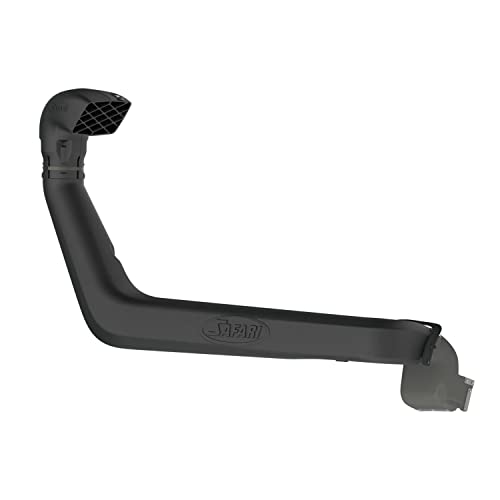
ARB SS1080HF Safari Snorkel Air Intake kit V-SPEC For Jeep Gladiato…

ARB SS450HP Safari Snorkel Air Intake kit ARMAX for Toyota 4Runner …

Water Fording Depth With Snorkel
Stock fording depth surprises most buyers. Purpose-built 4x4s already rate higher than people assume before adding any hardware.
| Vehicle | Stock Fording Depth |
|---|---|
| Ford Bronco (Sasquatch package) | 33.5 inches |
| Jeep Wrangler JL/Rubicon | 30 inches at 5 mph |
| Toyota 4Runner | 27.5 inches |
| Toyota Tacoma TRD Off-Road | 27.6 inches |
| Crossover SUVs (Bronco Sport, Outback class) | 18 to 20 inches |
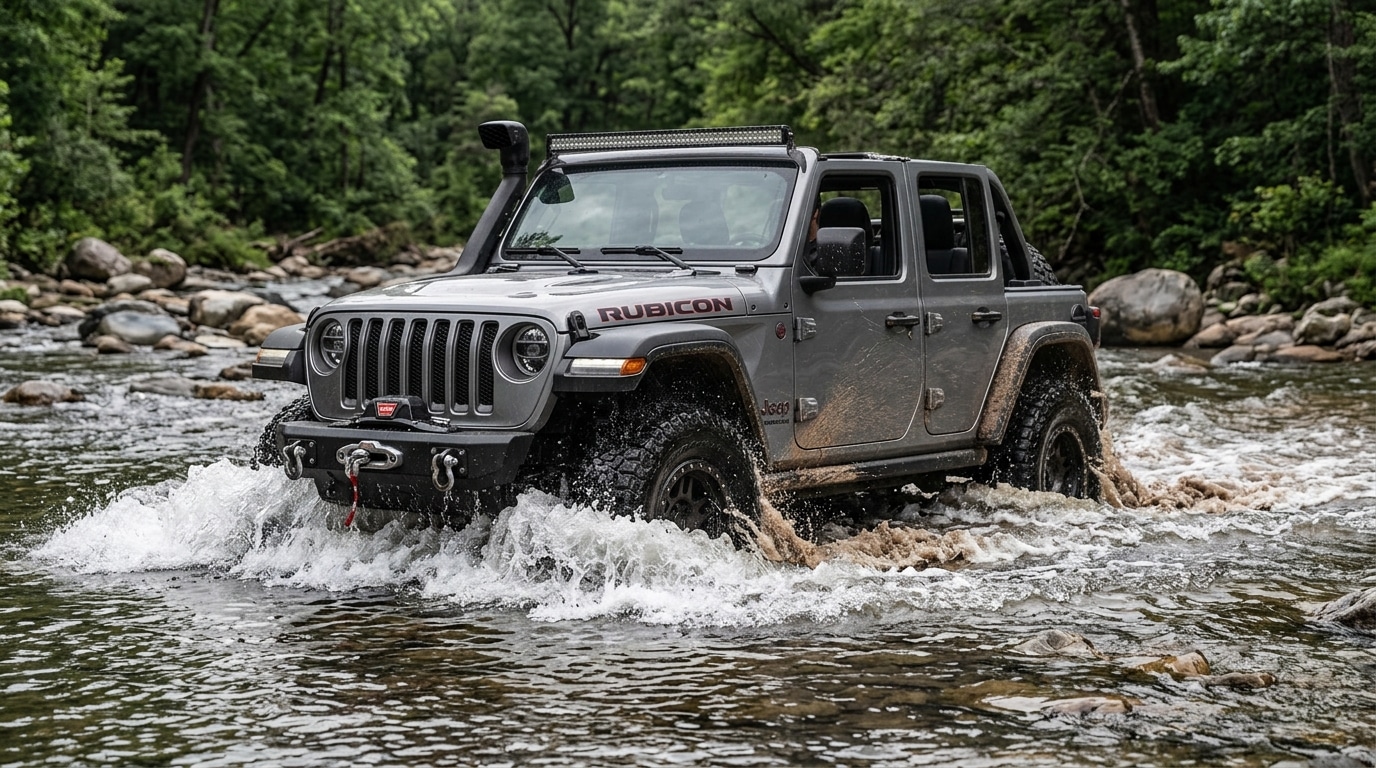
A properly sealed snorkel theoretically raises the fording ceiling to the level of the intake head at roof height. The word “theoretically” matters. If the seal fails or the drain plug stays open, none of this ceiling applies. A well-known industry column puts it plainly: a snorkel prevents water from entering the airbox at deeper depths. However, it does not raise any of the other vulnerable spots water attacks.
Differentials, transfer cases, and low-mounted breather tubes sit at their stock height regardless of what you bolt to your fender. Meanwhile, sensitive electrical connectors near bumper height, like an electric sway-bar disconnect, short out in water shallower than what would hydrolock your engine. For more on this, our guide to prepping your 4WD for water crossings covers the diff-breather and electrical side of the problem.
One forum thread captures the right mindset: a snorkel works as insurance against accidental deep water, not a license to exceed your rig’s recommended fording depth. Technique still matters as much as hardware. Shops report engines lost in as little as three inches of water. In each case, a driver hit a crossing too fast and splashed water upward into the engine bay.
Does a Snorkel Increase Horsepower?

Some manufacturer marketing claims a snorkel functions as a cold air induction system. The pitch says it pulls in cooler, denser air for a modern ECU to use for more power. This claim deserves scrutiny before you believe it.
Independent testing tells a different story. A dyno test on a Tacoma with a snorkel installed showed a power loss, not a gain. Similarly, owner forums back this up consistently. One 4Runner thread put it bluntly: snorkels reduce dust inhalation with the side effect of keeping water out. On their own, they do nothing for power or fuel economy.
The one credible horsepower number in this research came from Mishimoto’s own testing, and it came with a catch. Mishimoto measured 7.5 horsepower and 7.4 foot-pounds of torque testing their aftermarket intake alone, with no snorkel attached. Mishimoto never dyno-tested the snorkel and intake together. They only estimated the combined result would land somewhere between this intake-alone figure and a separate, smaller gain from other parts. No test measures what the Borne snorkel does for horsepower on its own.
Longer, curved snorkel tubing adds airflow restriction, which offsets any theoretical cold-air benefit on a stock engine and stock tune. Buy a snorkel for fording depth and dust protection. Do not buy one expecting a power gain, since the honest evidence does not support this claim on a stock setup.
Dust Filtration in the Desert

Dust protection delivers the more consistent real-world benefit for most overlanders. This holds especially true for anyone who drives dry, dusty terrain more often than they ford rivers. Specifically, roof-level air runs cleaner and cooler than air pulled from around a hot engine bay. As a result, filter life extends and clogging drops on long desert or outback routes.
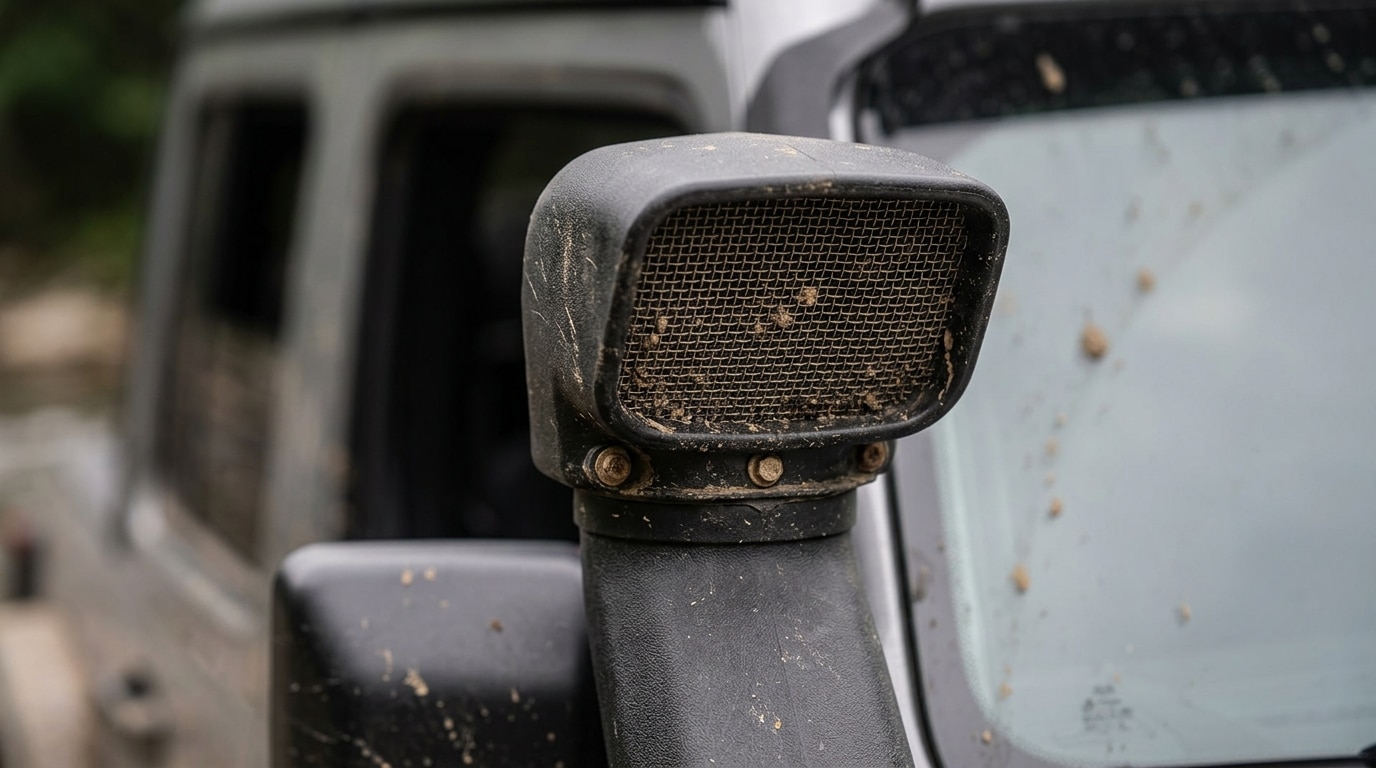
One snorkel manufacturer’s engineer describes a cyclonic separation effect at the intake head. Above roughly 15 mph, the open-face design ejects a portion of incoming airflow before it reaches the filter. This removes heavy dust particles first. The design only works if the head stays unshrouded and pointed correctly. Similarly, mounting it too close to the hood or angling it wrong cuts the effect significantly.
Overlanders who drive convoy routes through bull dust country often treat a snorkel and a quality air filter as a package, not a standalone fix. For a typical U.S. overlander mixing pavement and trail, the benefit looks different. Dust mitigation mostly extends filter life, since factory airboxes already filter out most incoming dust before it becomes a problem.
Off-Road Snorkel Installation Cost: DIY vs Professional
Professional installation commonly runs $300 to $700 in total, based on shop labor rates and typical job length. Owner-reported labor rates and install times vary widely by shop and platform, from an hour or two on some vehicles to most of an afternoon on others. Regional variance runs wide enough to make a local shop quote more reliable than any single published figure.
DIY installation is realistic for an owner comfortable cutting a body panel and working with sealant and rivets. Notably, brand-produced install videos exist for most of the kits in this comparison. Every source consulted for this guide stresses the same warning: sealing quality is the single point of failure. A rushed or incorrect seal costs more than a bad look. It defeats the entire purpose of the part.
Budget for a companion upgrade while you are under the hood. Our guide on why you need diff breathers explains the low-mounted breather relocation. It pairs naturally with a new snorkel, since both target the same water-crossing risk from different angles.
Snorkel Install Accessories and Companion Gear


Off-Road Snorkel Buying Guide: Choosing the Right Kit
The best off-road snorkel kit for your rig depends on your platform and how you drive it, not a single universal pick. Match your situation to a starting point instead of comparing every spec side by side. A Jeep JL Wrangler owner fording rivers on remote routes fits best with ARB Safari VSPEC or AEV’s Jeep-specific kit, both built around a forward-facing, fully sealed design. Bronco owners chasing documented performance data have one real option: Mishimoto Borne, the only brand in this guide with published dyno numbers, though those numbers come from the intake alone. A Tacoma or 4Runner owner splitting time between desert dust and occasional crossings fits well with ARB Safari Armax or Airflow Snorkel, both engineered around dust separation first.
Land Cruiser owners have the narrowest field. Safari Armax stands as the dominant option with documented fitment across 75, 200, and 300-Series trucks. Budget-conscious Tacoma and FJ Cruiser owners without a strict performance requirement should compare Airflow Snorkel against TJM Airtec, since both land in a similar price range with different water-separation designs.
Whichever kit fits your platform, skip the horsepower argument when you compare options. None of the six brands in this guide deliver a meaningful power gain on a stock engine. Let fitment, sealing quality, and your actual terrain make the call instead.
FAQ
Do you need a snorkel for off-roading?
Not always. A snorkel earns its keep for drivers who ford water regularly or drive dusty terrain often. Occasional trail use on a vehicle with a good stock fording depth rating often does not need one.
What is the difference between a snorkel and a raised air intake?
A raised air intake only relocates the entry point higher, with partial seals resisting splashes, not submersion. A true snorkel seals every joint from intake head to airbox for full or partial submersion protection.
Does a snorkel increase horsepower?
No, not on a stock engine. Dyno testing and owner forums consistently show no meaningful power gain, and one test even showed a power loss. Instead, the one documented gain came from an aftermarket intake swap, not the snorkel itself.
How deep can you ford water with a snorkel?
A properly sealed snorkel theoretically raises your fording ceiling to the height of the intake head. Differentials, transfer cases, and low electrical connectors stay at stock height and remain equally vulnerable. The snorkel alone does not solve every water-crossing risk.
How much does it cost to install an off-road snorkel?
Professional installation typically runs $300 to $700 total. Regional pricing and install time vary widely, and DIY installation is realistic for an owner comfortable with body panel cutting and sealant work.
Which off-road snorkel brands fit my vehicle?
Fitment is brand-specific. AEV fits Jeep JL Wrangler and JT Gladiator only. Mishimoto Borne fits the 2021-plus Ford Bronco only. ARB Safari and TJM Airtec cover the widest range, including Toyota Land Cruiser, 4Runner, and Tacoma platforms.