


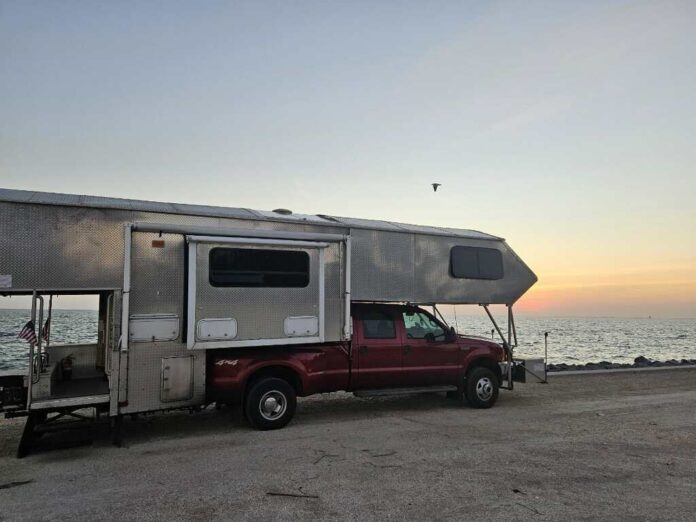

Quick Facts:
- Rig: One-of-a-kind homemade truck camper
- Truck: 2001 Ford F-350, 7.3L Power Stroke diesel, 265,000 miles
- Camper base: 12-foot Lance, extended and rebuilt over 6.5 years
- Total length: 30 feet
- Total weight: Around 17,000 pounds loaded
- Power: 400-watt solar, two house batteries, Honda slide-out generator
- Climate: 5,000 BTU residential AC plus propane furnace
- Asking price: $20,000 camper only, or $40,000 with the truck
- Location: Bradenton/Sarasota, Florida (winter), Minnesota (summer)
- Best for: Buyers who want a turnkey overland rig with serious attention value
Full interior tour by RVing with Andrew Steele. Used with credit.
9 min read
In This Article
- Why This Homemade Truck Camper Went Viral
- Key Specs at a Glance
- Why Tom Spent 6.5 Years Rebuilding This Homemade Truck Camper
- The Donor Truck: 2001 Ford F-350 With the 7.3L Power Stroke
- Exterior: Wedge Nose, Diamond Plate, and 3-Inch Walls
- Inside: King Loft, Wood Ceiling, and Custom Storage
- Off-Grid Power, Climate, and Suspension
- Rear Garage and Toy Hauler Potential
- Tom’s Story Behind This Homemade Truck Camper
- Homemade Truck Camper vs. Factory Build
- Price, Availability, and How to Contact Tom
- Frequently Asked Questions
Why This Homemade Truck Camper Went Viral
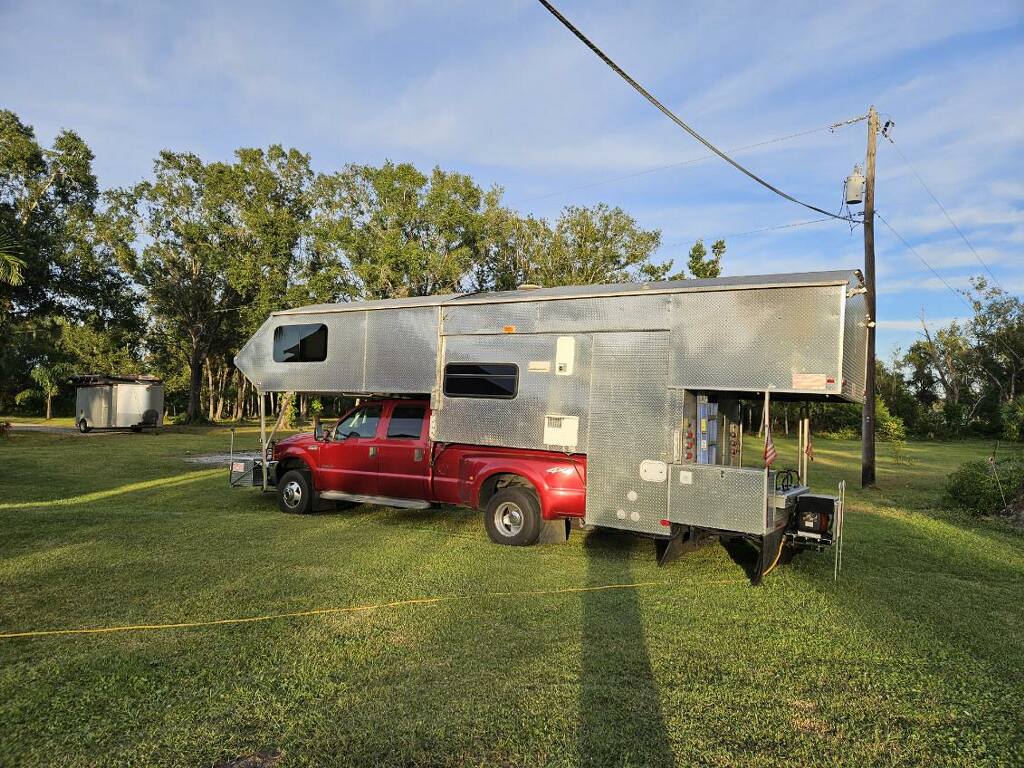
This homemade truck camper became the most-viewed rig on YouTube channel RVing with Andrew Steele after Andrew filmed it by accident in a Costco parking lot. The original short crossed seven million views. Andrew has chased coaches priced above three million dollars, yet this one-off DIY truck camper outperformed every luxury motor coach on his channel.
Behind the rig is Tom, a retired engineer who started with a 12-foot Lance slide-in and rebuilt it over 6.5 years into a 30-foot custom truck camper. The build sits on a 2001 Ford F-350 with the 7.3L Power Stroke diesel. After the viral hit, Andrew filmed the first-ever interior tour. As of this writing, the rig is officially listed as a truck camper for sale.
If you read 4wdTalk for serious truck-camper and overland content, this build deserves a close look. Tom’s engineering background shows in every design choice. From the wedge-shaped aerodynamic nose to the 3-inch foam-insulated walls, this is the kind of rig the truck-camper community studies before starting a build of their own. For a wider primer on the format, see our complete truck bed camper buying guide.
Key Specs at a Glance
| Specification | Details |
|---|---|
| Truck | 2001 Ford F-350, 7.3L Power Stroke diesel |
| Mileage | 265,000 miles, no rust, never on salted roads |
| Fuel economy | 7.4 mpg regardless of speed or load |
| Camper base | 12-foot Lance slide-in, fully rebuilt |
| Total length | 30 feet end to end |
| Total weight | Around 17,000 lbs loaded |
| Walls | 3-inch wood frame with foam insulation, diamond plate skin |
| Suspension | Heavily modified airbags at four corners, F-550 equivalent |
| Sleep area | King-size loft bed with his-and-her closets |
| Solar | 400-watt array with full controller bank |
| Climate | 5,000 BTU residential AC and propane furnace |
| Propane | Two 30-lb tanks with automatic switchover |
| Generator | Honda slide-out in receiver hitch |
| Bathroom | Full shower, 6 ft of headroom |
Why Tom Spent 6.5 Years Rebuilding This Homemade Truck Camper
Tom bought the truck and camper combo in 2003 from a retired Northwest Airlines pilot whose wife had died of cancer. For the first decade, Tom used the rig as a vacation vehicle with family. Then his longtime partner died of pancreatic cancer in 2015. Around the same time, his mother moved to Florida, so Tom started snowbirding between Minnesota and the Gulf Coast.
After two seasons on the road, Tom realized the 12-foot Lance was too small for full-time use. As a former engineer and facilities manager, he started sketching a way to add space without sacrificing the slide-in format. Unlike most DIY truck camper projects, the build took 6.5 years to complete.
“It took six and a half years of work putting this together,” Tom told 4wdTalk in a phone interview. Today, the rig is a fully custom truck camper with a 30-foot total footprint, while the original Lance slide-out and a single interior control panel are the only Lance components still in service.
Throughout the build, Tom kept no logbook and posted no videos. Every photo and clip of the rig online comes from strangers who pulled alongside him in parking lots. The accidental documentation is how Andrew Steele caught the rig at Costco in the first place.
The Donor Truck: 2001 Ford F-350 With the 7.3L Power Stroke
The donor truck is a 2001 Ford F-350 with the 7.3L Power Stroke diesel. Some viewers of the Andrew Steele tour assumed the chassis was an F-550. Tom asked us to clear this up. Specifically, the truck is an F-350 with a heavily modified suspension setup, including airbags at all four corners, which makes it perform equivalent to an F-550 in load-handling capacity.
The truck has 265,000 miles, has never seen snow, and has never touched salted roads. For 4wdTalk readers familiar with the 7.3L Power Stroke, those numbers signal a truck still in its prime. The 7.3 is widely regarded as the most durable Power Stroke Ford ever built, and engines from this era routinely cross 500,000 miles with proper maintenance. Tom has done every wrench turn himself since 2003. If you want a deeper take on the diesel platform argument, our piece on diesel vs gas trucks for overlanding covers the trade-offs in detail.
Fuel economy holds steady at 7.4 mpg. Speed does not change the number. Tom reports the same figure at 60 mph or 70 mph, towing or empty. For a 17,000-lb loaded rig with this much wind cross-section, the consistency is the engineering story worth noting.
Exterior: Wedge Nose, Diamond Plate, and 3-Inch Walls
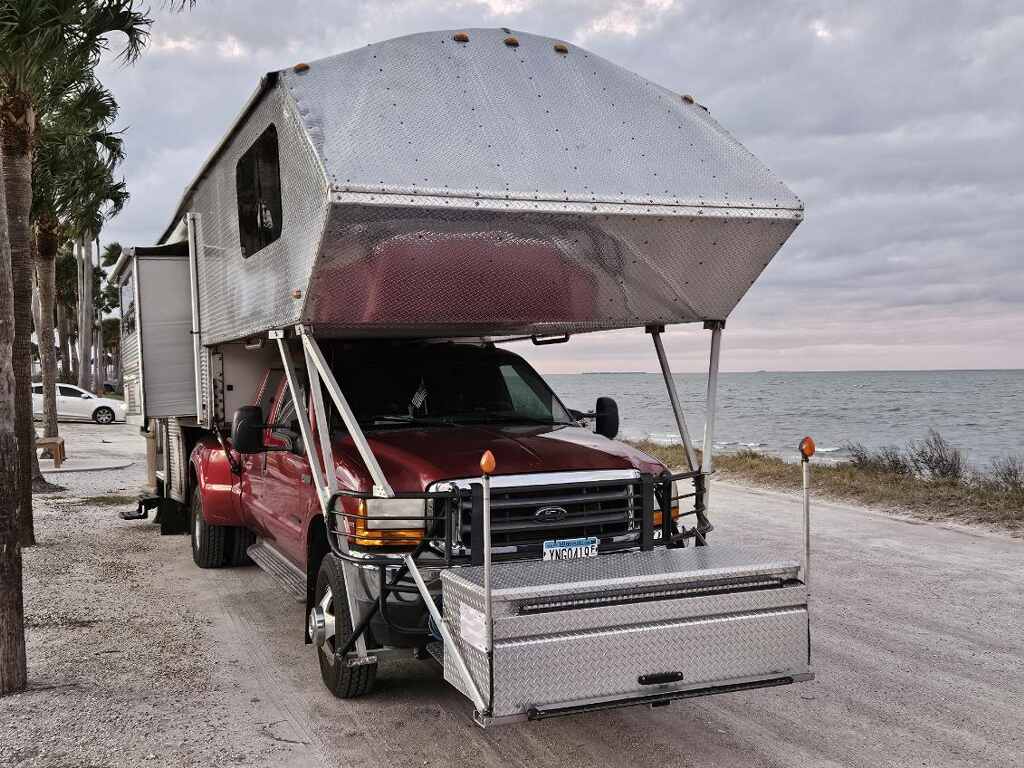
The exterior is where the engineer’s hand shows first. Tom designed a wedge-shaped front extension. His reasoning is direct: Class A motorhomes push wind, while Class C designs cut it. He duplicated the Class C wedge profile to break the airflow on a truck camper chassis. The wedge also houses a forward storage box for jack stands and self-sufficiency gear.
Similarly, wall construction follows the same engineering logic. The walls are 3 inches thick with foam insulation core. The skin is diamond plate aluminum, glued and screwed using stainless steel fasteners with neoprene washers at every penetration. Tom describes the finished envelope as bulletproof, hail proof, and leak proof. After more than a decade on the road, the seams have held.
The original Lance cab-over and slide-out remain visible in the side profile. Tom kept the Lance roof line at the front and built the new king-bed loft as a clean extension upward. Behind the slide, he added a full-width rear garage extension. The result is a coherent silhouette, even though the build merged three different structural sections.
Inside: King Loft, Wood Ceiling, and Custom Storage
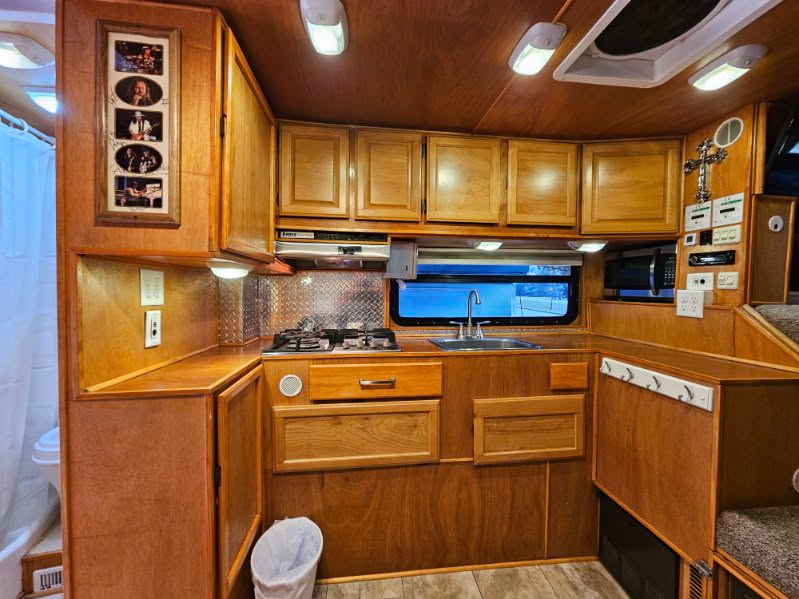
Inside, the rebuild replaces nearly every Lance component. The only original element left is the wall-mounted Lance control panel. Walking in through the rear entry, the kitchen sits left with the refrigerator faced in diamond plate. Tom installed a heavier-duty cooktop rather than a standard RV unit because he cooks stir-fry on the road. Above the cooktop, the 5,000 BTU residential AC unit replaces the typical rooftop RV unit.
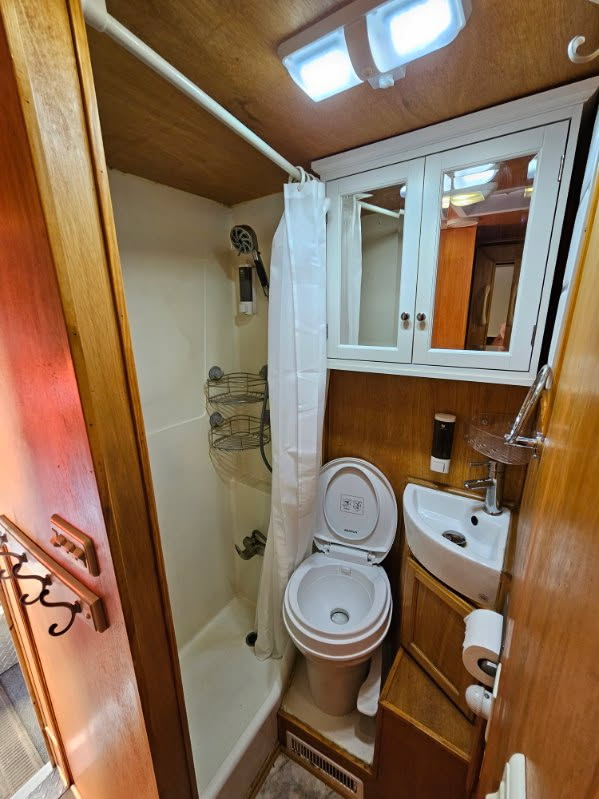
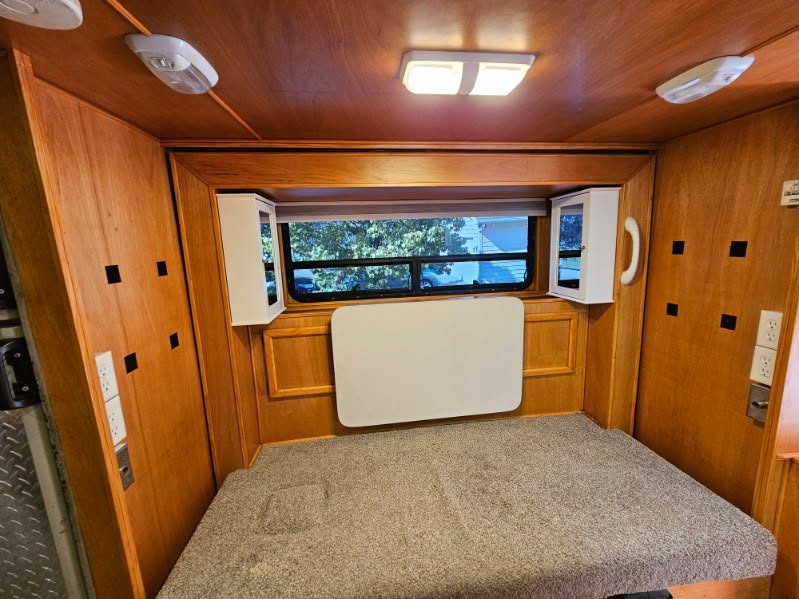
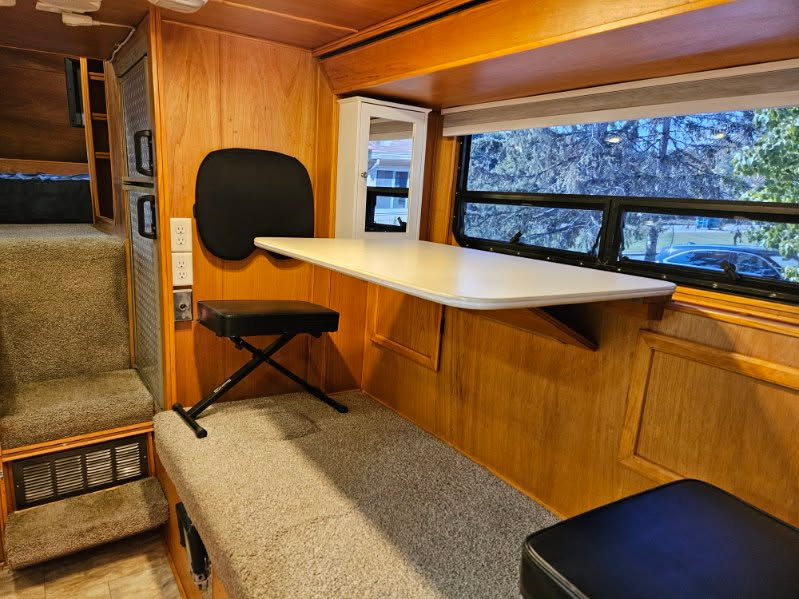
The dinette uses a flip-up table over portable benches. The setup converts to a bed for guests, while the chairs store overhead. In addition, storage runs under every surface, including pull-out trays sized for plastic bags and small kitchen tools. Across from the kitchen sits a small bathroom with a full shower and 6 feet of headroom. The bathroom retains its original Lance footprint, but the interior has been remodeled with white cabinetry.
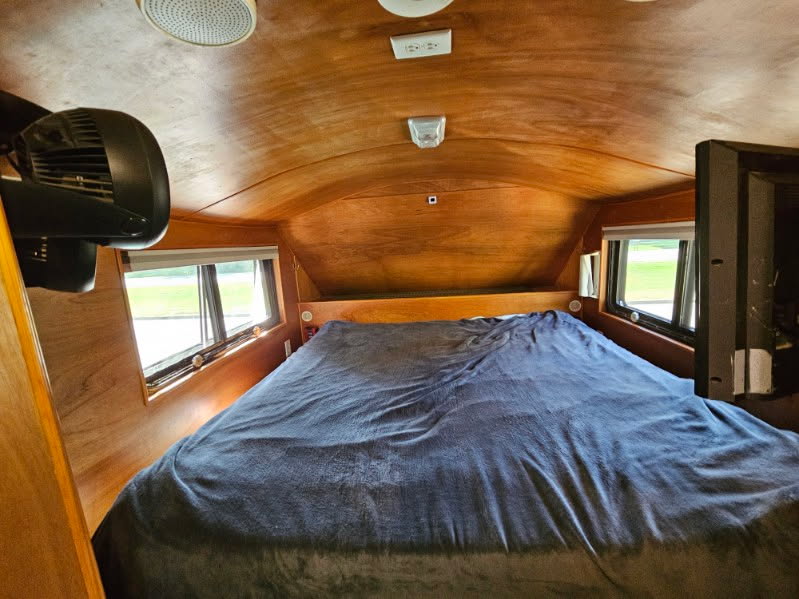
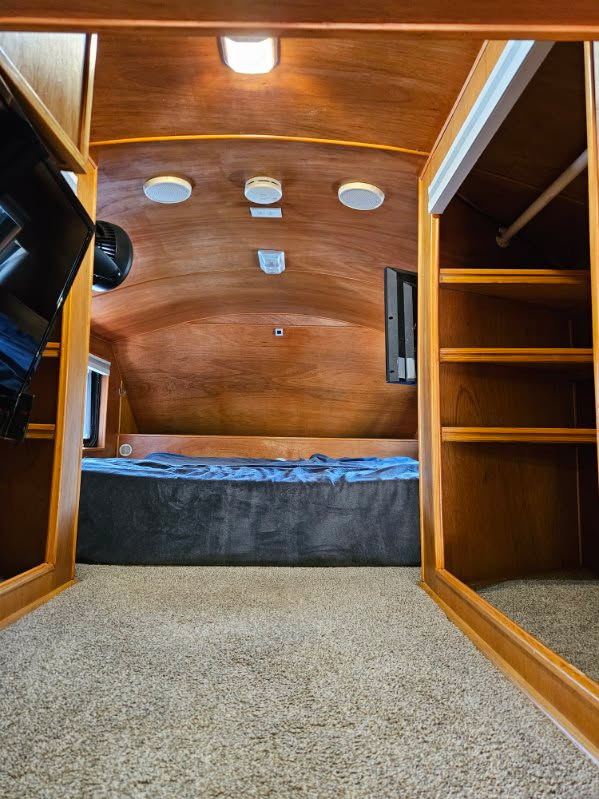
Up front, the wedge extension houses the king-size loft bed. Tom replaced the original queen cab-over because, as a tall person, he found the limited overhead space restrictive. The new loft includes his-and-her closets, two side windows, a large front window, ceiling fans, manual shades, and a Vizio TV. The wood ceiling is custom and was installed by Tom himself.
Off-Grid Power, Climate, and Suspension
For boondocking, the rig runs a 400-watt solar array with a full controller stack mounted inside the cabin. Two house batteries store energy under the dinette, while the freshwater tank sits in the same compartment. Propane runs from two 30-lb tanks with automatic switchover, feeding both the furnace and the water heater. If you are new to solar sizing for a build like this, our solar power for camping beginner’s guide walks through panel and battery selection.
The original LP gas generator dropped a valve and was beyond economical repair. Tom replaced it with a Honda generator mounted on a slide-out platform in the receiver hitch. The platform pulls cleanly for service, then locks back into place for travel. For climate control, the choice of a residential 5,000 BTU AC over a rooftop RV unit is a deliberate cost decision. According to Tom, traditional RV AC units run expensive to replace and short on efficiency.
Suspension is the part most viewers underestimate. Airbags at all four corners handle the 17,000-lb load. An interior controller mounted near the dinette adjusts pressure on the fly. The combination is what gives the F-350 its F-550-equivalent feel.
Rear Garage and Toy Hauler Potential
Behind the cabin slide-out, an extension houses what Tom calls his garage. Inside, the compartment holds a ladder, fishing poles, beach gear, and two electric bikes suspended on pulleys. A fold-down ramp drops from the rear hatch so the bikes roll directly in. For a snowbird who covers every Florida beach from Jacksonville to Pensacola, the cargo capacity is the difference between traveling and living on the road.
Tom suggests a use case for the next owner. For example, if you mounted the camper on an F-750 flatbed instead of the current F-350, you would extend the rear deck with a drive-in ramp and convert the unit into a true toy hauler. For overlanders and off-roaders shopping for a one-of-a-kind base platform, this is the conversation worth having with Tom directly.
Removing the camper for a future flatbed swap requires four electric jacks at the rear corners and a 6×6 wood beam with two high-lift jacks at the front. Tom designed the mount points so a future owner with a different truck has a path forward.
Tom’s Story Behind This Homemade Truck Camper
The build only tells half the story. The other half belongs to the owner who put 11 years of road life into shaping it.
Tom is now in his eleventh year on the road. “I spend summers in Minnesota and drive down to Sarasota in the winters,” Tom told 4wdTalk. “Everywhere I stop for gas, people pull over to take photos and ask about the rig.” He has friends in Sarasota and Orlando. His mother lives in Fort Myers. His favorite stretch of beach is Coquina Beach on Anna Maria Island.
One detail in the cabin is worth noting before you ask about it. A signed plaque hangs near the kitchen with signatures from Gary Rossington, Rickey Medlocke, Hughie Thomasson, Billy Powell, and Michael Cartellone. Tom collected the autographs across seven of the eight Lynyrd Skynyrd Simple Man cruises. Several of the signers have since passed away, including Gary Rossington in 2023, which is why the plaque carries personal value. The plaque goes with Tom to his next rig and does not transfer to the buyer.
The same applies to a small Grateful Dead sign by the entry. Both items are personal. Everything mechanical, structural, and functional stays with the camper.
Homemade Truck Camper vs. Factory Build
For buyers cross-shopping a factory hard-side slide-in, here is how this rig compares. A new 12-foot factory Lance, Northern Lite, or Arctic Fox runs roughly $50,000 to $80,000 before options. Those units arrive with manufacturer support, dealer warranty, and proven resale, while interior space stays limited to the original cab-over footprint and queen bed.
This homemade truck camper trades dealer support for substantially more interior volume, a king-size loft, a dedicated rear garage, and an engineered envelope you will not find in a production unit. The asking price reflects the trade: $20,000 for the camper alone or $40,000 for the truck and camper together. For a one-off custom rig with this much engineering inside it, the asking price is well under the typical cost of building a comparable DIY truck camper from scratch. Our guide on how to determine RV values helps frame the math for one-off rigs without an NADA reference.
Before any used camper purchase, work through a standard pre-purchase inspection. Our checklist of questions to ask before buying a used camper covers water damage, appliance function, tire age, and title concerns. Bring those questions to Tom directly.
Price, Availability, and How to Contact Tom
Availability notice. If Tom’s phone number is still listed below, the camper is still for sale. Tom has agreed to message us the moment the rig changes hands so we update this article and remove his contact details. As of publication, the rig remains available.
Notably, Tom’s asking prices are straightforward. First, the camper alone goes for $20,000. Second, the truck and camper together go for $40,000. Tom prefers to sell the camper only because he wants to keep the 7.3L truck. If you have been scanning truck camper for sale listings and have your own larger truck, such as an F-450 or F-550 flatbed, the camper-only price is the path he is steering buyers toward.
To reach Tom directly, call or text (763) 639-1453. He is in the Bradenton and Sarasota, Florida area through the spring, then returns to Minnesota for the summer. Delivery is negotiable depending on where the buyer is located. Serious buyers should bring a deposit conversation and a transport plan.
Frequently Asked Questions
How much does a custom truck camper cost?
A new factory hard-side slide-in truck camper runs $50,000 to $80,000 depending on brand, length, and slide-out configuration. A from-scratch DIY truck camper build of comparable size typically requires tens of thousands of dollars in materials plus years of labor. Tom’s asking price of $20,000 for this homemade truck camper reflects depreciation on an 11-year-old build, not the engineering inside it.
Why are truck campers so expensive?
Truck campers carry RV-grade appliances, holding tanks, insulation, slide-out mechanisms, and weatherproof construction inside a small footprint. Engineering for road vibration, payload limits, and four-season use drives material and labor cost. A homemade truck camper like Tom’s reduces brand markup but adds 6.5 years of one-person labor instead.
Is a truck camper considered an RV?
Yes. A truck camper is classified as a recreational vehicle by RVIA standards and by most state DMV registration codes. Insurance and titling treat slide-in truck campers similarly to travel trailers, though the truck and the camper are registered separately. Confirm titling rules with the DMV in your state before purchase.
Are king-size beds common in truck campers?
Production truck campers with king-size beds are uncommon because the cab-over footprint limits sleeping area to a queen in most cases. Custom builds get around the cab-over limit by extending the loft upward and outward, which is exactly what Tom did when he reworked the original Lance front section into a full king loft with side closets.
Do you need a CDL to drive a truck camper this size?
No CDL is required for a non-commercial slide-in truck camper, even at 30 feet total length and 17,000 lbs gross. Federal CDL rules apply to commercial vehicles and to combinations above 26,001 lbs gross combination weight in commercial use. A few states require special endorsements above 26,000 lbs for personal use, so check your state DMV.
How do you remove a truck camper from the truck?
Four electric jacks at the rear corners lift the camper off the bed, while front support comes from a wood beam set on two high-lift jacks. Tom designed the rig so a future owner with a different truck has a clear removal procedure. Removal typically takes one person 30 to 60 minutes once the jacks are positioned.