




Gas heater fuel burn is the first worry for anyone who plans to tap a vehicle tank for warmth. You park for the night, set the thermostat, and wonder whether the tank is empty by morning. The short answer is no. For example, the Velit gasoline air heater burns 0.05 to 0.13 gallons per hour, so a full night uses between half a gallon and 1.3 gallons.
This guide shows the math, explains how the pickup standpipe protects your tank, and covers the choices to change the total. As always, these numbers will vary depending on your specific heater and setup. Let’s get to it!
Quick Facts:
- Topic: Gas heater fuel burn and overnight tank use
- Gasoline burn rate: 0.05 to 0.13 gallons per hour
- Diesel burn rate: 0.05 to 0.12 gallons per hour
- Ten-hour night: About 0.5 to 1.3 gallons
- Pickup standpipe: At least 25 mm above the tank floor
- Power draw: 20 to 46 watts at 12V
- Heater output: 14,000 BTU (4 kW)
- Price: $729
- Best for: Gas-engine vans, trucks, and campers
8 min read
In This Guide
Gas Heater Fuel Burn Overview

Gas heater fuel burn is low because a gasoline parking heater pulls a small stream of fuel from the vehicle tank, burns it in a sealed chamber, and blows warm air into the cabin. The pump meters fuel in tiny pulses, so the draw is slow and steady. Specifically, the heater sips fuel instead of gulping it. Therefore, the question is not whether the heater empties the tank, but how much fuel a night costs you.
For the Velit unit, there’s a range instead of a single number. Specifically, the heater burns less on a low setting and more at full output. For example, a mild night in a small van holds the low end, while a hard freeze pushes the heater toward the high end. Our Velit gasoline air heater review covers the full spec list and owner feedback.
Most buyers also ask about the install, since any gasoline parking heater needs a fuel pickup inside the tank. Our guide to air heater mounting layouts covers where the heater itself goes. This article stays on the fuel side.
Fuel Burn Numbers at a Glance
| Measure | Velit Figure |
|---|---|
| Gasoline consumption | 0.05 to 0.13 gal/h |
| Diesel consumption | 0.05 to 0.12 gal/h |
| Heat output | 14,000 BTU (4 kW) |
| Electrical draw | 20 to 46 watts |
| Standpipe height | At least 25 mm above the tank floor |
| Aux fuel port kit | Sprinter, Transit, and ProMaster |
Buy Direct From Velit
Heat Your Rig Off the Fuel You Already Carry
The Velit gasoline air heater burns as little as 0.05 gallons per hour and ships with a full install kit for $729.
Overnight Fuel Use Math
Overnight fuel use is simple multiplication. Take the burn rate in gallons per hour and multiply it by the hours you run the heater. The table below applies the manual’s low and high rates to three night lengths. The totals are our own arithmetic, not Velit figures.
| Run Time | Low Setting (0.05 gal/h) | Full Output (0.13 gal/h) |
|---|---|---|
| 6 hours | 0.30 gal | 0.78 gal |
| 8 hours | 0.40 gal | 1.04 gal |
| 10 hours | 0.50 gal | 1.30 gal |
Gas Heater Fuel Burn as a Tank Percentage
Put those totals against a real tank. For example, a 25-gallon tank loses 2% on the low setting over ten hours, and 5.2% at full output. A smaller 20-gallon tank loses 2.5% and 6.5%. As a result, a single night rarely moves the gauge more than one needle width.
The worst case matters for long stays. Meanwhile, seven nights at full output for ten hours burns 9.1 gallons. Seven nights on the low setting burns 3.5 gallons. However, most nights land between those totals, because the thermostat throttles the heater down once the cabin warms.
Gas Heater Fuel Burn in Dollars and Miles
Fuel price changes by region, so treat this as an example. At $4 per gallon, a ten-hour night costs $2.00 on the low setting and $5.20 at full output. Compared with a campground fee, this is small money. Still, your own pump price decides the real figure.
Similarly, miles tell the same story. A rig rated at 15 miles per gallon travels about 7.5 miles on half a gallon, and about 19.5 miles on 1.3 gallons. In other words, a cold night costs roughly one trip to a nearby trailhead.
How the Standpipe Protects Your Tank From Gas Heater Fuel Burn
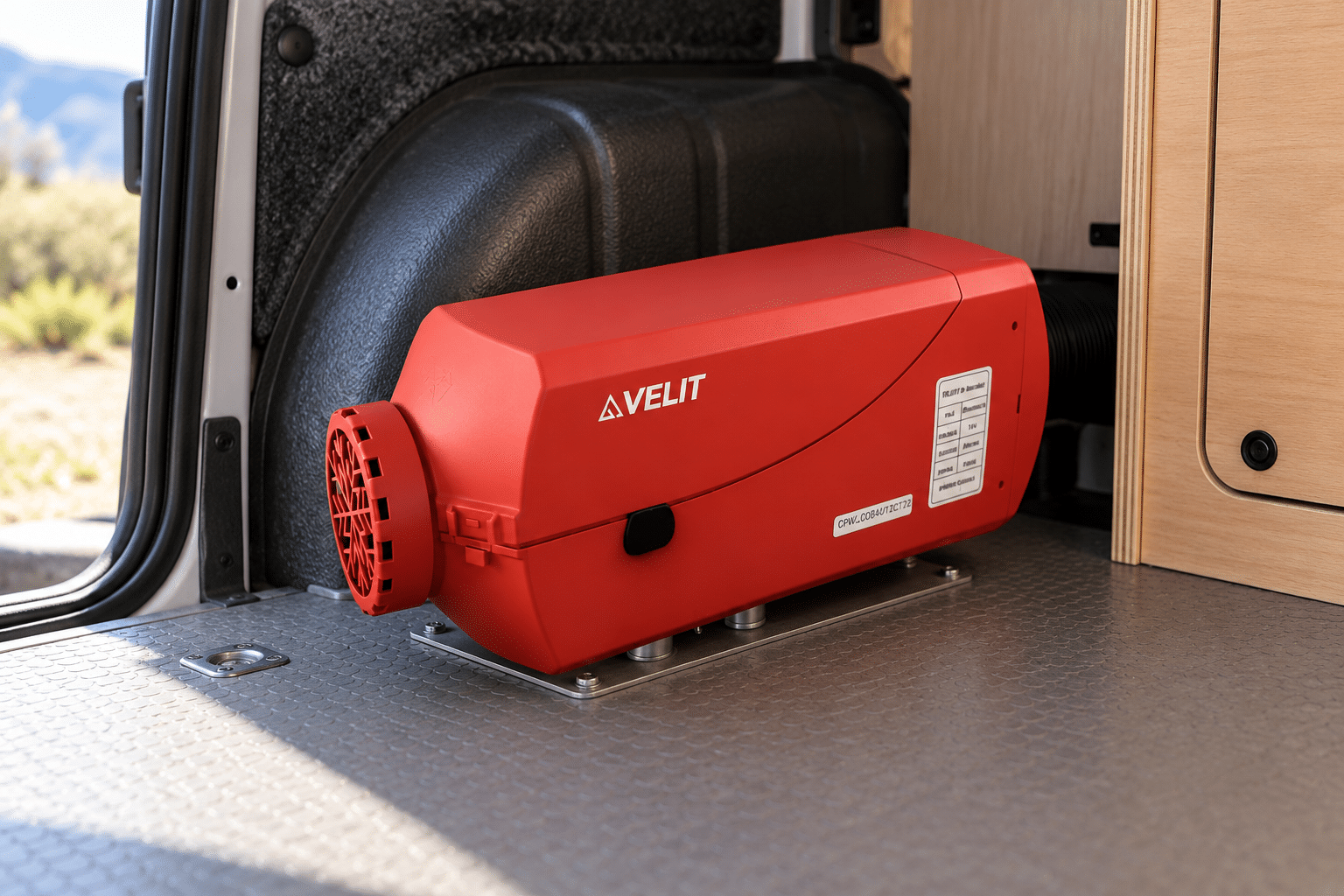
The standpipe is a short tube dropped into the tank to feed the heater. The Velit manual sets the pickup at least 25 mm, about one inch, above the tank floor. Because of this, the heater stops drawing fuel while a thin layer remains in the tank.
The engine uses its own pickup, which sits lower. Therefore, the heater runs dry before the engine does. This design gives you a built-in reserve, so a forgotten gauge never leaves you stranded because of the heater.
Auxiliary Fuel Port or Custom Standpipe
Sprinter, Transit, and ProMaster vans have a factory auxiliary fuel port. The Velit kit includes a connector for this port, so you skip drilling into the tank. Other vehicles need a standpipe added to the tank, and one owner called dropping the tank the hardest part of the job.
Safety note: Gasoline vapor ignites easily. Disconnect the battery, work in open air, and keep sparks away from the tank. If you are unsure about fuel work, hire a certified installer.
Fuel Pump and Line Limits
The manual also limits how high the fuel pump sits above the tank, and how far it sits from the heater. Those limits come with a diagram, so check your own manual before you plan the line route. A short route keeps the pump working easily and reduces air in the line. In addition, a clean, tight fitting at every joint keeps air out of the fuel path and protects the pump from needless strain.
What Changes Gas Heater Fuel Burn

Four inputs move the total. First, outside temperature matters most, since a colder night keeps the heater at higher output. Next, insulation matters, because a leaky van loses heat faster. Then thermostat setting counts, since a lower target means lower output. Finally, altitude changes the air-fuel mix, which the Velit adjusts with a built-in barometer.
Thermostat Settings and Gas Heater Fuel Burn
A smart thermostat now ships standard with the Velit. You set a target temperature, and the heater ramps up or down to hold it. Consequently, a 60°F target burns less than a 70°F target on the same night. Dropping the target five degrees is the easiest way to cut fuel use.
Van Size, Insulation, and Gas Heater Fuel Burn
A gasoline parking heater in a small, well-insulated van holds heat with the heater on low for much of the night. A large, leaky one pushes the heater toward full output. For example, an owner reported staying comfortable at 28°F in an eleven-window passenger van, which likely means higher burn than a lined cargo van. Sizing your heater to your van helps here, since an oversized unit wastes fuel through frequent cycling.
Power Draw Is Small Too
The heater draws 20 to 46 watts while running. Over a ten-hour night at a 30-watt average, you use about 25 amp-hours from a 12V system. Moreover, the startup phase draws more while the glow plug heats. Although fuel is the bigger cost, your battery still deserves a glance.
Smart Thermostat Included
Set a Target and Let the Heater Throttle Itself
Bluetooth control, built-in CO sensing, and a two-year limited warranty come standard.
A Simple Tracking Habit
Track your own burn for the first week. Note the gauge reading at bedtime and again at sunrise, along with the outside temperature and your thermostat target. Next, compare the drop against the table above. Because tank gauges are coarse, a week of notes gives a better average than any single night. Moreover, the log shows which thermostat target costs the most fuel, so you tune the setting to your van instead of guessing.
Gasoline vs. Diesel Fuel Burn
The biggest difference is small. The Velit lists 0.05 to 0.13 gallons per hour on gasoline and 0.05 to 0.12 on diesel. Over a ten-hour night, the gap is at most 0.1 gallons. Fuel burn alone should not decide which variant you buy.
Instead, pick the fuel by what your rig drinks. A gas-engine van should take the gasoline unit, since a second fuel means a second tank and a second fill-up. A diesel rig should take the diesel unit for the same reason. Both versions also cost $729 on the same listing.
If you are still choosing, remember gasoline is more volatile than diesel. Consequently, the install details, such as the standpipe and the line routing, worth extra care.
Final Verdict
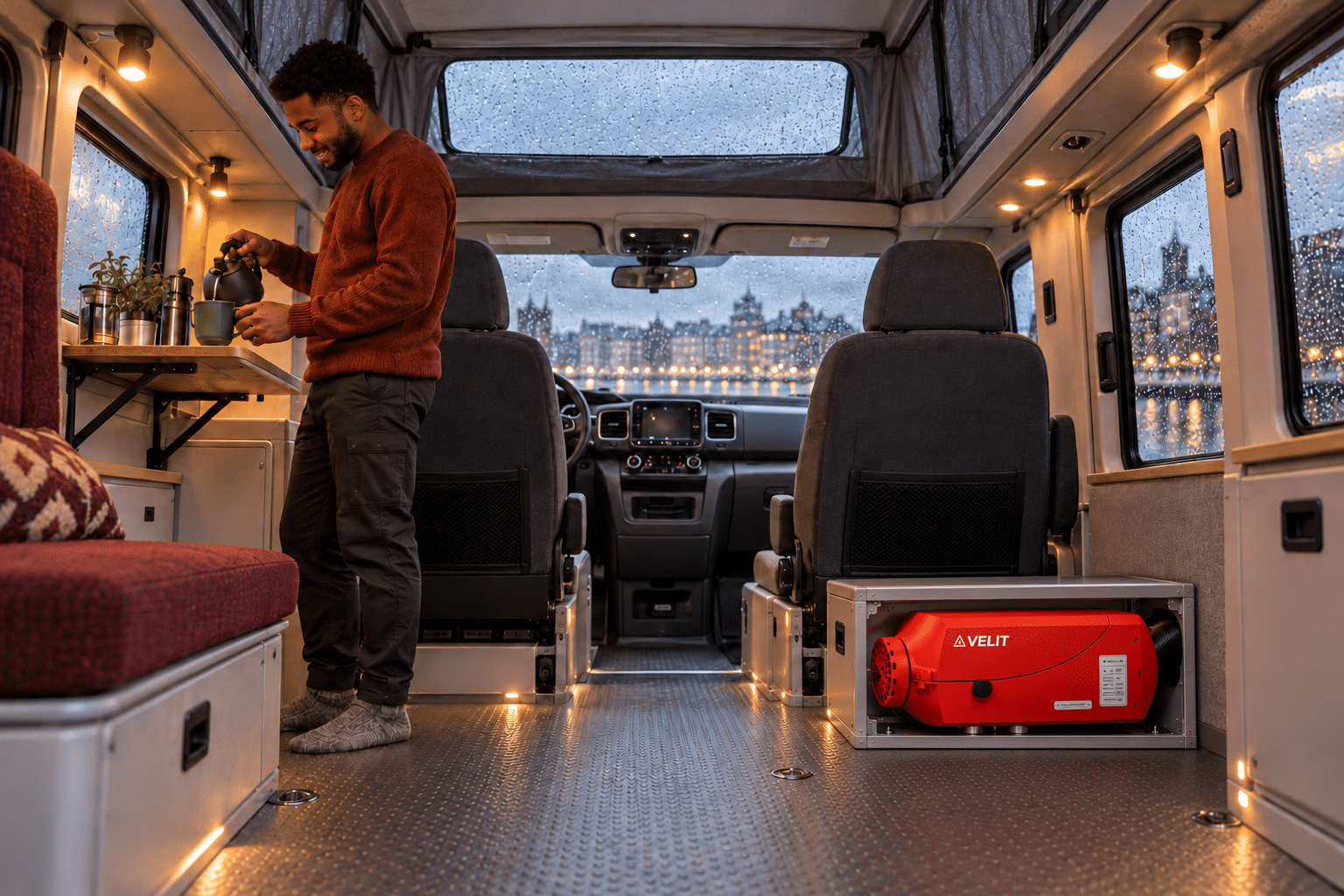
The Velit gasoline air heater will not drain your tank. At 0.05 to 0.13 gallons per hour, a ten-hour night uses 2% to 6.5% of a typical tank, and the standpipe keeps a reserve for the engine. Its biggest strength is simple: it runs off the fuel you already buy.
The trade-offs are real. Installation on a vehicle without an auxiliary port means dropping the tank, and gasoline demands extra care around vapor. Anyone who wants dealer-backed service should price a hired installer. Short trips in mild weather need less heat. Therefore, a smaller unit suits them better.
On value, the fuel cost is low compared with the $729 purchase. A week of cold nights burns between 3.5 and 9.1 gallons by our math, which is a small fraction of a fill-up for most rigs.
We recommend the Velit gasoline air heater for gas-powered vans and trucks where a second fuel is a hassle. Keep the tank above a quarter before bed, and check the gauge each morning for the first week. This habit shows your real burn rate and builds trust in the numbers.
Ready to Buy?
Stay Warm on Half a Gallon a Night
Order the gasoline or diesel version direct from Velit for $729.
FAQ
How much gas does a gasoline heater burn overnight?
The Velit burns 0.05 to 0.13 gallons per hour. A ten-hour night uses about 0.5 gallons on the low setting and 1.3 gallons at full output.
Will a gas heater leave me with an empty tank?
No. The heater pickup sits at least 25 mm above the tank floor, so the heater stops drawing before the engine does. Still, keep the tank above a quarter before bed.
What is a standpipe?
It is a short tube inside the tank to feed fuel to the heater. Sprinter, Transit, and ProMaster vans use a factory auxiliary port, and the Velit kit includes the connector.
Does the heater drain my battery too?
Only slightly. It draws 20 to 46 watts while running, which is about 25 amp-hours over a ten-hour night at a 30-watt average. Startup draws more briefly.
Does gasoline or diesel burn less fuel?
The Velit lists 0.05 to 0.12 gallons per hour on diesel and 0.05 to 0.13 on gasoline. The difference is small, so choose by the fuel your vehicle already uses.
Heads up: Clicking on our affiliate links and exploring our sponsored content helps us at no extra cost to you, and we only recommend gear we’re absolutely crazy about!