


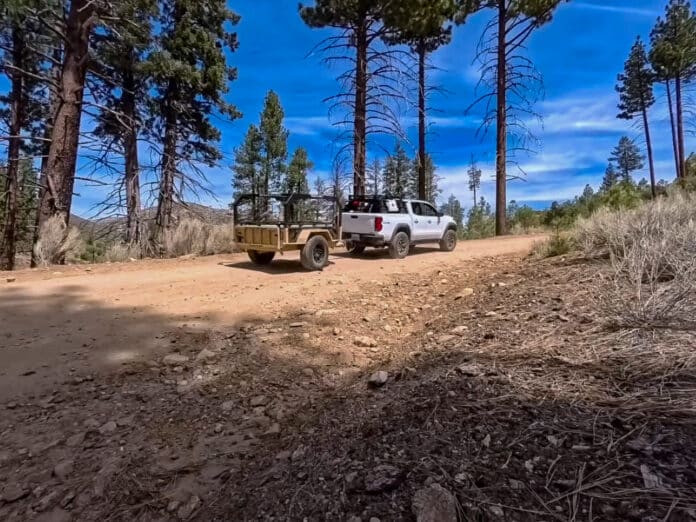

After decades of camping and overlanding across the American West, I’ve watched more people buy the wrong-sized trailer than almost any other gear mistake. Some load a compact trailer beyond its limits three trips in and wonder why the axle is groaning. Others drag a full-size rig through tight canyon tracks they would have navigated in a lightweight setup without breaking a sweat. Trailer size carries the most downstream consequences of any single decision. Because it shapes your tow vehicle requirements, campsite choices, fuel costs, and gear capacity, it affects every trip you take.
Big Slack Off Road builds both ends of this spectrum in the same lineup, which makes the comparison unusually clean. The Slack Wagon Junior and the full Slack Wagon share the same manufacturer DNA, the same Timbren axleless suspension philosophy, and the same build quality standard. Because the engineering origin is identical, the differences between them come down to real-world specs rather than brand-to-brand variable quality. This guide walks you through those differences so you choose the right trailer for how you camp in practice, not how you picture yourself camping.
Quick Facts:
- Topic: Small vs large overland trailer comparison
- Trailers compared: Slack Wagon Junior ($4,499) and Slack Wagon ($5,999)
- Skill level: No mechanical skills required
- Key decision factors: Payload, tow vehicle, trip length, group size
- Junior payload: 700 lb (500 lb empty, 1,200 lb GVWR)
- Full Slack Wagon payload: 2,000 lb (900 lb empty, 3,000 lb GVWR)
- Price difference: $1,500 between the two
- Best for: Solo travelers and couples weighing gear needs against tow capacity
10 min read
In This Guide
- Why Trailer Size Is the Most Important Decision You’ll Make
- Overland Trailer Specs: Side by Side
- Payload: The Number Driving Your Decision
- Matching Your Trailer to Your Tow Vehicle
- How Your Trip Style Should Drive the Decision
- Slack Wagon Junior vs. Slack Wagon: Which Should You Choose?
- Pros and Cons
- Final Verdict
- Frequently Asked Questions
Why Trailer Size Is the Most Important Decision You’ll Make
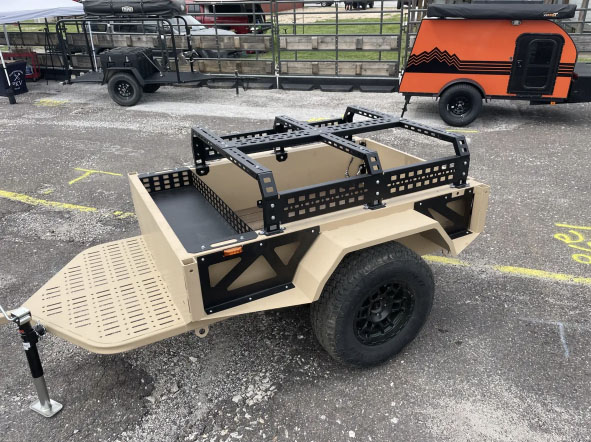
When most buyers start shopping for a small vs large overland trailer, they focus on features: water tanks, roof tents, kitchen slides. Those details matter, but they matter after you’ve answered a more fundamental question: how much trailer weight and payload do you need? A trailer with a 700-pound payload and one with a 2,000-pound payload serve different purposes entirely. Each shapes a completely different overlanding experience.
The Slack Wagon Junior starts at $4,499 and tips the scales at 500 pounds empty. Its 1,200-pound GVWR leaves you 700 pounds of payload for gear, water, food, and everything else. For a solo traveler or a couple running a tight kit, 700 pounds is workable. For a family of four heading out for two weeks, it fills up faster than expected. Our overland trailer buying guide covers the math of gear weight in depth. The short version: water runs roughly 8 pounds per gallon, and a weekend trip for two often requires 20 to 30 gallons.
The full Slack Wagon starts at $5,999 and weighs approximately 900 pounds empty. Its 3,000-pound GVWR delivers 2,000 pounds of payload. For comparison, the Junior carries 700 pounds. The bed size difference is also significant. The Junior runs 31 by 60 inches; the full Slack Wagon stretches to 48.5 by 78 inches. For context, a standard twin mattress is 38 by 75 inches. The full trailer’s bed sleeps two adults comfortably without any additions.
Overland Trailer Specs: Side by Side
| Specification | Slack Wagon Junior | Slack Wagon (Full) |
|---|---|---|
| Starting price | $4,499 | $5,999 |
| Empty weight | 500 lb | ~900 lb |
| GVWR | 1,200 lb | 3,000 lb |
| Payload capacity | ~700 lb | ~2,000 lb |
| Bed size | 31 x 60 in | 48.5 x 78 in |
| Width | 57 in | 74 in |
| Axle system | Timbren axleless | Timbren axleless (standard) |
| Standard tires | ATV / DOT standard | 32 in (35 in max) |
Buy Direct From Big Slack Off Road
Slack Wagon Junior, Built for the Light Traveler
500 lb empty, 700 lb payload, $4,499. The compact overland trailer for solo travelers and couples who run a tight, efficient kit.
Payload: The Number Driving Your Decision

Payload is the weight your trailer carries above its own empty weight. For a lightweight overland trailer like the Slack Wagon Junior, this number is the core of the value proposition. Before picking a trailer size, add up everything you plan to load. Include water, food, camping gear, recovery equipment, tools, and any accessories mounted to the trailer. Most first-time trailer buyers underestimate this number by 30 to 50 percent.
Calculating Your Realistic Gear Weight
Start with water. At 8.3 pounds per gallon, a 20-gallon tank weighs 166 pounds full. A two-person, five-day trip often requires 25 to 30 gallons for drinking, cooking, and hygiene. Add a recovery kit (Hi-Lift jack, traction boards, shackles) at roughly 50 to 80 pounds. A rooftop tent adds another 100 to 150 pounds. Food and cooking gear for a week runs 30 to 60 more. A modest two-person kit frequently reaches 450 to 550 pounds before luxury items. The Junior’s 700-pound payload handles this with moderate margin. A full-size refrigerator (30 to 50 lb) alone narrows the margin. Add solar panels (15 to 30 lb) and a second spare tire (30 to 40 lb), and the payload ceiling arrives quickly.
The full Slack Wagon’s 2,000-pound payload removes equipment trade-off decisions entirely. Families traveling with children load sleeping gear, clothes, kitchen equipment, and recreational gear without calculating trade-offs. Extended expeditions of two weeks or more, where water resupply is uncertain, benefit from the extra payload room. Hauling 60 gallons of water (498 lb) plus a full overlanding kit still leaves over 1,400 pounds of headroom.
Matching Your Trailer to Your Tow Vehicle
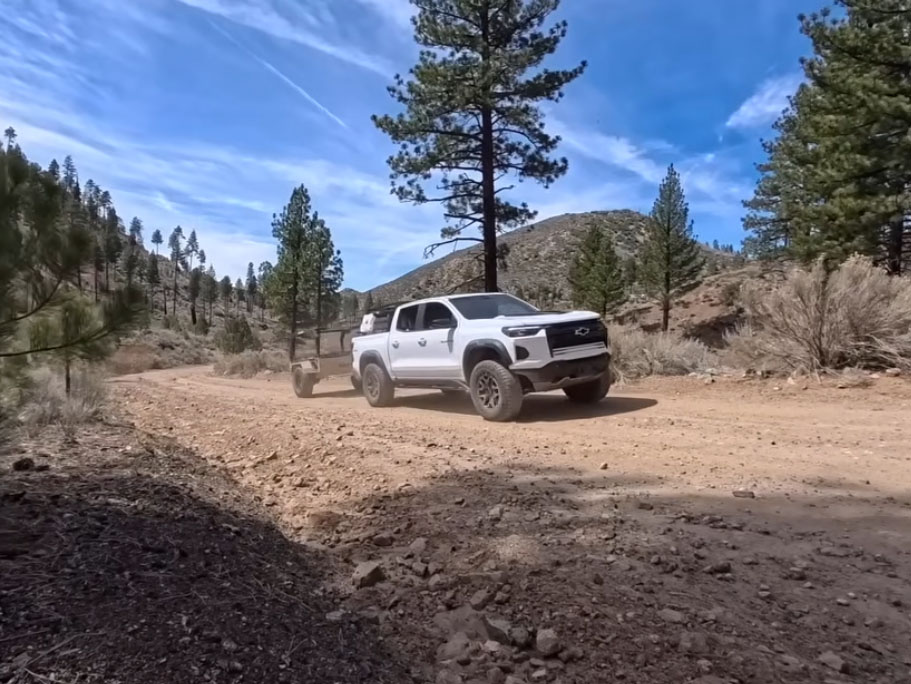
Your tow vehicle’s rating determines how much trailer you’re legally and safely allowed to pull. Most overlanding rigs fall into two broad categories. Mid-size trucks and SUVs (Toyota Tacoma, 4Runner) are rated for 3,500 to 6,500 pounds depending on configuration. Full-size trucks and SUVs (F-150, Tundra, Land Cruiser) are typically rated for 8,000 to 13,000 pounds. However, total tow rating is only part of the equation.
Why GVWR Ratio Matters More Than Raw Tow Rating
For off-road trailer towing, the conventional wisdom is to keep the loaded trailer weight below 75 percent of the tow vehicle’s tow rating. This margin accounts for steep grades, loose surfaces, altitude, and emergency braking. A Toyota 4Runner with a 5,000-pound tow rating performs best with a loaded trailer under 3,750 pounds. The Slack Wagon Junior at its 1,200-pound GVWR easily fits this profile. Even fully loaded, the Junior leaves enormous safety margin on a capable mid-size SUV.
The full Slack Wagon at 3,000-pound GVWR stays within the 4Runner’s envelope when kept under 75 percent load, but requires more careful weight management. For tongue weight limits, check your vehicle owner’s manual or the NHTSA trailer towing guidelines. For a visual sense of how the full trailer handles, check out the Slack Wagon walkaround video on a capable tow vehicle. Also, tongue weight matters: the general rule is 10 to 15 percent of total trailer weight at the hitch. At 3,000 pounds GVWR, expect 300 to 450 pounds of tongue weight on the full Slack Wagon, which approaches the limit of many mid-size vehicle hitch ratings.
How Your Trip Style Should Drive the Decision
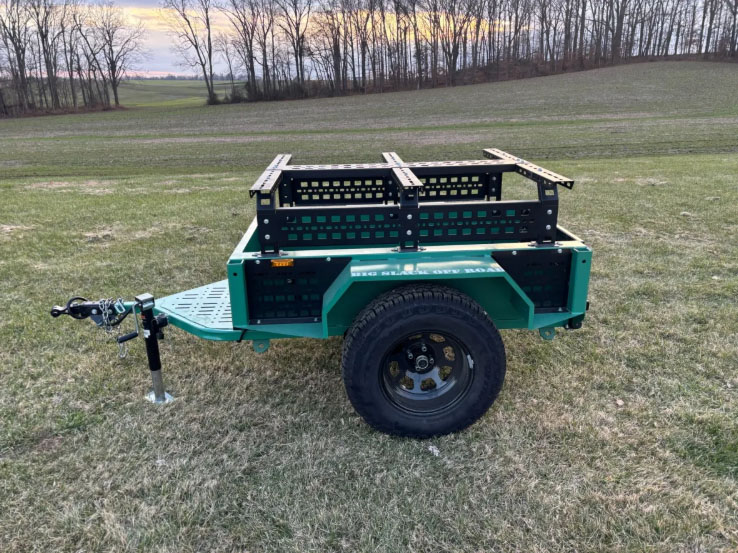
Payload and tow vehicle numbers give you the technical boundary. Within this boundary, your camping style determines which trailer fits your actual situation.
A lightweight overland trailer suits this profile well. Consider the Junior for weekend trips of two to three nights. Solo travelers, couples, and anyone prioritizing access to narrow two-track roads with a minimalist gear philosophy will find it well suited. At 57 inches wide, the Junior slips through tighter terrain and follows your tow vehicle more closely on switchbacks. You’ll also spend less fuel: towing an extra 500 pounds of trailer makes a measurable difference on long highway stretches.
Consider the full Slack Wagon for week-long trips or longer. It also suits families, groups prioritizing comfort over trail access, and anyone running a fully built-out expedition setup with refrigeration and extended water storage. The 48.5-by-78-inch bed gives two adults actual sleeping room. The 74-inch width matches standard camp spaces and accepts full-size gear bins and storage solutions. For a thorough look at the full trailer’s features and build quality, our full Slack Wagon review covers the real-world experience in depth.
Save on the Full Slack Wagon
Full Slack Wagon, 2,000 lb Payload, Built for the Long Haul
At $5,999 base, the full Slack Wagon delivers 78-inch bed length and a 3,000-pound GVWR for families and extended expeditions.
Slack Wagon Junior vs. Slack Wagon: Which Should You Choose?

For anyone weighing the small vs large overland trailer decision, the $1,500 price gap narrows quickly when you factor in what each size enables. The Junior’s lower weight means less fuel cost per trip and a wider range of eligible tow vehicles. For a Jeep Wrangler or Toyota Tacoma driver, the Junior delivers a full overland trailer without exceeding practical towing limits. Conversely, the full Slack Wagon’s 2,000-pound payload represents enough carrying capacity to eliminate equipment trade-off decisions entirely, which has real value for longer or more demanding trips.
The biggest differentiator, beyond the numbers, is width. At 57 inches, the Junior is narrower than most full-size pickup trucks. At 74 inches, the full Slack Wagon is wider than most mid-size SUVs and requires deliberate trail line selection. This matters on off-road trails where the trailer tracks differently from the tow vehicle. Narrow trailers follow mid-size SUVs through tight switchbacks with minimal steering correction. Wider trailers require deliberate line selection. On shelf roads and two-track routes, the margin between trailer and edge is often mere inches.
Who wins the overland trailer comparison depends entirely on your situation. For two people running weekend trips and occasional week-long expeditions. The Junior handles the load with margin to spare. For families, long-haul travelers, or anyone building a fully equipped expedition rig, the full Slack Wagon justifies its extra weight and cost. Neither is the wrong answer for its intended use.
Pros and Cons
Slack Wagon Junior, Pros
- 500 lb empty weight keeps tow stress low on mid-size SUVs and trucks
- 57-inch width navigates tight trails and narrow two-track roads
- $4,499 starting price is the lower entry point for a capable overland trailer
- 700 lb payload handles a two-person kit with careful packing
- Timbren axleless suspension handles rough terrain without a conventional axle tube
Slack Wagon Junior, Cons
- 700 lb payload fills quickly when water, recovery gear, and shelter are added
- 31 x 60-inch bed is too short for two adults to sleep without modifications
- Limited room for extended water storage on trips over five days
- ATV tire sizing limits options compared to full-size off-road rubber
Full Slack Wagon, Pros
- 2,000 lb payload accommodates full family and extended expedition kit
- 78-inch bed length sleeps two adults flat without any add-ons
- 3,000 lb GVWR handles refrigerators, large water tanks, and solar arrays simultaneously
- 32-inch standard tires (35-inch max) match full-size off-road wheel and tire fitment
- 74-inch width fits standard camp platforms and overland gear organization systems
Full Slack Wagon, Cons
- ~900 lb empty weight requires a capable tow vehicle with appropriate hitch rating
- 74-inch width demands more deliberate line selection on narrow trails
- $5,999 starting price is a meaningful step up from the Junior
- Greater fuel consumption on long highway segments compared to the Junior
Final Verdict
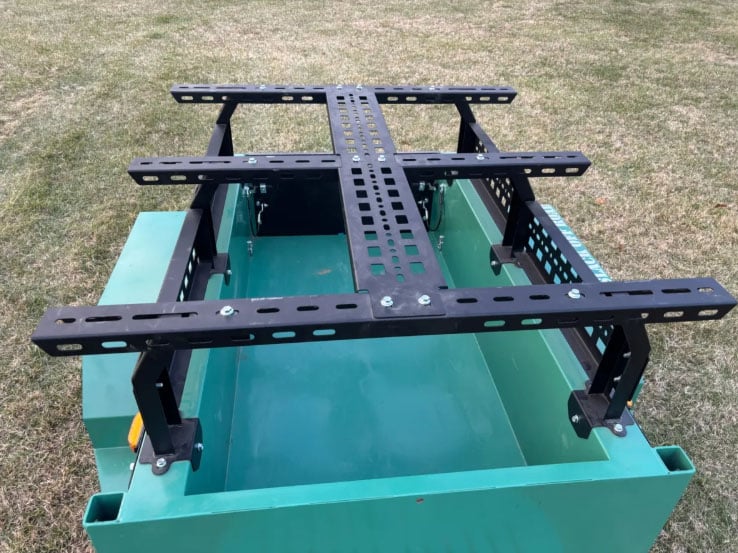
The right answer in this small vs large overland trailer comparison: choose the one sized for your actual trips, not your aspirational ones. For couples doing weekends and occasional week-long expeditions, the Slack Wagon Junior delivers the right balance: lower weight, lower price, and better access to tight terrain. Its 700-pound payload handles a thoughtfully packed two-person kit, and its 57-inch width follows a mid-size SUV or Tacoma through challenging terrain without requiring constant line correction.
However, for families, longer trips where resupply is uncertain, or fully built expedition setups with refrigeration and serious storage, the full Slack Wagon is the correct choice. Its 2,000-pound payload removes the equipment trade-off conversations. Also, the 78-inch bed is a fundamental comfort upgrade for two adults compared to the Junior’s 60-inch platform. The $1,500 price difference is real, but so is the capability gap.
In any small vs large overland trailer comparison, build quality is also a variable. Here, both trailers share the same Timbren axleless suspension system and the same quality standard from Big Slack Off Road. Neither is a compromise on build. The question is purely about scale. Specifically, the decision reduces to one honest question: what does a realistic gear list for your typical trip weigh? Answer it before you look at any other feature.
Ready to Buy?
Check Today’s Price on the Slack Wagon Junior
Buy direct from Big Slack Off Road. The Junior ships fully assembled and ready to tow. Contact Big Slack Off Road directly for current lead times and available build slots.
Frequently Asked Questions
What size overland trailer do I need for two people?
For two people doing weekend to week-long trips, a trailer with 600 to 900 pounds of payload typically covers a well-packed kit. The Slack Wagon Junior’s 700-pound payload handles two adults’ gear when water, shelter, and recovery equipment are chosen for weight efficiency. If you prefer bringing a larger water supply or full-size cooking and sleeping gear without trade-offs, step up to a trailer with a 1,500-pound-plus payload.
What is the difference between the Slack Wagon and Slack Wagon Junior?
The Slack Wagon Junior starts at $4,499, weighs 500 pounds empty, and carries 700 pounds of payload across a 31-by-60-inch bed. The full Slack Wagon starts at $5,999, weighs approximately 900 pounds empty, and carries 2,000 pounds of payload across a larger 48.5-by-78-inch bed. Both use Timbren axleless suspension, but the full trailer is wider (74 inches vs. 57 inches) and runs larger tires. The key difference is payload capacity and sleeping space.
Do mid-size SUVs handle overland trailer towing?
With the right trailer, a Toyota 4Runner or Tacoma handles the Slack Wagon Junior comfortably at its 1,200-pound GVWR. Most 4Runner and Tacoma configurations are rated at 5,000 pounds or more. The full Slack Wagon at 3,000-pound GVWR also falls within these vehicles’ ratings. Off-road towing, however, requires more careful weight management than highway use. For sustained off-road towing, staying below 75 percent of your tow rating is a sound practice regardless of the trailer you choose.
How much does a compact overland trailer weigh?
Compact overland trailers typically range from 400 to 900 pounds empty depending on construction materials and included equipment. The Slack Wagon Junior weighs 500 pounds empty, placing it in the lighter half of this range. At its 1,200-pound GVWR, it stays well within the tow capacity of most mid-size trucks and SUVs. Larger expedition trailers like the full Slack Wagon weigh 1,000 pounds or more empty with GVWRs approaching or exceeding 3,000 pounds.
Is an overland trailer worth it over a rooftop tent alone?
An overland trailer adds what a rooftop tent alone lacks: payload capacity, ground-level storage, and a dedicated camping platform for multi-day self-sufficiency. Every overland trailer buying guide frames this as the core trade-off: sleeping comfort vs. carrying capacity. For travelers who need to carry water, tools, recovery gear, and food for multi-day trips, a trailer’s payload capacity more than justifies the investment. The Slack Wagon Junior at $4,499 costs more than most rooftop tent setups. However, it delivers a significantly more capable and organized overlanding platform. Specifically, it shines on trips where resupply is not available.
Our articles might have affiliate links and the occasional sponsored content, but don’t sweat it – if you buy something, we get a little kickback at no extra cost to you, and we only hype products we truly believe in!