



Every year at overland expos I watch buyers walk up to a shiny trailer with knobby tires. Then they ask if it will handle real off-road duty. After decades of overlanding across the American West as the founder of 4WDTalk, I’ve learned the honest answer is usually no.
A true overland trailer differs from a regular camping trailer in ways you rarely see in the showroom. Specifically, the frame material, suspension design, ground clearance, and onboard systems all separate purpose-built rigs from marketing exercises with a lifted axle. Most buyers only learn the difference the first time something breaks. Specifically, a leaf spring cracks on a washboard or a fiberglass shell splits on a wash crossing.
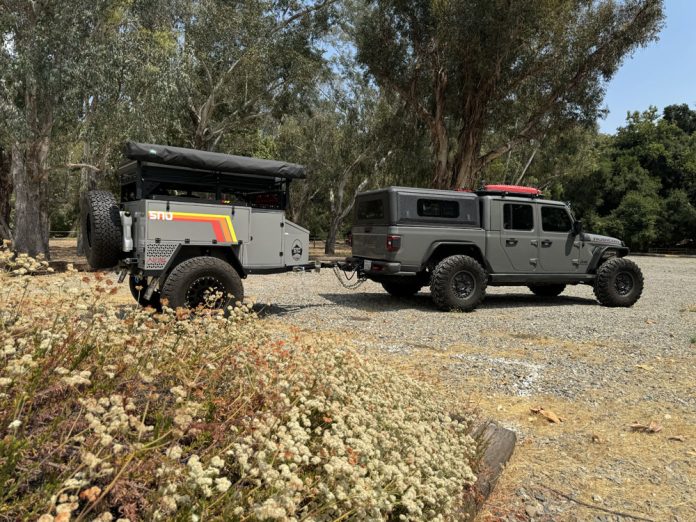
I’ve toured the SNO Trailers facility and hitched their Alpine trailer behind my Gladiator. Also, I’ve run it through terrain most regular camping trailers would never survive. So this piece is field-tested advice, not marketing copy. In it, you’ll learn the specific build features distinguishing a real off-road trailer from a dressed-up overland trailer. The SNO Trailers Alpine serves as the concrete example throughout. Specifically, its factory build sheet reads exactly the way a purpose-built off-road trailer should.
Quick Facts
- Product: SNO Trailers Alpine, a purpose-built off-road trailer
- Dry Weight: 1,500 lbs
- Dimensions: 12’2″ L x 6’3″ W x 5’9″ H
- Departure Angle: 40 degrees
- Frame: Powder-coated steel with proprietary anti-rust base coating
- Body: Aluminum
- Suspension: Fabtech fully-integrated (optional long-travel)
- Wheels & Tires: 17″ Method wheels with 275/70/R17 all-terrain tires
- Hitch: Max Coupler articulating hitch
- Starting Price: Around $29,995
- Best for: Buyers wanting a genuine off-road trailer built to expedition standards
8 min read
In This Guide
- What “Off-Road Trailer” Means at the Build Level
- SNO Trailers Alpine at a Glance
- Frame and Body: The Structural Difference
- Suspension and Running Gear on an Off-Road Trailer
- Ground Clearance, Departure Angle, and Off-Road Geometry
- Onboard Systems Real Off-Road Duty Demands
- Pros and Cons
- Final Verdict
- Frequently Asked Questions
What “Off-Road Trailer” Means at the Build Level

An off-road trailer is engineered for continuous exposure to washboard vibration and rocky impacts. Also, steep approach and departure angles and remote-terrain water crossings are part of the design brief. In contrast, a regular camping trailer is engineered for interstate towing to prepared campgrounds. The two products share almost nothing at the chassis level, even when they look similar in marketing photos.
Confusion happens because dealers rebrand camping trailers as “off-road ready” once they add off-road tires and a lift kit. However, tires and lifts do not change the frame material, the suspension geometry, or the hitch articulation. Consequently, buyers learn the difference only after their trailer breaks. Common failure modes include cracked leaf springs on forest service roads or split fiberglass panels on wash crossings. My earlier piece on what to look for in an overlanding camper trailer covers the buyer’s framework in depth.
Four categories separate a true off-road trailer from a regular one. Specifically, the frame and body must handle impact and corrosion. The suspension must absorb continuous vibration without failure. Ground clearance and departure angle must clear the terrain you want to run. Also, onboard systems must survive dust, moisture, and temperature swings capable of killing a residential-grade RV. Every one of those categories rewards purpose-built engineering.
SNO Trailers Alpine at a Glance
| Specification | Details |
|---|---|
| Length | 12’2″ |
| Width | 6’3″ |
| Height | 5’9″ |
| Dry Weight | 1,500 lbs |
| Departure Angle | 40 degrees |
| Frame | Powder-coated steel with anti-rust base coating |
| Body | Aluminum |
| Suspension | Fabtech fully-integrated (optional long-travel) |
| Wheels & Tires | 17″ Method wheels with 275/70/R17 all-terrain tires |
| Hitch | Max Coupler articulating hitch |
| Power System | 100Ah Renogy AGM, solar charge controller, external solar plug |
| Starting Price | Around $29,995 |
Buy Direct From SNO Trailers
See the Alpine at SNO Trailers
Starting around $29,995, the Alpine ships factory-direct with a purpose-built off-road build sheet.
Frame and Body: The Structural Difference

A regular camping trailer’s frame is stamped steel or thin-wall tubing, sized for smooth-road towing. In contrast, an off-road trailer frame handles impact loads from washboard and rocky terrain without cracking welds or bending rails. Specifically, powder-coated steel is the industry standard for expedition trailer frames. It absorbs impact and flex loads better than aluminum tubing or bonded fiberglass composites.
Corrosion resistance is the second frame-level difference. Off-road trailers travel through creek crossings, coastal salt air, high-altitude snow, and desert washes. Consequently, an anti-rust base coating under powder coat is standard on serious off-road builds. The Alpine’s proprietary anti-rust base coating goes on before powder coating. So it blocks the biggest long-term threat to any steel chassis.
Body material matters too. Aluminum is standard on true off-road trailers because it saves weight without sacrificing strength. Also, it resists corrosion in a way steel bodies do not. In contrast, fiberglass shells common on regular camping trailers crack under impact from rocks or heavy branches. Also, thin-gauge aluminum siding on lifestyle trailers dents easily from routine trail brush. A purpose-built off-road trailer uses thicker gauge aluminum on structural body panels for durability.
Suspension and Running Gear on an Off-Road Trailer
Suspension is where regular camping trailers fail earliest. Specifically, leaf-spring suspensions engineered for interstate loads crack when subjected to continuous washboard vibration. Off-road trailer suspension systems use independent designs. Examples include Timbren rubber-spring axle-less setups, torsion axles, or full independent suspensions like the Fabtech system on the Alpine. Each design absorbs impact without transferring shock through the frame.
The Alpine’s Fabtech fully-integrated suspension includes shocks and brakes engineered for off-road loads. Consequently, the trailer follows the tow vehicle predictably through rocky sections and absorbs washboard without loosening bolts or cracking welds. Optional long-travel Fabtech suspension takes performance further for buyers running the roughest terrain. In contrast, a leaf-spring trailer bounces sharply, and repeated cycles fatigue the springs into eventual failure.
Wheels and tires complete the running gear picture. A true off-road trailer runs the same tire size as the tow vehicle whenever possible. So a single spare covers both. The Alpine’s 17-inch Method wheels wear 275/70/R17 all-terrain tires. Consequently, they match common tow vehicles from Jeep, Toyota, and Ford. In contrast, regular camping trailers run 14-inch or 15-inch trailer-specific wheels requiring a dedicated spare. Buyers underestimate how much this matters until a sidewall fails 200 miles from cell service.
Ground Clearance, Departure Angle, and Off-Road Geometry

Off-road trailer geometry matters as much as build material. Specifically, ground clearance measures how much space sits between the trailer’s underside and the terrain. Regular camping trailers typically run 10 to 14 inches, engineered for graded roads. In contrast, a purpose-built off-road trailer runs 18 inches or more, matching or exceeding the tow vehicle’s clearance. Consequently, the trailer clears the same obstacles the tow vehicle does.
Departure angle is the second geometry number worth watching. Specifically, it measures how steep a trail crest the trailer will crest without dragging its rear frame. Regular camping trailers run departure angles of 15 to 25 degrees. In contrast, the Alpine’s 40-degree departure angle matches or exceeds most tow vehicles. So the trailer never becomes the limiting factor on trail selection.
Hitch articulation is the third geometry element. A traditional ball hitch permits limited side-to-side and up-and-down movement, which binds under trail flex. In contrast, a Max Coupler articulating hitch permits full rotation on multiple axes. So the trailer follows through off-camber terrain without stress on the hitch or frame. The Alpine ships with a Max Coupler as standard. Consequently, a lifestyle-grade ball hitch would fail on the terrain the Alpine is built to run.
Save on the Alpine
Configure Your SNO Trailers Alpine
Add long-travel Fabtech suspension, upgraded water and power, and factory-installed accessory mounts.
Onboard Systems Real Off-Road Duty Demands
Regular camping trailers rely on residential-grade electrical and plumbing components. Specifically, they operate near shore power and paved campground infrastructure. In contrast, an off-road trailer needs sealed, dust-rated, and moisture-resistant systems. Specifically, it operates through creek crossings, washboard dust storms, and altitude-driven pressure changes. The gap in component quality is significant.
Electrical systems on a true off-road trailer use sealed AGM or lithium batteries rated for vibration and heat. The Alpine’s 100Ah Renogy AGM handles vibration better than flooded lead-acid. Also, its waterproof solar charge controller survives dust and moisture. Sealed connectors, marine-grade wiring, and protected fuse panels are also standard on serious builds. In contrast, residential-grade shore-powered components would corrode or fail on backcountry duty within a season.
Water systems face similar challenges. Off-road trailer plumbing uses reinforced hoses, sealed pumps, and impact-resistant tanks positioned to protect against rock strikes from below. The Alpine’s tank capacity, Joolca HOTTAP shower kit, and external solar plug were designed with backcountry conditions in mind. For a full comparison of onboard systems between the Alpine and another premium builder, my Turtleback Expedition Trailer vs SNO Trailers Alpine writeup covers each system category. Also, my full Alpine review walks through the Alpine’s build in depth.
Pros and Cons
Pros
- Powder-coated steel frame with anti-rust base coating handles impact and corrosion
- Aluminum body resists dents from trail brush and rocks
- Fabtech fully-integrated suspension absorbs washboard without frame stress
- 40-degree departure angle matches most tow vehicles
- Max Coupler articulating hitch survives off-camber trail flex
- 17″ Method wheels share tire size with common tow vehicles
- Sealed AGM battery and waterproof solar controller handle backcountry conditions
- Factory-installed water and power reduces aftermarket buildout time
Cons
- Starting price around $29,995 is a real investment vs lifestyle-grade trailers
- 1,500-lb dry weight benefits from a mid-size or larger tow vehicle
- 6’3″ width fits most trails but rules out the tightest two-tracks
- Steel frame adds weight compared to full aluminum-tube constructions
- Purpose-built build demands more maintenance knowledge than a bare teardrop
Final Verdict

For buyers wanting a genuine off-road trailer rather than a lifestyle build with mud tires, the SNO Trailers Alpine delivers on every category worth measuring. Above all, its biggest strength is honesty on the spec sheet. The steel frame, anti-rust coating, Fabtech suspension, Max Coupler hitch, and sealed electrical system are the same features you would spec on a scratch backcountry build.
Trade-offs are real, though. Buyers wanting the lightest possible tow behind a small SUV should look at simpler platforms. Examples include the SNO Trailers Recon or a basic teardrop. Also, buyers wanting fully-loaded RV comfort with slide-outs and a full bathroom should shop travel trailers instead. The Alpine sits in the middle: a purpose-built overland trailer with expedition-tier build and modular comfort systems.
On value, the Alpine holds up strongly. Its roughly $29,995 starting price sits mid-tier among expedition trailers. Also, each build category above earns its keep on the trail. Comparably-priced competitors often skimp on one or two categories. Consequently, a broken component shows up two years later. In contrast, the Alpine’s build sheet reads consistent across every category.
Overall, I recommend the SNO Trailers Alpine as a true off-road trailer for buyers running serious backcountry terrain. However, if your priority is short weekend runs on graded roads with occasional trail access, a lighter platform serves better.
Ready to Buy?
Check Today’s Price on the Alpine
SNO Trailers ships factory-direct with a full warranty and configuration support before your build begins.
Frequently Asked Questions
What separates an off-road trailer from a regular camping trailer?
Four categories separate the two: frame and corrosion protection, suspension design, ground clearance, and onboard systems built for dust and vibration. Specifically, a true off-road trailer uses powder-coated steel with anti-rust coating and independent suspension. Also, it runs 18+ inches of ground clearance and sealed electrical systems. Regular camping trailers use lighter tubing, leaf springs, and residential-grade components.
Is an off-road trailer worth the extra cost?
Yes, for buyers running actual off-road terrain. Specifically, regular camping trailers fail on washboard, rocky descents, and creek crossings, which produces expensive repairs and ruined trips. In contrast, a purpose-built off-road trailer handles the same terrain without incident. Also, it holds resale value better because the buyer pool is wider.
What ground clearance does an off-road trailer need?
Serious off-road duty needs 18 inches of ground clearance or more. Also, this range matches common mid-size and full-size tow vehicles. In contrast, regular camping trailers run 10 to 14 inches. So they drag on graded forest service roads and cannot handle rocky sections. The SNO Trailers Alpine sits at expedition-tier clearance with a 40-degree departure angle.
Do I need a Max Coupler hitch on an off-road trailer?
A traditional ball hitch works for graded roads and prepared campgrounds. However, off-camber trail terrain binds a ball hitch and eventually damages the frame or hitch itself. In contrast, articulating hitches like the Max Coupler permit multi-axis rotation. So the trailer follows the tow vehicle through flex without frame stress. Serious off-road builds like the SNO Trailers Alpine include one as standard.
What suspension is best for an off-road trailer?
Independent designs outperform leaf springs on off-road terrain. Specifically, options include Timbren rubber-spring axle-less setups and torsion axles. Also, full independent suspensions like the Fabtech system on the Alpine. Each design absorbs washboard vibration and rock impacts without cracking welds or fatiguing components. Leaf springs remain common on regular camping trailers but fail early under backcountry use.
Will a mid-size SUV tow a true off-road trailer?
Yes, provided the trailer’s dry weight and tongue weight fit the tow vehicle’s rating. The SNO Trailers Alpine at 1,500 lbs dry works with common mid-size SUVs. Examples include the Toyota 4Runner, Jeep Wrangler Rubicon, and Ford Bronco. Also, buyers should confirm hitch class and wiring compatibility before purchase.
Heads up: Clicking on our affiliate links and exploring our sponsored content helps us at no extra cost to you, and we only recommend gear we’re absolutely crazy about!