


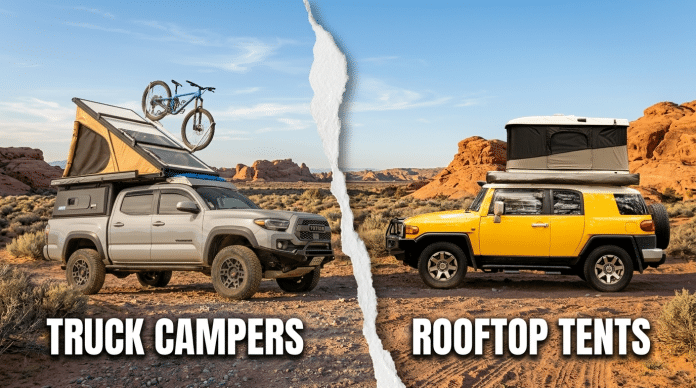

Quick Verdict: A truck camper vs rooftop tent decision comes down to trip length, budget, and vehicle payload. I have found that rooftop tents win for weekend warriors spending under $2,000 who want fast setup and minimal vehicle modification. Truck campers win for extended overlanders running 7+ day trips who need weather protection, insulation, and interior living space. If you travel in cold weather or shoulder seasons, a four-season ground tent with a stove (like the Bereg UP series which is my personal go-to hot tent) offers a third option with better heating and lower vehicle weight impact than either.
Last updated: April 2026 | 11 min read
If you land on the truck camper side of this decision, our truck bed camper buying guide walks through the full buying process from payload to pop-up versus hard-side.
In This Guide
- The Core Trade-Off Explained
- Truck Camper vs Rooftop Tent: Side-by-Side Specs
- Weight and Payload Impact on Your Rig
- Total Cost of Ownership
- Comfort and Livability on Extended Trips
- Setup Time and Ease of Use
- Fuel Economy and Driving Dynamics
- Cold Weather and Four-Season Performance
- The Third Option: Ground Tents for Overlanding
- Pros and Cons
- Final Verdict
- Frequently Asked Questions
For the other direction of this trade-off, our rooftop tent vs ground tent comparison covers when staying on the ground actually saves money and adds flexibility.
The Core Trade-Off Explained

Every overlander who upgrades past ground sleeping faces the same fork in the road: truck camper or rooftop tent? Both shelter systems mount to or sit on your vehicle, both keep you off the ground, and both let you camp almost anywhere your rig fits. However, the similarities end there. A truck camper provides insulated walls, a sealed interior, and often includes a kitchenette, battery system, and storage. Lighter-weight pop-up camper trailers and lightweight truck campers offer a middle ground between rooftop tents and full hard-side campers. A rooftop tent gives you a mattress on top of your vehicle with a fabric shell and a ladder. Or if you run like I did for four years and had a number of different tents mounted to the top of my Turtleback Expedition trailer.
Neither option is universally better, and the right choice depends on your trip profile: weekend camping trips in mild weather favor rooftop tents, while multi-week expeditions through varying climates and terrain favor truck campers. Besides trip length, budget matters. You will spend $1,200-$3,500 on a quality rooftop tent versus $12,000-$60,000+ when comparing a truck bed camper of similar build quality. Understanding exactly where each system excels and where it falls short prevents a costly mistake.
This guide compares every factor side by side: weight, cost, comfort, setup, fuel impact, and cold-weather performance. We also cover a third option (four-season ground tents) for overlanders who want the heating capability of a truck camper without the weight penalty or price tag.
Truck Camper vs Rooftop Tent: Side-by-Side Specs
| Factor | Rooftop Tent (RTT) | Popup Truck Camper | Hard-Side Truck Camper |
|---|---|---|---|
| Weight | 100-200 lbs | 800-1,500 lbs | 1,500-3,500 lbs |
| Price Range | $1,200-$3,500 | $12,000-$28,000 | $27,000-$62,000+ |
| Setup Time | 2-10 minutes | 5-15 minutes (pop up) | Always ready |
| Sleeping Capacity | 2-3 people | 2-3 people | 2-4 people |
| Insulation | Minimal (fabric) | Moderate (canvas/foam) | Full (rigid walls) |
| Fuel Impact | 1-3 MPG loss | 2-4 MPG loss | 3-6 MPG loss |
| Kitchen/Storage | None (separate gear) | Basic (some models) | Full kitchen common |
| Off-Road Capability | Excellent (low CG) | Good (moderate CG) | Limited (high CG) |
| Stealth Camping | Poor (visible tent) | Good (looks like work truck) | Moderate (obvious camper) |
Looking for cold-weather capability without the truck camper price tag? Bereg four-season hot tents support wood stove heating to -40°F at a fraction of the weight and cost.
Reader Favorite
Bereg Four-Season Hot Tents
Canvas walls, wood-stove jack, and reinforced seams built for Canadian winters. The tent most of our hot-tent camping readers end up on after comparing options.
Weight and Payload Impact on Your Rig
Rooftop tent overlanding wins on weight by a wide margin. A softshell RTT weighs 100-150 lbs, and a hardshell model runs 150-200 lbs. Actually I have seen some that are in the ~80lb area as well. Talk about light weight!! In contrast, a popup overland truck camper weighs 800-1,500 lbs or a hard-side truck camper at 1,500-3,500 lbs. For a half-ton truck like the Ford F-150 or Toyota Tundra with a typical payload capacity of 1,400-1,800 lbs, a heavy truck camper eats 50-100% of your available payload before you add passengers, water, fuel, and gear.
Rooftop tent weight capacity also matters. Most RTTs support 400-900 lbs of static weight (when parked), but the dynamic rating while driving drops to 150-200 lbs. Your vehicle’s roof rack or bed rack system needs to support the tent plus its dynamic load. Check your rack’s dynamic weight rating, not the static rating, before purchasing. In comparison, truck campers distribute weight through the truck bed, not the roof, which is inherently more stable for the vehicle’s suspension geometry.
For mid-size trucks like the Toyota Tacoma or Ford Ranger with payload capacities of 1,600-1,860 lbs, a heavy hard-side truck camper still eats most of your available payload. Instead, these rigs pair better with lightweight popup campers (under 1,000 lbs) or rooftop tents. Full-size trucks with 1,800+ lb payloads handle both options comfortably, making the truck camper vs rooftop tent decision less about capability and more about preference. Consider upgrading your rig’s trailer suspension to handle the extra weight more effectively. A good friend of mine who has a diesel Gladiator placed a ARB camper on the back of his rig and had to upgrade the suspension to keep it from sagging.
Total Cost of Ownership

Budget separates more overland shelter decisions than any other factor. A quality softshell RTT from brands like iKamper, Roofnest, or 23ZERO costs $1,500-$3,500. Hardshell models from the same brands run $2,500-$5,000. In addition, you need a roof rack or bed rack ($500-$1,500), and most RTT owners add an awning ($200-$600) and exterior lighting ($50-$200).
Popup truck campers from Four Wheel Campers, Scout, or Go Fast start at $12,395 (Four Wheel Campers Project M base price) and run to $27,900+ for insulated models with heaters and kitchenettes (Scout Yoho at $23,297+). Hard-side campers from Lance, Palomino, or Hallmark range from $27,000 to $62,000+ (Lance models run $30,000-$62,000 alone). Also add suspension upgrades ($1,000-$3,000) to handle the extra weight, and total cost of ownership for a truck camper setup reaches $15,000-$65,000.
However, cost per trip tells a different story. If you camp 50+ nights per year on extended overlanding trips, a $30,000 truck camper amortizes to $120 per night over 5 years (assuming 50 nights annually). A $2,500 RTT at the same usage rate costs $10 per night. For weekend campers averaging 10-15 nights per year, the RTT’s lower upfront cost wins decisively. Full-time overlanders, however, find the truck camper’s superior comfort and durability justify the premium.
Featured on Bereg Tents
Four-Season Shelter Without the Truck Camper Price Tag
Bereg UP-series hot tents weigh 37-65 lbs and support wood stove heating to -40°F. No rack needed, minimal payload penalty.
Comfort and Livability on Extended Trips
On a 2-night weekend trip, a rooftop tent provides perfectly adequate sleeping comfort. The built-in mattress (typically 2-3 inches of high-density foam) keeps you off the ground, the fabric shell blocks wind and light rain, and setup takes under 10 minutes. For short trips in mild weather, this is all most people need from their overland shelter setup.
However, extended trips expose the RTT’s limitations. After 5+ consecutive nights, the thin mattress and limited headroom wear on your body. You sleep in the tent and do everything else outside or in the truck cab. As a result, you have no interior space for changing clothes, organizing gear, or waiting out a rainstorm while staying comfortable. Meanwhile, a popup or hard-side overland truck camper offers 6+ feet of headroom (popped up), a flat sleeping surface, interior storage, and often a small kitchen area where you cook, eat, and work without leaving your shelter.
In any truck bed camper comparison, hard-side models from Lance and Hallmark stand out with features approaching a small RV: furnaces, water tanks, propane stoves, refrigerators, and 12V electrical systems with solar charging. Consequently, these amenities eliminate the need for separate camping equipment and drastically reduce daily setup and teardown time on multi-week trips. The trade-off is weight, cost, and reduced off-road capability from the higher center of gravity.
Setup Time and Ease of Use

Rooftop tents excel at quick deployment. A softshell RTT unfolds in 3-5 minutes by unlatching the cover, extending the ladder, and unzipping the entrance. Hardshell models are even faster, popping open in under 2 minutes with gas-strut assistance. Then takedown follows the same process in reverse. Especially when you arrive at camp after dark, this speed matters or need to break camp quickly in the morning.
Popup truck campers require 5-15 minutes to raise the roof, secure the pop-up mechanism, and arrange the interior. While straightforward, the process involves more steps than an RTT. Hard-side truck campers need no setup at all since the living space is permanently enclosed, making them the fastest option from “parked” to “sleeping.” However, loading and unloading a truck camper from the bed (if you want to use the truck without the camper) takes 30-60 minutes and requires jacks or a forklift.
One factor RTT owners underestimate: you lose access to your vehicle while you have the tent up. Therefore, moving the truck for any reason means collapsing the tent, driving, and setting up again. With a truck camper, you pack up and roll in minutes since the camper stays mounted and self-contained during driving.
Fuel Economy and Driving Dynamics
Aerodynamic drag and weight both reduce fuel economy, but they affect different shelter types in different ways. A rooftop tent adds 100-200 lbs of weight and increases the vehicle’s frontal profile, creating drag. Studies and owner reports consistently show a 1-3 MPG loss at highway speeds (55-70 mph) with an RTT mounted. Hardshell RTTs with wedge or clamshell shapes minimize drag better than softshell models, losing only 1-2 MPG versus 2-3 MPG for bulky softshells.
Conversely, truck campers add more weight but sit inside or over the truck bed, causing less aerodynamic disruption per pound than a roof-mounted RTT. Still, the sheer mass of a 1,500-3,500 lb hard-side camper drops fuel economy by 3-6 MPG. A popup camper with its roof lowered during driving cuts drag significantly, losing only 2-4 MPG. On a 5,000-mile overlanding trip at current fuel prices, the difference between a rooftop tent (2 MPG loss) and a hard-side camper (5 MPG loss) translates to approximately $200-$400 in additional fuel costs.
Driving dynamics change substantially with a truck camper. The higher center of gravity increases body roll in corners and crosswind sensitivity on highways. Similarly, braking distances extend by 10-20% under full load. Rooftop tent overlanding preserves your vehicle’s near-stock handling characteristics, which matters on technical off-road terrain where body roll and top-heavy weight distribution create tipover risk on side-slopes.
Cold Weather and Four-Season Performance
Cold weather performance creates the widest gap between these two shelter types. A rooftop tent offers single-layer fabric protection with no insulation. Below 40°F, sleeping in an RTT grows uncomfortable without a high-quality sleeping bag rated 15-20 degrees below the expected low temperature. Once temperatures hit 20°F, most RTT users report frost inside the tent, frozen condensation on the fabric, and cold air intrusion through zippers and seams.
In a truck bed camper comparison focused on cold weather, insulated walls, sealed windows, and furnaces let truck campers operate comfortably in temperatures down to -20°F or lower. The insulation (typically 1-2 inches of foam in popup models and 2-4 inches in hard-side models) retains heat from propane furnaces and body warmth. For overlanders who travel through fall, winter, or early spring in mountain states, the Pacific Northwest, or Canada, a truck camper extends the usable season by 4-6 months compared to an RTT.
However, truck campers are not the only cold-weather solution. Four-season ground tents with stove jacks, such as the Bereg UP series or similar hot tents, provide wood-stove heating capable of maintaining 60-70°F interior temperatures in subzero conditions. These weigh 37-65 lbs depending on model and store in the truck bed alongside your other gear. For cold-weather overlanders who do not want the weight, cost, or payload penalty of a truck camper, a hot tent represents the highest warmth-to-weight ratio of any overland shelter setup. Quality canvas wall tents like the Elk Mountain canvas wall tent demonstrate how canvas construction excels in extreme weather conditions with proper wood stove integration.
Featured on Bereg Tents
Bereg UP-5: Built for Extreme Cold Camping
Stove-compatible four-season tent tested to -40°F. Russian-engineered construction with reinforced seams. Ships from Canada.
The Third Option: Ground Tents for Overlanding
Most truck camper vs rooftop tent discussions ignore a third shelter category entirely: high-quality ground tents designed for vehicle-based expedition travel. Modern four-season hot tents like the Bereg UP-2, UP-5, and UP-7 weigh 37-65 lbs, pack into a duffel bag in the truck bed, and provide stove-compatible shelter for 2-7 people. Notably, they add zero weight to your roof, zero drag to your profile, and zero impact to your fuel economy while driving.
The trade-off is setup time and ground contact. A ground tent takes 10-20 minutes to pitch versus 2-5 minutes for an RTT, and you sleep on the ground rather than elevated on your vehicle. However, with a quality sleeping pad (R-value 5+) and a wood stove vented through the stove jack, a Bereg hot tent provides warmer, more comfortable sleeping conditions than either an RTT or a popup camper in temperatures below 20°F.
For overlanders who split their season between warm-weather weekend trips and cold-weather extended camps, combining a rooftop tent with a four-season ground tent covers both scenarios at a fraction of the cost of a truck camper. To illustrate, run the RTT for quick summer camps and the hot tent for late-season cold-weather trips where heating matters more than speed of setup.
Pros and Cons
Rooftop Tent Strengths
- Low cost ($1,200-$3,500) and minimal vehicle modification needed
- Lightweight (100-200 lbs) preserves payload for gear and water
- 2-5 minute setup and teardown for fast camp transitions
- Maintains near-stock vehicle handling and off-road performance
- Elevates sleeping above ground moisture, mud, and critters
- Works on SUVs, trucks, and wagons with appropriate rack systems
Rooftop Tent Limitations
- Zero insulation limits comfort below 40°F without extreme sleep systems
- No interior living space; all cooking and gear management happens outside
- Vehicle immobilized while tent is deployed (no quick moves)
- Condensation buildup in cold or humid conditions soaks bedding
- 1-3 MPG fuel economy loss from added drag and weight
- Ladder access is awkward for older users or anyone with joint issues
Truck Camper Strengths
- Insulated walls and furnaces enable year-round four-season use
- Self-contained interior with kitchen, storage, and living space
- No setup time needed (hard-side); always ready to sleep and cook
- Stealth camping capability (popup and cap styles look like work trucks)
- 10-20+ year lifespan with proper maintenance
- Higher resale value than rooftop tents
Truck Camper Limitations
- High cost ($12,000-$62,000+) plus $1,000-$3,000 in suspension upgrades
- Heavy (800-3,500 lbs) reduces remaining payload for passengers and gear
- 3-6 MPG fuel economy loss from weight and aerodynamic profile
- Raised center of gravity limits off-road capability on steep side-slopes
- Requires full-size truck for most models; limits vehicle options
- Loading/unloading takes 30-60 minutes if you want to use the truck without it
Final Verdict
The truck camper vs rooftop tent question does not have a single right answer because the two systems serve different trip profiles. If you camp 10-20 nights per year in mild weather on weekend trips and value simplicity, a rooftop tent gives you everything you need for $1,500-$3,500. Overlanders running 30+ nights per year across multiple seasons who cook and live in their shelter and need protection from weather extremes find an overland truck camper pays for itself in comfort and extended usability.
For overlanders in the middle ground, combining a summer RTT with a four-season Bereg hot tent covers warm-weather speed and cold-weather heating without committing $27,000+ to a truck camper. This dual-shelter approach keeps your truck’s payload available for water, recovery gear, and passengers while still providing wood-stove warmth when temperatures drop below freezing.
Whichever overland shelter setup you choose, match it to your heaviest-use scenario. A truck camper bought for occasional weekend use is wasted money. Similarly, a rooftop tent taken on a January mountain trip is a miserable experience. Start with how you currently camp, not how you wish you camped, and choose the system for the trips you will realistically take.
Featured on Bereg Tents
Pair Your RTT With a Four-Season Hot Tent
Bereg UP-series tents add cold-weather capability to any overland setup. Stove-ready from the box with minimal payload impact.
Editor’s Pick
Bereg Four-Season Hot Tents
A hot tent gives you the bug-free, weather-proof basecamp a truck camper delivers, without the payload math. Worth a look if you are still undecided.
Frequently Asked Questions
How much weight does a rooftop tent add to my vehicle?
Softshell rooftop tents weigh 100-150 lbs, and hardshell models weigh 150-200 lbs. Add 20-50 lbs for the mounting hardware and crossbars. Total rooftop tent weight capacity should stay within your rack’s dynamic load rating (typically 150-200 lbs for most aftermarket racks). Also check both your rack rating and your vehicle’s roof load limit before buying.
Is a truck camper worth it for weekend camping?
For weekend-only use (10-15 nights per year), a truck camper is hard to justify financially. At $27,000+, you pay $1,800+ per trip-night in the first year. A rooftop tent at $2,500 costs $167-$250 per trip-night in year one. Truck campers make financial sense at 30+ nights per year, where the per-night cost drops and the comfort advantages compound over multi-day trips.
Which setup is better for off-road overlanding?
In any truck camper vs rooftop tent matchup on technical trails, rooftop tents win because they add less weight and maintain a lower center of gravity. A 150 lb RTT on a bed rack barely affects your vehicle’s off-road handling, while a 2,000 lb truck camper raises the center of gravity by 12-18 inches and noticeably increases body roll on side-slopes. For rock crawling, desert trails, and mountain passes, the RTT preserves your vehicle’s capability.
How do truck campers and RTTs compare in rain and wind?
Truck campers are superior in severe weather. Hard walls and sealed windows block wind, rain, and hail completely. RTTs handle moderate rain well, but sustained high winds (30+ mph) cause fabric flapping, noise, and sometimes water intrusion through zippers. Extended heavy rain in an RTT often leads to condensation soaking the mattress and bedding. If you camp in the Pacific Northwest or other high-rainfall regions, a truck camper provides significantly better weather protection.
What vehicles work best with a truck camper?
Full-size trucks (Ford F-150/250, Ram 1500/2500, Chevy 1500/2500, Toyota Tundra) support the widest range of truck campers. For lightweight popup campers under 1,000 lbs, mid-size trucks like the Toyota Tacoma and Ford Ranger work well. Always check your specific truck’s payload capacity (found on the driver’s door jamb sticker) and subtract your passengers, gear, and water weight to determine how heavy a camper your rig supports.
Is a ground tent a viable alternative for overlanding?
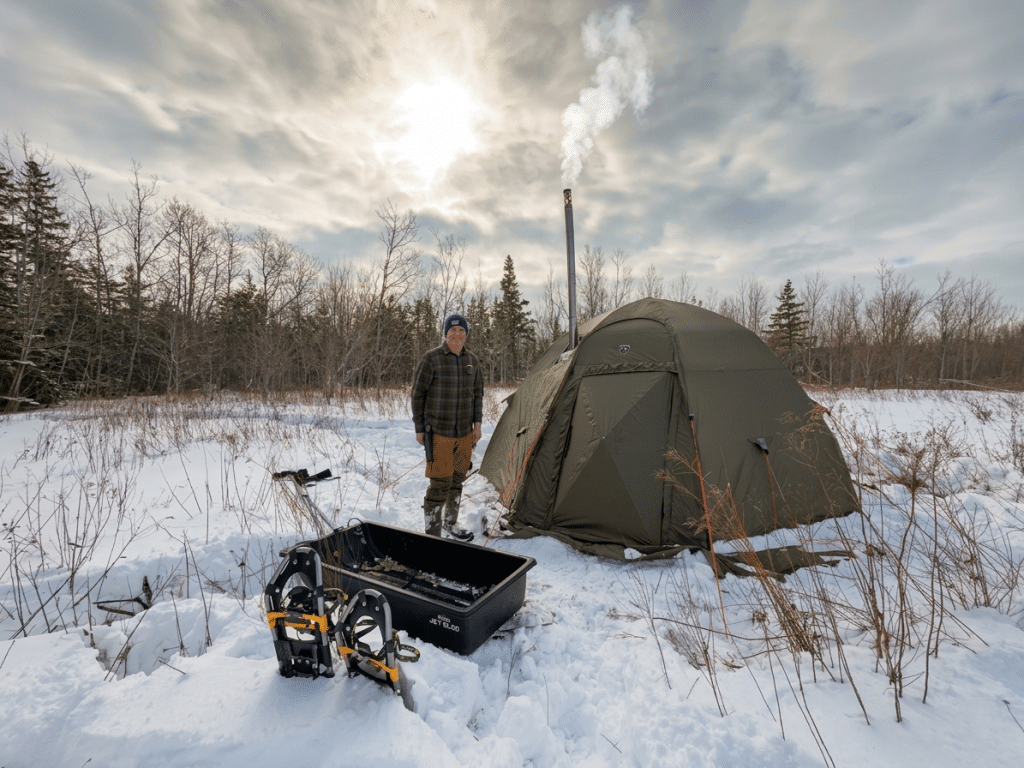
Yes, especially for cold-weather travel. Four-season hot tents like the Bereg UP series weigh 37-65 lbs and support wood stove heating to -40°F. They require more setup time than an RTT (10-20 minutes), but the heating capability exceeds both RTTs and most popup truck campers. Combining an RTT for summer and a hot tent for winter gives you year-round capability at a fraction of a truck camper’s cost.