



Quick Facts:
- Topic: Leveling kit vs lift kit for trucks and SUVs
- Leveling kit height: About 1 to 2.5 inches, often front only
- Lift kit height: About 2 to 6 inches or more
- Install time: Most leveling kits go on in a few hours
- Towing and payload: Neither kit raises your ratings
- Tire fitment: Set by your exact truck, wheel and offset, not by kit height alone
- Warranty: Aftermarket parts do not void coverage by themselves
- Best for: Owners choosing between a small stance fix and a bigger suspension upgrade
8 min read
In This Guide
- Leveling Kit vs. Lift Kit: The Short Answer
- What a Leveling Kit Does
- What a Lift Kit Does
- Leveling Kit vs. Lift Kit Side by Side
- Tire Fitment Limits for Each Kit
- Warranty, Towing and Legal Limits
- Install, Alignment and Total Budget
- Which to Buy: Leveling Kit or Lift Kit?
- Final Thoughts
- Frequently Asked Questions
Leveling Kit vs. Lift Kit: The Short Answer
The leveling kit vs lift kit choice comes down to one question: how much height and tire do you want? A leveling kit raises the front of your truck to remove factory rake. In contrast, a lift kit adds more height overall and often changes more of the suspension.
Rough Country, a lift and leveling kit maker, lists leveling kits at about 1 to 2.5 inches of front height on many applications. It lists lift kits at about 2 to 6 inches or more. However, the ranges overlap, so a 2 inch leveling kit and a 2 inch lift kit are different products. Height alone does not tell you which one fits your truck, so a lift kit vs leveling kit comparison has to start with your tires, your budget and your goals.
I reviewed the ICON Stage 7 suspension on my 2020 Jeep Gladiator, so I come at this question from the lift kit side. This guide explains the difference between leveling kit and lift kit designs in plain terms. You also get a side by side table, the tire, warranty and legal limits, and a short rule for choosing.
What a Leveling Kit Does
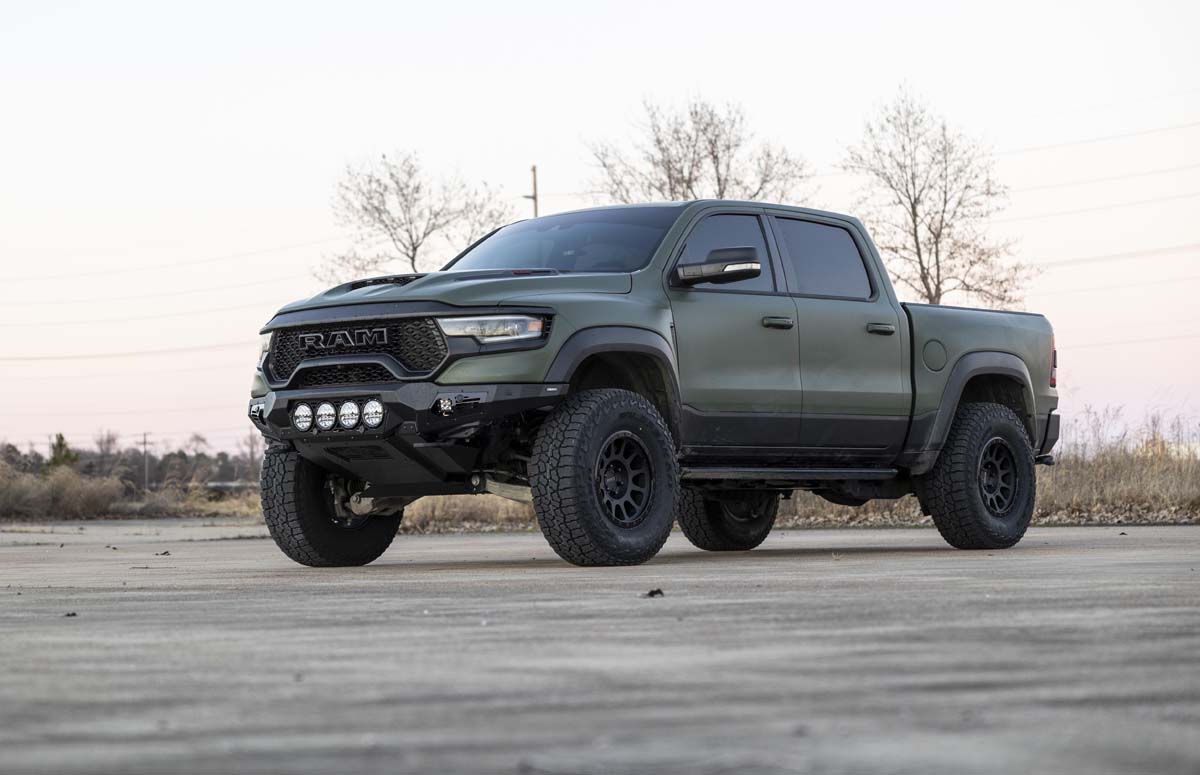
Many pickups leave the factory with the nose slightly lower than the tail. According to Rough Country, this rake exists partly so the rear settles under load. A leveling kit raises the front to even the stance, which also adds ground clearance up front.
Rough Country sells a bolt-on 2 inch spacer kit for 2009 to 2027 Ford F-150 trucks. It also sells a 2 inch N3 loaded strut kit for 2019 to 2025 Chevy Silverado and GMC Sierra 1500 trucks. Confirm the fitment on each listing for your exact year, trim and drive type.
2 inch leveling kits mentioned in this guide

Rough Country 2" Leveling Kit for Ford F-150 (2009-2027) & Ford Rap…

Rough Country 2" Leveling Kit with N3 Struts for Chevy Silverado & …
Kit designs vary. Rough Country lists spacer, loaded strut, coil spacer and torsion bar leveling designs, and its catalog shows spacers and struts as the two biggest groups. Most kits install in a few hours. Rough Country says most of its leveling kits start under $100, while its N3 loaded struts list at $349.95 as of November 25, 2026.
Design also matters for ride and travel. For instance, owners on Reddit often say spacers suit street driving, while off-road use lets the CV axles droop further. Owners also report a firmer ride from preload and spring-based designs. Our post on why you should avoid strut spacers covers those drawbacks in more depth.
What a Lift Kit Does
A lift kit covers a wider range. Rough Country puts lift kits at about 2 to 6 inches or more, and the extra height buys room for larger tires. For example, some Rough Country F-150 applications with about 2 inches of lift list 33 inch tire combinations. Its taller 6 inch F-150 systems, however, list certain 35 inch combinations.
A 2 inch lift vs leveling kit match-up shows why the labels confuse buyers. Some 2 inch systems are built to level the truck, while others raise it and keep some factory rake. Therefore, check whether the listed height applies to the front, the rear or the whole truck.
Taller kits also bring more parts. Rough Country says taller systems often need extra components to keep the suspension and steering geometry in the right place. Our guide to choosing a Jeep lift kit walks through those choices for Jeeps. Because the parts list grows with the height, plan the whole build before you buy the kit.
Leveling Kit vs. Lift Kit Side by Side
| Factor | Leveling Kit | Lift Kit |
|---|---|---|
| Typical height gain | About 1 to 2.5 inches, often front only | About 2 to 6 inches or more |
| Main goal | Remove factory rake | Add height and tire room |
| Install | Usually simpler; most kits take a few hours | Usually more involved |
| Kit cost | Usually lower | Usually higher |
| Ride | Spacer kits keep more of the factory suspension; replacement struts or springs change more | Taller kits often need more parts to hold suspension and steering geometry |
| Extra costs | Alignment when the instructions require it | Wheels, tires, alignment, calibration, extra parts |
| Towing and payload | No increase | No increase |
The difference between leveling kit and lift kit products comes down to height, tire room and cost. Specifically, pick a leveling kit when you want to remove rake, gain modest front height and keep the budget small. Pick a lift kit when you want larger tires, a bigger stance change or a suspension upgrade. Either way, check the maker’s fitment list before you order.
Tire Fitment Limits for Each Kit
No universal rule says 2 inches of height equals 33 inch tires. Rough Country lists the factors: year, make, model, 2WD or 4WD, trim, wheel diameter and width, offset, backspacing, tire width, suspension design and trimming. Change one of them and the answer changes. Instead of trusting a rule of thumb, treat the kit maker’s fitment list for your exact truck as the answer.
For example, a bolt-on 2 inch F-150 spacer kit lists fitment for tires up to 33 inches. Taller systems list certain 35 inch combinations. In a 2 inch lift vs leveling kit choice, the kit alone does not set the tire size. Therefore, pick your tire size first, then pick the kit whose fitment list names it for your truck.
I have run 35 inch tires on my 2020 Jeep Gladiator for years, so I know the tire size drives every other choice. If you plan to go this big, read our wheel and tire fitment guide first. Then check whether you need to regear for 35s.
Warranty, Towing and Legal Limits
According to the FTC, companies cannot void your warranty or deny coverage solely because you use a part made by another company. However, they are allowed to refuse coverage for defects or damage caused by third-party parts or services. A kit does not end your warranty, but a failed part tied to the kit might not be covered.
Neither kit raises your tow rating, payload, GVWR or GAWR, Rough Country notes. Therefore, your manufacturer ratings stay the same after a lift or a level, and you still load and tow to those numbers. If you tow often, think about rake first: Rough Country warns the rear might sit lower than the front once you level the truck and then load the bed or hook up a trailer.
Height limits also apply. California Vehicle Code section 24008.5 caps frame height at 23 inches for passenger vehicles other than housecars. For other vehicles the cap is 27 inches up to 4,500 pounds GVWR, 30 inches from 4,501 to 7,500 pounds and 31 inches from 7,501 to 10,000 pounds. The lowest part of the body floor must stay within 5 inches of the frame top, and GVWR means the manufacturer’s rating, modified or not. Frame height, under the law, runs from the ground to the lowest point of the frame on an unladen truck. Check your own state’s rules before you buy.
Install, Alignment and Total Budget
The kit price is only part of the budget. Rough Country says your full budget might also include wheels, tires, alignment, professional installation, speedometer calibration and additional suspension parts. Alignment is needed after a height change when the kit instructions require it.
If you install the kit yourself, tighten every bolt to the torque spec in the instructions. A click-type torque wrench makes the check simple. Also, support the truck on jack stands, never on a jack alone.

EPAuto 1/2-inch Drive Click Torque Wrench, 10-150 ft/lb, 13.6-203.5 N/m
A click-type torque wrench for tightening kit hardware to the maker's spec.
- 1/2 inch drive click-type design
- 10 to 150 ft-lb range
- Dual ft-lb and Nm scale
- 150 ft-lb ceiling will not cover every heavy-duty fastener
Which to Buy: Leveling Kit or Lift Kit?
Use this short rule to settle the leveling kit vs lift kit question.
- Choose a leveling kit if you want to remove rake, add modest front height and keep the total cost low.
- Choose a lift kit if you want larger tires, more height or a suspension upgrade.
- Skip both until you confirm tire fitment for your exact truck.
Before you order, work through this checklist in order.
- Pick the tire size you want.
- Find the kit fitment list for your year, trim and 2WD or 4WD setup.
- Add up the kit, tires, wheels, alignment and installation.
- Check your state’s height rules.
- Read your warranty terms and tell your insurer about the change.
Whichever kit you pick, set aside money for alignment and tires. The kit is the smaller part of the bill when you upsize.
Final Thoughts
In the lift kit vs leveling kit debate, start with the tire you want, not the kit. Once you know the tire size, the fitment list for your truck tells you how much height you need. A leveling kit covers a small stance fix, and a lift kit covers bigger tires and a bigger change.
The trade-offs are plain. A leveling kit costs less and installs faster, but it adds limited height. Meanwhile, a lift kit adds more room, but you pay for it in parts, tires and labor. Neither one raises what your truck is rated to tow or carry.
If you are still unsure, read the maker’s fitment list for your year and model, and talk to an installer about alignment. Then you buy once instead of twice.
Frequently Asked Questions
Is a 2 inch lift kit the same as a 2 inch leveling kit?
No. A leveling kit mainly raises the front to remove rake, while a lift kit adds height across the truck and often brings extra suspension parts. Rough Country lists leveling kits at about 1 to 2.5 inches of front height on many applications and lift kits at about 2 to 6 inches or more. Compare the fitment list for your exact truck before you decide.
Does a 3 inch leveling kit do the same as a 3 inch lift kit?
Not always. Rough Country lists many leveling kits at 1 to 2.5 inches, so a 3 inch claim often describes a lift kit or a specific truck application. Tire fitment also depends on your wheel, offset and trim. Therefore, read the kit listing for your year and model.
Will a leveling kit or lift kit void my warranty?
Not by itself. The FTC says companies cannot void your warranty solely because you use another company’s part. They are allowed to refuse coverage for damage caused by the part.
Does a leveling kit or lift kit raise towing capacity?
No. Rough Country states neither kit raises tow rating, payload, GVWR or GAWR. Your manufacturer ratings stay the same, so check them in your owner’s manual before you tow.
Do I need an alignment after installing a leveling kit?
Follow the kit instructions. Rough Country says you need an alignment after a height change when the instructions require one.