


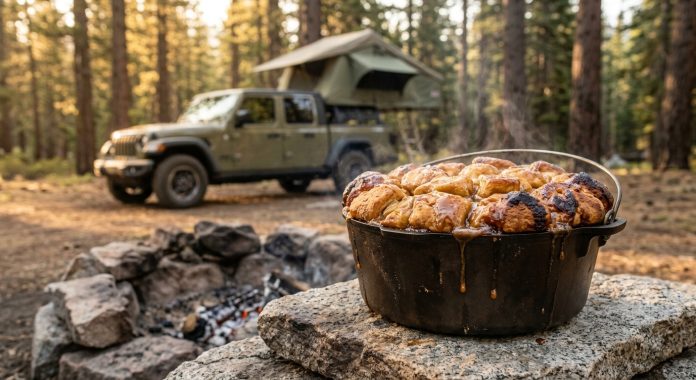

Quick Verdict: Dutch oven monkey bread feeds 8 overlanders as a pull-apart dessert or breakfast with refrigerated biscuit dough quartered, rolled in cinnamon sugar, then layered with a butter-brown-sugar syrup. First, quarter the biscuits and toss in cinnamon sugar. Next, layer into a 12-inch Lodge Camp Dutch Oven. Finally, pour melted butter-sugar syrup over the top and bake at 350F on 17 top and 8 bottom briquettes for 40 minutes. Gooey, caramelized, crowd-pleasing.
Save this recipe for your next trip.
Last updated: April 2026 | Prep: 15 min | Cook: 40 min | Serves: 8
Written by Alex Schult
Editor in Chief of 4wdTalk.com. 15+ years of off-road and overlanding experience with 1,000+ hours on the trail. Tests Dutch oven recipes at base camp on a Jeep Gladiator and Chevy Colorado ZR2 across the Sierras, Mojave, and Big Bear backcountry.
We tested this recipe on actual overland trips. Amazon affiliate links support 4wdTalk.com at no extra cost to you.
In This Recipe
Why This Recipe Works for Overlanders
Dutch oven monkey bread wears two hats at base camp: dessert after dinner or pull-apart breakfast the next morning. First, refrigerated biscuit dough tubes ship shelf-stable for weeks and run 15 minutes of prep, which puts this recipe in the weeknight-feasible category alongside cobbler and lava cake. Second, the pull-apart format skips slicing entirely; diners grab sticky nuggets directly from the Dutch oven with their hands, which turns the dessert into a shared camp moment. Third, the caramelized butter-brown-sugar syrup soaks into every biscuit piece during the bake, producing a texture between sticky bun and bread pudding.
On a Sierras Thanksgiving-weekend trip at 7,100 feet with 6 friends, I baked this Dutch oven monkey bread as a morning-3 breakfast after coffee. Specifically, I quartered 3 tubes of Pillsbury Grands Flaky Layers (24 biscuits total) into 96 nuggets, tossed them in 1 cup of cinnamon sugar, layered into the 12-inch Lodge oven, then poured 1 stick of melted butter mixed with 3/4 cup brown sugar over the top. Moreover, the bread baked 45 minutes on 18 top and 9 bottom (altitude adjusted) at 350F, and the internal dough hit 200F per Serious Eats biscuit doneness guidance.
This recipe is part of our dutch oven camping recipes collection. For a similar biscuit-dough dessert, see the Dutch Oven Cinnamon Rolls. Both spokes roll up to our camp cooking for overlanders guide.
Equipment You Need
- Lodge 12-inch Camp Dutch Oven (6 quart): holds 3 tubes of biscuit dough quartered
- Charcoal chimney starter: lights 30 briquettes in 15 minutes
- Kingsford Original briquettes: holds 350F across 40-minute bake
- Lid lifter, 12-inch minimum: for doneness check at 35 minutes
- Large zip bag or mixing bowl: for tossing biscuit quarters in cinnamon sugar
- Small saucepan: for melting butter with brown sugar
- Sharp kitchen shears or knife: for quartering raw biscuit dough
- Long-handled tongs, 16-inch: Cuisinart 16-inch tongs for coal placement
- Heat-resistant gloves rated 932F: RAPICCA gloves for safe handling
- Disposable foil liner (strongly recommended): for cleanup of the caramelized sugar
The Workhorse
Lodge 12-Inch Camp Dutch Oven, 6 Quart
Pre-seasoned cast iron with flanged lid holds 96 biscuit quarters from 3 Pillsbury Grands tubes plus 1/2 cup of butter-brown-sugar syrup with 1 1/2-inch clearance for the dough to rise during the bake.
Ingredients
Serves 8
- 3 tubes (16.3 oz each) Pillsbury Grands Flaky Layers biscuits, 24 biscuits total
- Cinnamon sugar coating:
- 3/4 cup granulated sugar
- 3 tablespoons ground cinnamon
- 1/2 teaspoon kosher salt
- Butter-brown-sugar syrup:
- 1 stick (8 tablespoons) unsalted butter, melted
- 3/4 cup dark brown sugar, packed
- 1 teaspoon vanilla extract
- 1/2 teaspoon kosher salt
- Optional add-ins:
- 1/2 cup chopped pecans or walnuts
- 1/3 cup raisins or dried cranberries
- Optional vanilla glaze (post-bake):
- 1 cup powdered sugar
- 2 tablespoons whole milk
- 1/2 teaspoon vanilla extract
Step-by-Step Instructions
Prep the Briquettes and Coatings
- Light the briquettes: Load 30 Kingsford briquettes into a chimney over newspaper. Wait 15 to 20 minutes until they coat with gray ash and glow orange-red. Meanwhile, line the Dutch oven with heavy-duty foil for easy cleanup.
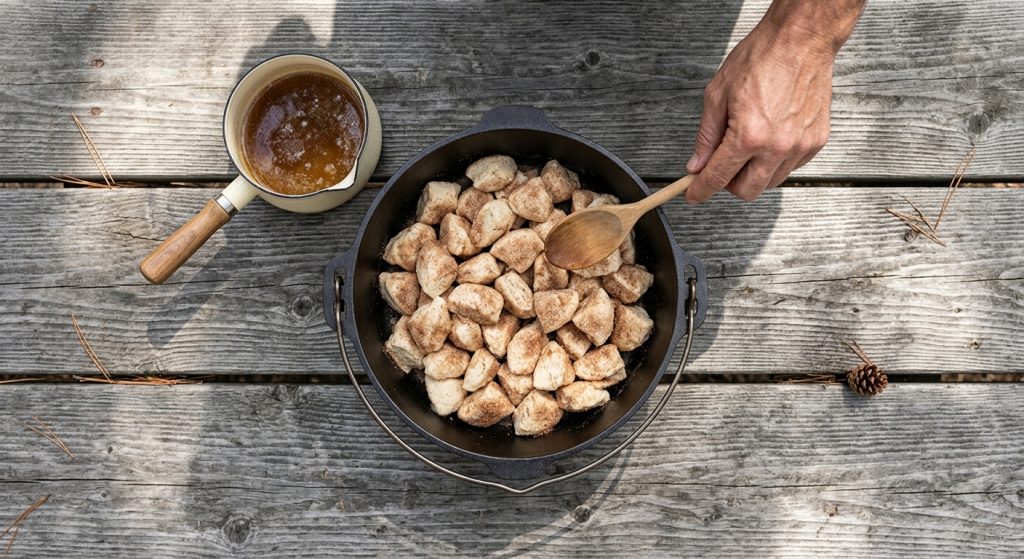
- Mix the cinnamon sugar: In a large zip bag or mixing bowl, combine 3/4 cup granulated sugar, 3 tablespoons cinnamon, and 1/2 teaspoon salt. Specifically, the salt balances the sweetness and enhances the cinnamon notes.
- Quarter the biscuits: Open all 3 tubes of Pillsbury Grands. Using sharp kitchen shears or a knife, cut each biscuit into 4 equal quarters. Afterward, you should have 96 bite-sized nuggets of dough.
- Toss in cinnamon sugar: Add the biscuit quarters to the zip bag or bowl of cinnamon sugar. Next, toss gently until every piece is fully coated on all sides. Shake off excess sugar if any pieces look overloaded.
Layer the Biscuits and Build the Syrup
- Layer into the Dutch oven: Drop the coated biscuit pieces into the foil-lined Dutch oven in 3 loose layers. If using pecans and raisins, sprinkle between the layers for even distribution.
- Make the syrup: In a small saucepan over a camp stove burner on medium-low, melt 1 stick of butter. Then stir in 3/4 cup dark brown sugar, 1 teaspoon vanilla, and 1/2 teaspoon salt. Cook 2 minutes, stirring continuously, until the sugar dissolves into a glossy amber syrup.
- Pour syrup over biscuits: Pour the warm butter-brown-sugar syrup evenly across the layered biscuit pieces in the Dutch oven. Moreover, the syrup should drip down through the layers, coating every nugget as it travels to the bottom.
Bake, Rest, and Serve
- Arrange 350F coals: Using tongs and gloves, rearrange the coals. Specifically, 8 briquettes underneath and 17 lit briquettes on the flanged lid in a ring pattern with 2 in the center.
- Bake 35 to 45 minutes: Cover and bake at 350F for 35 to 45 minutes. Rotate the Dutch oven 90 degrees at 15 minutes and 30 minutes. Additionally, add 10 fresh lit briquettes from a second chimney batch at the 25-minute mark.
- Check doneness at 35 minutes: Lift the lid with a lid lifter. The top should be deep golden-brown, the syrup should bubble vigorously around the edges, and an instant-read thermometer inserted into the center should read 200F internal per Serious Eats biscuit doneness guidance.
- Rest 5 minutes: Remove the Dutch oven from the coals with gloves. Rest 5 minutes with the lid off. Consequently, the syrup thickens slightly and the pull-apart pieces set enough to lift cleanly without tearing.
- Invert and glaze (optional): For a restaurant-style presentation, place a large plate over the Dutch oven, grip with gloves, and flip to invert the monkey bread onto the plate. Next, drizzle the vanilla glaze (if using) over the top while warm. Alternatively, serve directly from the Dutch oven for a rustic presentation; diners pull pieces with their hands.
Briquette Math for 350F
A 12-inch Dutch oven at 350F for a sugar-heavy bake needs 25 briquettes total in a 2-to-1 top-heavy ratio: 17 on the lid and 8 underneath. Specifically, the top-heavy stack browns the monkey bread top into amber-gold while the bottom briquettes caramelize the syrup without scorching the dough against the cast iron.
Lodge briquette counts at 350F:
- 8-inch (2 quart): 9 top / 5 bottom
- 10-inch (4 quart): 17 top / 9 bottom
- 12-inch (6 quart): 17 top / 8 bottom
- 14-inch (8 quart): 21 top / 11 bottom
Altitude affects monkey bread because the biscuit dough rises faster in thinner air. Therefore, above 5,000 feet elevation, add 1 top and 1 bottom briquette and extend bake by 5 minutes. Above 7,500 feet, add 2 top and 2 bottom and extend 8 minutes. On the Sierras Thanksgiving trip at 7,100 feet, the standard 40-minute bake needed 47 minutes with 18 top and 9 bottom before the centers fully set at 200F. Moreover, at altitude the biscuits rise taller, producing a fluffier pull-apart texture than sea-level versions.
Field Tips for Sticky Monkey Bread
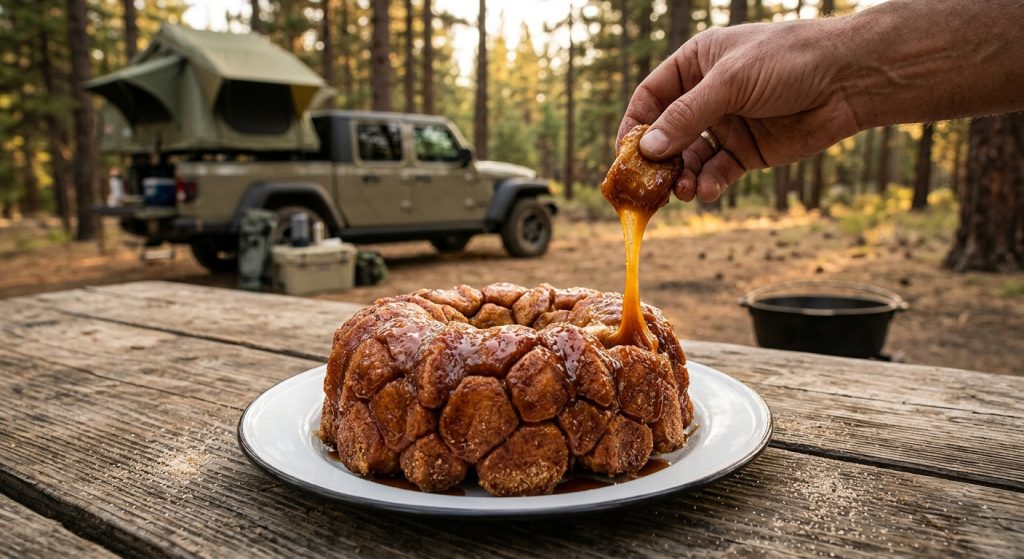
Foil liner beats no liner every time. Specifically, the caramelized butter-brown-sugar syrup hardens on cast iron overnight into a rock-hard coating which requires 45 minutes of soaking and scrubbing to remove. Instead, a heavy-duty foil liner lifts out of the Dutch oven with all the caramel stuck to it, which turns post-dessert cleanup into a 30-second task. Moreover, the foil costs $0.50 versus 45 minutes of camp chore time.
Warm the syrup, do not pre-cook too long. Consequently, the butter-brown-sugar syrup needs only 2 minutes of simmer to dissolve the sugar; cooking longer thickens it into caramel which solidifies before soaking into the biscuit layers. Instead, pour the syrup over the biscuits while it is still pourable and glossy. The bake finishes the caramelization.
Toss biscuits in zip bag for cleaner coating. Specifically, shaking 96 biscuit quarters in a 1-gallon zip bag with the cinnamon sugar coats every piece evenly in 30 seconds, compared to 2 minutes of mixing in a bowl with a spoon. Alternatively, use a mixing bowl with a rubber spatula if no zip bag is handy. Moreover, the bag method keeps hands clean of sticky sugar.
Variations and Substitutions
- Caramel pecan style: Fold 1 cup chopped pecans between biscuit layers. Add 2 tablespoons heavy cream to the butter-sugar syrup for richer caramel notes.
- Apple cinnamon: Add 1 large diced Granny Smith apple between biscuit layers. Increase cinnamon in the coating to 4 tablespoons.
- Savory breakfast version: Skip sugar entirely. Toss biscuits in 1/2 cup grated Parmesan, 2 teaspoons Italian herbs, and 1 teaspoon garlic powder. Replace butter-sugar syrup with 1/2 cup melted butter plus 4 minced garlic cloves.
- Cream cheese stuffed: Press 1/4 teaspoon cream cheese into each biscuit quarter before tossing in cinnamon sugar. Adds pockets of cheesecake-like richness.
- Pumpkin spice: Replace 1 tablespoon cinnamon with 1 tablespoon pumpkin pie spice. Fall-forward profile which pairs with autumn overlanding trips.
- Chocolate chip: Add 1 cup of mini chocolate chips between biscuit layers. Drizzle 1/4 cup hot fudge over the top during the final 5 minutes of bake.
- Scaled for 4 people: Use a Lodge 10-inch Camp Dutch Oven. Use 1 1/2 tubes of biscuits (12 biscuits). Halve the cinnamon sugar and syrup. Bake on 17 top and 9 bottom for 30 minutes.
- Scaled for 12 people: Use a 14-inch Lodge Camp Dutch Oven. Use 4 tubes of biscuits. Increase syrup by 30%. Bake on 21 top and 11 bottom briquettes for 48 minutes.
Essential Tool
Camp Chef 12-Inch Dutch Oven Lid Lifter
Hooked steel end pulls the flanged lid off cleanly during doneness checks without scattering 17 lit briquettes onto the sticky monkey bread surface. Additionally, the 12-inch reach protects hands from caramelized sugar bubbling at the edges.
Storage and Leftovers
Leftover Dutch oven monkey bread holds safely in an airtight bag for up to 3 days at camp ambient temperature, or 5 days in a cooler below 40F. Reheat individual pieces on a grill grate over 4 low briquettes for 3 minutes, or wrap in foil and warm in the Dutch oven on 6 bottom briquettes for 5 minutes. Moreover, day-2 monkey bread stays soft and sticky because the caramel continues to coat the biscuit dough overnight.
For a breakfast upgrade the next morning, crumble leftover monkey bread into a cast iron skillet with 2 beaten eggs and 1/4 cup milk. Then scramble over medium heat for 4 minutes into a rich French-toast-style camp breakfast. Alternatively, freeze extras in heavy-duty foil for up to 2 months per USDA guidance; thaw at ambient temperature for 30 minutes before reheating.
Frequently Asked Questions
How many briquettes for Dutch oven monkey bread at 350F?
A 12-inch Lodge Camp Dutch Oven at 350F uses 17 briquettes on the lid and 8 underneath. Moreover, a 10-inch Dutch oven needs 17 top and 9 bottom. The 2-to-1 top-heavy ratio browns the monkey bread top into amber-gold while the bottom briquettes caramelize the syrup without scorching.
What biscuits work best for monkey bread?
Pillsbury Grands Flaky Layers work best because they hold structure when quartered and release the flaky pull-apart layers during the bake. Alternatively, Pillsbury Grands Southern Homestyle or Annie’s Organic Flaky biscuits work. Avoid thin butter-biscuit varieties; they melt into the caramel and lose definition.
Why use a foil liner?
The butter-brown-sugar syrup caramelizes onto cast iron overnight into a rock-hard coating requiring 45 minutes of soaking and scrubbing. Specifically, a heavy-duty foil liner lifts out of the Dutch oven with all caramel stuck to it, reducing post-dessert cleanup from 45 minutes to 30 seconds.
How do I know when monkey bread is done?
An instant-read thermometer in the center should read 200F internal per Serious Eats biscuit doneness guidance. Moreover, visual cues include deep golden-brown top, syrup bubbling vigorously around the edges, and no visible raw dough showing through the surface. All three signs confirm doneness.
Should I invert the monkey bread?
Inverting produces restaurant-style presentation with the sticky caramel glaze draping across the top, but serving directly from the Dutch oven works for a rustic camp vibe. Specifically, inverting requires a large plate, gloves, and careful technique because the Dutch oven weighs 20 pounds when full. Skip inverting for family-style service; diners pull pieces with their hands.
Will kitchen shears work better than a knife?
Kitchen shears cut refrigerated biscuit dough faster and cleaner than a knife, which tears the dough edges. Specifically, sharp shears produce 96 uniform quarters in 90 seconds; a knife takes 3 minutes and leaves ragged edges. Moreover, shears keep hands cleaner because they avoid the cutting-board-and-sticky-dough dance.
Is vanilla glaze required?
No, the glaze is optional because the butter-brown-sugar syrup already provides sweetness. Specifically, skip the glaze for a simpler camp dessert or add it for a bakery-style finish. For the glaze, whisk 1 cup powdered sugar with 2 tablespoons milk and 1/2 teaspoon vanilla until pourable; drizzle over warm monkey bread.
Does Dutch oven monkey bread work at high altitude?
Yes, the recipe performs well above 5,000 feet with tweaks. Specifically, add 1 top and 1 bottom briquette and extend bake by 5 minutes between 5,000 and 7,500 feet; add 2 top and 2 bottom and extend 8 minutes above 7,500 feet. Moreover, the biscuits rise taller at altitude, producing fluffier pull-apart texture.
You Might Also Like
-
- Dutch Oven Cinnamon Rolls (sibling biscuit-dough recipe)
- Dutch Oven Mountain Man Breakfast (hearty breakfast pairing)
- Dutch Oven Blueberry Pancake (sweet breakfast pairing)
- Dutch Oven Sausage Hash Brown Casserole (savory breakfast pairing)
- Return to the full Dutch Oven Camping Recipes collection