


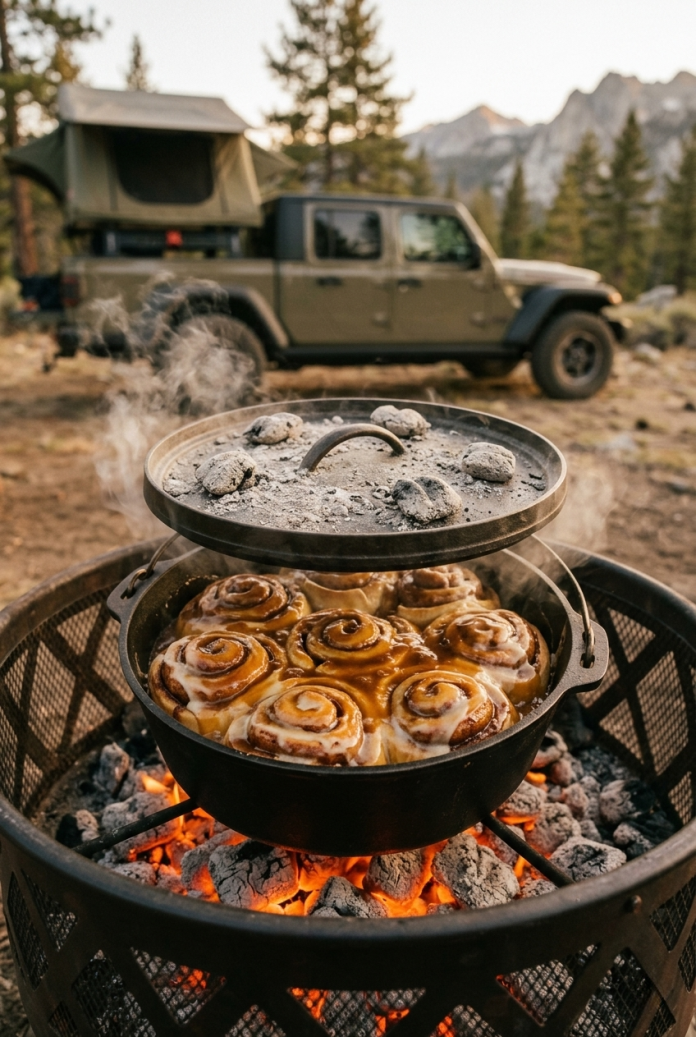

Quick Verdict: Dutch oven cinnamon rolls at base camp deliver bakery-quality breakfast in 45 minutes flat. Use a Lodge 10-inch Camp Dutch Oven, 8 refrigerated jumbo rolls or a scratch dough, and 19 briquettes on top with 10 underneath for a steady 375F bake. Caramel sauce pools at the bottom; icing drizzles on hot. Feeds 8 hungry overlanders.
Save this recipe for your next trip.
Last updated: April 2026 | Prep: 10 min | Cook: 35 min | Serves: 8
Written by Alex Schult
Editor in Chief of 4wdTalk.com. 15+ years of off-road and overlanding experience with 1,000+ hours on the trail. Tests Dutch oven recipes at base camp on a Jeep Gladiator and Chevy Colorado ZR2 across the Sierras, Mojave, and Big Bear backcountry.
We tested this recipe on actual overland trips. Amazon affiliate links support 4wdTalk.com at no extra cost to you.
In This Recipe
Why This Recipe Works for Overlanders
Dutch oven cinnamon rolls solve the weekend morale problem on day 2 or 3 of a trip. First, the smell alone wakes up the whole camp faster than a diesel fire-up. Second, a 10-inch Dutch oven on 19 top and 10 bottom briquettes holds 375F long enough to bake 8 jumbo rolls evenly. Third, the brown sugar and butter base caramelizes against the hot cast iron, yielding a sticky bottom layer competing head-on with any bakery roll.
Moreover, I baked Dutch oven cinnamon rolls on a 3-day Sierras trip last October with 8 inches of snow on the ground. The rolls rose and baked identically to a home oven because the Dutch oven traps heat regardless of ambient air temperature. Specifically, briquette ash insulates against wind and cold, unlike a propane camp stove where cold wind steals most of the heat.
This recipe is part of the full dutch oven camping recipes collection. For a heartier breakfast, check Dutch Oven Mountain Man Breakfast. Both spokes roll up to our camp cooking for overlanders guide.
Equipment You Need
- Lodge 10-inch Camp Dutch Oven (4 quart): flanged lid for holding coals on top
- Charcoal chimney starter: lights 30+ briquettes in 15 minutes
- Kingsford Original briquettes: consistent heat for predictable bake times
- Lid lifter: 12-inch minimum to rotate the lid safely
- Parchment paper: prevents bottom scorch and makes cleanup trivial
- Heat-resistant gloves: rated to 932F for cast iron work
- Long-handled tongs: 16-inch for placing and adjusting coals
- Instant-read thermometer: confirms internal temperature reaches 190F
- Small mixing bowl: for whisking icing at camp
The Essential
Lodge 10-Inch Camp Dutch Oven, 4 Quart
Pre-seasoned cast iron with flanged lid. Holds 8 jumbo cinnamon rolls with room to rise. The exact Dutch oven used in this recipe and every Dutch oven article on 4wdTalk.
Ingredients
Serves 8
For the rolls (quick version):
- 1 tube (17.5 oz) Pillsbury Grands Cinnamon Rolls with icing (8 jumbo rolls)
- OR 1 homemade batch (see scratch recipe in variations below)
For the caramel bottom:
- 4 tablespoons unsalted butter
- 1/3 cup packed brown sugar
- 1/4 cup heavy cream
- 1/2 teaspoon cinnamon
- 1/4 teaspoon kosher salt
- 1/2 cup chopped pecans (optional, classic)
Icing (scratch or extra drizzle):
- 1 cup powdered sugar
- 2 tablespoons heavy cream or milk
- 1/2 teaspoon vanilla extract
- Pinch kosher salt
Step-by-Step Instructions
- Light the briquettes: Load 35 briquettes into a charcoal chimney. Light with newspaper or a firestarter. Wait 15 to 20 minutes until the coals develop gray ash and glow orange-red. Meanwhile, prep the Dutch oven.
- Prep the caramel base: In a small saucepan over a camp stove or cleared fire ring, melt 4 tablespoons of butter. Afterward, stir in the brown sugar, heavy cream, cinnamon, and salt. Cook for 2 minutes until the sugar dissolves and the mixture thickens slightly.
- Line the Dutch oven: Cut a parchment paper circle slightly larger than the bottom of the 10-inch Dutch oven. Press it into place. Next, pour the caramel sauce over the parchment. Sprinkle chopped pecans evenly across the caramel if using.
- Arrange the rolls: Open the Pillsbury Grands tube. Set the icing packet aside for later. Place 8 rolls in the Dutch oven: 7 around the outside edge and 1 in the center. Leave at least 1/2 inch of space between rolls to allow rising during the bake.
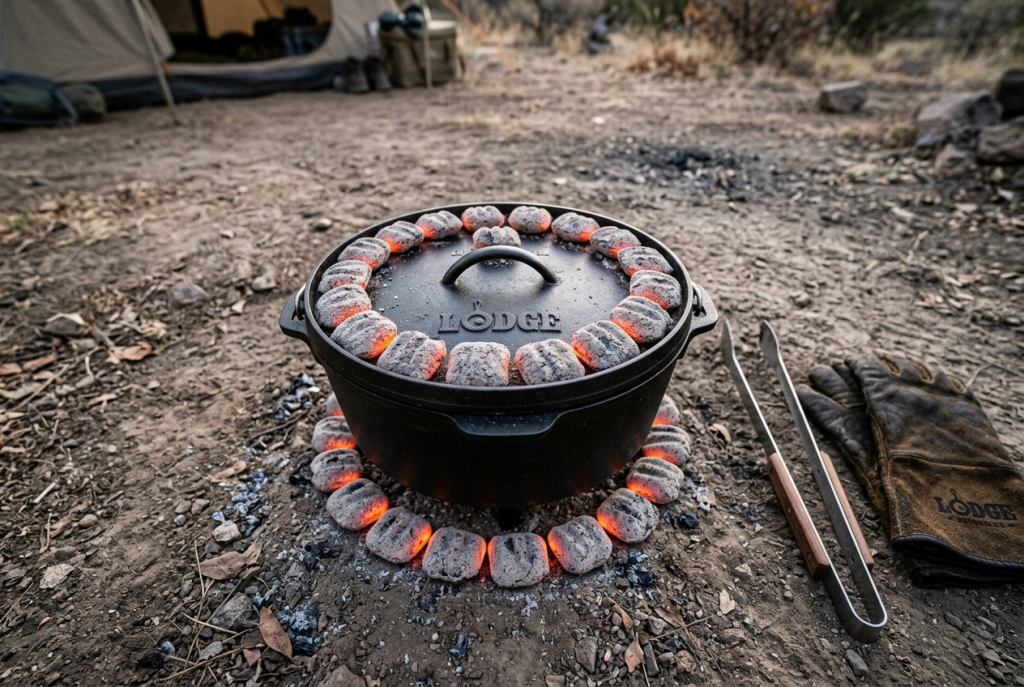
- Arrange the coals: Using long-handled tongs and heat-resistant gloves, place 10 lit briquettes in a ring on the ground where the Dutch oven will sit. Set the Dutch oven on the bottom coals. Afterward, place 19 briquettes on the flanged lid in a ring pattern around the outer edge with a couple in the center.
- Bake: Cover and bake for 30 to 35 minutes. Rotate the Dutch oven 90 degrees every 10 minutes, and rotate the lid 90 degrees in the opposite direction, to even out hot spots. Additionally, check at the 25-minute mark for color.
- Check doneness: Use a lid lifter to lift the lid straight up (avoid dumping ash inside). The rolls should be deep golden brown on top with the caramel bubbling at the edges. Internal temperature of the center roll should reach 190F with an instant-read thermometer.
- Invert and serve: Remove the Dutch oven from the coals with gloves. Let it rest for 5 minutes. Meanwhile, run a butter knife around the edge. Next, carefully invert onto a heatproof platter or cutting board so the caramel bottom faces up. Finally, drizzle the packet icing (or scratch icing) over the hot rolls.
- Serve hot: Pull apart or cut with a knife. Hot coffee and fresh rolls are peak overland breakfast energy.
Briquette Math for 375F
A 10-inch Dutch oven needs 19 briquettes on the lid and 10 underneath for a steady 375F bake, according to the Lodge Cast Iron briquette chart. Therefore, for baked goods at 375F on any Dutch oven size, apply the Lodge “3 up, 2 down” rule relative to your Dutch oven diameter in inches, then add or subtract from the baseline.
Lodge official briquette counts by Dutch oven size at 375F:
- 8-inch (2 quart): 10 top / 5 bottom
- 10-inch (4 quart): 19 top / 10 bottom
- 12-inch (6 quart): 21 top / 11 bottom
- 14-inch (8 quart): 23 top / 12 bottom
Altitude changes baking behavior. Specifically, above 5,000 feet, reduce top briquettes by 1 and extend bake time by 3 to 5 minutes. Above 7,500 feet, reduce top briquettes by 2 and extend bake time by 5 to 8 minutes. Because air pressure is lower, baked goods rise faster but set slower, which is why the gentler heat and longer bake produces better texture.
Field Tips for Base Camp Baking
Wind kills Dutch oven cinnamon rolls bakes faster than any other variable. Consequently, on any trip with 10+ mph wind, block the Dutch oven with a natural windbreak, a Fireside Outdoor Pop-Up Fire Pit, or position the rig as a wind shield. Specifically, wind over 15 mph drops effective oven temperature by 50 to 75F and adds 10 minutes to the bake.
Rotating the Dutch oven and lid prevents hot spots. Additionally, briquettes burn unevenly, so even Kingsford Original coals generate hot and cold zones. Rotating the Dutch oven 90 degrees clockwise and the lid 90 degrees counterclockwise every 10 minutes averages out the bake. Skipping rotation produces a scorched side and an underdone side every time.
Cold mornings matter more than cold cook surfaces. Ambient temperatures below 40F steal heat from the Dutch oven. Therefore, on a sub-40F morning, add 2 to 3 briquettes to the bottom count and extend bake time by 5 minutes. I learned this the hard way on a Big Bear trip in February, when the rolls came out raw in the center after the standard 35 minutes.
Variations and Substitutions
- Scratch dough version: Mix 2.5 cups bread flour, 1 packet instant yeast, 2 tablespoons sugar, 1 teaspoon salt, 3/4 cup warm milk, 1 egg, and 3 tablespoons softened butter. Knead 5 minutes. Roll to 1/4 inch, spread with 1/4 cup softened butter, 1/2 cup brown sugar, 2 teaspoons cinnamon. Roll, slice into 8 rounds. Rise 45 minutes before baking as directed.
- Apple fritter version: Add 1 diced Granny Smith apple and 1/2 teaspoon nutmeg to the caramel base. The apple softens during the bake and becomes a signature topping.
- Maple bacon version: Substitute 1/4 cup pure maple syrup for the brown sugar in the caramel. Add 1/2 cup crumbled cooked bacon on top of the caramel before laying the rolls.
- Cream cheese icing: Whisk 2 ounces softened cream cheese into the powdered sugar mix along with 1 extra tablespoon of cream.
- Pumpkin spice version: Add 1 teaspoon of pumpkin pie spice to the caramel base. Swap vanilla in the icing for 1/2 teaspoon maple extract.
- Scaled for 4 people: Use a Lodge 8-inch Dutch oven and 4 rolls. Reduce caramel ingredients by half. Use 10 briquettes on top, 5 underneath for 375F.
- Scaled for 12 people: Use a Lodge 12-inch Dutch oven. Double the caramel base. Fit 10 rolls (8 outer, 2 center). Use 21 top briquettes, 11 underneath.
Essential Tool
Camp Chef Lid Lifter, 12-Inch
Lifts the Dutch oven lid straight up without tipping coals or ash into the food. Essential for rotating the lid mid-bake. The one tool every Dutch oven overlander needs.
Storage and Leftovers
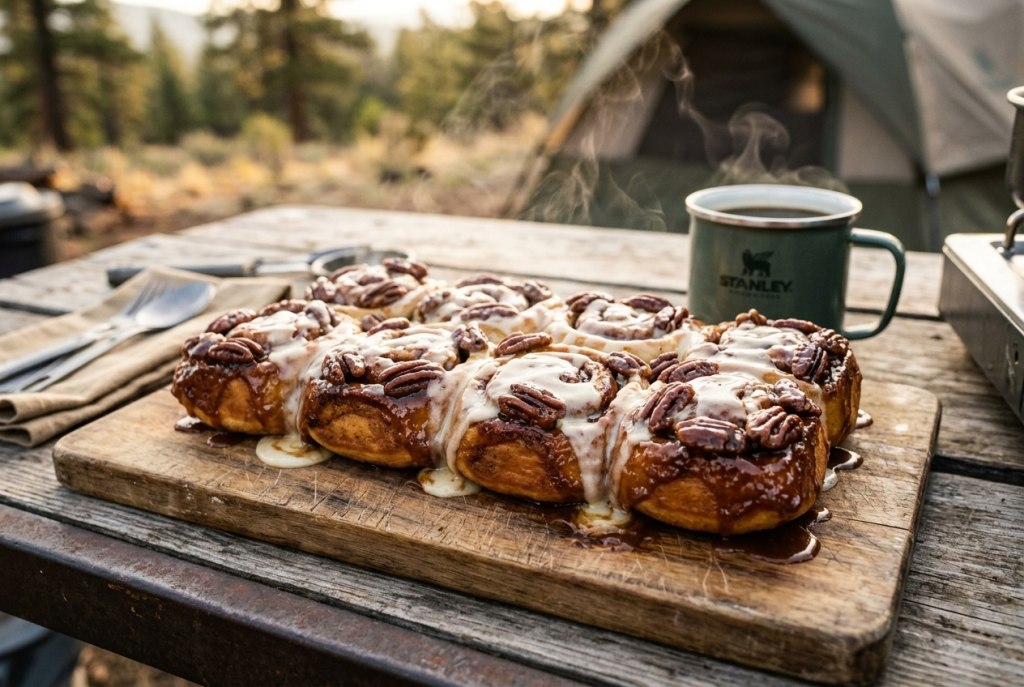
Leftover Dutch oven cinnamon rolls keep in a sealed container at ambient temperature for up to 24 hours, or refrigerated below 40F for up to 3 days. Reheat at camp by wrapping individual rolls in foil and placing on medium coals for 4 minutes, flipping halfway. Alternatively, warm in a cast iron skillet over low heat on a propane burner with a sprinkle of water and a foil cover to steam-reheat.
Frozen rolls stay good for 30 days in a vacuum-sealed bag. Thaw overnight in the cooler before reheating. However, the caramel hardens during freezing and softens on reheat, slightly changing the texture. For best flavor, eat within 48 hours.
Frequently Asked Questions
How many briquettes for Dutch oven cinnamon rolls at 375F?
Dutch oven cinnamon rolls in a 10-inch Lodge Camp Dutch Oven at 375F need 19 briquettes on the lid and 10 underneath, according to the Lodge Cast Iron official briquette chart. Moreover, for a 12-inch Dutch oven at the same temperature, use 21 top and 11 bottom. Both ratios apply the Lodge 3-up, 2-down guideline relative to Dutch oven diameter.
Do refrigerated Pillsbury rolls work as well as scratch dough?
Yes, Pillsbury Grands Cinnamon Rolls perform identically to scratch dough in a Dutch oven because the caramel sauce on the bottom creates the signature gooey bake regardless of dough source. Scratch dough offers more flavor control and a chewier crumb. However, Pillsbury cuts prep from 90 minutes to 10 minutes at camp, which matters when the whole crew is waiting for breakfast.
What if I do not have a lid lifter?
Without a lid lifter, use long-handled heat-resistant gloves and two 18-inch steel hooks or spatulas to balance the lid when removing. Additionally, a pair of channel-lock pliers grips the lid handle securely for tipping and rotating. Nonetheless, a dedicated lid lifter is the safest and easiest option; a 12-inch Camp Chef model runs under $20 on Amazon.
How do I prevent the bottom from burning?
Burned bottoms come from either too many bottom briquettes or failing to rotate the Dutch oven. Therefore, stick to 10 briquettes underneath for a 10-inch Dutch oven, rotate every 10 minutes, and use parchment paper to create a thermal buffer between the caramel and the cast iron. Additionally, position briquettes in a ring pattern with an empty center zone to reduce direct bottom heat.
How do I bake cinnamon rolls without charcoal briquettes?
Wood coals from a hardwood campfire work as a charcoal substitute, though they deliver less consistent heat. Specifically, hardwood coals burn 25 to 50F hotter than briquettes and extinguish faster, so bake times shorten by 5 to 8 minutes. Similarly, a propane camp oven accessory fitted over a two-burner camp stove produces consistent 375F for 35 minutes with a single canister.
How long do frozen cinnamon roll dough rounds last at camp?
Scratch-made and pre-shaped frozen cinnamon rolls keep frozen for 30 days. Thaw in the cooler for 12 hours and proof at ambient temperature for 45 to 60 minutes before baking. Meanwhile, Pillsbury refrigerated tubes keep sealed in the cooler for 14 days below 40F. Always check the expiration date stamped on the tube before packing.
Is it safe to bake in a Dutch oven with smoky smell from last night?
Absolutely, a seasoned Dutch oven develops a seasoned patina over time, adding flavor rather than detracting from it. However, if last night’s chili left heavy residue, wash with hot water and a scraper (no soap), dry thoroughly, and wipe with a thin layer of oil before baking rolls. Otherwise, strong savory residues transfer to delicate sweet bakes.
Is parchment paper necessary?
Parchment paper prevents the caramel sauce from carbonizing against the cast iron and makes cleanup trivial. Without parchment, expect 15 minutes of scrubbing and the risk of stripping the Dutch oven seasoning. Alternatively, a heavy coat of softened butter applied to the Dutch oven bottom works as a substitute, but parchment remains the easier and cleaner path.
You Might Also Like
- Dutch Oven Mountain Man Breakfast (sibling recipe)
- Dutch Oven Peach Cobbler (sibling recipe, coming soon)
- Return to the full Dutch Oven Camping Recipes collection
- For a foil packet breakfast option, see Foil Packet Breakfast Burritos