


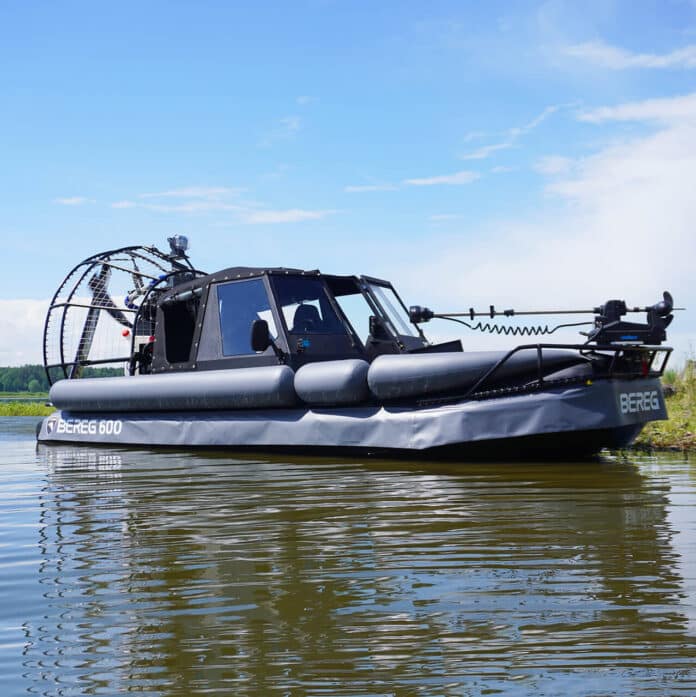

Most overlanders and expedition campers spend a lot of time thinking about what happens when the road ends. A lifted truck with mud tires is the answer for some. Others turn to tracked ATVs or amphibious rigs. But there’s a category of terrain, frozen lakes, snow-covered marshes, braided river systems, ice floes in transition, that stops almost everything with wheels or tracks, and that’s where the airboat conversation starts in earnest.
Airboats operate on the principle of air propulsion over the surface rather than traction through it, which means they work equally on open water, ice thick enough to stand on, and the unpredictable transitional terrain where neither a boat nor an ATV is safe. For anyone working in or traveling through that category of terrain regularly, the airboat isn’t an exotic luxury. It’s the practical tool that keeps operations moving when everything else is parked.
I’ve spent significant time evaluating expedition vehicles for extreme terrain, including a comparative look at Sherp ATVs, airboats, and Argo amphibious rigs in winter camp contexts, and the trade-offs between them are sharper than most buyers expect. Airboats specifically occupy a performance niche that no other vehicle type fills: high speed on ice and snow, functional on open water, and operable in the flooded, iced-over, and transitional terrain that defines northern wilderness access in winter and spring.
The Bereg 600 Turbo is the most capable turbocharged airboat I’ve seen specified for this use case, pairing a turbocharged 190 HP Honda engine with an 800 kg payload, an aluminum navigation cabin, and a PVC hull system engineered to survive the kind of surface contact that destroys lighter vessels. This review covers the full specification, the performance envelope, the practical use cases, and the honest trade-offs that come with a pre-order airboat at this capability level.
Quick Facts:
- Product: Bereg-600 TURBO Airboat (Pre-Order, 3-6 month lead time)
- Price: $92,645.85 CAD, contact Bereg Canada for deposit and delivery details
- Engine: Honda L15, turbocharged, 190 HP, liquid-cooled, electric start
- Top speed: 65 km/h (40 mph) on water; 100 km/h (62 mph) on snow and ice
- Payload: 800 kg (1,764 lb), up to 5 persons
- Hull: PVC 1100 g/m² with reinforced tubes; PE1000 4mm bottom armor
- Dimensions: 600 cm × 235 cm (19 ft 8 in × 7 ft 9 in); 780 kg (1,720 lb)
- Fuel: 2 × 75L tanks; premium gas; 0.8 L/km consumption
- Airtight compartments: 11
- Best for: Northern wilderness access, ice fishing expeditions, SAR operations, remote camp resupply, cross-terrain scouting
10 min read
In This Review
- What an All-Terrain Airboat Is and Why It Matters
- Engine and Performance: The 190 HP Turbo Advantage
- Hull Construction and Durability
- Payload, Capacity, and Range
- Aluminum Cabin, Navigation, and Operator Comfort
- Terrain Versatility: Water, Snow, Ice, and the Transitions Between
- Who the Bereg 600 Turbo Is Built For
- Full Specifications at a Glance
- Pros and Cons
- Final Verdict
- Frequently Asked Questions
What an All-Terrain Airboat Is and Why It Matters
Specifically, an airboat is a flat-bottomed vessel propelled by an aircraft-style propeller mounted above the hull, typically driven by a high-output automotive or aircraft engine. Because propulsion comes entirely from air thrust rather than a submerged propeller or wheel traction, an airboat has no mechanical contact with the surface it’s traveling across. Consequently, this single engineering fact gives airboats a capability profile that no other vehicle class shares: they operate on open water, frozen ice, snow-covered terrain, and the transitional “neither-nor” surfaces like slush, flooded ice, and braided shallow river systems where conventional boats ground out and wheeled or tracked vehicles break through.
In practice, the consequence is access. For northern wilderness hunters, trappers, ice fishermen, search-and-rescue operators, and expedition campers working in boreal and subarctic environments, the spring and fall transition periods are the most dangerous and the most inaccessible. Ice is forming or breaking up, water levels are unpredictable, and the terrain that was navigable two weeks earlier is no longer safe for ATVs, snowmobiles, or boats. An airboat transitions across these conditions without the same surface-contact risk, which translates directly into operational windows that no other vehicle extends. For a deeper comparison of how airboats stack up against tracked ATVs and amphibious rigs in expedition contexts, our Sherp vs. airboat vs. Argo winter camp comparison covers the practical trade-offs in detail.
Engine and Performance: The 190 HP Turbo Advantage
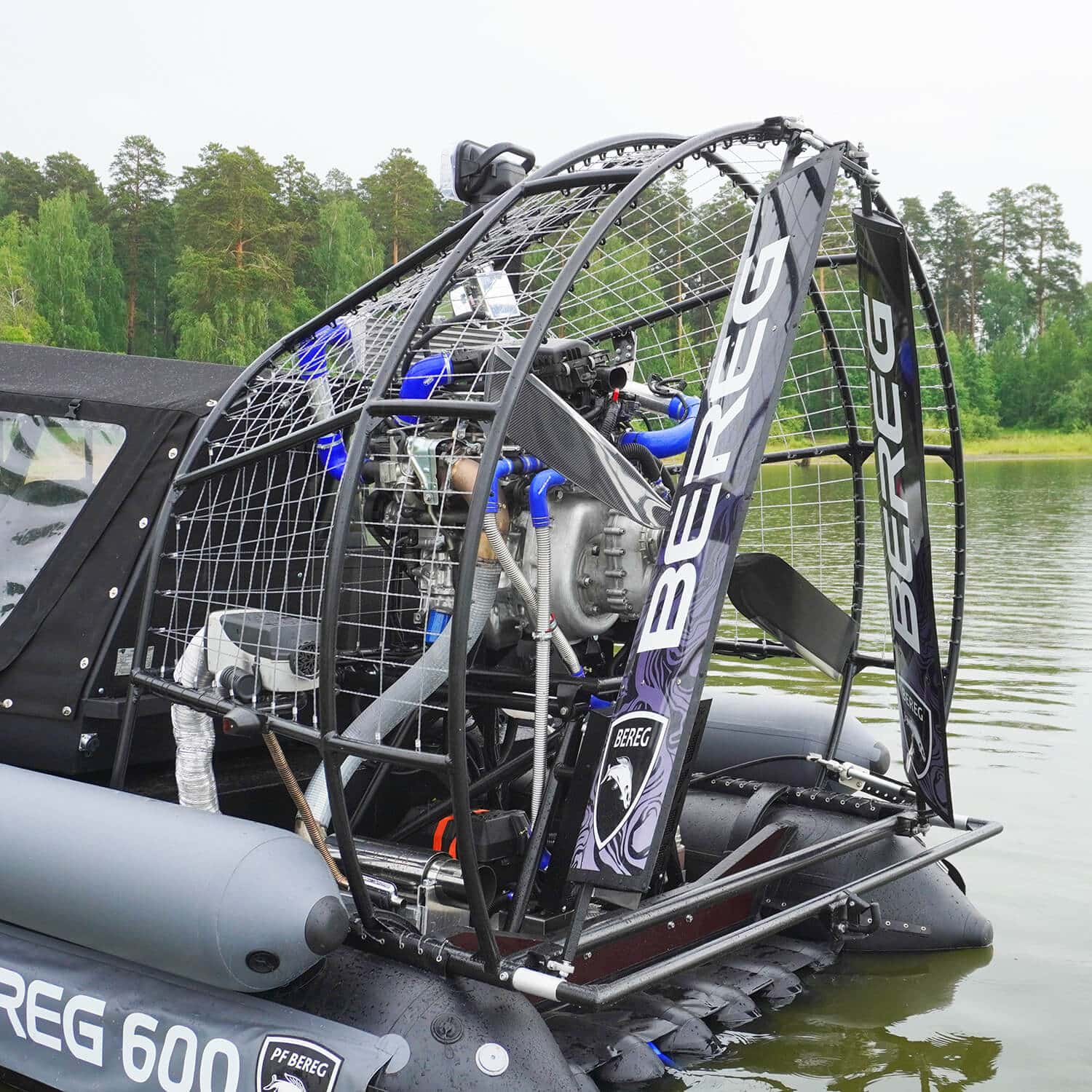
The Bereg 600 Turbo’s performance case starts with the engine. Airboat performance is determined almost entirely by the thrust-to-weight ratio: the output of the propulsion unit versus the loaded weight of the vessel. At 190 HP from a turbocharged Honda L15 four-stroke engine driving an adjustable-pitch four-blade propeller, the 600 Turbo produces the thrust output of a performance-class airboat in a hull weighing 780 kg unloaded. That combination delivers surface performance most airboats in this size class don’t reach: 65 km/h (40 mph) on water and 100 km/h (62 mph) on snow and ice under full operational load.
Turbocharged configuration is particularly important at altitude and in cold conditions. Naturally aspirated engines lose significant power in cold, dense air and at elevation; a turbocharger recovers that power loss by using exhaust gases to compress intake air, maintaining closer to sea-level power output across a wider range of operating conditions. For a vessel used in northern wilderness environments where air density varies significantly between summer water operations and winter ice work, the turbo configuration keeps performance consistent rather than degrading it when conditions are hardest. The Honda L15 platform is also a proven, widely-supported automotive engine rather than a bespoke powerplant, which matters for serviceability in locations far from specialized facilities.
Additionally, fuel consumption is rated at 0.8 L/km, which at full-load speed translates to a meaningful operational range from the standard 150L total tank capacity (2 × 75L tanks with a quick-switching system). At 100 km/h on snow, for example, the tank range covers 187 km between fills at rated consumption. The quick-tank-switching system allows running from one tank while keeping the other in reserve, a practical range management feature for remote operations where refueling is a significant logistical consideration.
Hull Construction and Durability
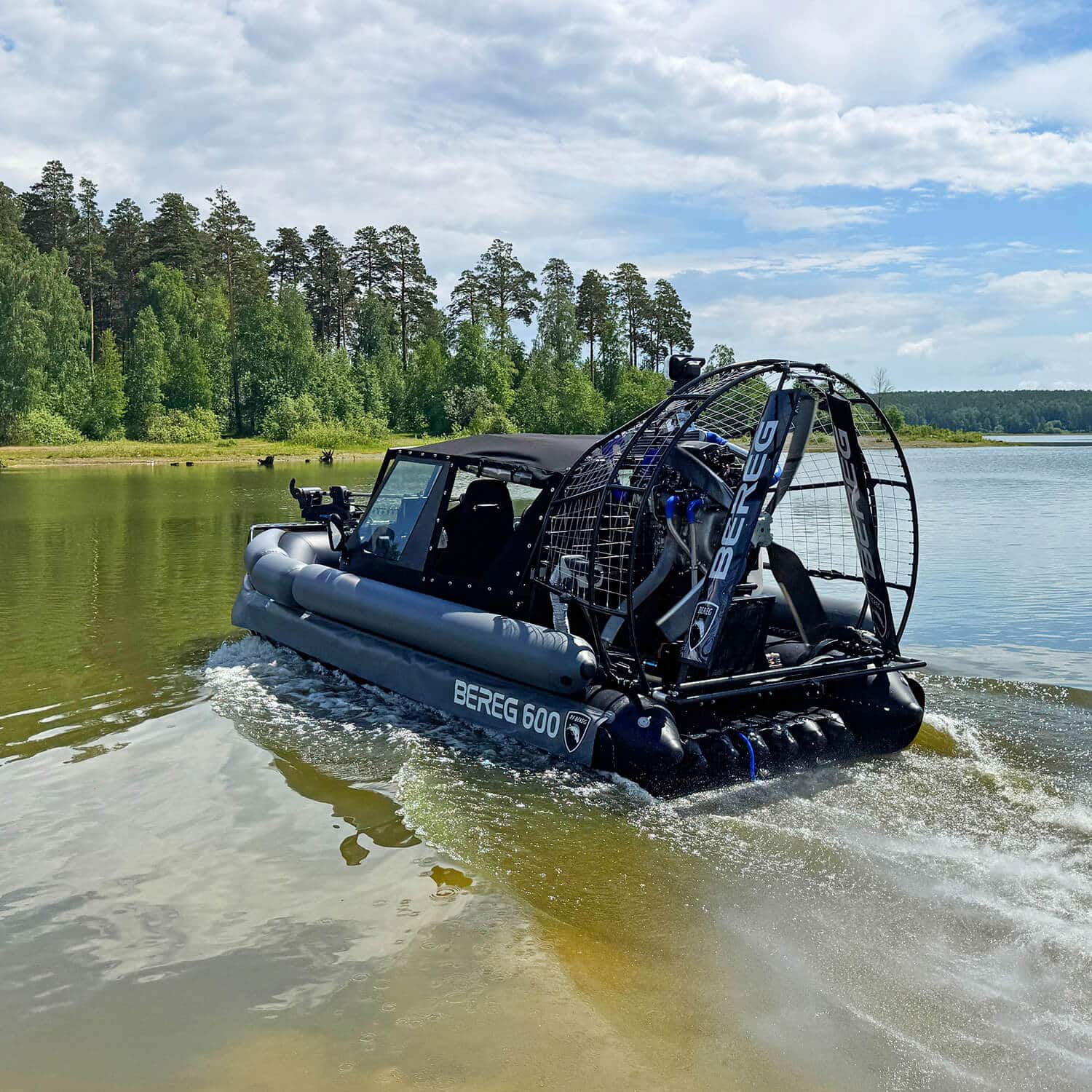
Ultimately, the hull is where an expedition airboat either earns its price or reveals its compromises. Surface-contact events on ice, debris, rocks in transitional water, and submerged obstacles are not edge cases in northern wilderness use; they are recurring operational conditions. A hull engineered for performance only, without adequate abrasion and impact resistance, becomes a liability in exactly the environments where the airboat is most valuable.
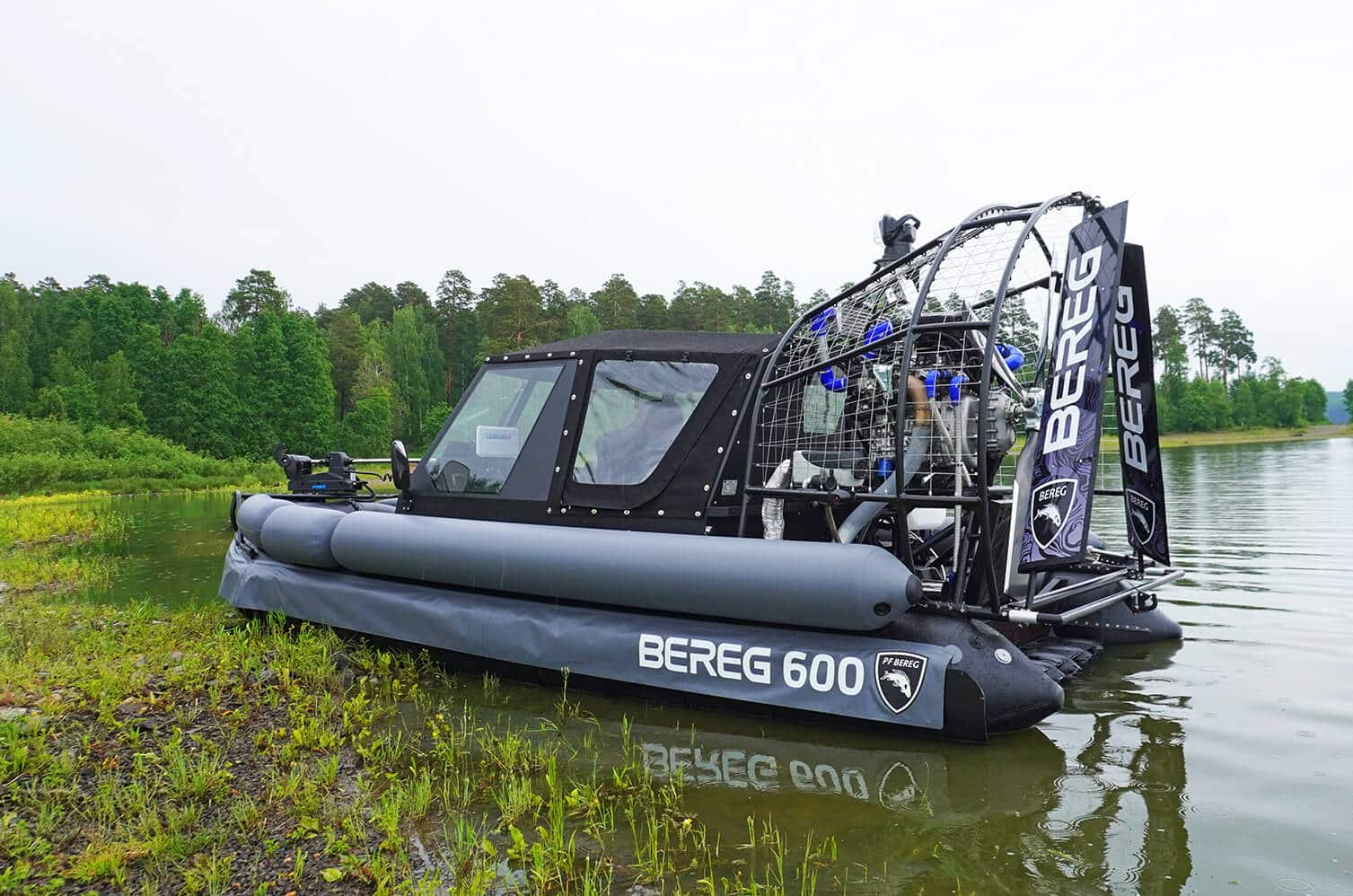
The Bereg 600 Turbo addresses this with two distinct protective systems. Primary hull construction uses PVC 1100 g/m² material with reinforced tubes, a specification in the professional-grade range for inflatable vessel construction. Specifically, PVC at this weight delivers puncture resistance and abrasion tolerance significantly beyond recreational-grade materials while maintaining the flexibility advantages of an inflatable hull versus a rigid fiberglass or aluminum alternative. The second layer of protection is a PE1000 plastic armor plate at 4mm thickness applied to the hull bottom, the highest-contact zone in any surface operation. PE1000, or ultra-high-molecular-weight polyethylene, is used in marine and industrial applications specifically for its combination of impact resistance, abrasion resistance, and low surface friction, the same material used in industrial cutting boards, marine fendering, and heavy equipment wear surfaces. At 4mm thickness across the hull bottom, it provides meaningful protection against the ice edges, submerged rocks, and debris contact events that typically cause hull damage in transitional terrain.
The hull’s 11 airtight compartments provide redundant buoyancy. Losing one or even several compartments to a significant impact does not compromise the vessel’s ability to float and continue operating, which is the critical safety factor in remote water and ice operations where self-rescue capability determines whether a surface failure is a serious incident or a mission-ending emergency. The main tube diameter of 0.5m and the bottom tube diameter of 0.2m provide the hull profile geometry that creates stable surface contact across ice, snow, and water simultaneously.
Pre-Order Now, 3-6 Month Lead Time
Bereg 600 Turbo: 190 HP All-Terrain Airboat
65 km/h on water, 100 km/h on snow and ice. 800 kg payload. PVC 1100 hull with PE1000 4mm bottom armor. Authorized Bereg Canada distributor. Contact for deposit and delivery timeline.
Payload, Capacity, and Range
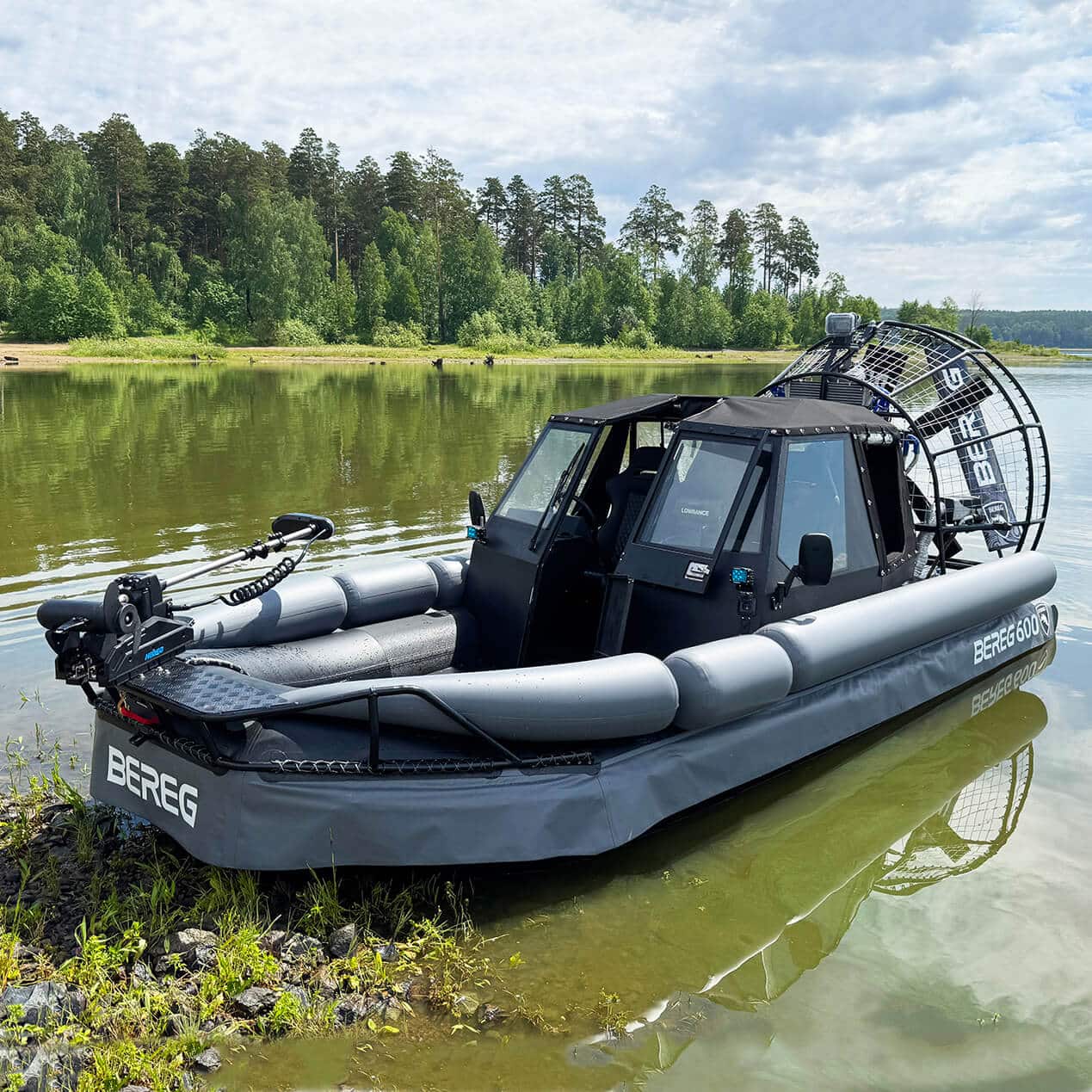
An 800 kg (1,764 lb) airboat payload capacity at the 600 Turbo’s performance specs is the number that defines its operational class. For context, many production airboats in the 15-19 foot length range carry 400 to 600 kg of payload while delivering similar or lower speed numbers. The 600 Turbo’s combination of 190 HP turbocharged output with an 800 kg payload means that carrying five adults with full gear, provisions, and equipment does not significantly degrade the performance that makes the vessel useful. A lower-power airboat with the same payload fully loaded becomes sluggish, loses its ability to plane on water, and loses the speed advantage on snow and ice that justifies the platform in the first place.
Five-person capacity with the rated payload creates specific use cases: a two-person crew with full expedition provisions and camp gear for a week-long wilderness operation, a four-person search-and-rescue response team with equipment, or a hunting party with all harvested material, fuel for return, and camp equipment combined. Airboat payload capacity math matters for these calculations because operations in remote terrain involve fuel, rescue gear, camp equipment, and harvested material in combinations that exceed the capacity of lower-rated vessels without the performance penalty.
Range at the rated 0.8 L/km fuel consumption depends on the surface and speed. On water at 65 km/h, the 150L combined tank capacity delivers approximately 187 km of range. At higher speeds on snow and ice, consumption increases, so realistic range at sustained high-speed snow travel will be lower. The 150L capacity with dual tanks and quick-switching provides a practical baseline for planning, and the manual pump included in standard equipment allows transfer from external fuel containers for extended operations.
Aluminum Cabin, Navigation, and Operator Comfort
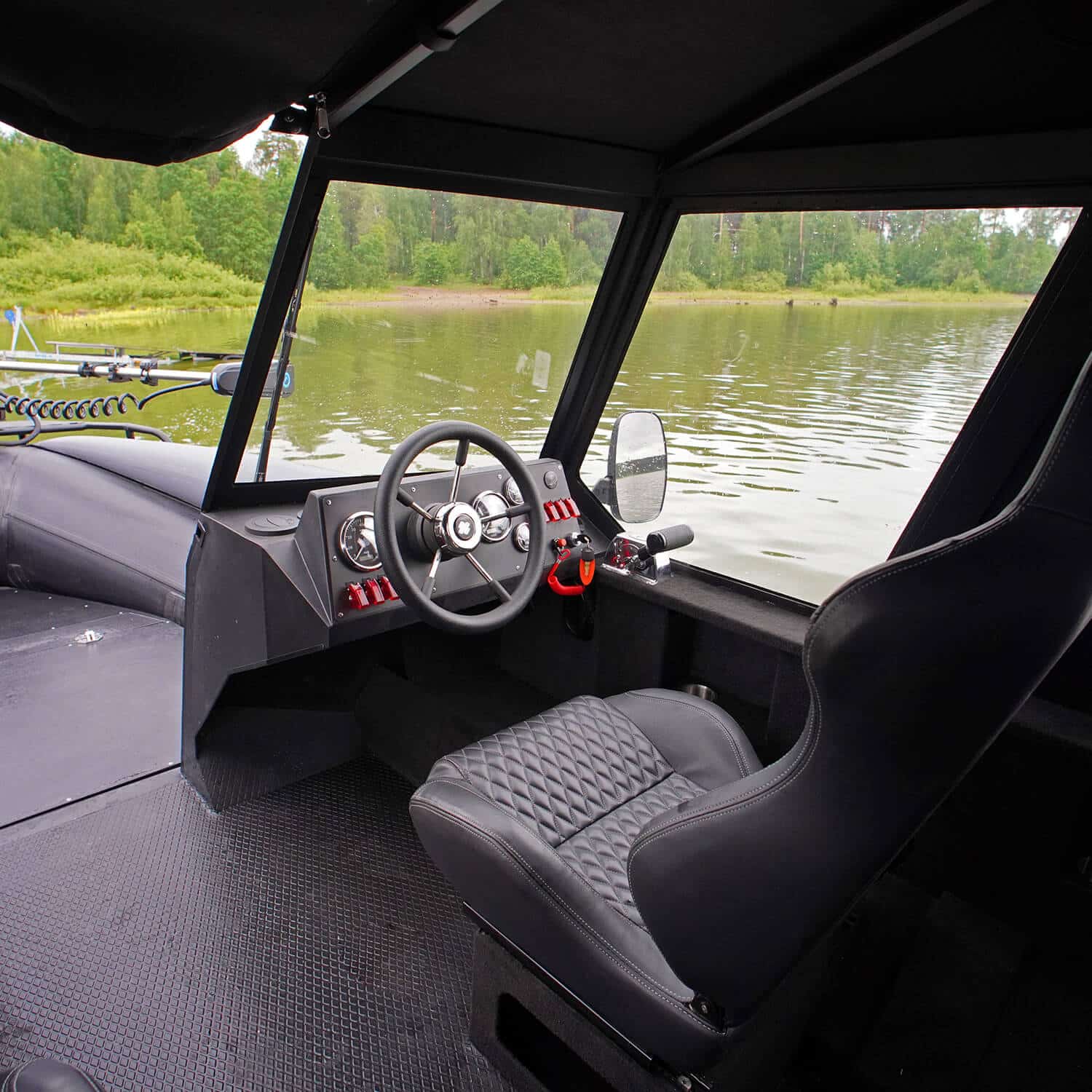
The Bereg 600 Turbo’s standard equipment goes well beyond the hull and engine. The aluminum cabin with navigation canopy, deck, and dual side boards creates a protected operator environment that fundamentally changes the usability of the vessel in cold, wet, and high-speed conditions. Operating an airboat at 100 km/h on a frozen lake in February without a proper windscreen and cabin structure is a cold-exposure problem. With the aluminum canopy and cabin, the operator position is sheltered from wind blast and precipitation, which extends operational hours in adverse conditions significantly.
The multifunction steering console includes a speedometer, tachometer, fuel gauge, engine temperature gauge, voltmeter, USB charger, and 12V power socket, a complete instrumentation package rather than the minimal gauging common in work-class airboat configurations. Four low-beam headlights and dual electric windshield wipers support low-light and precipitation operations. A 60 Ah battery supports the electrical load of cabin heating, lighting, and instrumentation without draining under extended operation. Cabin heating is standard equipment, not an option, a specification reflecting Bereg’s design intent for genuine cold-weather expedition use rather than fair-weather performance demonstration.
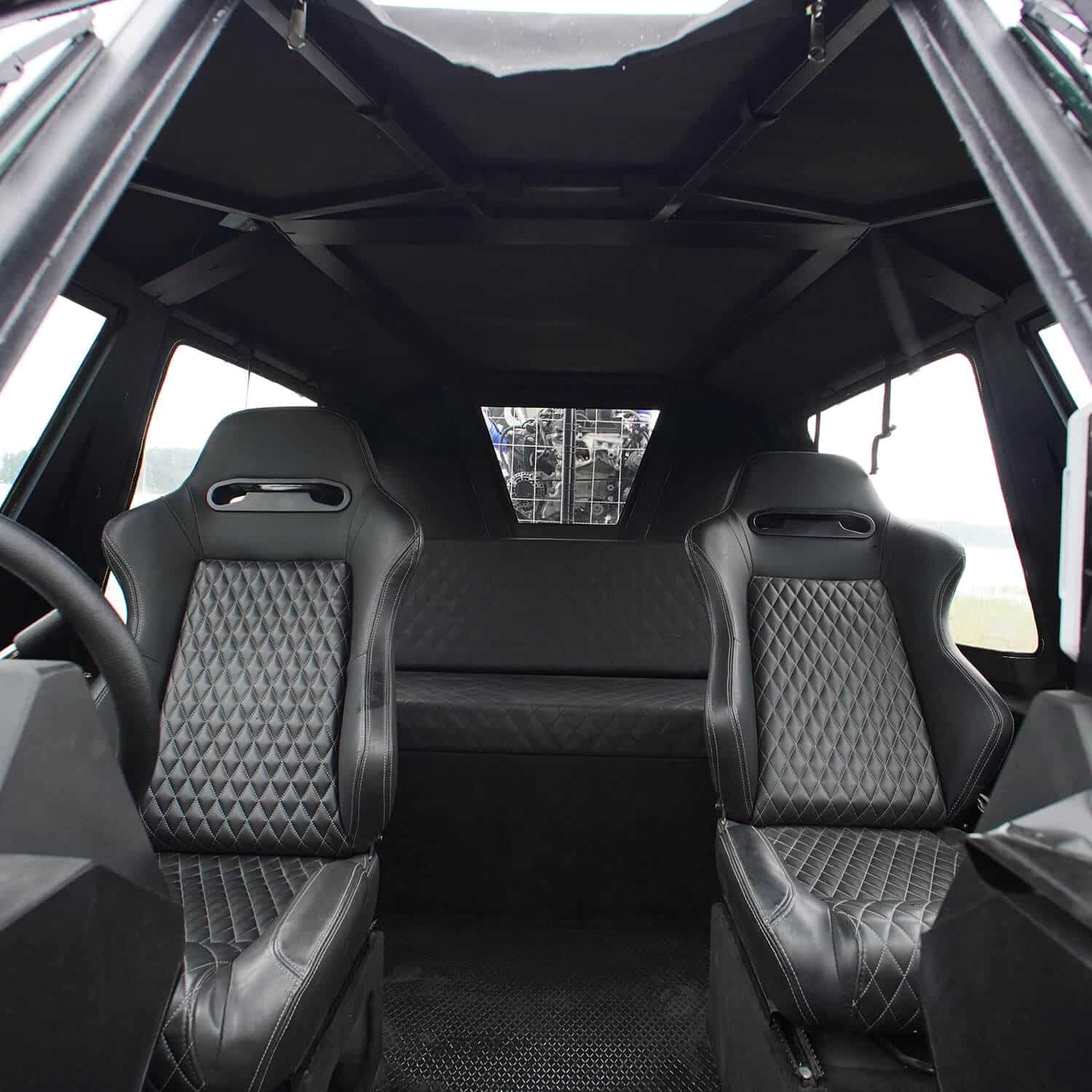
Seating includes a driver’s seat, a passenger seat beside the driver, and a rear passenger bench for additional occupants. The inclusion of a front bumper on a vessel that operates at 100 km/h on snow indicates design awareness of the contact events that occur in real operational use, not test-track performance. Colors available include winter camouflage, forest camouflage, digital camo, and graphite gray, covering the operational contexts from military and SAR applications to hunting and expedition use.
Terrain Versatility: Water, Snow, Ice, and the Transitions Between
The performance numbers for open water and snow/ice are straightforward. The more important capability for northern wilderness operations is the transitional terrain performance: slush ice, flooded tundra, braided river systems at low water, and the partially frozen conditions of early winter and late spring where no other vehicle category operates safely or effectively.
An airboat’s hull profile at low speed, combined with the absence of underwater appendages, allows navigation in water as shallow as the hull draft, which for a vessel of the 600 Turbo’s PVC hull design is measured in centimeters rather than feet. Braided river systems with shifting channels and gravel bars, which stop conventional aluminum boats and jet skis, are operational terrain for an airboat that doesn’t require depth to steer or propel itself. Similarly, ice in transition, partially open leads, pressure ridges, and refrozen areas of inconsistent thickness, is terrain where a wheeled or tracked vehicle faces catastrophic risk and a conventional boat cannot operate. Distributed contact footprint and buoyant hull allow navigation across these surfaces at appropriate speed and technique.
That 100 km/h snow-and-ice speed figure is not a drag-run number; it reflects the hull and propulsion combination’s ability to maintain speed under full load on packed snow and clear ice, the two most common winter surface conditions in northern boreal and subarctic environments. At that speed, the 600 Turbo covers winter wilderness distances that take multiple days by snowmobile or tracked ATV in hours, which changes the operational calculus for any mission that requires speed over range.
Authorized Bereg Canada Dealer
Bereg 600 Turbo: Purpose-Built for Extreme Terrain
190 HP turbocharged Honda L15, adjustable-pitch 4-blade propeller, 11-compartment PVC hull with PE1000 4mm bottom armor. Ships from Bear River, Nova Scotia. Contact Bereg Canada for pre-order deposit.
Who the Bereg 600 Turbo Is Built For
At $92,645.85 CAD with a 3-6 month pre-order lead time, the Bereg 600 Turbo is not a recreational toy or an impulse purchase. It’s a purpose-built expedition tool for operators who need genuine all-terrain capability across water, snow, and ice, and for whom downtime or inaccessibility in those conditions has real operational consequences.
Specifically, northern wilderness hunters and trappers who operate on lakes, rivers, and frozen terrain across the full seasonal cycle are the clearest fit. The vessel covers the open water of late summer and fall, the transitional freeze-up period when neither boats nor snowmobiles are safe, and the hardpack winter surface where speed matters for covering territory. Similarly, fishermen accessing remote ice fishing locations that require crossing variable-quality ice and open leads find in the 600 Turbo a vessel that removes the safety calculation from the transit entirely. Search-and-rescue and emergency response teams in northern regions use airboats specifically for the transitional terrain problem, where a response vehicle needs to reach a location regardless of whether the surface is currently water, ice, slush, or snow. Remote camp operators, survey teams, and northern conservation officers represent additional professional use cases where the 800 kg payload and multi-surface performance combine into a single-vessel solution for complex terrain logistics.
This vessel is not the right choice for campers who want occasional lake access or hunters who rarely leave the road system. Price, lead time, and operational complexity of a 190 HP airboat are appropriate for operators who use the capabilities regularly enough that the per-trip cost pencils out against the alternatives. For those operators, the 600 Turbo offers a capability package that no other production vessel in its class matches.
Full Specifications at a Glance
| Specification | Details |
|---|---|
| Engine | Honda L15, 4-stroke turbocharged, 190 HP, liquid-cooled, electric start |
| Propeller | Adjustable-pitch 4-blade |
| Max speed (water) | 65 km/h (40 mph) |
| Max speed (snow/ice) | 100 km/h (62 mph) |
| Payload capacity | 800 kg (1,764 lb) |
| Passenger capacity | Up to 5 persons |
| Hull weight | 780 kg (1,720 lb) |
| Length × Width | 600 cm × 235 cm (19 ft 8 in × 7 ft 9 in) |
| Hull material | PVC 1100 g/m² with reinforced tubes |
| Bottom armor | PE1000 plastic, 4 mm thickness |
| Main tube diameter | 0.5 m |
| Bottom tube diameter | 0.2 m |
| Airtight compartments | 11 (redundant buoyancy) |
| Fuel capacity | 2 × 75L (150L total) with quick-switching system |
| Fuel consumption | 0.8 L/km (rated) |
| Battery | 60 Ah |
| Cabin | Aluminum with navigation canopy, deck, side boards (×2) |
| Lighting | 4 × low-beam headlights; 2 × electric windshield wipers |
| Console | Speedometer, tachometer, fuel gauge, engine temp, voltmeter, USB, 12V socket |
| Cabin heater | Standard (not optional) |
| Colors | Winter Camo, Forest Camo, Digital Camo, Graphite Gray |
| Price | $92,645.85 CAD (pre-order; contact Bereg Canada for deposit) |
| Lead time | 3-6 months from order |
Pros and Cons
Pros
- 190 HP turbocharged Honda L15 maintains consistent power output in cold and high-altitude conditions where naturally aspirated engines lose meaningful thrust
- 100 km/h on snow and ice under rated load covers distances in hours that take tracked vehicles days, fundamentally changing the operational range of northern wilderness missions
- 800 kg payload with 5-person capacity allows full expedition loadout, crew, gear, fuel, and harvested material, without the performance penalty that degrades lower-rated airboats under load
- PE1000 4mm bottom armor provides industrial-grade impact and abrasion resistance against ice edges, submerged rocks, and debris contact, protecting the hull in exactly the conditions where the vessel is most valuable
- 11 airtight compartments ensure redundant buoyancy; losing multiple compartments to impact does not sink the vessel, which is the critical safety architecture for remote water and ice operations
- Aluminum cabin with navigation canopy, cabin heater, 4-headlight lighting system, and full instrumentation console make the 600 Turbo operable in low-light and cold conditions as a standard specification
- Adjustable-pitch 4-blade propeller allows optimization between acceleration, top speed, and fuel economy rather than fixing the operator to a single performance compromise
- Honda L15 automotive platform is widely supported for service, with parts availability significantly better than bespoke marine or aircraft powerplants
- Dual 75L tanks with quick-switching extend practical range and allow running from one tank while holding the other in reserve for remote operations
Cons
- $92,645.85 CAD is a significant investment, US buyers should verify the current exchange rate, as the USD equivalent will differ from the listed CAD price; the total cost is appropriate only for operators with regular high-need use cases
- 3-6 month pre-order lead time requires advance planning; this is not a vessel available for an upcoming season without a deposit placed well in advance
- At 780 kg (1,720 lb) unloaded, the 600 Turbo requires a purpose-built trailer and a capable tow vehicle, a loaded 3/4-ton truck minimum for safe highway transport
- Airboat operation requires skill and practice, particularly at high speed on ice and in transitional terrain; new operators should expect a learning curve before reaching the vessel’s full performance envelope safely
- Airboats are loud by design; the propeller-driven propulsion system produces significant noise that affects communication and wildlife disturbance radius in hunting contexts
- No reverse thrust capability in standard airboat operation, maneuvering in tight spaces and docking require skill and planning, unlike a conventional boat with a reversible drive
- Fuel consumption at high speed and heavy load on ice will exceed the rated 0.8 L/km; buyers planning extended high-speed operations should plan fuel logistics conservatively
Final Verdict
The Bereg 600 Turbo sits in a specific and underserved market position: a production all-terrain airboat with genuine expedition specifications, a cabin system built for cold-weather operational use, and an engine platform with the output to maintain performance under full load across all the surface types it’s rated for. The 190 HP turbo, the 800 kg payload, the PE1000 armored hull bottom, and the aluminum cabin with heater and full instrumentation are not marketing upgrades. They are the specifications that define the gap between a capable working vessel and one that underperforms when conditions are worst.
For the operators this vessel is built for, the investment calculus is therefore straightforward. Northern wilderness hunters, ice fishing guides, SAR teams, and remote camp operators who currently navigate seasonal terrain limitations with multiple vehicles and uncertain transition windows get a single-vessel solution that eliminates those limitations across the operational year. The pre-order timeline and CAD pricing require advance planning and exchange-rate awareness, but neither changes the fundamental capability case. At this specification level, the Bereg 600 Turbo stands as the turbocharged airboat to consider for serious all-terrain expedition use in North America. Specifically, it is the expedition airboat that addresses the airboat for snow and ice performance gap that most production vessels leave unresolved.
Ready to Pre-Order?
Bereg 600 Turbo, Contact Bereg Canada
Pre-orders require a deposit. Lead time is 3-6 months. Contact Bereg Canada at info@beregcanada.com or 1-902-247-2840 for deposit details and current delivery timeline.
Frequently Asked Questions
What is the Bereg 600 Turbo’s top speed?
The Bereg 600 Turbo reaches 65 km/h (40 mph) on water and 100 km/h (62 mph) as an airboat for snow and ice. Speed varies between surfaces because the lower resistance of packed snow and ice compared to water, where the hull must overcome surface tension and water drag to plane. Both figures are rated under operational load, not empty-hull test conditions.
How much can the Bereg 600 Turbo carry?
The rated payload is 800 kg (1,764 lb) with a maximum capacity of 5 persons. This figure covers the combined weight of occupants, gear, fuel, and equipment. At a practical planning weight of 90 kg per person, five adults account for 450 kg of the payload, leaving 350 kg for equipment, provisions, and fuel beyond the standard tank load. For hunters, that margin covers harvested material, camp gear, and emergency supplies without exceeding the rated capacity.
What engine powers the Bereg 600 Turbo?
The 600 Turbo uses a Honda L15 four-stroke turbocharged engine producing 190 HP with liquid cooling and electric start. As an automotive platform, the Honda L15 has broad parts availability and service network support, which matters for buyers operating in remote locations. Its turbocharged configuration maintains consistent power output in cold and high-altitude conditions where naturally aspirated engines lose thrust.
Is the Bereg 600 Turbo available to buy now?
The 600 Turbo is currently available as a pre-order through Bereg Canada, the authorized North American distributor based in Bear River, Nova Scotia. Lead time is 3-6 months from order. Pre-orders require a deposit; contact Bereg Canada at info@beregcanada.com or 1-902-247-2840 to discuss deposit arrangements and current delivery timelines.
How does an airboat compare to a Sherp or Argo for winter terrain?
Airboats, tracked ATVs like the Sherp, and amphibious rigs like the Argo serve overlapping but distinct terrain profiles. Airboats excel at high-speed transit on open water, ice, and snow, and are uniquely capable in transitional terrain, partially frozen water, slush ice, and shallow braided rivers, where neither wheeled/tracked vehicles nor conventional boats operate safely. Tracked ATVs like the Sherp handle soft ground and off-road terrain better but are slower on ice and cannot operate on open water safely. The Argo bridges water and land well but at lower speed and payload than a purpose-built airboat at this specification level. Our Sherp vs. airboat vs. Argo comparison covers these trade-offs in full detail.
Heads up: Clicking on our affiliate links and exploring our sponsored content helps us at no extra cost to you, and we only recommend gear we’re absolutely crazy about!