


I’ve camped for the bulk of my life and really got into overlanding during the pandemic. Over those years, the question I heard most from families shopping for trailers stays the same: where do the kids sleep? A two-person cabin works great for a couple. However, it stops working the moment a third or fourth person joins the trip.
The Iron Peak XTR-10 is one of the few off-road trailers with a factory answer to this problem. Specifically, Iron Peak sells hard-shell rooftop tents installed on the trailer’s aluminum roof rack. This guide walks through what an Iron Peak XTR-10 rooftop tent adds, what it costs, and where the trade-offs show up on the trail. As a result, you will know whether the four-person setup fits your crew before you place an order.
Quick Facts:
- Topic: Adding an Iron Peak XTR-10 rooftop tent to sleep four
- Base trailer MSRP: $64,220 per the Iron Peak brochure
- Cabin bed: 60 x 80-inch queen tri-fold memory mattress
- Roof mount: Aluminum roof rack with T-track crossbars
- Factory tent options: 23Zero Armadillo Horizon 2 and Horizon 3, FSR Aspen Lite Standard
- Installed tent cost: $2,875 to $4,485
- Added weight: About 100 to 205 pounds, depending on the tent
- Best for: Families of three to five who want one tow-behind camp
8 min read
In This Guide
- Can the XTR-10 Sleep Four?
- Key Specs at a Glance
- Iron Peak XTR-10 Rooftop Tent Options
- Weight, Height and Towing Changes
- Sleeping Four With an Iron Peak XTR-10 Rooftop Tent
- What the XTR-10 Roof Rack Gives Up
- Trailer Rooftop Tent vs. a Ground Tent
- Pros and Cons
- Final Verdict
- Frequently Asked Questions
Can the XTR-10 Sleep Four?

Yes, an Iron Peak XTR-10 rooftop tent turns the trailer into a four-person camp. The insulated cabin holds two adults on a 60 x 80-inch queen mattress. Meanwhile, a two-person tent on the roof rack sleeps two more. Pick the three-person Horizon 3, and the total rises to five.
This setup fits a specific buyer. For example, a couple with two kids gets one trailer instead of a trailer plus a ground tent. Groups of friends sharing one rig benefit too. In contrast, couples who never camp with more than two people gain little from the extra weight and cost.
The nearest alternative is a ground tent pitched beside the trailer. It costs less, although it adds setup time and takes up campsite space. For background on the base trailer, read our full XTR-10 review before pricing a tent.
Key Specs at a Glance
| Specification | Details |
|---|---|
| Dry weight | 2,110 lbs |
| Tongue weight | 260 lbs |
| Overall height | 85 inches |
| Overall width | 90 inches |
| Overall length (with hitch and spare) | 206 inches |
| Ground clearance | 22 inches |
| Cabin sleeping | 60 x 80-inch queen, 48-inch headroom |
| Roof | Aluminum rack with T-track crossbars, 250-watt solar panel, 12V AC unit |
| Suspension and hitch | Cruisemaster CRS2 independent, DO35 articulating coupler |
Buy Direct From Iron Peak
Build an XTR-10 With a Factory Rooftop Tent
Iron Peak installs the tent on the roof rack before delivery, so your trailer arrives ready to sleep the whole crew.
Iron Peak XTR-10 Rooftop Tent Options
Iron Peak lists three hard-shell tents in its XTR-10 brochure, each priced with installation. Hard shells make sense on a trailer because they close fast and shed wind. Also, they stay packed flat while you tow down washboard roads.
23Zero Armadillo Horizon 3 ($4,485 installed)
The Horizon 3 is the tent for families of five, since 23Zero rates it for three adults. It carries a 3-inch self-inflating mattress with dual fill ports. Ask Iron Peak for final numbers before you commit, because weight drives every towing decision below.
23Zero Armadillo Horizon 2 ($4,185 installed)
The Horizon 2 sleeps two adults on a 2.5-inch self-inflating mattress. It weighs 205 pounds and stands 13.25 inches tall when closed, including rails and ladder. Open, it measures 96 inches wide and 61 inches long, with 49 inches of height. For a classic family of four, the Horizon 2 matches the brief exactly.
FSR Aspen Lite Standard ($2,875 installed)
The Aspen Lite is the budget and weight-saving pick. FSR lists it at 100 pounds with a closed height of 7.375 inches. Inside, it offers 45.5 x 76 inches of floor, rated for one to two people. As a result, it works best for two kids or one adult, rather than two full-size adults.
Weight, Height and Towing Changes
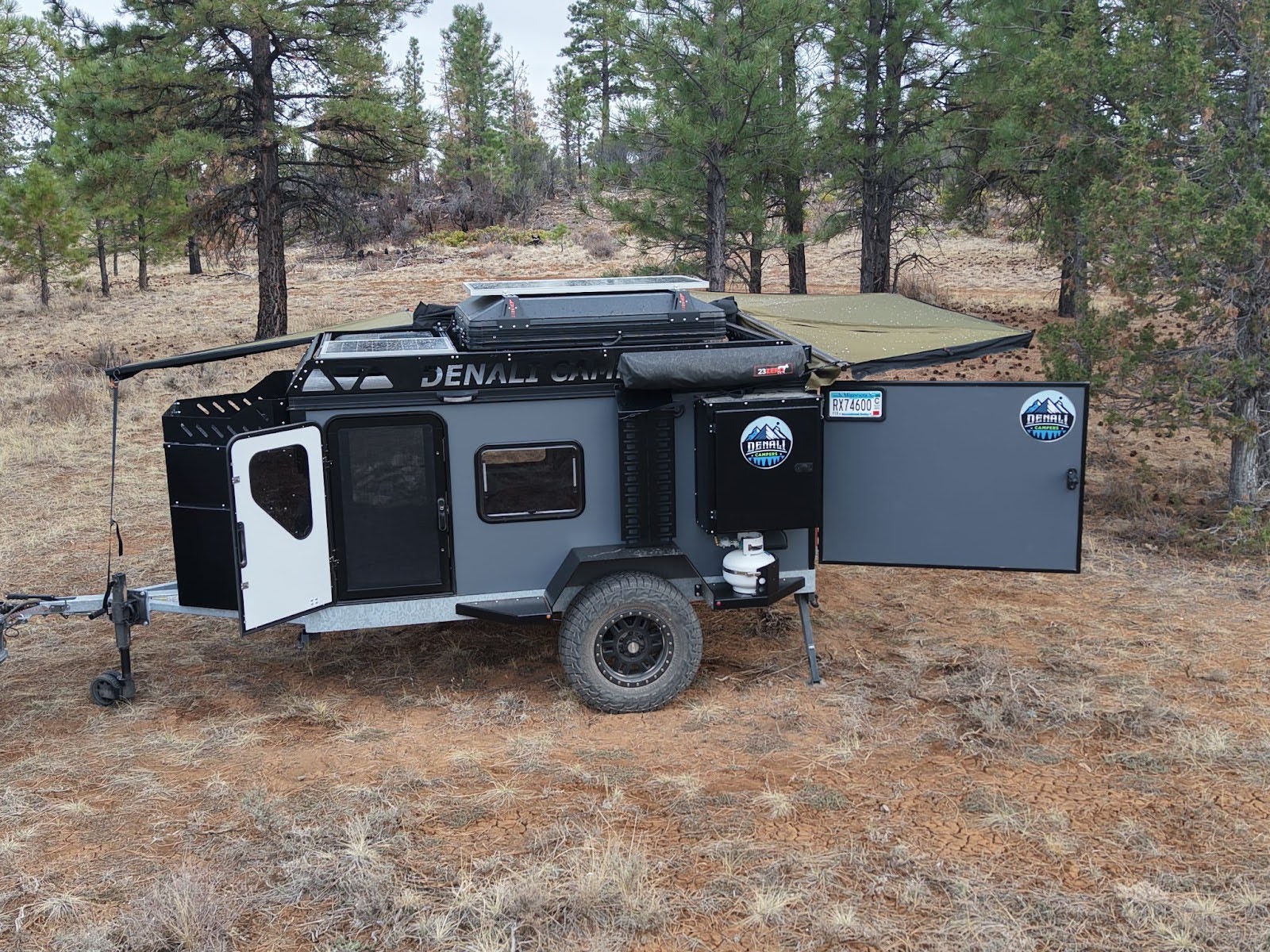
A trailer rooftop tent adds weight up high, and your tow setup feels it. The XTR-10 weighs 2,110 pounds dry. Therefore, adding a tent puts the trailer at roughly 2,210 to 2,315 pounds before water, food, gear or propane.
Fill the 38-gallon water tank, and you add about 317 pounds more, since water weighs roughly 8.34 pounds per gallon. Consequently, a loaded family trip pushes past 2,700 pounds quickly. Check your tow vehicle’s rated capacity, payload and tongue-weight limit against a scale ticket, not the brochure number.
Center of Gravity on Off-Camber Trails
Weight on the roof raises the trailer’s center of gravity. The Cruisemaster CRS2 independent suspension and 22 inches of clearance help on rough ground. However, off-camber shelf roads deserve extra care with 100 to 205 pounds sitting above the 85-inch roofline. Load heavy gear low and near the axle to offset it.
Garage and Storage Clearance
Height changes daily life at home. The XTR-10 stands 85 inches tall stock. With an Aspen Lite, it reaches about 92.4 inches, and a Horizon 2 brings it close to 98.3 inches. For example, a standard 8-foot garage door opening measures 96 inches, so the Horizon 2 setup likely needs outdoor or RV storage.
From experience: After 15-plus years of overlanding across Wyoming, Utah, the Sierra Nevada and the Southwest, I weigh every trailer loaded, never dry. My tow rig is a 2020 Jeep Gladiator Rubicon, and I plan around the scale number. Add the tent, water and gear on paper before you buy, and you avoid surprises at the first steep grade.
Sleeping Four With an Iron Peak XTR-10 Rooftop Tent
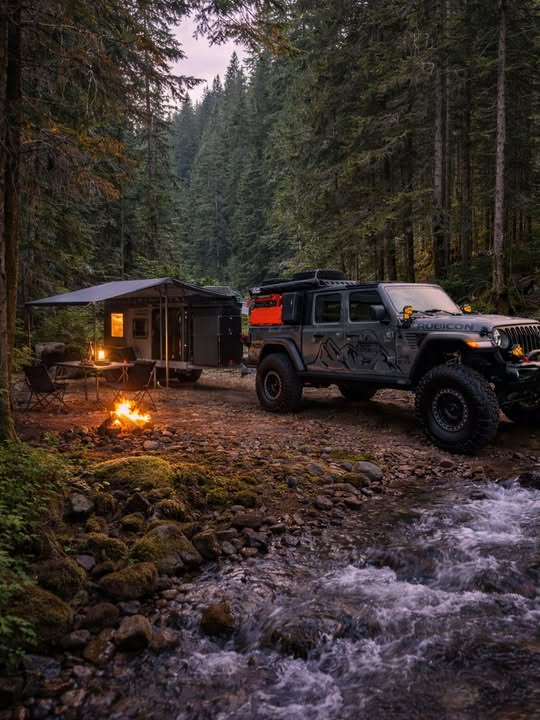
The best four-person layout puts adults in the cabin and kids on the roof. The cabin gets Truma propane heat, a 12V roof AC unit and 48 inches of headroom. In contrast, the rooftop tent relies on its own insulation. Parents keep the climate-controlled bed, while kids get the adventure of the ladder.
Setup Adds One Step
A hard-shell tent adds about a minute to camp setup; FSR says the Aspen Lite deploys in under one. First, level the trailer with the Ark rear stabilizing jacks. Next, pop the tent, then open the galley and awning. Our step-by-step XTR-10 camp setup guide covers the rest of the routine.
Kitchen, Water and Power for Four
Four people drain supplies about twice as fast as two. The 38-gallon tank, for instance, covers dishes, drinking and quick showers for a long weekend with careful use. Similarly, the 113-liter dual-zone fridge holds three to four days of food for a family. Meanwhile, the 300 Ah lithium battery handles lights and phone charging for the tent crew through the cabin’s USB outlets.
Safety note: Kids climbing a rooftop tent ladder at night face a fall of more than 7 feet. Set the ladder on firm, level ground, keep a light at the base, and supervise young children on every climb.
What the XTR-10 Roof Rack Gives Up

The XTR-10 roof rack does double duty today, and a tent takes over most of it. Stock, the T-track crossbars carry bikes, boards, recovery gear or a cargo box. Once a tent mounts there, most of this space disappears. Therefore, plan where kayaks or bikes ride before you order.
The roof also holds a 250-watt solar panel and the 12V AC unit. Consequently, ask Iron Peak how the tent sits relative to the panel, because shade cuts solar output. Iron Peak installs these tents at the factory, so it knows the layout. Still, confirm it on your build sheet.
Cold-Weather Trade-Offs
The cabin earns its four-season rating with insulated composite panels and Truma heat. Unlike the cabin, a rooftop tent has no ducted heat from the trailer. As a result, kids in the tent need warmer sleeping bags on cold nights. Read our guide to four-season camping with the XTR-10 for cabin-side winter tips.
Room for the Whole Crew
Price an XTR-10 for Four or Five Campers
Compare the Horizon 2, Horizon 3 and Aspen Lite on your build sheet before you order.
Trailer Rooftop Tent vs. a Ground Tent
A ground tent is the main alternative, and it wins on cost. A quality four-season ground tent runs well under the $2,875 Aspen Lite install price. Also, it adds no roof weight and leaves the rack free for bikes or boats.
However, the rooftop tent wins on speed and site flexibility. It sets up in about a minute, stays off wet or rocky ground, and needs no flat tent pad. Because many dispersed sites in the West offer one level spot, a roof tent keeps the whole family on one footprint.
Choose the rooftop tent if you move camp often or camp on rough ground. In contrast, choose a ground tent if you base-camp for days, store the trailer in a garage, or watch the budget closely.
Pros and Cons
Pros
- Sleeps four with a Horizon 2, or five with a Horizon 3
- Factory install from Iron Peak, priced on the build sheet
- Hard-shell tents deploy in about one minute
- Keeps sleepers off wet, rocky or sloped ground
- Aspen Lite option adds only 100 pounds
- One trailer footprint at tight dispersed sites
Cons
- Adds $2,875 to $4,485 to a $64,220 trailer
- Horizon 2 adds 205 pounds above the roofline
- Raises height to about 92 to 98 inches
- Takes over most of the T-track roof rack
- Tent gets no Truma heat or AC from the cabin
Final Verdict

The Iron Peak XTR-10 rooftop tent option makes sense for families of four who want one trailer, one camp and fast setup. Its biggest strength is the factory install. Iron Peak mounts a proven hard-shell tent before delivery, so you skip rack-fitment guesswork.
The trade-offs are weight, height and rack space. A Horizon 2 adds 205 pounds up top and pushes the trailer near 98 inches tall. Therefore, buyers with garage storage, light tow vehicles or roof-mounted bikes should look elsewhere or pick the 100-pound Aspen Lite.
On value, the Horizon 2 at $4,185 installed costs about 6.5% of the trailer’s MSRP. For a family, this buys a second bedroom with no ground tent to pitch or dry out. Meanwhile, the Aspen Lite at $2,875 suits families with two younger kids.
My recommendation: families of four should spec the Horizon 2, and families of five should wait for confirmed Horizon 3 weights. If you rarely camp with more than two, skip the tent and keep a ground tent in the front storage box instead.
Ready to Build?
Spec Your Four-Person Iron Peak XTR-10
Start your build with Iron Peak and add a factory-installed rooftop tent in one order.
Frequently Asked Questions
How many people does the Iron Peak XTR-10 sleep?
Stock, the XTR-10 sleeps two adults on its 60 x 80-inch queen mattress. With a factory Horizon 2 rooftop tent, it sleeps four. Similarly, the three-person Horizon 3 raises capacity to five.
Which rooftop tents does Iron Peak offer for the XTR-10?
Iron Peak’s brochure lists three hard-shell options with installation. These include the 23Zero Armadillo Horizon 3 at $4,485, the Horizon 2 at $4,185, and the FSR Aspen Lite Standard at $2,875.
How much weight does a rooftop tent add to the XTR-10?
The FSR Aspen Lite adds about 100 pounds, and the 23Zero Horizon 2 adds 205 pounds. Horizon 3 weight was still listed as TBD at the time of writing. Always add water, gear and passengers’ kit to find your true towed weight.
Will an XTR-10 with a rooftop tent fit in a garage?
Probably not in a standard garage. The trailer stands 85 inches tall stock, and a tent adds 7.4 to 13.25 inches. Consequently, a Horizon 2 setup lands near 98 inches, above a typical 96-inch door opening.
Does the rooftop tent get heat or AC from the trailer?
No, the Truma heater and 12V AC unit serve the insulated cabin only. Therefore, rooftop tent sleepers need sleeping bags rated for the night’s low temperature.