


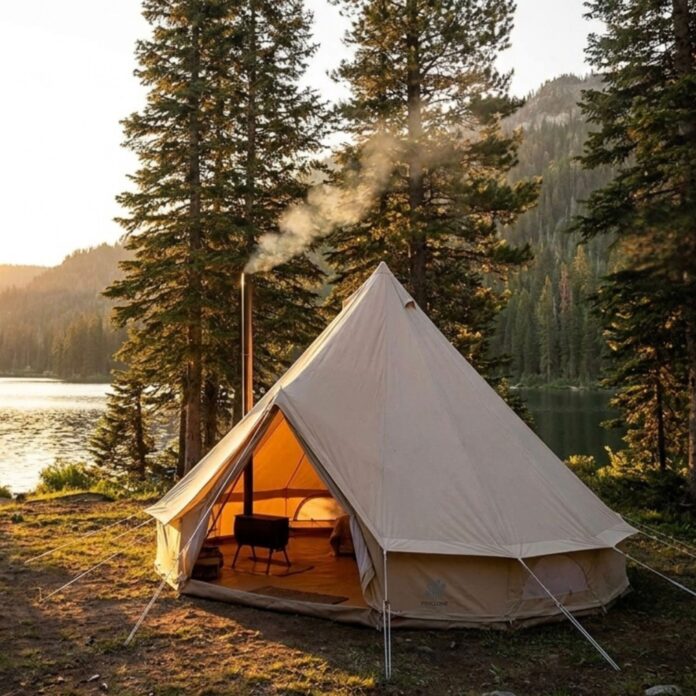

Quick Facts:
- Brand: Psyclone Tents (Australian company, US base in Oceanside, California)
- Guide covers: Psyclone Tents bell tent sizes (13, 16, 19 ft)
- Tent type: Canvas, single center pole design
- Canvas: 340 gsm / 10 oz poly-cotton blend
- Floor: 520 gsm heavy-duty PVC
- Capacity: 2 to 4 double beds
- Price range: $749 to $1,190
- Warranty: 12-month workmanship guarantee
- Best for: Campers and overlanders who want a durable all-season basecamp
8 min read
In This Guide
- Psyclone Tents Bell Tent Overview
- Psyclone Tents Bell Tent Specs at a Glance
- Canvas and Construction Across the Range
- Floor Styles, Windows, and Stove Jacks
- 13 ft Bell Tent: Couples and Weekend Camps
- 16 ft Bell Tent: The Family Workhorse
- 19 ft Bell Tent: Group and Basecamp Camping
- 13 ft vs. 16 ft vs. 19 ft: Which Size Fits Your Trips?
- Psyclone Tents Bell Tent Pros and Cons
- Final Verdict
- Frequently Asked Questions
Psyclone Tents Bell Tent Overview: Built for Campers
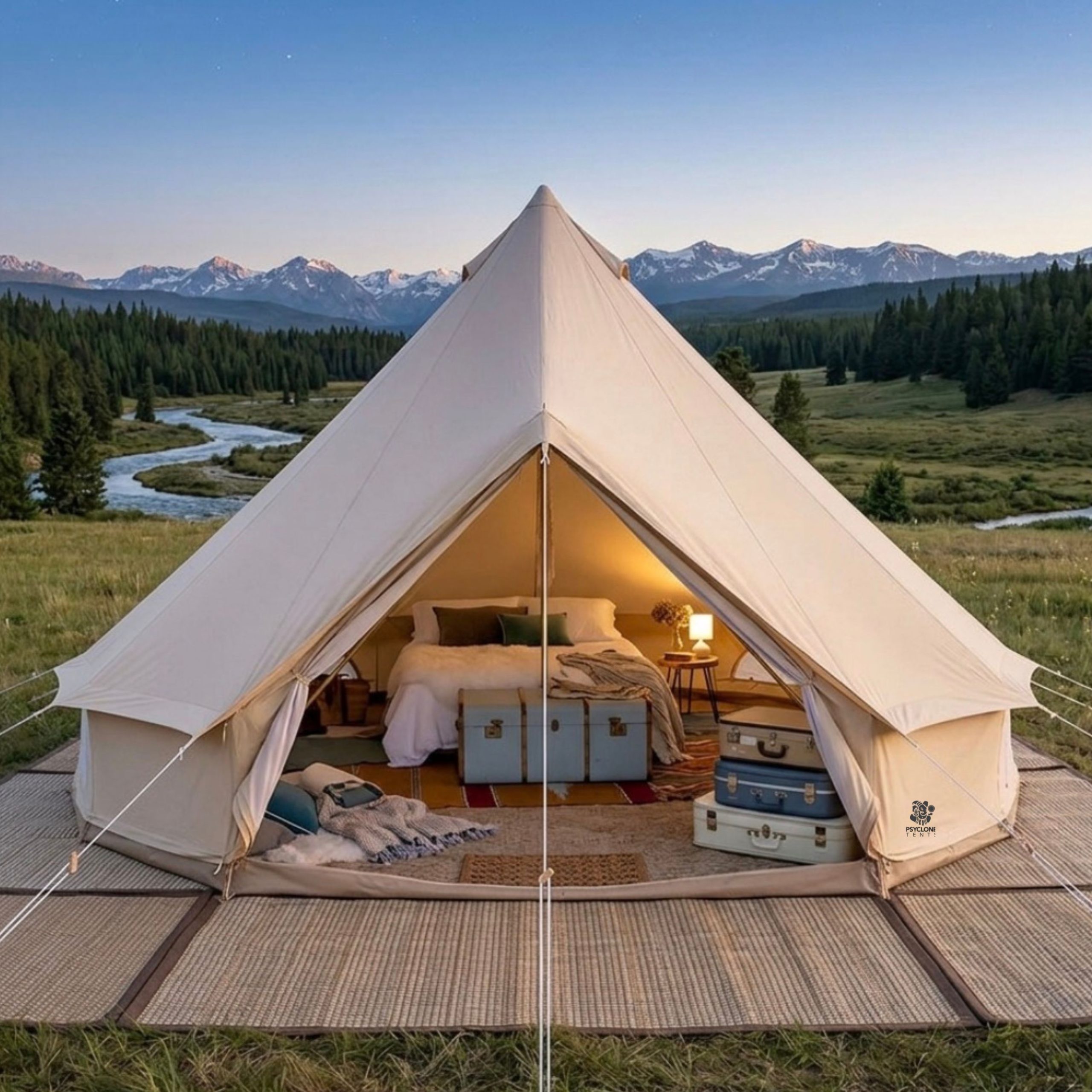
Most campers reach for a nylon dome because it packs small. A Psyclone Tents bell tent answers a different need. Instead of a quick overnight shelter, it gives campers a canvas basecamp built around one tall center pole and a wide floor. Canvas also breathes, so it holds heat in winter and stays cooler under summer sun.
Psyclone Tents is an Australian company, and it now runs its US operation from Oceanside, California. This guide compares the brand’s three larger bell tent sizes: the 13 ft, the 16 ft, and the 19 ft. Although each size targets a different group, all three share the same heavy canvas and the same all-weather build. Many owners also pitch the larger sizes as a glamping tent. For setup basics, our bell tent buying guide explains how the single-pole design works.
Price tracks size and style. The 13 ft line starts at $749, while the 19 ft sells at $1,190. Although those figures sit above big-box tents, they land below many canvas competitors. Psyclone also backs every tent with a 12-month workmanship guarantee and free mainland US shipping.
Picture a four-day trip with two adults, two kids, and a dog. A nylon dome leaves gear stacked against the walls. By contrast, a 16 ft bell tent fits three double beds, a table, and storage with room to spare. The extra space changes how a trip feels, especially when rain keeps the group inside.
Psyclone Tents Bell Tent Specs at a Glance
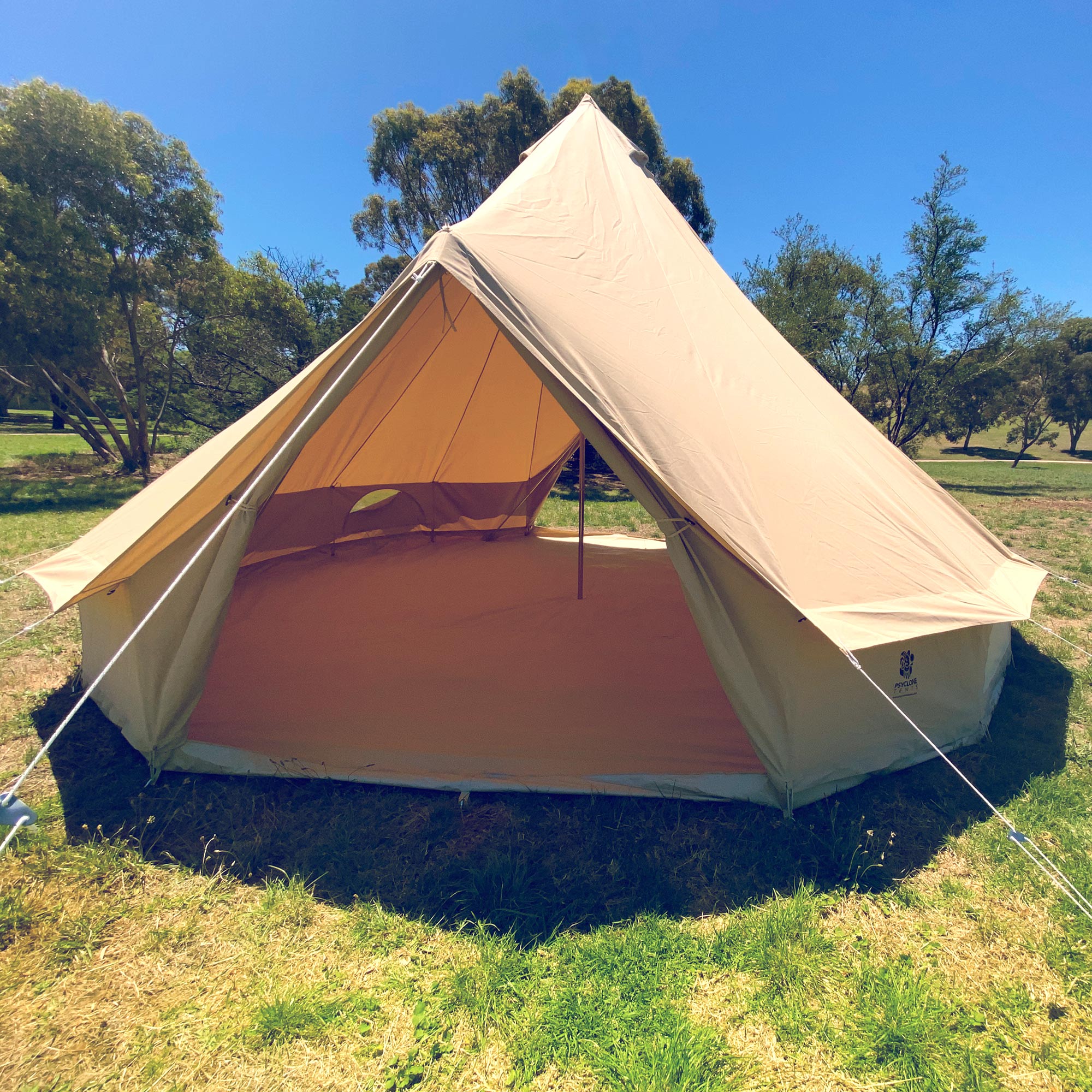
The table below lines up the three sizes Psyclone sells for group camping. Use it to match diameter, capacity, and weight to your trips. Because every Psyclone Tents bell tent shares the same 340 gsm canvas and 520 gsm PVC floor, the real differences come down to footprint, height, and weight.
| Specification | 13 ft (4M) | 16 ft (5M) | 19 ft (6M) |
|---|---|---|---|
| Canvas diameter | 13 ft / 4 m | 16 ft / 5 m | 19 ft / 6 m |
| Sleeping capacity | 2 double beds | 3 double beds | 4 double beds |
| Center pole height | 8.2 ft / 2.5 m | 9.8 ft / 3 m | 11.5 ft / 3.5 m |
| Doors | 1 (front) | 1 (front) | 2 (front and back) |
| Packed weight | About 63 lbs | About 80 lbs | About 124 lbs |
| Floor styles | 4 options | 4 options | Removable only |
| Pegs included | 26 | 28 | 32 |
| Price range | $749 to $830 | $880 to $955 | $1,190 |
Canvas and Construction Across the Range
Every size shares one canvas spec. Psyclone uses a 340 gsm poly-cotton blend, treated for fire retardance and mould resistance. For reference, owner reviews note many budget canvas tents use 285 gsm fabric or lighter. The heavier weave sheds water faster and sags less when wet. Because canvas also breathes, condensation drops compared with a sealed nylon shell.
The floor is a 520 gsm PVC groundsheet, thick enough to take stakes and foot traffic without puncturing. Doors and windows run on official YKK zips. Ropes also use metal tensioners instead of plastic sliders, so they hold tension through wind. Each tent then ships with galvanized pegs, a canvas carry bag, and a top loop for drying.
If you are weighing canvas against other tent shapes, our bell tent vs wall tent comparison breaks down the trade-offs. In short, a bell tent trades pack size for living space and lifespan. Treated canvas of this weight makes a dependable all-season bell tent, while a typical nylon tent fades far sooner.
Floor Styles, Windows, and Stove Jacks
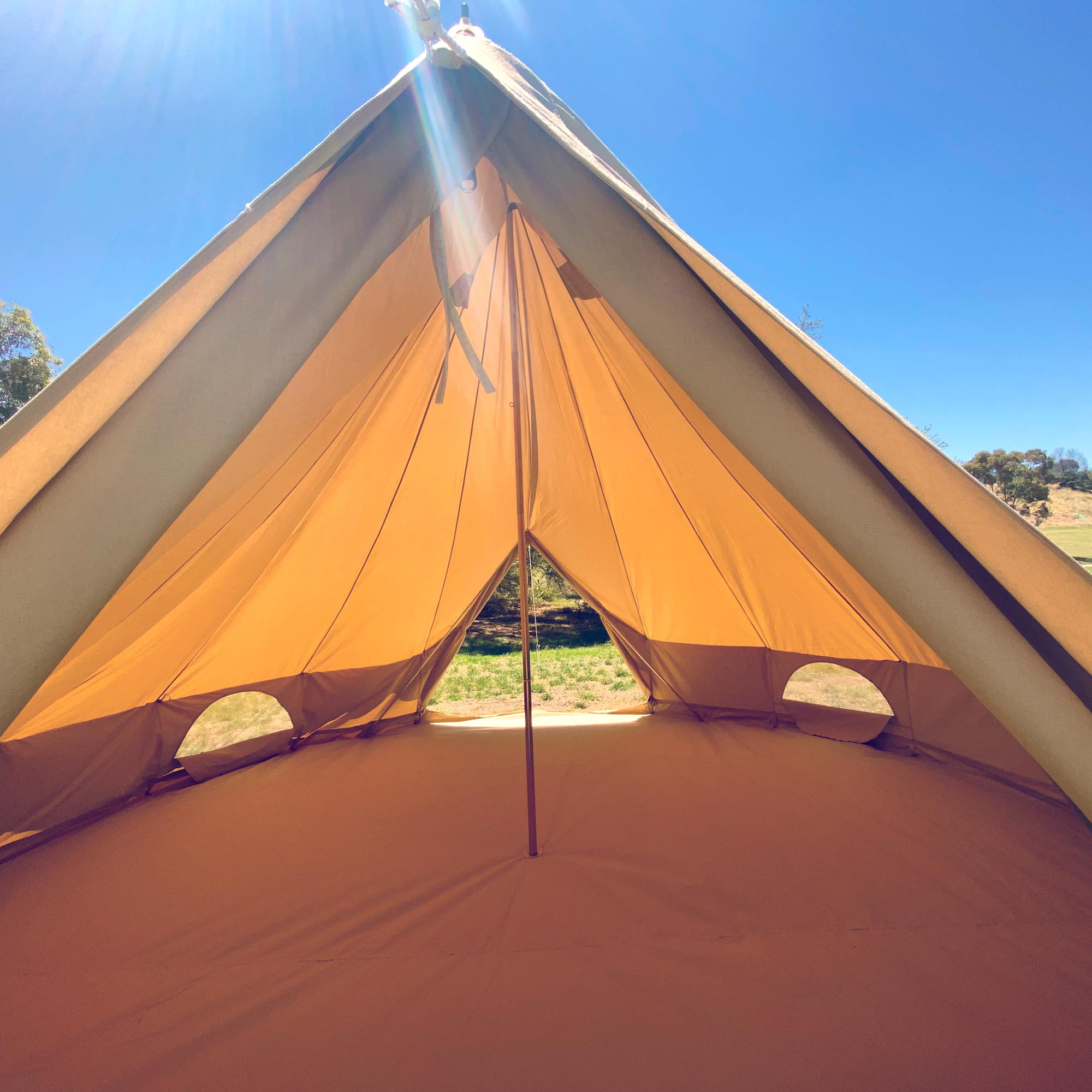
Psyclone sells the 13 ft and 16 ft in four styles, while the 19 ft comes only with a removable floor. Knowing the differences helps you match a tent to your climate.
A fixed floor stitches the groundsheet to the walls, which seals out drafts and insects. The removable floor, by contrast, zips off entirely, so you gain ventilation on hot nights. Extra-windows builds keep the fixed floor but raise the window count, to eight windows on the 13 ft and 10 on the 16 ft.
The stove jack style matters most for cold-weather trips. Psyclone pre-cuts an 11 cm opening for a wood-stove flue, although the tent ships without a stove or jack boot. With a stove fitted, however, canvas holds heat well. Our hot tent camping guide walks through stove selection and safe flue setup.
For three-season campers, the standard fixed floor covers most needs. The stove jack stays an upgrade, so add it only when winter camping is part of your plan.
13 ft Bell Tent: Couples and Weekend Camps
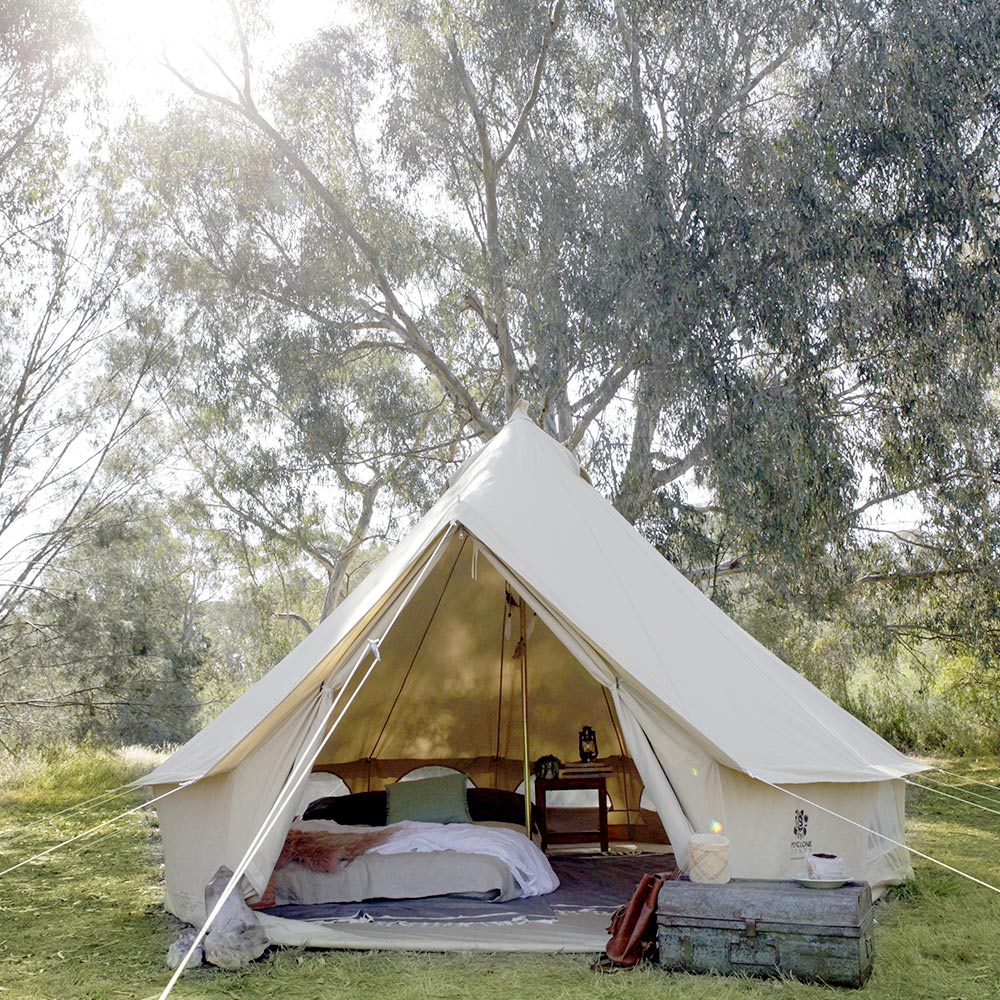
The 13 ft model is the entry point for group-sized canvas camping. At 4 m across, it holds two double beds plus a small table or gear bins. For example, two adults with one or two young kids fit without crowding. Because the center pole reaches 8.2 ft, most adults stand upright.
Packed weight lands near 63 lbs, including poles and pegs. For an overlander, the tent and pole bags ride well in a roof basket, although they weigh far more than a backpacking tent. One person still pitches it in 10 to 15 minutes.
This size comes in four styles, priced from $749 for the fixed floor to $830 for the extra-windows build. Durability is where the canvas earns its price, since verified buyer reviews on the product page describe the 13 ft holding up through hailstorms with no water pooling on the floor. For couples who want canvas toughness without a family-sized footprint, the mix of a low entry price and proven weather resistance makes the 13 ft a sensible starting point.
16 ft Bell Tent: The Family Workhorse
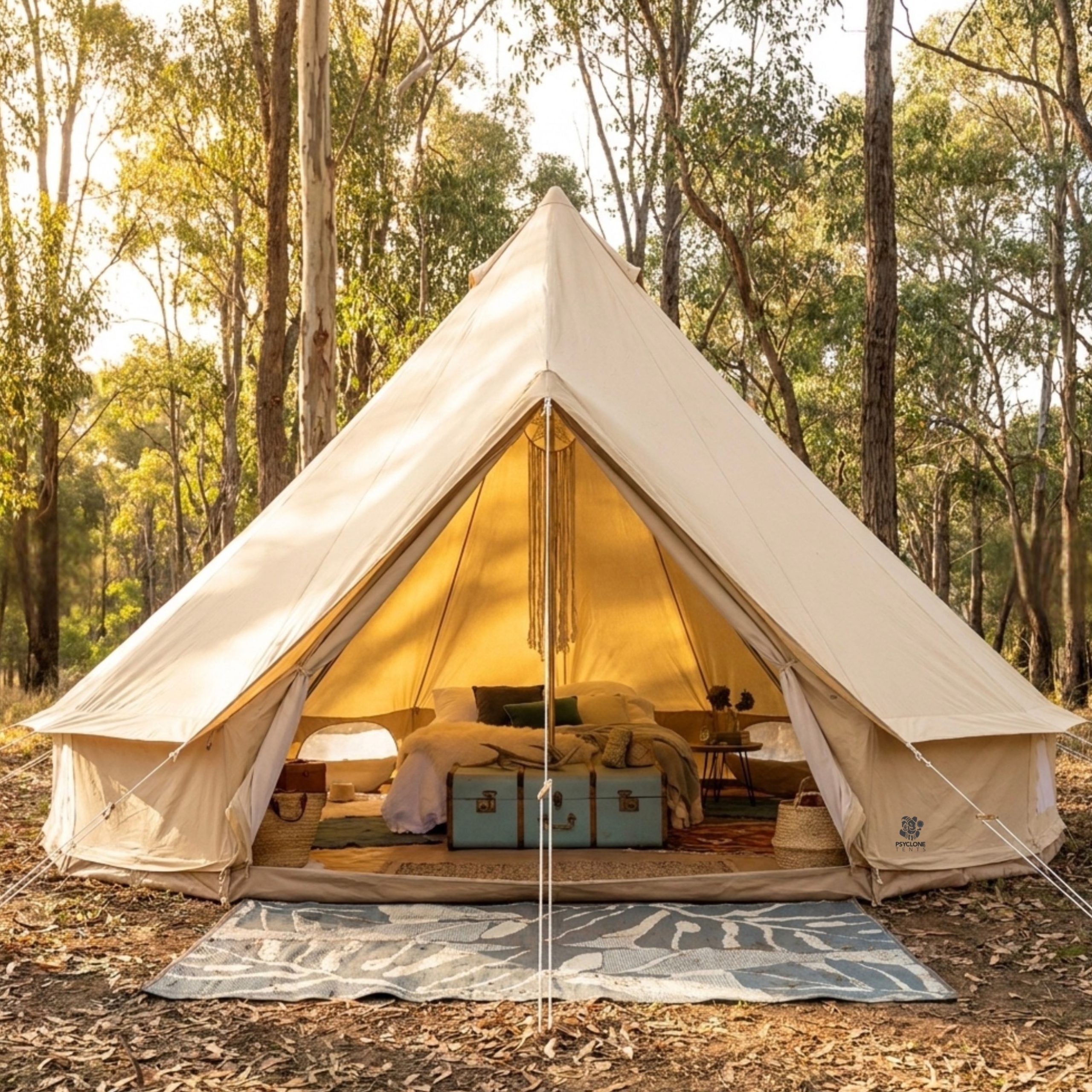
Step up to the 16 ft, and the floor plan changes the trip. Five meters across fits three double beds plus a table, chairs, and a cooler. As a result, it suits most families well. A family of four or five also lives here without stepping over each other, and our look at why tent space matters explains how interior room shapes sleep.
Weight climbs to roughly 80 lbs, so two people handle the carry more easily than one. Setup still runs 10 to 15 minutes. The 16 ft offers the same four styles, priced from $880 to $955.
Verified buyer reviews back this size up. One describes first-time campers who pitched their 16 ft at a Texas state park in 30 mph winds with no trouble. The extra-windows style brings the 16 ft to 10 window panels total, a real gain for hot-climate campers. It also doubles as a roomy glamping tent for weddings and rentals.
19 ft Bell Tent: Group and Basecamp Camping
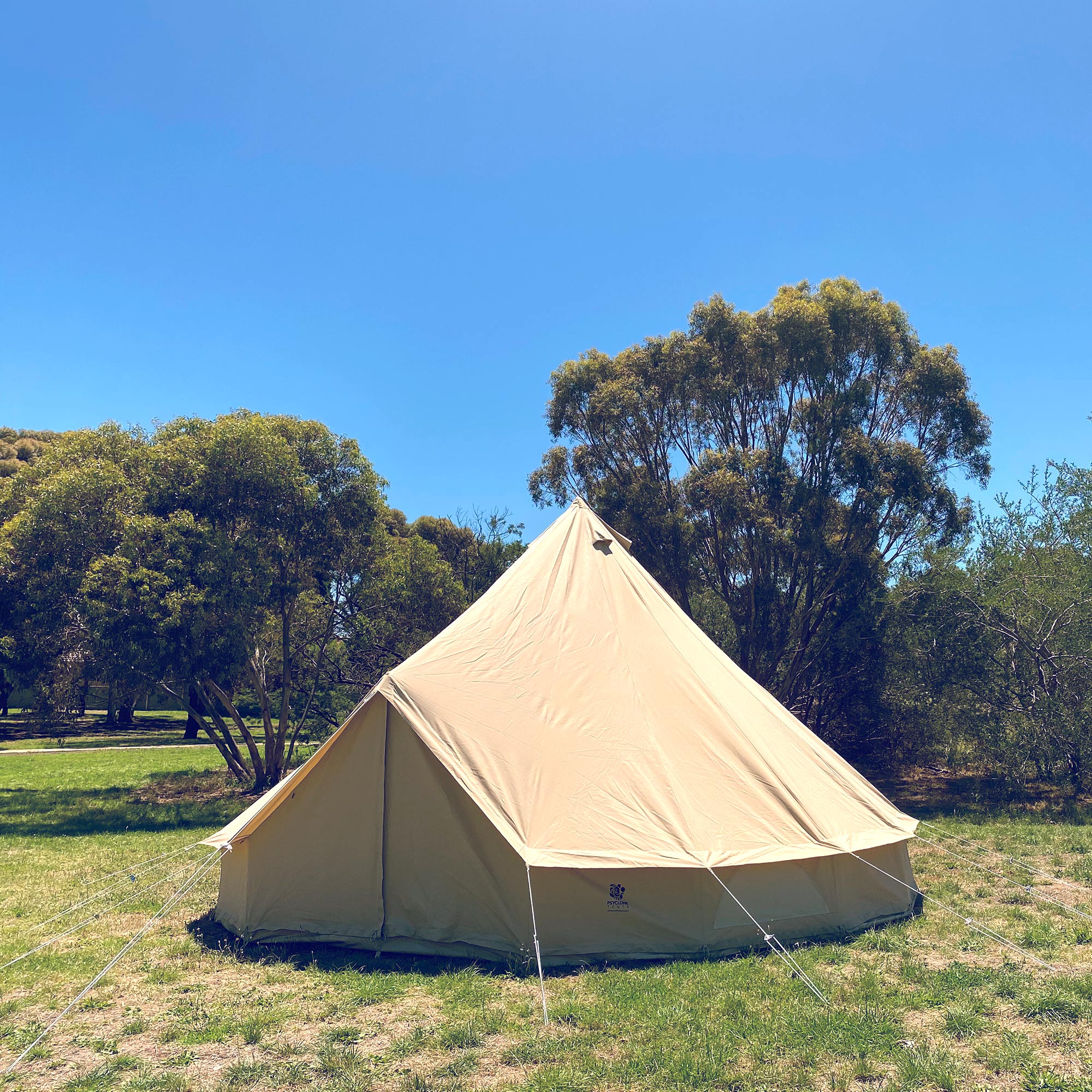
Two doors and a 6 m floor put the 19 ft in a different class, and so does the weight. It holds four double beds, while a second door, front and back, improves airflow at a busy basecamp. This size ships in one configuration, a removable floor at $1,190, and a thicker 38 mm pole supports the taller 11.5 ft peak.
Weight is the real trade-off. At roughly 124 lbs packed, the 19 ft becomes a two-person, vehicle-dependent tent. Overlanders running a fixed basecamp, hunting parties, and families hosting guests are therefore the natural buyers. For a weekend trip with frequent moves, however, it asks more effort than most campers want.
13 ft vs. 16 ft vs. 19 ft: Which Size Fits Your Trips?
Three differences drive the choice: floor space, weight, and price. Move up one size, and you gain a double bed of room. At the same time, however, you add 15 to 45 lbs and several hundred dollars.
Pick the 13 ft if you camp as a couple and move camp often, since it is the lightest of the three. Choose the 16 ft for a family of four or five, especially if you want lounging room in bad weather. The 16 ft is the best fit for most readers of this guide. Step up to the 19 ft only when you run a fixed basecamp or host larger groups.
On value, the 13 ft delivers canvas durability at the lowest entry price. The 16 ft costs more, yet it gives you the most room for the money. For most campers and overlanders weighing bell tent sizes, therefore, the decision comes down to honest group size and how often camp moves.
Psyclone Tents Bell Tent Pros and Cons
Pros
- 340 gsm poly-cotton canvas resists mould and outweighs the thinner canvas on many budget tents
- 520 gsm PVC floor handles stakes and foot traffic without puncturing
- Official YKK zips and metal rope tensioners hold up in wind
- Three group sizes, 13 ft through 19 ft, cover couples to four-bed camps
- One person pitches any size in 10 to 15 minutes
- Stove jack option turns the 13 ft and 16 ft into winter-ready shelters
- 12-month workmanship guarantee with free mainland US shipping
Cons
- Packed weight runs 63 to 124 lbs, far above a nylon dome tent
- A single front guy rope sits in the doorway path, a frequent owner complaint
- Stove jack tents arrive without a stove or jack boot, bought separately
Final Verdict
Psyclone builds a focused canvas line for campers who want durability and space over a light pack. Across all three sizes, the 340 gsm canvas and 520 gsm floor are the core strength. These tents are built to last seasons, not one summer.
The trade-offs are weight and price. Backpackers should look at a nylon tent instead, since 63 lbs is the lightest option here. Campers who move basecamp daily will also feel the bulk. A bell tent rewards trips where you pitch once and stay put.
On value, the lineup holds up well for heavy canvas. Psyclone’s prices sit below premium bell tent brands, while the 340 gsm fabric is a genuine mid-heavy weight rather than thin budget canvas.
For most readers, the 16 ft fixed-floor model is the pick: enough room for a family, a manageable carry, and a fair $880 start. Couples on tighter budgets should size down to the 13 ft instead. Before buying, compare this range against our top bell tents roundup.
Frequently Asked Questions
What is a canvas bell tent?
A canvas bell tent is a circular shelter built around a single tall center pole, with an A-frame pole bracing the door. Canvas walls then slope down from the peak, which gives the tent its bell shape. Compared with a nylon dome, canvas also breathes better and handles temperature swings more evenly.
Are Psyclone bell tents waterproof?
Yes. Each Psyclone Tents bell tent uses a 340 gsm poly-cotton canvas treated to shed water, alongside a 520 gsm PVC floor. New canvas needs weathering first, so spray it and let it dry until the stitch holes swell shut. Owners then report dry interiors through multi-week rain.
What size bell tent do I need?
Match the size to your group and to how often you move camp. For example, the 13 ft suits couples, the 16 ft suits families of four or five, and the 19 ft suits larger groups. As you compare bell tent sizes, weigh floor space against the heavier carry weight.
Are bell tents good for winter camping?
They are, especially with a stove jack fitted. Canvas holds heat far better than nylon, and a wood stove vented through the pre-cut opening keeps a 13 ft or 16 ft tent warm. Even without a stove, treated canvas still blocks wind, which makes it a true all-season bell tent.
How long does a canvas bell tent last?
With care, a heavy canvas tent lasts many seasons. Owners in this lineup, for instance, report four or more years of regular use. To protect the fabric, dry it before storage and reproof it as the coating wears.
How long does it take to set up a Psyclone bell tent?
One person sets up any size in roughly 10 to 15 minutes. First, position the canvas; next, raise the center pole and door pole; then stake the perimeter and tension the ropes. Practice makes later pitches faster, though the 19 ft takes a little longer than the 13 ft.