


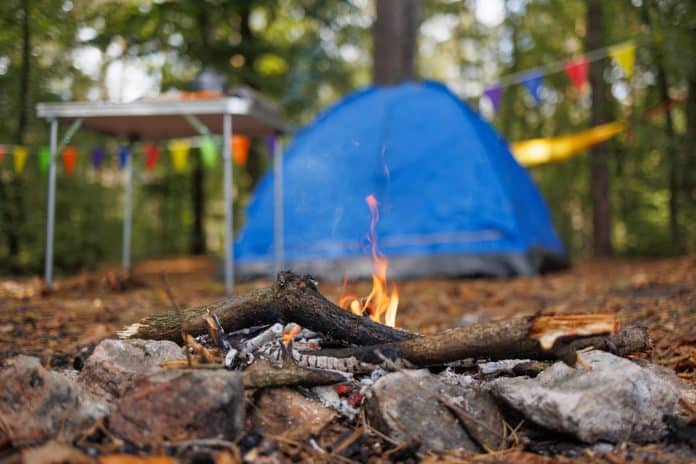

Quick Verdict: Fire season 2026 is shaping up to start earlier and hit harder across the West and beyond. Western snowpack sits at 8-27% of median, drought is expanding, and NIFC already forecasts above-normal fire potential from Texas to the Pacific Northwest by summer. If you camp, overland, or spend time outdoors, expect more campfire restrictions in more places this year. A propane fire pit like the Howl R1 ($349) or R4 ($1,474) gives you a legal, UL-certified fire option during Stage I and Stage II burn bans, so your trips stay on schedule regardless of restrictions.
Last updated: April 2026 | 9 min read
In This Article
- 2026 Fire Season Overview: Why Campers Should Pay Attention
- Snowpack Numbers: The Foundation of Fire Season 2026
- Drought Forecast: What NOAA Projects Through Summer
- Fire Potential Beyond the West
- How Fire Restrictions Affect Your Camping Trips
- Why a Propane Fire Pit Solves the Campfire Problem
- Howl Fire Pit Videos: Setup and Field Performance
- Traditional Campfire vs. Propane Fire Pit: Which Fits Fire Season 2026?
- Pros and Cons
- Final Verdict
- Frequently Asked Questions
2026 Fire Season Overview: Why Campers Should Pay Attention
Fire season 2026 is setting up to be one of the most restrictive camping seasons in recent memory. Specifically, snowpack across all western states is running at record to near-record lows, drought is building fast, and the National Interagency Fire Center (NIFC) already projects above-normal significant fire potential from April through the summer months. For anyone who camps, overlands, or spends weekends outdoors, these conditions directly affect where you go, when you go, and whether you get to have a fire when you get there.
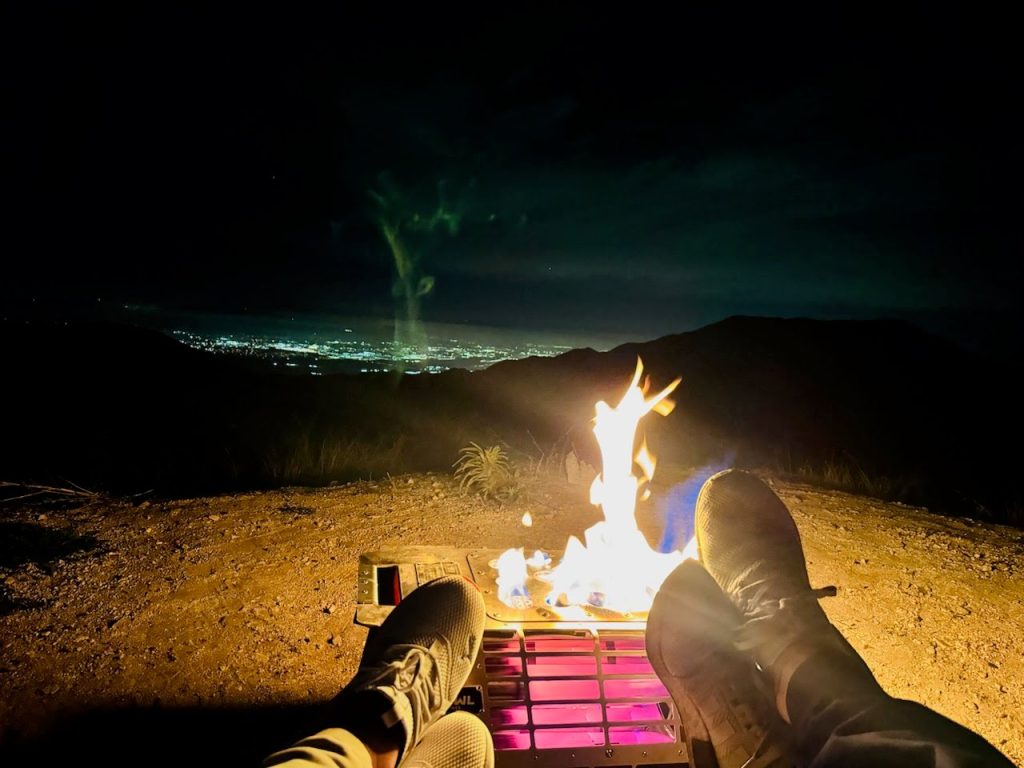
I live in Southern California, and over the past five years I have watched several of my favorite camping spots get scorched by devastating wildfires. As a result, even when fire bans are not in effect, I prefer using my Howl propane fire pits from a safety standpoint. I have taken both my Howl R1 and R4 through camping trips in Big Bear, Joshua Tree, and Anza-Borrego. The convenience and peace of mind are worth every dollar. When I saw the 2026 fire outlook data from Howl’s team this morning, I knew this was a message worth sharing.
This article breaks down the specific numbers behind the 2026 fire outlook, explains how campfire restrictions will affect your trips, and covers why propane fire pit camping is the smartest gear investment you make this year. All data below comes from the Natural Resources Conservation Service, NOAA’s Climate Prediction Center, and NIFC forecasts.
Snowpack Numbers: The Foundation of Fire Season 2026
Snowpack is the single biggest factor in how early fire season starts. Because snow keeps forests and grasslands wetter longer, it delays the drying cycle and gives land managers more time before conditions turn dangerous. This year, however, the numbers are historically bad.
According to the Natural Resources Conservation Service, snowpack is at 24% of median in the Upper Colorado basin, 18% in the Great Basin, 14% in the Lower Colorado, and 8% in the Rio Grande basin. Consequently, these percentages represent some of the lowest readings on record for these watersheds.
| State / Region | Snowpack (% of Median) | Source |
|---|---|---|
| Colorado | 27% | WCC NRCS |
| Utah | Lowest on record | UT Div. of Water Resources |
| Arizona (SWE at peak) | 25% | Drought.gov |
| New Mexico (SWE) | 44% | Drought.gov |
| California | 18% | Water Resources CA |
| Upper Colorado Basin | 24% | NRCS |
| Great Basin | 18% | NRCS |
| Lower Colorado Basin | 14% | NRCS |
| Rio Grande Basin | 8% | NRCS |
For campers, the takeaway is straightforward. Less snowpack means drier forests earlier in the season. Therefore, drier forests trigger campfire restrictions weeks or months ahead of typical schedules. If you plan summer trips to Colorado, Utah, or California backcountry, expect fire ban camping conditions to start well ahead of schedule.
Drought Forecast: What NOAA Projects Through Summer
The snowpack deficit feeds directly into drought conditions, and NOAA’s outlook makes the connection clear. Specifically, the Climate Prediction Center reports record heat in mid to late March alongside an increased chance of below-normal precipitation and above-normal temperatures through April, May, and June. As a result, forecast confidence for expanding drought this spring is rated high.
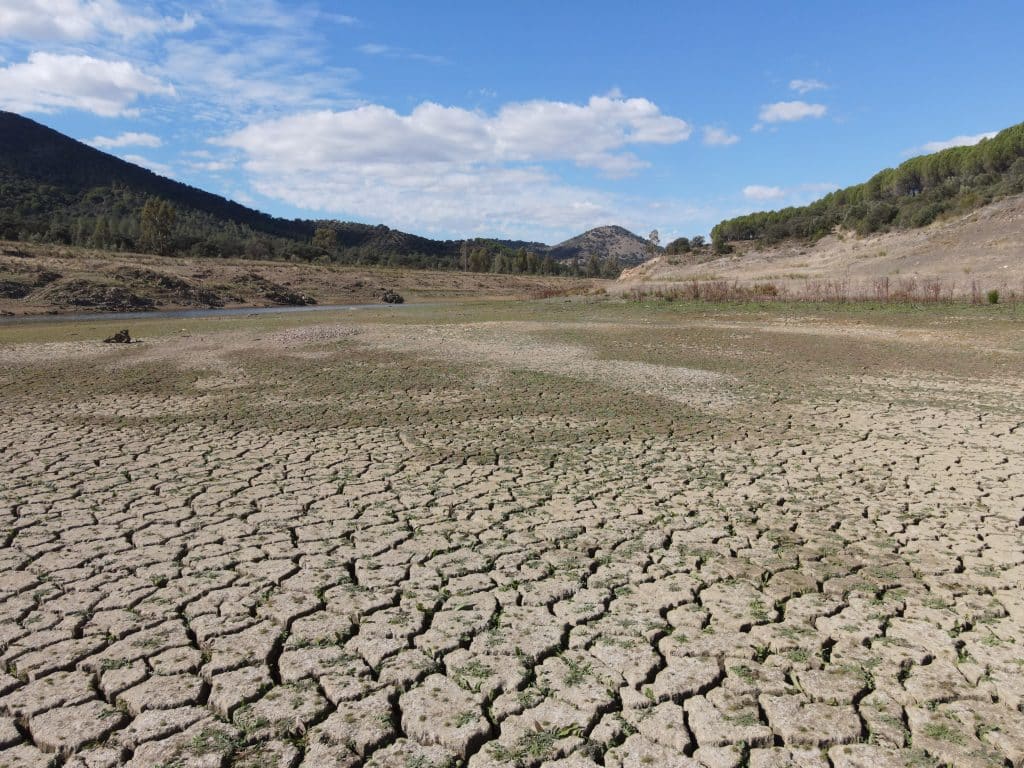
In practical terms, the landscape is drying out faster and staying dry longer. Areas where you would normally have a campfire through June or July will likely see campfire restrictions 2026 kick in weeks earlier. Because the soil moisture deficit compounds over time, conditions get worse as summer progresses rather than stabilizing.
For overlanders and dispersed campers, drought also changes trail conditions significantly. Dust increases, water sources dry up earlier, and fire danger signs shift from yellow to red faster than expected. Consequently, checking fire restriction maps before every trip is no longer optional this season.
Fire Potential Beyond the West
One of the most important details in the NIFC forecast is the geographic spread. Notably, the 2026 fire outlook is not limited to western states. NIFC projects above-normal significant fire potential starting in April for South Texas and large portions of the Southeast.
Elevated fire potential reaches parts of East Texas and Louisiana by June. Then in July, the forecast expands across all of East Texas and the Lower Mississippi Valley. This is significant because southeastern campfire restrictions have historically been less common, and campers in those regions are less accustomed to fire bans affecting their trips.
Meanwhile, the western outlook intensifies through summer. Above-normal fire potential is expected by June in southern Nevada, southern Utah, Colorado’s West Slope, northern California, and the Inland Northwest. The forecast then covers most of the interior West by July. If you travel across multiple states for camping, overlanding, or hunting, expect to encounter fire ban camping rules in regions where you have not seen them before.
Featured on Howl Campfires
Keep Your Fire Legal All Season
Howl’s UL-certified propane fire pits are approved during Stage I and Stage II burn bans. No wood, no sparks, no restrictions.
How Fire Restrictions Affect Your Camping Trips
Campfire restrictions 2026 will show up in several ways this season, and many campers will not expect all of them. For example, Stage I restrictions typically ban open wood fires but allow propane and gas stoves. Stage II restrictions, however, ban all open flames, though certified propane devices often remain permitted depending on the jurisdiction.
Beyond formal burn bans, the Howl team reports hearing from customers east of Colorado who are already dealing with related pressures. Specifically, fire marshals are requiring brush and deadfall to be cleared. HOAs are also pushing hard on property cleanup. Meanwhile, insurance companies are inspecting properties and requiring defensible space to maintain coverage. These changes affect how people use their land and where, when, and how they have fires.
For campers specifically, the effects are direct and immediate. Your favorite dispersed camping spot in the national forest will close or restrict fires earlier than usual. Similarly, campgrounds will enforce stricter rules. Some areas will close entirely during high-risk periods. Therefore, checking fire restriction maps and calling ranger districts before your trip is essential this year.
Why a Propane Fire Pit Solves the Campfire Problem

The reason I switched to propane fire pit camping two years ago is simple: I wanted to keep having fires without worrying whether I was contributing to the next wildfire. After watching fires destroy areas around my Southern California camping spots, the risk of a wood campfire, even a careful one, stopped feeling worth it.
A propane fire pit eliminates the primary ignition risks entirely. For instance, there are no flying sparks, no uncontrolled embers, and no smoldering coals left behind. You turn a valve to start, and you turn it off to stop. Specifically, the Howl R4 reaches full heat (62,000 BTU/hr at 1,300°F+) in about three minutes and shuts down instantly when you close the valve.
Both the Howl R1 and R4 carry UL certification and also meet ANSI Z21.97-2017 standards for outdoor gas appliances. This certification is why they generally remain legal during Stage I and Stage II burn bans nationwide. However, regulations vary by jurisdiction, and some areas impose Stage III restrictions prohibiting all open flame. Always confirm local rules with the ranger district or campground before your trip. When your campground posts a fire ban notice, a certified portable fire pit is typically your legal path to keeping a fire at camp.
Howl Fire Pit Videos: Setup and Field Performance
I have tested both the Howl R1 and R4 at camp and reviewed them on my YouTube channel. The R1’s startup time (roughly 3 minutes to full heat) is noticeably faster than gathering and lighting wood. The R4 handles wind without flame distortion, which matters for exposed desert campsites like those in Joshua Tree and Anza-Borrego. Watch both videos below for the full breakdown of setup, heat output, and real-world propane fire pit camping performance.
For a closer look at specifications and long-term durability, read our portable fire pit buying guide which compares the Howl lineup against other options on the market.
Featured on Howl Campfires
The R1: 11 lbs, $349, 54,000 BTU
Packs to shoebox size with collapsible legs. 8-hour burn time on a standard 20 lb propane tank. Perfect for fire ban camping.
Traditional Campfire vs. Propane Fire Pit: Which Fits Fire Season 2026?
The choice between a traditional wood campfire and a portable fire pit comes down to legality, safety, and convenience during fire season 2026. With campfire restrictions 2026 expected to start earlier and cover more territory, a wood campfire becomes unreliable as your primary fire option for the season.
| Feature | Traditional Campfire | Howl Propane Fire Pit |
|---|---|---|
| Legal during burn bans | No | Yes (Stage I and II) |
| Startup time | 15-30 minutes | ~3 minutes |
| Spark/ember risk | High | Zero |
| Shutoff time | 30-60 min (coals) | Instant (valve off) |
| Wind performance | Dangerous in wind | R4 tested to 120 mph |
| Wet weather | Fails with wet wood | Works in rain and snow |
| Heat output (BTU) | ~30,000-50,000 | 54,000 (R1) / 62,000 (R4) |
| Leave No Trace | Ash, scorch marks | Zero trace |
| Ambiance (crackle/smell) | Yes | Flame only, no crackle |
| Cost | $5-15/bundle | $349 (R1) / $1,474 (R4) |
A traditional campfire gives you the crackling sound and wood smoke smell nothing else replicates. I am the first to admit I love a wood fire. However, during a season where snowpack is at 8-27% of median and drought is expanding, the tradeoff leans heavily toward safety and legality. You will encounter restrictions at campgrounds and dispersed sites you have visited for years without issues. As a result, a propane fire pit means your trip happens regardless.
For a closer look at how the best portable fire pits compare across different seasons and conditions, check our roundup article.
Pros and Cons
Pros of Switching to Propane Fire Pits for Fire Season 2026
- Legal during Stage I and Stage II burn bans across all 50 states and Canada
- Zero spark and ember risk eliminates your contribution to wildfire ignition
- Instant shutoff (turn the valve) vs. 30-60 minutes waiting for wood coals to die
- Works reliably in rain, snow, and wind up to 120 mph (R4 BarCoal)
- Full heat in approximately 3 minutes vs. 15-30 minutes for wood
- UL-certified and ANSI Z21.97-2017 compliant for verified safety standards
- Leave No Trace: zero ash, zero scorch marks on the ground
- 8-hour burn time (R1) on a standard 20 lb propane tank
Cons to Consider
- No wood fire crackle or smoke smell, the ambiance is flame-only
- Upfront cost is significant: $349 for R1, $1,474 for R4
- Requires carrying a propane tank (20 lb tank adds weight and space)
- R4 weighs 27 lbs, which is heavier than most wood-burning portable pits
- Not intended for cooking (dedicated cooking setups still needed)
Final Verdict
Fire season 2026 is shaping up to be early, widespread, and restrictive. The data is consistent across every source: snowpack at historic lows (California at 18%, Colorado at 27%, Utah at record lows), drought expanding with high confidence through summer, and above-normal fire potential from Texas to the Pacific Northwest. Consequently, if you spend time outdoors between now and fall, this season will affect your plans.
The honest tradeoff with a propane fire pit is ambiance. You lose the crackle and the wood smoke smell, and I will always love a traditional campfire. However, after watching fires scar places I camp in Southern California, the peace of mind from using my Howl R1 and R4 through Big Bear, Joshua Tree, and Anza-Borrego outweighs the nostalgia. These fire pits, as I have said in my reviews, are the best I have used. Above all, I trust the safety Howl has built into them.
For campers who want the most portable option, the Howl R1 at $349 and 11 lbs is the entry point. It packs to shoebox size and delivers 54,000 BTU with an 8-hour burn time. Alternatively, for those who want maximum heat and wind performance for off-grid camping, the R4 at $1,474 delivers 62,000 BTU, operates in 120 mph winds, and reaches 1,300°F+.
This is not the year to wing it. Check restrictions before every trip, and assume your favorite spots will get sensitive early. Have a better plan than hoping wood fires are allowed. A portable fire pit gives you a plan, and the Howl lineup gives you the best version of it.
Featured on Howl Campfires
Ready for Fire Season? Get Your Howl.
UL-certified, burn-ban approved, and built in Colorado from 304 stainless steel. Check pricing on the R1 and R4 today.
Frequently Asked Questions
Are propane fire pits legal during fire bans?
Yes, UL-certified propane fire pits like the Howl R1 and R4 are approved during Stage I and Stage II burn bans across all 50 states and Canada. They meet ANSI Z21.97-2017 standards for outdoor gas appliances. However, always verify local regulations with the ranger district or campground before your trip, since some jurisdictions impose Stage III restrictions prohibiting all open flame.
How bad will fire season 2026 be for camping?
The 2026 fire outlook is tracking to start earlier and cover more geography than recent years. Specifically, western snowpack is at 8-27% of median, NOAA forecasts expanding drought through summer with high confidence, and NIFC projects above-normal fire potential from Texas to the Pacific Northwest by July. Therefore, expect more campfire restrictions in more places, starting earlier in the season.
What states have the worst fire risk in 2026?
According to NIFC, above-normal significant fire potential is expected by summer 2026 in southern Nevada, southern Utah, Colorado’s West Slope, northern California, the Inland Northwest, South Texas, East Texas, Louisiana, and the Lower Mississippi Valley. Notably, Utah and Arizona have recorded their lowest snowpack levels in history this season.
Is a propane fire pit worth the cost for camping?
A propane fire pit costs more upfront ($349 for the Howl R1, $1,474 for the R4) compared to buying firewood at $5-15 per bundle. However, the value calculation changes when wood fires are banned at your campsite. For example, one cancelled trip due to fire restrictions offsets a significant portion of the cost. Additionally, propane costs roughly $3-4 per refill and provides 6.5-8 hours of burn time.
What is the difference between the Howl R1 and R4?
The Howl R1 weighs 11 lbs, produces 54,000 BTU/hr, operates at 800°F, and costs $349. It packs to shoebox size with collapsible legs and runs 8 hours on a 20 lb propane tank. In contrast, the R4 weighs 27 lbs, produces 62,000 BTU/hr, operates at 1,300°F+, and costs $1,474. It also uses BarCoal technology tested to 120 mph winds and includes three burners versus one on the R1.
Do I still need to check campfire restrictions if I have a propane fire pit?
Yes. While propane fire pits remain legal during most burn bans, some areas impose Stage III restrictions prohibiting all open flame during extreme conditions. Therefore, always check current restrictions with the local ranger district, BLM office, or campground before your trip. Conditions during fire season 2026 are expected to change rapidly as drought expands.