


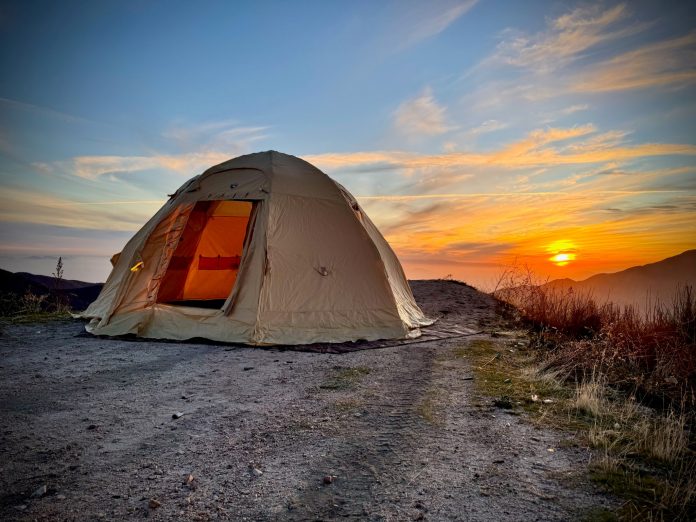

There’s a moment that happens to almost every cold-weather camper at least once: you’re zipped into a sleeping bag rated for temperatures you’re experiencing, wearing every layer you brought, and you’re still not warm. The tent wall is dripping condensation. Your gear smells like damp dog. And somewhere outside, the wind is working on the rain fly. This is the experience that three-season tents were never designed to solve, and it’s exactly the experience driving a growing shift toward stove-equipped camping among overlanders, hunters, and backcountry campers who’ve had enough of surviving the night instead of enjoying it.
I’ve been camping across the U.S. for decades, and I’ve watched this shift happen in real time, in my own gear list. The turning point was a stretch of nights in the Sierra where the combination of a winter camping tent with diesel heater and the right double-wall construction meant I woke up warm, dry, and comfortable instead of counting the hours until sunrise. It’s not a new concept, but the gear has improved dramatically, and the category is expanding beyond hunters and hardcore winter campers to anyone who wants to extend their camping season without giving up comfort. This guide covers why the switch makes sense, what to look for, and how the PF Bereg UP-5 illustrates what this category looks like when done right.
Quick Facts:
- Topic: Why hot tent camping is growing and what makes a great hot tent
- Who it’s for: Overlanders, hunters, cold-weather campers, and anyone extending their camping season
- Key feature: A stove jack, a heat-resistant port in the tent fly for routing a stove pipe safely out of the shelter
- Featured tent: PF Bereg UP-5 ($1,650), double-wall Oxford dome with built-in stove jack, sub-60-second umbrella frame, rated -50°C to +30°C
- Primary benefit: A warm, livable interior on cold nights instead of a survival situation in a sleeping bag
- Trade-off: Weight (~65 lbs) and cost make this a vehicle-based camp setup, not a backpacking option
- Best stove pairing: Wood stove or diesel heater routed through stove jack rated to 1,200°C
9 min read
In This Article
- What Is Hot Tent Camping?
- Why Campers Are Making the Switch
- The Stove Jack: What It Does and Why It Matters
- Double-Wall Construction and Heat Retention
- Who Benefits Most From Hot Tent Camping
- The PF Bereg UP-5 as a Hot Tent: What Five Years of Use Reveals
- What to Look for in a Hot Tent
- Pros and Cons of Hot Tent Camping
- Final Verdict
- Frequently Asked Questions
What Is Hot Tent Camping?
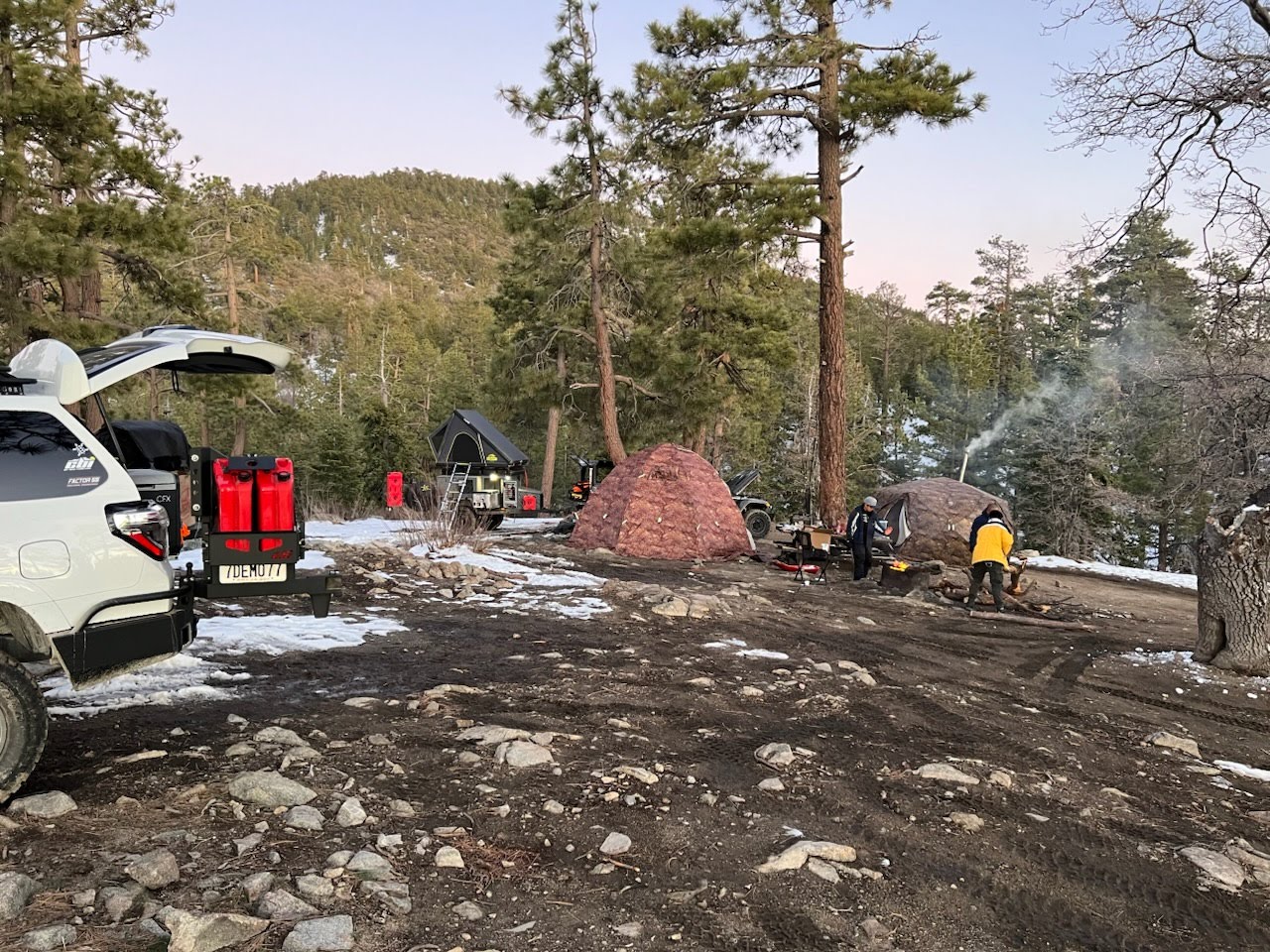
Hot tent camping refers to camping in a tent equipped with a stove jack, which is a heat-resistant port in the fly or canopy designed to route a stove pipe safely out of the shelter. A stove, either a wood-burning model or a diesel or propane heater, runs inside the tent, raising the interior temperature well above ambient conditions outside. The result is a shelter that functions less like a weather barrier and more like a heated room: warm enough to sit up, cook, play cards, and genuinely relax rather than retreating into a sleeping bag at dusk.
Wood stove tent camping has roots in northern European, Scandinavian, and North American hunting traditions where winter camps required more than a sleeping bag to function. Russian and Siberian hunters, Finnish ice fishermen, and North American wilderness guides have used heated tent camps for generations. What’s changed in recent years is the available gear: modern hot tents combine lightweight materials, precision stove jack design, and structural innovations like the umbrella-frame dome that make the setup accessible to a broader range of campers. The winter camping tent category has moved from a niche practice among hardcore cold-weather specialists to a mainstream option for anyone who camps past October. For a closer look at the stove side of the equation, our hot tent wood stove buying guide covers what to pair with your shelter.
Why Campers Are Making the Switch to Hot Tent Camping
This growth comes down to one core realization: the difference between surviving a cold night and genuinely enjoying one isn’t a thicker sleeping bag. It’s a heated shelter. Once a camper has experienced this setup, returning to a cold tent in below-freezing conditions feels like a regression.
The Cold-Tent Limitation
A standard three-season tent is a weather barrier, not a thermal system. It blocks wind and rain, but interior temperature tracks closely with ambient outdoor temperature once body heat reaches equilibrium inside the sealed space. On a 25-degree night, a three-season tent interior runs somewhere between 30 and 40 degrees: marginally warmer than outside, but not livable. Campers in this environment spend the evening in sleeping bags from the moment they stop moving, and morning involves a cold gear scramble before the sun raises the temperature.
A four-season tent with a stove changes that picture entirely. Interior temperatures with a small wood stove or diesel heater running at low output hold comfortably between 55 and 70 degrees Fahrenheit, depending on the shelter’s insulation and the output of the heat source. Campers in a four-season tent sit up, cook at a camp table, read, and use the hours between sunset and sleep the way they’d use an indoor space. That shift in the evening experience is what drives repeat hot tent campers back to the setup season after season.
Extending the Camping Season
A hot tent with stove jack is the most effective single change a camper makes to extend their season into fall and winter without switching to a trailer or van setup. Hunters who push into October and November elk and deer camps, overlanders who want to keep running trails into the shoulder seasons, and families who want to camp at elevation without being limited to summer weekends all find a heated shelter addresses the barrier that ends their season early.
For Wyoming campers especially, the shoulder-season window is some of the best camping of the year. Crowds are gone, colors are at peak in late September and October, and the high-elevation sites open up once summer hikers stop showing up. This style of camping extends access to those conditions by making cold nights manageable instead of punishing. Our ground tent buying guide covers how hot tents compare to other shelter categories for season extension.
The Social Experience
A heated tent large enough for a group transforms the camping social dynamic. Cold three-season tents push people to individual sleeping bags early in the evening. A heated tent with standing room and a stove running, the group stays together longer, eats better, and builds the kind of camp experience worth repeating. This is particularly relevant for families with kids, hunting parties, and overlanding groups where the evening around camp is a meaningful part of the trip.
Buy Direct From PF Bereg
PF Bereg UP-5: Hot Tent Camping Done Right
Double-wall Oxford construction, built-in stove jack rated to 1,200°C, and an umbrella-frame dome that deploys in under 60 seconds. Rated from -50°C to +30°C with a 10-year frame warranty.
The Stove Jack: What It Does and Why It Matters
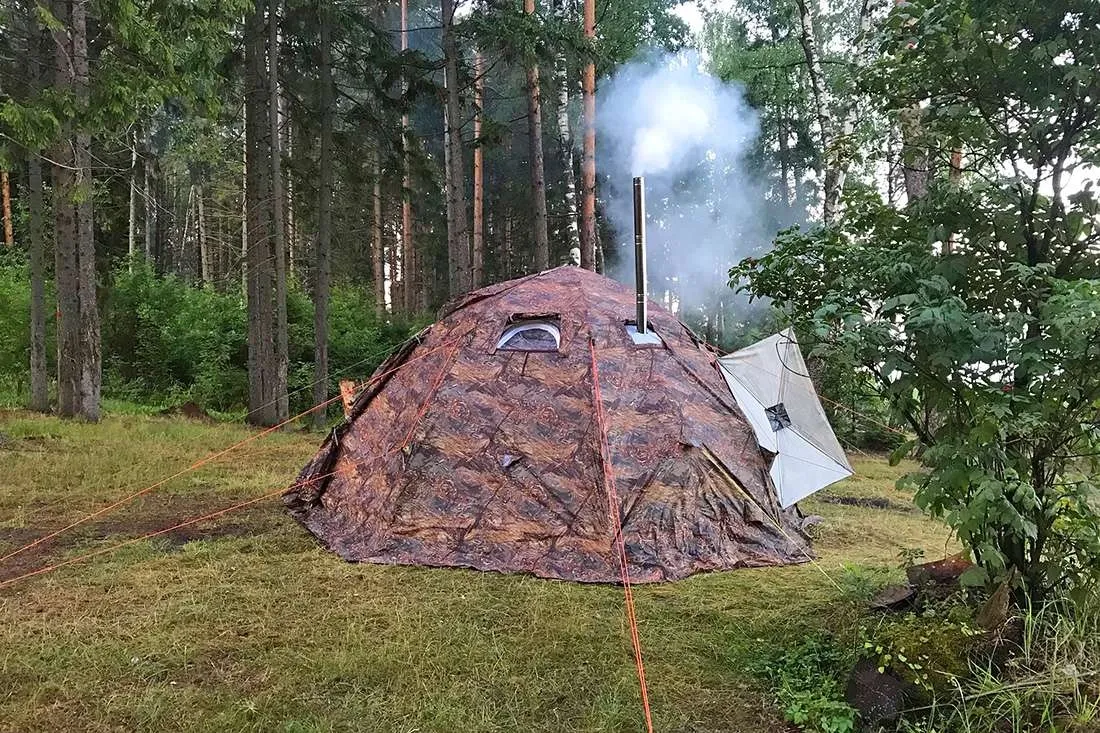
The stove jack is the defining feature of a hot tent with stove jack integration. Without it, running a wood stove or fuel-burning heater inside a tent is a carbon monoxide and fire hazard. With a properly designed stove jack, the stove pipe exits safely through the tent fly, venting combustion gases outside while the heat radiates into the interior. This is the engineering solution that makes running a stove inside a tent safe rather than reckless.
A quality stove jack uses heat-resistant fabric rated to withstand high temperatures at the pipe contact point, with a metal insert that allows selection of the correct diameter for the specific stove pipe being used. The PF Bereg UP-5 includes a built-in stove jack rated to 1,200 degrees Celsius, with a selectable-diameter metal insert. Positioning at the upper section of the dome, which is both the safest location for heat management and the most effective position for the chimney effect: hot combustion gases rise through the pipe and exit at the top of the tent, pulling fresh air in through lower vents and creating continuous airflow that manages moisture and CO concentration simultaneously.
Not all stove jacks are created equal. Aftermarket patch kits added to standard tents are a significant downgrade from factory-integrated jacks in terms of positioning, heat resistance, and sealing. A tent purpose-built for stove use locates the jack where it functions properly and builds heat-resistant material into the surrounding fabric, not the collar alone. For pairing options, our hot tent wood stove buying guide details which stoves work best with the UP-5’s jack diameter range.
Double-Wall Construction and Heat Retention in Hot Tent Camping

A stove jack enables heat input. Double-wall construction determines how well the shelter holds that heat. Single-wall tent interiors cool quickly as they equilibrate with the ambient outdoor temperature, and heat escapes rapidly through conduction. A double-wall design places an air gap between the outer fly and the inner layer, which acts as insulation, keeping the inner surface warmer and reducing the rate of heat loss to the outside.
The PF Bereg UP-5 uses Oxford 300 with PU 4000 waterproofing on the outer fly and Oxford 210 with PU 2000 on the inner layer. Between those two layers, an air gap reduces condensation and retains heat inside the sleeping space. In field testing across five-plus winters, including Sierra snowstorms and Wyoming high-desert nights with wind gusts sounding like a freight train coming through camp, the UP-5’s interior stays dramatically warmer than single-wall alternatives used in comparable conditions. The double-wall construction also nearly eliminates the condensation drip problem that plagues single-layer tents in cold weather: moisture migrates to the outer fly rather than dripping on gear inside.
Who Benefits Most From Hot Tent Camping

Stove-jack camping isn’t the right setup for every camper, but for specific use cases it represents a categorical improvement over cold-tent alternatives.
Hunters who run multi-day spike camps in October and November are the original hot tent campers and still one of the clearest beneficiaries. A warm, dry basecamp at the end of a cold day in the field is not a luxury in that context, it’s a functional necessity that determines whether a hunter recovers well enough to perform the next day. Ice fishermen in northern climates use the same logic: a heated shelter on frozen water extends productive fishing hours and prevents the kind of cold exposure that shortens trips.
Overlanders and vehicle campers who want to push into shoulder-season conditions without committing to a trailer or camper build represent the fastest-growing segment of the stove-tent market. The setup requires a vehicle for transport given the weight, but it delivers a camping experience that outperforms most trailer setups in some key metrics: interior volume, weather resistance, and the specific comfort of tent camping cold weather setups provide on a harsh night. For anyone overlanding in the mountain West, the Rockies, or the high plateau country of Wyoming and Utah, stove-jack camping extends the practical camping calendar by two to three months in both directions.
The PF Bereg UP-5 as a Hot Tent: What Five Years of Use Reveals
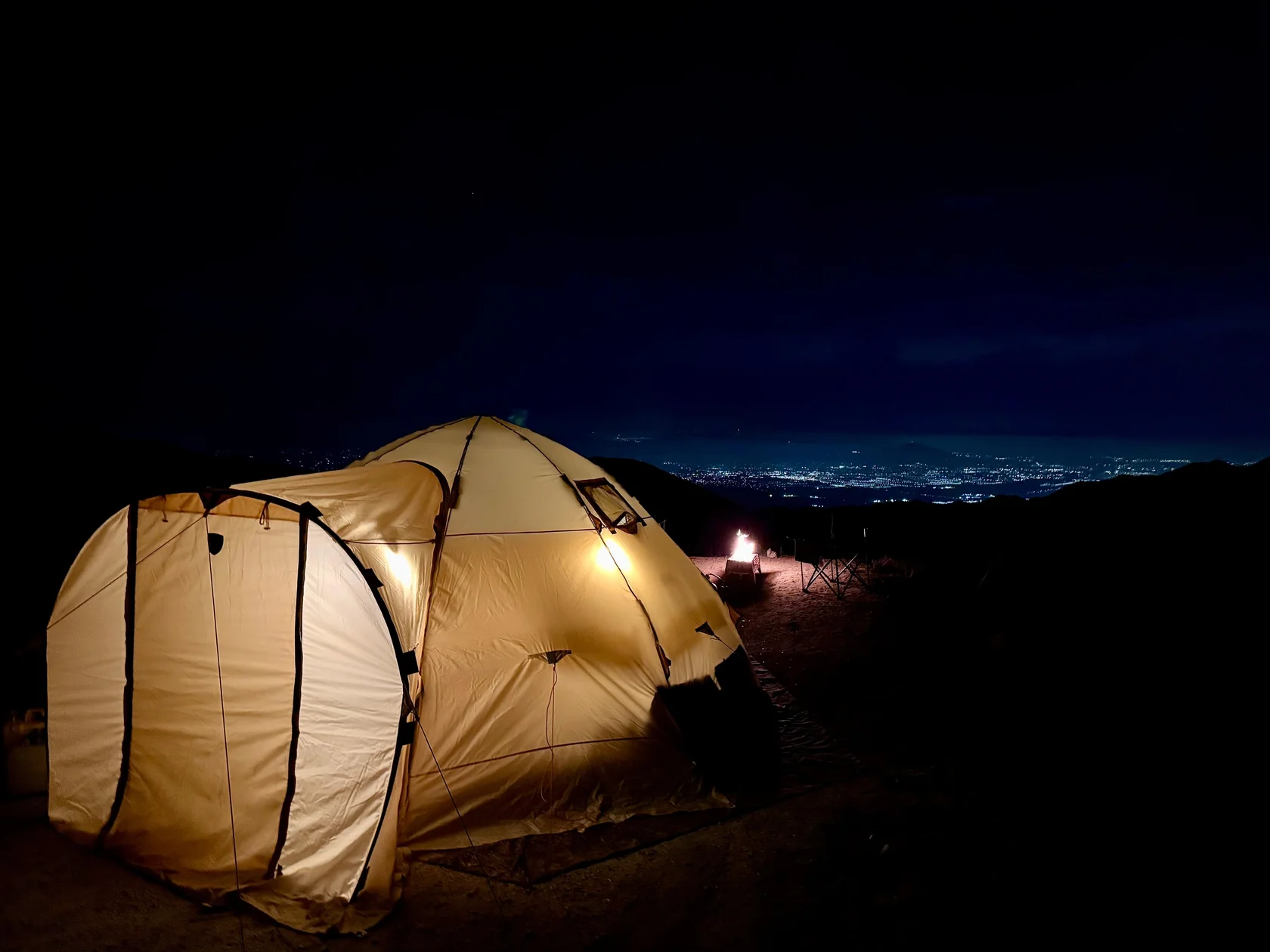
Most hot tent reviews focus on specifications. After five years of running the PF Bereg UP-5 across a wide range of conditions, the field picture is more nuanced than any spec sheet suggests.
The setup speed is one of the most practically significant features and one of the easiest to underestimate from a spec sheet. At a Big Bear campsite found at dusk after six previous spots were taken on a packed Labor Day holiday weekend, the UP-5 was fully deployed in under a minute while a competing inflatable tent still required a 10-minute setup. When daylight is fading, a kid is asking about dinner, and camp still needs to be made, a shelter going from bag to livable in under 60 seconds is a qualitatively different experience than one requiring 10 to 20 minutes. That advantage compounds on hunting trips where camp moves, on shoulder-season overlanding when weather turns, and on any night where arrival and setup happen after sunset.
Stove jack integration in the UP-5 has been tested with both wood-burning stoves and diesel heaters across those five years. Zero degradation is visible at the pipe contact zone, and the interior stays warm enough with a small diesel heater running at low output on nights in the low 20s Fahrenheit to sit comfortably in a single layer without a sleeping bag. With a wood stove tent configuration, the interior becomes warm enough to be described, without exaggeration, as a sauna. That experience, combined with the Disc-O-Bed bunk configuration that fits two adults inside with a stove and personal gear without the space feeling compromised, makes the UP-5 the kind of shelter a camper stops shopping for once they’ve used it. Five years and counting, no bent frame rods, no failed zippers, no seam blowouts.
Dome geometry also contributes to the heated shelter experience in ways beyond aesthetics. Its umbrella-frame distributes wind load across all eight B95T1 aluminum legs simultaneously, which means the shelter holds its shape and seals against wind infiltration in conditions that deflate lesser tents. In a heated hot tent, wind infiltration is not only a comfort problem, it’s a thermal efficiency problem: every gap in the shelter envelope is a heat loss point. The UP-5’s fit between frame and fabric is tight enough that a stove running at low output maintains interior temperature even in sustained wind. Our canvas wall tent buying guide compares the heat retention trade-offs between dome hot tents and traditional wall tent setups for campers evaluating both options.
What to Look for in a Hot Tent
Not every tent marketed as a hot tent delivers on the category’s core requirements. These are the specifications and design features worth verifying before committing to a purchase.
| Feature | What to Look For | PF Bereg UP-5 |
|---|---|---|
| Stove jack | Factory-integrated, heat-resistant to 600°C+, selectable diameter | Built-in, rated to 1,200°C, selectable metal insert |
| Wall construction | Double-wall with air gap for insulation and condensation control | Oxford 300 PU 4000 outer + Oxford 210 PU 2000 inner |
| Temperature rating | Rated to at least -20°C/-4°F for genuine four-season use | Rated from +30°C to -50°C |
| Frame material | Aviation-grade or 7000-series aluminum for cold-temperature ductility | B95T1 aluminum (equivalent to AA7075), 10mm rods |
| Ventilation | Ceiling vent + low-level vents for convection airflow with stove running | Ceiling vent + bottom ventilation openings + stove pipe chimney effect |
| Interior volume | Full standing room (7 ft+ center height) for comfortable hot tent use | ~14.4 ft diameter, 7+ ft center height |
| Setup speed | Under 5 min for solo setup; consider umbrella-frame designs | Under 60 seconds, umbrella-frame deployment |
| Seam sealing | Factory-sealed seams on both fly layers | Sealed seams throughout outer and inner fly |
| Warranty | Multi-year frame warranty signals manufacturer confidence in materials | 10-year frame warranty |
Extend Your Camping Season
PF Bereg UP-5: Hot Tent, Four-Season Ready
Oxford 300/210 double-wall construction, 1,200°C stove jack, sub-60-second setup, and five-plus years of field-proven performance across Sierra snowstorms and Wyoming high-desert wind.
Pros and Cons of Hot Tent Camping
Pros
- A warm, livable interior on cold nights transforms the camping experience from survival-mode to genuinely enjoyable, with interior temps holding 55-70°F with a stove running
- Extends the camping season by two to three months in both directions, opening up shoulder-season and winter conditions that cold tents make miserable
- The stove chimney effect actively manages moisture and carbon dioxide inside the shelter, creating better air quality than a sealed cold tent
- Group social experience improves dramatically: people stay up, cook, talk, and use the heated space rather than retreating to sleeping bags at sunset
- Double-wall hot tents like the UP-5 virtually eliminate condensation drip on gear, since moisture migrates to the outer fly rather than the sleeping space
- For vehicle-based campers, the weight cost is absorbed by the rig, and the comfort gain is delivered on every single night at camp
- A quality hot tent with a solid frame handles wind and snow loads that collapse or damage cheaper shelters, adding safety alongside comfort
Cons
- Weight: quality hot tents like the UP-5 weigh 60+ lbs, restricting the setup to vehicle-based camps; backpackers and hikers need a different solution
- Cost: the UP-5 is $1,650 plus stove; the full system investment is higher than a typical cold-tent setup by a meaningful margin
- Stove fuel management adds a logistics layer to camp planning: wood collection or propane/diesel supply needs consistent attention
- Carbon monoxide risk exists with any combustion heat source; a CO detector inside the tent is non-negotiable and adds to the kit list
- Setup and breakdown still require more steps than a simple rain fly and stakes; the stove pipe, jack sealing, and ventilation checks add time
- Running a stove inside a tent in established campgrounds with fire restrictions is limited; the setup shines in dispersed camping, hunting camps, and private land
Final Verdict
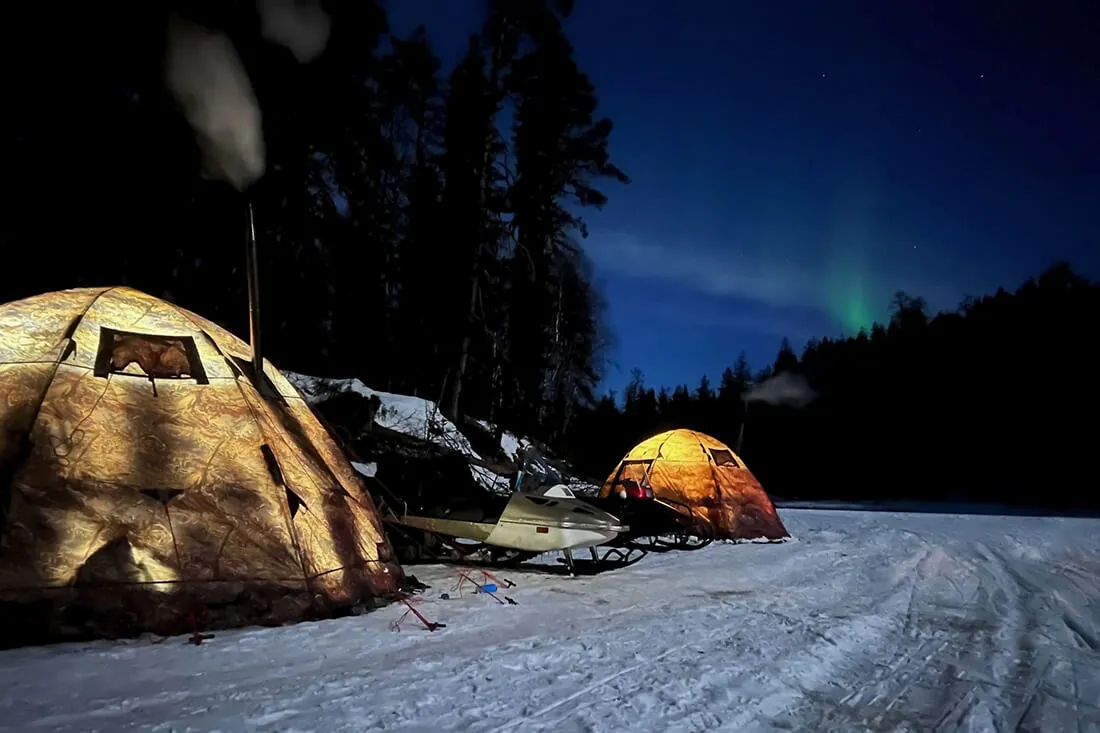
The growth in this category is not a trend in the fleeting sense. It’s a durable shift driven by a simple and repeatable discovery: once a camper has spent a cold night in a heated tent, the cold-tent alternative stops being acceptable. The comfort differential is too large and too consistent to ignore. For overlanders, hunters, and shoulder-season campers who’ve been limited by cold nights, the hot tent setup resolves the barrier entirely rather than managing it with more layers and a heavier sleeping bag.
The PF Bereg UP-5 represents what the category looks like when it’s done well: a factory-integrated stove jack rated to 1,200°C, double-wall Oxford construction with a meaningful air gap, a sub-60-second umbrella-frame deployment, and a 10-year frame warranty on aviation-grade B95T1 aluminum. Five-plus years of field use across conditions ranging from Sierra snowstorms to Wyoming freight-train wind has produced zero structural failures and consistent performance. At $1,650 it’s a significant investment, but for campers who use it regularly in the conditions it was built for, the value compounds across years of dry mornings, warm evenings, and camping seasons that run well past October.
The alternative is another cold night of tent camping cold weather conditions in a three-season shell, hoping the sleeping bag rating holds up. A quality stove-jack shelter ends that calculation.
Ready to Make the Switch?
Check Today’s Price on the PF Bereg UP-5
Order direct from PF Bereg with a 10-year frame warranty. Available in the UP-5 and UP-5 Deluxe with four arched entrances and mini vestibule included.
Frequently Asked Questions
What is a hot tent and how is it different from a regular tent?
A hot tent includes a factory-integrated stove jack, which is a heat-resistant port in the fly that allows a stove pipe to exit safely while the stove runs inside the shelter. Standard tents have no provision for a heat source other than body heat. The difference in interior temperature on a cold night is substantial: a regular tent interior on a 25-degree night runs 30 to 40 degrees inside, while a hot tent with a small stove running holds 55 to 70 degrees. A stove-jack tent converts the shelter from a weather barrier into a heated livable space.
Is hot tent camping safe?
Stove-tent camping with a properly installed stove and stove jack is safe when basic precautions are followed. A carbon monoxide detector inside the tent is non-negotiable and should run whenever a combustion heat source is in use. The stove pipe must exit through the stove jack rather than through an improvised opening, and the stove jack should be factory-integrated with heat-resistant fabric rather than an aftermarket patch. Ventilation, cracking a low vent and leaving the ceiling vent open, maintains fresh air exchange and prevents CO accumulation. Thousands of hunters, overlanders, and winter campers use this setup safely every season with these basic protocols in place.
What stove works best for hot tent camping?
Wood-burning camp stoves and diesel heaters are the two most common heat sources for this style of camping. Wood stoves provide radiant heat from the stove body and operate without fuel logistics beyond wood collection; they produce a camp ambiance that many hot tent campers specifically value. Diesel heaters (like the widely used Chinese-market units) offer precise temperature control and run from a small fuel tank, making them better for remote camps where wood collection isn’t practical. Both work well with the UP-5’s stove jack. Our hot tent wood stove buying guide covers sizing, pipe compatibility, and safety considerations in detail.
How cold can you camp with a hot tent?
With a quality double-wall hot tent and a functioning heat source, practical camping temperatures extend well below 0°F. The PF Bereg UP-5 is rated for comfort to -50°C/-58°F, and field use confirms the double-wall Oxford construction holds heat effectively well below freezing. Fuel supply and stove output, not the tent structure itself, are the limiting factors at extreme temperatures. Most campers running a stove setup find the setup comfortable into the -20 to -30°F range with a wood stove or diesel heater running at moderate output.
Is the PF Bereg UP-5 a good hot tent for beginners?
Yes, particularly for vehicle-based campers new to stove-equipped tent camping. Sub-60-second umbrella-frame deployment removes the learning curve of threading poles, so beginners get the tent up correctly on the first try. A factory-integrated stove jack with a selectable-diameter metal insert accommodates the most common stove pipe sizes without modification. Purchase confidence is backed by a 10-year frame warranty. Weight is the main consideration for beginners, at approximately 65 lbs, the UP-5 requires a dedicated cargo space in a vehicle rather than a backpack, which makes it most appropriate as a basecamp or overlanding shelter rather than a hike-in tent.
Heads up: Clicking on our affiliate links and exploring our sponsored content helps us at no extra cost to you, and we only recommend gear we’re absolutely crazy about!