


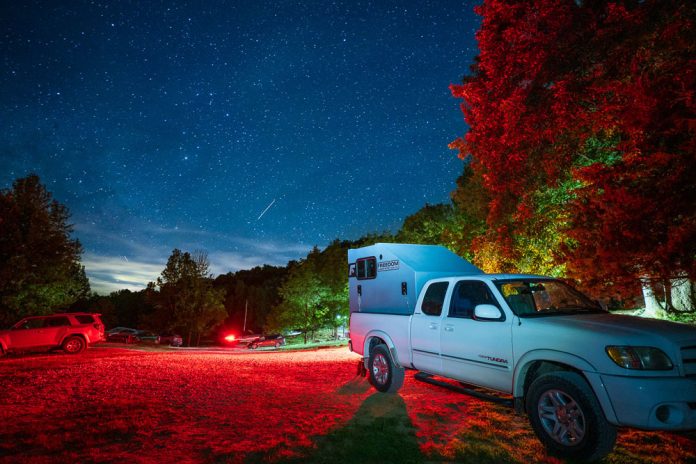

I’ve been camping and overlanding most of my life. Every shelter type taught me something different. The truck bed camper category taught me the most about trade-offs: weight versus weather, price versus insulation, complexity versus usability. After years of making those trade-offs in real conditions, I know which ones matter and which ones only sound important.
Buying a truck bed camper is one of the more consequential gear decisions a truck owner makes. The wrong call affects every trip until you replace it. Get the weight wrong and you’re fighting payload limits on every outing. Wrong insulation means shivering through October nights. A size mismatch means the camper either won’t fit your truck or won’t fit two people comfortably.
This guide covers every factor worth evaluating – insulation, weight, size, mounting, materials, price, and warranty – with real numbers and honest guidance. The rise of lightweight overlanding has added strong new options at the mid-range price point, and this is the moment to buy smart rather than just buy big.
Quick Facts:
- Topic: Truck bed camper buying guide – what to evaluate before purchase
- Audience: Truck owners buying their first or next truck bed camper
- Key factors: Insulation, weight, size/fitment, mounting system, materials, price, warranty
- Top pick: Freedom Camper by Freedom Campers – $3,499.99 (sale from $3,599.99)
- Weight range: 175 to 270 lbs depending on model
- Insulation: Four-season rated, all-weather
- Warranty: 3-year limited warranty
- Best for: Hunters, overlanders, and truck campers who want a lightweight, four-season shelter without the price of a traditional truck camper
9 min read
In This Guide
- Buying a Truck Bed Camper: What the Market Looks Like Now
- Insulation: The Factor That Determines Your Season Range
- Weight and Payload: The Math That Trips Most Buyers Up
- Size and Fitment: Getting the Right Model for Your Truck
- Mounting Systems: How Your Camper Stays Put
- The Freedom Camper: Best Value in the Category
- Truck Bed Camper vs. Other Shelter Types: Which Should You Buy?
- Pros and Cons of Buying a Truck Bed Camper
- Final Verdict
- Frequently Asked Questions
Buying a Truck Bed Camper: What the Market Looks Like Now
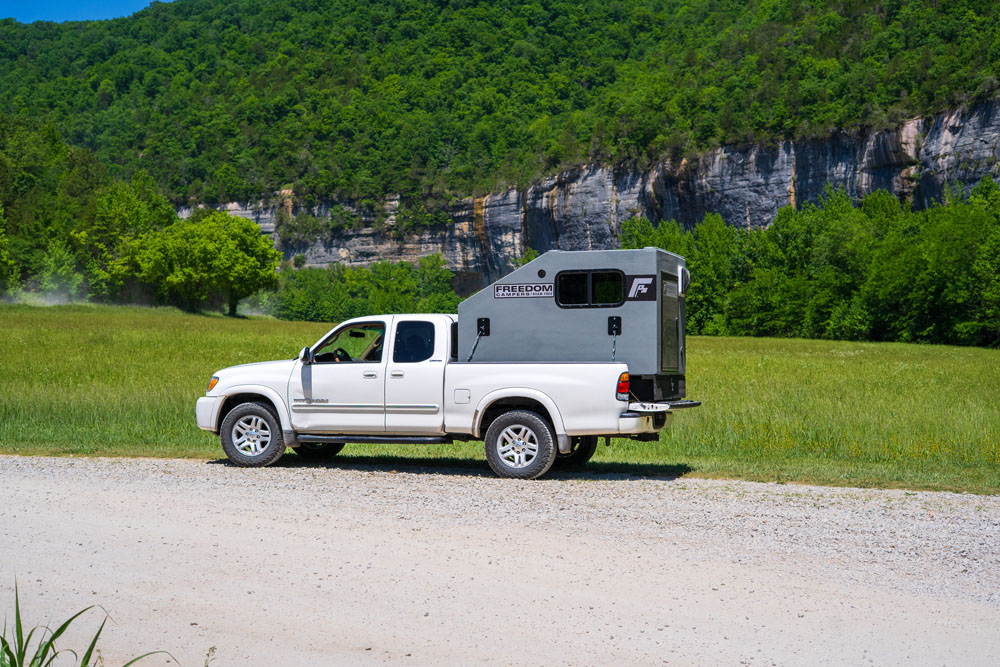
The truck bed camper market splits into three tiers. At the bottom, basic non-insulated truck shells and camper caps run $500 to $1,500 and offer weather cover without meaningful thermal protection. In the middle, insulated hard-shell campers like the Freedom Camper run $3,000 to $5,000. They deliver four-season capability at weights two people handle without equipment. At the top, traditional hard-side slide-in truck campers with full kitchens and bathrooms run $15,000 to $50,000 and weigh 1,000 to 3,500 lbs loaded. Each tier serves a different buyer. Understanding which one matches your use case is the first step when buying a truck bed camper.
The mid-range insulated hard-shell category has grown. More truck owners want four-season shelter without a $25,000 camper or a 2,000-lb payload penalty. Options in this tier prioritize lightweight construction, simple mounting, and genuine insulation over amenities. The trade-off is clear: no kitchen, no bathroom, sitting height rather than standing. For hunters, overlanders, and truck campers who prioritize access over amenities, that trade-off delivers more value than any other tier at the price.
Before evaluating any specific camper, establish your answers to four questions: What truck do you drive and what is its payload rating? What temperature range will you camp in? Will you load and unload solo or with a partner? Do you need to detach the camper at camp to drive the trail? Those four answers narrow the field before you look at a single spec sheet. They prevent the most common buying mistake: choosing a camper based on features rather than fit.
| Tier | Price Range | Weight | Insulation | Best For |
|---|---|---|---|---|
| Basic shell/cap | $500-$1,500 | 100-200 lbs | None | Weather cover, gear storage |
| Insulated hard-shell | $3,000-$5,000 | 175-270 lbs | Four-season rated | Hunters, overlanders, weekend campers |
| Full slide-in camper | $15,000-$50,000+ | 1,000-3,500 lbs | Full insulation + utilities | Extended expeditions, full-time use |
Insulation: The Factor That Determines Your Season Range

Insulation is the single most important factor when buying a truck bed camper for any use beyond fair-weather camping. A non-insulated shell provides wind and rain protection but tracks exterior temperature closely – useful in summer, miserable in fall, dangerous in winter. An insulated hard-shell maintains interior warmth independent of occupant body heat. This matters for solo campers, for pre-warming a shelter during the day, and for 2 AM temperature drops in September at elevation.
When evaluating insulation in a truck bed camper, look for three things. First, whether the manufacturer specifies a comfort temperature rating rather than just “insulated” language. Vague marketing copy like “insulated for comfort” without a temperature floor is a red flag. Second, whether insulation extends to the floor panel. The ground is a significant heat drain in cold camping, and many campers insulate the walls but skip the floor. Third, whether ventilation options exist for moisture management. An insulated shelter with no ventilation builds condensation through the night, which saturates sleeping gear by morning regardless of how good the insulation is.
I’ve camped in insulated hard-shells in Wyoming October, and the floor insulation matters as much as the wall rating when temperatures drop overnight. The Freedom Camper specifies all-weather, four-season insulation with a comfort rating that covers the conditions most hunters and overlanders encounter in the American West. Its insulated floor panel addresses ground heat drain directly. Ventilation is provided through a 15×30-inch side window and a door window, both of which allow moisture management without sacrificing meaningful heat. For a camper at $3,499.99, that insulation specification matches or exceeds hard-shell options costing significantly more.
Top Pick for Truck Bed Camper Buyers
Freedom Camper: Four Seasons, Four Sizes, One Smart Price
175 to 270 lbs. Built in Lamar, Missouri. 3-year limited warranty. On sale at $3,499.99 – fits midsize and full-size trucks plus trailers.
Weight and Payload: The Math That Trips Most Buyers Up
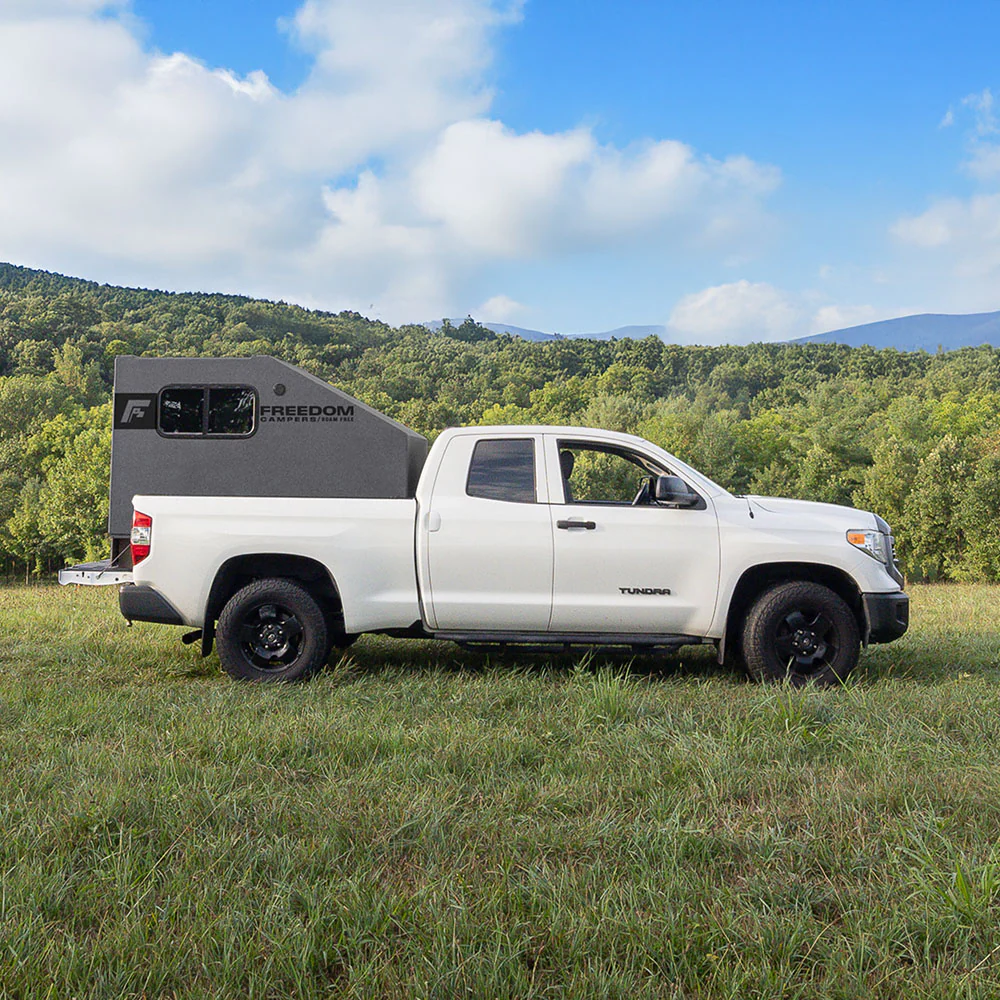
Payload capacity is the number most buyers underestimate when buying a truck bed camper. Your truck’s payload rating is on the sticker inside the driver’s door jamb (see the NHTSA vehicle placard guide). It is the maximum weight the bed and cab can carry combined. That includes the camper, your gear, water, fuel, passengers, and any accessories mounted to the bed or rack. A half-ton truck with a 1,500-lb payload rating, a 300-lb camper, two 200-lb passengers, and 200 lbs of gear is already at 900 lbs. Add water (83 lbs for 10 gallons), recovery gear (50 lbs), and food (50 lbs) and you’re over the rating before packing sleeping bags.
For midsize truck owners on a Tacoma, Ranger, Colorado, or Gladiator, payload ratings typically run 1,000 to 1,500 lbs. Camper weight is a critical constraint. The Freedom Camper’s 48×79 model at 175 lbs leaves ample payload budget for gear, water, and recovery equipment. Compare that to a traditional slide-in camper at 1,000 to 1,500 lbs loaded. The payload math stops working before you’ve added a single piece of gear. For full-size trucks with payload ratings of 1,500 to 2,200 lbs, the 58×89 model at 195 lbs provides even more headroom.
The practical rule: the camper should use no more than 20 percent of your payload rating. The remaining 80 percent covers gear, water, passengers, and accessories. A 175-lb camper on a 1,200-lb payload truck consumes 14.6 percent – reasonable. A 1,000-lb camper on a 1,500-lb payload truck consumes 66.7 percent – a problem before you’ve loaded anything else.
Size and Fitment: Getting the Right Model for Your Truck

Truck bed dimensions vary enough across makes and models that fitment requires specific measurement checks. Short bed or long bed designations do not cover the full range. Interior bed width – the distance between the wheel wells – determines which camper width fits. This dimension varies even among trucks in the same class. Most midsize trucks run 42 to 48 inches between wheel wells. Most full-size trucks run 50 to 56 inches, though some run wider. A camper that spans the wheel wells requires a raised platform; one that sits above them fits directly in the bed.
The Freedom Camper offers four models covering the realistic range of truck bed dimensions. The 48×79 (79L x 48W x 54H inches exterior) fits midsize trucks including the Tacoma, Ranger, Maverick, Colorado, Canyon, Frontier, Ridgeline, and Gladiator. It also fits full-size trucks with the tailgate closed. Full-size short-bed and standard-bed trucks take the 58×79 (79L x 58W x 54H) and 58×89 (89L x 58W x 54H). For flatbed trucks and utility trailers only, the 72×89 (89L x 72W x 54H, 270 lbs) is the right model. Freedom Campers provides a free Truck Compatibility Guide PDF on their product page for full fitment verification by make and model.
Interior dimensions matter as much as exterior fitment. All Freedom Camper models share a 48-inch interior height – comfortable sitting, not standing. Length ranges from 74.5 inches on the 48×79 to 84.5 inches on the 58×89, enough for most adults to sleep flat. Width runs 44 inches on the 48×79 and 54 inches on the 58-inch-wide models. That difference determines whether two people sleep side by side comfortably or in a tight stack. Check both exterior fitment to your truck and interior dimensions against your sleeping situation before buying.
Mounting Systems: How Your Camper Stays Put

A truck bed camper that shifts, bounces, or rattles on rough roads damages both the camper and the truck bed. It also creates a distracting drive on any road worth driving to. Mounting system quality is a factor many buyers skip in the research phase and regret immediately on the first washboard road. Evaluate the mounting system on four points: dedicated anchor points, number of connections, whether removal requires tools, and the manufacturer’s stance on ratchet straps. A manufacturer that recommends ratchet straps as the primary mounting system is a red flag.
The Freedom Camper uses a Truck Mounting Kit consisting of eight side mount plates and four turnbuckles. This system anchors to the truck bed rails and creates a firm, rattle-free connection. Removal requires no specialized tools when you need the bed back. The alternative is the Trailer Mounting Kit – six floor plates and hardware for semi-permanent trailer attachment. This suits buyers who want to leave the camper on a trailer and drive the truck independently. Note that ratchet straps are explicitly not recommended by Freedom Campers as a substitute for the mounting kit, and using them voids the warranty. The Truck Mounting Kit is required for in-bed use.
For most midsize and full-size truck models, a wheel well platform is required before mounting. The platform raises the camper above the wheel arches and creates the flat mounting surface the system requires. It also creates the underbed storage area Freedom Campers calls “the garage.” Freedom Campers provides a free DIY platform guide. Material cost runs $100 to $300 depending on lumber choice. Several aftermarket drawer systems are also compatible with the platform design for buyers who want organized underbed storage.
Ready to Buy?
The Freedom Camper Ships Direct in the Lower 48
Two people load it without equipment. Roof panels support solar and accessories. Truck and trailer mounting kits available.
The Freedom Camper: Best Value in the Category

Evaluated against all criteria – insulation, weight, fitment, mounting system, materials, price, and warranty – the Freedom Camper stands out as the strongest value in the mid-range insulated hard-shell category. Built in Lamar, Missouri and backed by a 3-year limited warranty. Four models start at $3,499.99 and cover the full range of midsize and full-size truck platforms. For context, that’s less than most quality rooftop tent setups and a fraction of any comparable slide-in truck camper.
The construction uses proprietary insulation throughout the walls, ceiling, and floor panel for four-season performance. The roof features two composite wood panels that serve as mounting points for racks, solar panels, or awnings. Optional accessories include a 10,000 BTU 12-volt rooftop AC unit and an 11-inch 12-volt ventilation fan with LED lighting and bug screen. Available in gray or tan, it ships to the lower 48 states. Wyoming and several other Western states require a custom freight quote. For the hands-on assessment of real-world performance and sizing, the Freedom Camper review covers the full picture.
| Model | Exterior (L x W x H) | Interior (L x W x H) | Weight | Best Fit |
|---|---|---|---|---|
| 48×79 | 79 x 48 x 54 in. | 74.5 x 44 x 48 in. | 175 lbs | Midsize trucks |
| 58×79 | 79 x 58 x 54 in. | 74.5 x 54 x 48 in. | 185 lbs | Full-size short bed |
| 58×89 (Most Popular) | 89 x 58 x 54 in. | 84.5 x 54 x 48 in. | 195 lbs | Full-size standard bed |
| 72×89 | 89 x 72 x 54 in. | 85 x 68 x 48 in. | 270 lbs | Flatbeds / trailers |
Truck Bed Camper vs. Other Shelter Types: Which Should You Buy?
Buying a truck bed camper makes the most sense for truck owners who want four-season weather protection, prefer not to tow a trailer, and want the flexibility to leave the shelter at camp. It makes less sense for someone who needs a kitchen and bathroom, camps only in developed campgrounds, or wants to swap the shelter between vehicles. For a detailed breakdown across the shelter spectrum, the truck camper vs. teardrop trailer comparison covers price, weight, and flexibility in depth.
Versus a rooftop tent ($900 to $3,500): the truck bed camper wins on insulation, interior space, and weather protection. The rooftop tent wins on bed availability and setup speed. If four-season performance is the priority, the Freedom Camper at $3,499.99 delivers better thermal performance than any RTT at a comparable price. Its sleeping surface runs 74.5 to 84.5 inches versus 56 to 60 inches on most RTTs. Its rigid shell handles wind and snow without modification. Versus a full slide-in truck camper ($15,000 to $50,000): the truck bed camper wins on price, weight, and payload impact. The slide-in wins on amenities. For most buyers in the mid-range category, the Freedom Camper occupies the optimal position: four-season shelter at a price that doesn’t require a financing decision.
Pros and Cons of Buying a Truck Bed Camper
Pros
- Four-season insulated protection at mid-range prices – Freedom Camper starts at $3,499.99
- Lightweight – 175 to 195 lbs for the three smaller models; two people load without equipment
- Detachable – leave at camp and drive the trail unencumbered
- No tow vehicle required; the truck is the camping platform
- Access to dispersed sites and forest roads unavailable to trailers and RVs
- Roof mounting panels support solar, racks, and awning accessories
- Freedom Camper backed by 3-year limited warranty, built in Missouri
Cons
- Occupies the truck bed – most models require a wheel well platform ($100 to $300 DIY)
- 48-inch interior height limits movement to sitting, not standing
- No kitchen or bathroom – camp stove and external cooking setup required
- Custom freight quote needed for Wyoming and several other Western states
- Wrong size choice requires replacement – fitment verification before purchase is essential
Final Verdict
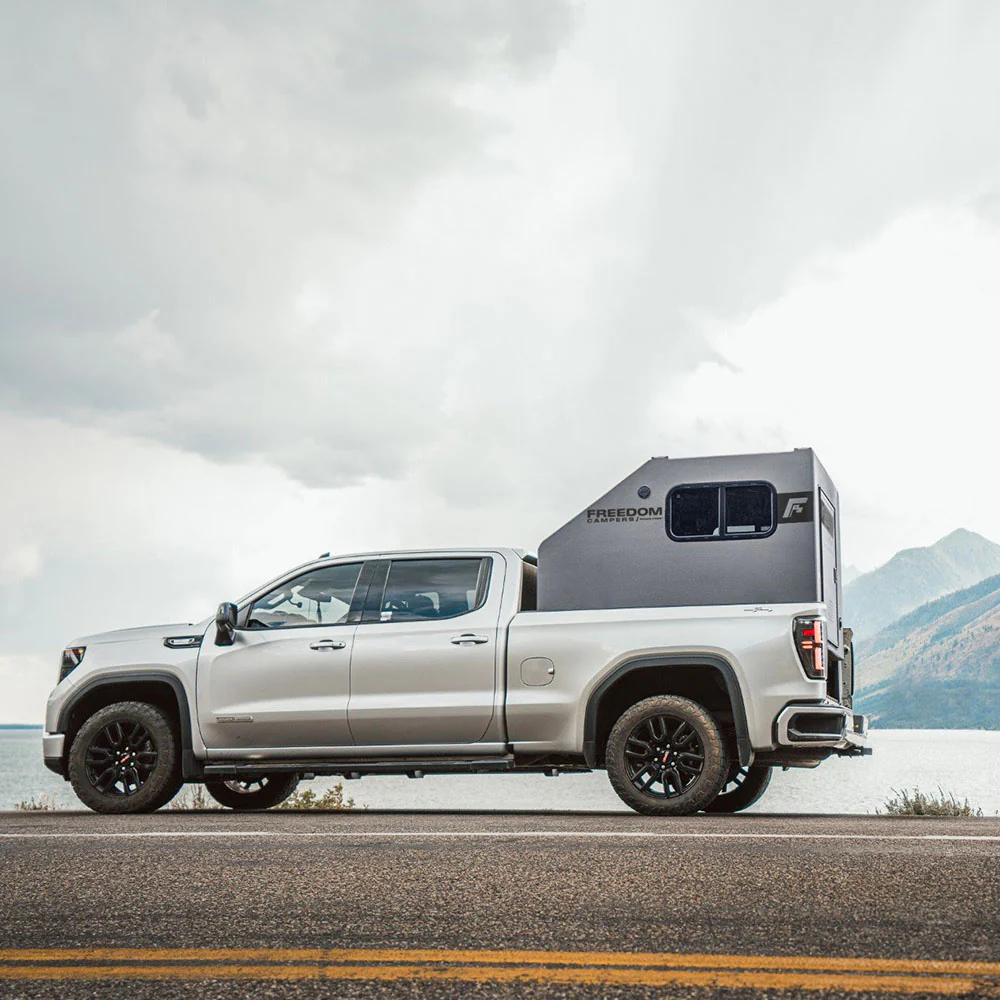
Buying a truck bed camper is the right decision for truck owners who want four-season shelter without the payload penalty and price of a full slide-in camper. The category’s best value at the mid-range price point is the Freedom Camper. Four size options cover midsize through full-size trucks and trailers. Four-season insulation, 175 to 270 lbs by model, and a 3-year warranty start at $3,499.99. It does not have a kitchen, a bathroom, or standing headroom. Those absences are the right trade-offs for the buyer who prioritizes access, payload, and trip frequency over amenities.
Before buying, confirm four things. First, your truck’s payload rating against the camper weight plus your expected gear load. Second, the correct model for your specific bed dimensions using Freedom Campers’ free Truck Compatibility Guide. Third, whether you need a Truck Mounting Kit (in-bed use) or Trailer Mounting Kit (trailer use). Fourth, whether you need to build a wheel well platform before mounting. None of those steps are difficult, but skipping any one of them creates a problem on delivery day that delays your first trip.
If you need a kitchen and bathroom, a traditional slide-in truck camper in the $15,000 to $25,000 range is the right next step. If you’re choosing between a truck bed camper and a trailer, the comparison is worth reading before you decide. Order the 48×79 for midsize trucks. Order the 58×89 for full-size platforms. Both deliver the best insulated truck bed camper value at the price. Register after purchase to activate the 3-year limited warranty.
Ready to Buy?
Check Today’s Price on the Freedom Camper
Ships direct in the lower 48. Built in the USA. 3-year limited warranty. Register after purchase to activate coverage.
Frequently Asked Questions
What should I look for when buying a truck bed camper?
Evaluate in order: insulation rating, camper weight versus payload, exterior dimensions versus your bed, mounting system quality, interior sleeping dimensions, price versus warranty, and whether the manufacturer provides a compatibility guide. Skipping any of these checks – particularly payload and fitment – is the most common and costly mistake buyers make.
How much does a truck bed camper weigh?
Weight varies significantly by tier. Basic non-insulated shells run 100 to 200 lbs. Insulated mid-range hard-shells like the Freedom Camper run 175 to 270 lbs depending on model. Traditional slide-in truck campers run 1,000 to 3,500 lbs fully loaded. For midsize and most full-size trucks, the mid-range insulated hard-shell is the only category that leaves meaningful payload budget for gear, water, and passengers after accounting for the camper itself.
What is the best truck bed camper for the money?
In the mid-range insulated hard-shell category, the Freedom Camper delivers the best combination of insulation, weight, fitment range, mounting quality, and warranty for the price. At $3,499.99, it costs less than most quality rooftop tents. It provides better weather protection, a longer interior sleeping surface, and rigid wind and snow resistance. Four sizes cover midsize trucks through full-size platforms and trailer use. Built in Lamar, Missouri, with a 3-year limited warranty.
Do I need a platform for a truck bed camper?
For most truck bed campers, including the Freedom Camper’s 48×79, 58×79, and 58×89 models, yes. A raised platform clears the wheel wells, creates a flat mounting surface for the turnbuckle system, and adds underbed storage space. Freedom Campers provides a free DIY platform guide – material cost runs $100 to $300 depending on lumber choice. The 72×89 model is designed for flatbeds and trailers where no platform build is required. Several aftermarket drawer systems are also compatible with the platform design for organized underbed storage.
Does the Freedom Camper fit my truck?
The 48×79 fits most midsize trucks: the Toyota Tacoma, Ford Ranger, Ford Maverick, Chevrolet Colorado, GMC Canyon, Nissan Frontier, Honda Ridgeline, and Jeep Gladiator. Full-size trucks including the F-150, F-250, F-350, Silverado, Sierra, Tundra, Ram 1500 through 3500, and Nissan Titan use the 58×79 and 58×89 models. For flatbed trucks and trailers only, the 72×89 is the correct choice. Download the free Truck Compatibility Guide from the Freedom Campers product page for full verification by year, make, and model before purchasing.
Can I use a truck bed camper on a trailer?
Yes. The Freedom Camper’s Trailer Mounting Kit – the default kit – uses six metal floor plates and hardware for semi-permanent trailer attachment. The 58×89 model fits a 5×8 trailer, and the 72×89 is designed specifically for flatbeds and trailers. Using a trailer setup lets you leave the camper at basecamp while driving the truck independently. That is one of the key advantages of the truck bed camper category over tow-behind shelters.
A quick heads-up: If you snag something through our affiliate links or check out our sponsored content, we might earn a commission at no extra cost to you. But fear not, we’re all about recommending stuff we’re truly stoked about!