


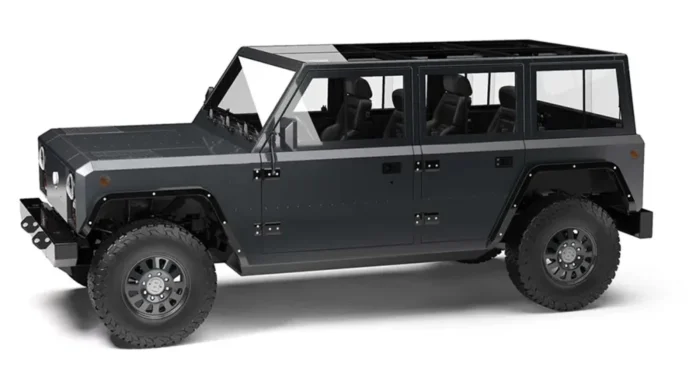

Quick Facts:
- Company: Bollinger Motors
- Founded: 2014 by Robert Bollinger in Hobart, New York
- Flagship Vehicles: B1 SUV and B2 pickup, 614 hp, 200-mile range
- Original Price: $125,000 base
- Parent Company: Mullen Automotive (now Bollinger Innovations), acquired 2022
- Shutdown Date: November 21, 2025
- Auction Date: May 13, 2026 (427 lots, 20 trucks, $1 starting bids)
- Best for: EV history buffs and anyone tracking the Bollinger Motors collapse
9 min read
In This Article
- A Cult EV Truck Goes to Auction
- Bollinger Motors Timeline at a Glance
- Robert Bollinger and the Catskills Origin Story
- The Boxy B1 and B2 That Captured Off-Roaders
- The Mullen Takeover and the Commercial Pivot
- The Final Year and the Bollinger Motors Collapse
- The May 2026 Court-Ordered Auction
- Pros and Cons of the Bollinger Legacy
- Final Verdict
- Frequently Asked Questions
A Cult EV Truck Goes to Auction
The Bollinger Motors collapse ends a decade-long ride from cult EV darling to court-ordered liquidation. On May 13, 2026, Michigan-based Maynards Industries will auction off everything the failed startup owned, including 20 Class 4 electric trucks, with bids starting at $1 (according to Robb Report). The proceeds go to unpaid suppliers, workers, and the state of Michigan.
I followed Bollinger Motors from the beginning. When the B1 prototype broke cover in 2017, the boxy silhouette grabbed my attention immediately. Sure, it looked angular and unapologetic, but I kind of liked it. Most EV designers were chasing slippery aerodynamic blobs. Bollinger went the other direction with a shape lifted straight from a child’s drawing of a truck. As someone who has owned a Jeep Gladiator and a Chevy Colorado ZR2, and rented a Ford Bronco Badlands across the Mojave, I appreciated the honesty of the design.
However, the auction tells a different story than the early hype. Suppliers are owed millions. Workers filed 70 wage claims with Michigan’s Department of Labor. The state is clawing back nearly $1 million of a $3 million grant. The boxy promise of a “G-Wagon meets Bronco” electric off-roader gave way to a corporate mess which hollowed out the original vision.
Bollinger Motors Timeline at a Glance
| Date | Milestone |
|---|---|
| 2014 | Bollinger Motors founded by Robert Bollinger in Hobart, NY |
| September 2017 | B1 three-door SUV prototype unveiled |
| September 2019 | Five-door B1 and B2 pickup revealed, 614 hp, 200-mile range |
| January 2022 | B1 and B2 production suspended indefinitely |
| September 2022 | Mullen Automotive acquires controlling stake (~95%) |
| September 2024 | B4 Class 4 commercial truck enters production with Roush Industries |
| May 2025 | Federal court places Bollinger in receivership after founder’s $10M loan lawsuit |
| June 2025 | Emerges from receivership; Mullen rebrands as Bollinger Innovations |
| October 2025 | Bollinger Innovations delisted from Nasdaq |
| November 21, 2025 | Bollinger Motors officially shuts down |
| January 2026 | Returned to receivership; 20 trucks seized |
| March 2026 | Robert Bollinger buys back B1 and B2 IP and prototypes for $250,000 |
| May 13, 2026 | Court-ordered auction of 427 lots, including 20 trucks |
Robert Bollinger and the Catskills Origin Story
Robert Bollinger grew up outside Pittsburgh, drawing cars and dreaming of starting his own company. He earned a degree in industrial and product design from Carnegie Mellon University, then spent most of his career in personal-care branding. He helped grow John Masters Organics into a recognizable brand before selling his stake and moving to a farm in Hobart, New York, a small town in the Catskills.
The truck idea came from the farm. While running grass-fed beef operations with Simon Martinez, Robert Bollinger needed a work vehicle. Every truck on the market felt like a compromise. Gas pickups were noisy and inefficient. Diesels required maintenance he wanted to avoid. Existing EVs lacked utility. Therefore, he sketched what he wanted himself.
The Bollinger Motors office was a converted barn on his Hobart property. The team built the first B1 prototype with help from Hi-Tech Automotive contractors. By the time the prototype rolled out in 2017, the company had no factory, no investors of scale, and no production timeline. Still, the brand earned attention from Wired, MotorTrend, and the EV enthusiast community within months of the unveil.
The Boxy B1 and B2 That Captured Off-Roaders
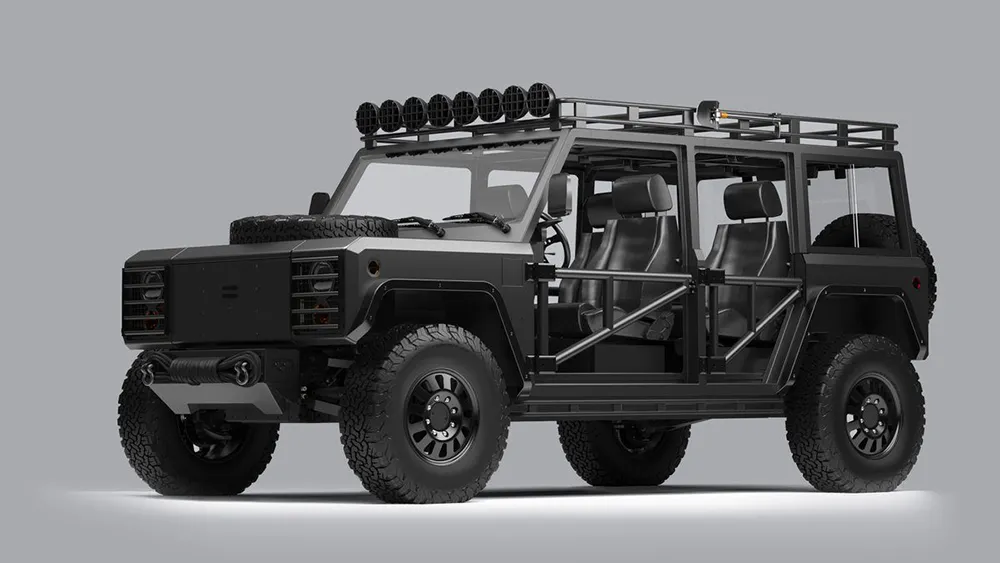
The 2017 B1 prototype was a three-door, four-wheel-drive electric SUV with 360 horsepower and an announced range of up to 200 miles on the larger 120 kWh battery. Bollinger pitched it as a no-compromise utility vehicle: removable doors, removable roof panels, a flat load floor, and a pass-through swallowing 16-foot 2x4s. The look split the room. Some thought it crude. Others, including me, found the rejection of EV-blob design refreshing.
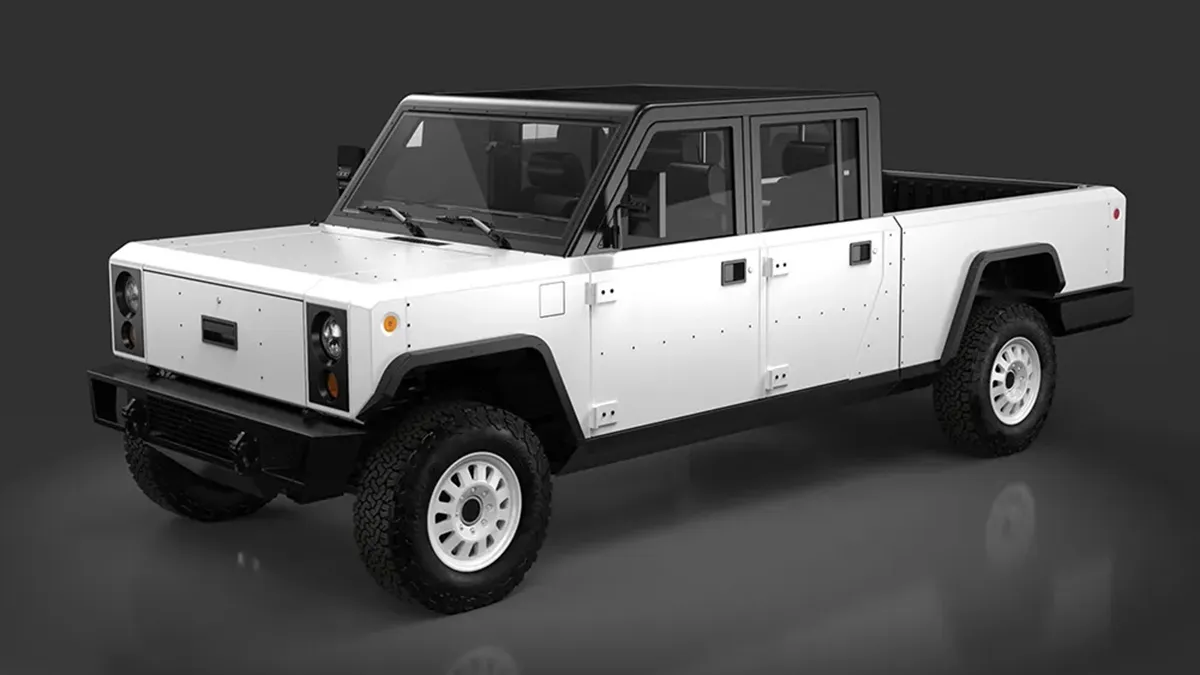
By 2019, Bollinger had revised the design into a five-door B1 SUV and added the B2 pickup truck. Both vehicles upgraded to dual motors producing 614 horsepower and 905 Nm of torque. Curb weight came in at 5,000 pounds. Price climbed to $125,000 base. For context, the figure landed between a loaded Rivian R1S and the eventual Hummer EV pickup.
However, the production timeline kept slipping. Initially targeting late 2020 production with early 2021 sales, Bollinger pushed deadlines repeatedly. In January 2022, the company announced production was suspended indefinitely, according to Car and Driver. Pre-order deposits sat in limbo. The consumer EV truck market was filling up fast with Rivian, Tesla Cybertruck, Ford F-150 Lightning, and Hummer EV. Bollinger needed capital and a path to scale.
The Mullen Takeover and the Commercial Pivot
In September 2022, California-based Mullen Automotive acquired a controlling stake in Bollinger Motors, eventually growing the position to roughly 95%. Mullen, led by CEO David Michery, brought capital but also brought baggage. The company had been a public meme stock since 2021, with an accumulated deficit exceeding $2 billion and nine reverse stock splits between 2022 and 2025 (according to the Detroit News).
Under Mullen ownership, Bollinger pivoted away from consumer SUVs and trucks toward Class 3 through Class 6 commercial electric vehicles. The B4 cab-forward truck became the new flagship, targeting fleet buyers in delivery, utility, and municipal work. In September 2024, Bollinger started B4 production with contract manufacturer Roush Industries in Livonia, Michigan. The state had committed a $3 million Michigan Economic Development Corporation grant tied to creating 237 jobs and investing $44 million in the metro Detroit area.
For a moment, the pivot looked workable. Customer orders came in. Founder Robert Bollinger, still chairman at the time, told a launch crowd in September 2024, “The odds of us getting to this point are so astronomically against us, and we actually did it.” Then everything unraveled.
The Final Year and the Bollinger Motors Collapse
The Bollinger Motors collapse accelerated in May 2025 when Robert Bollinger sued Mullen to recover a $10 million loan he had given the company. He warned in court filings about Bollinger heading toward insolvency, putting his money at risk. A federal judge placed the truck maker into receivership. Production halted. Rent went unpaid. Suppliers filed liens.
In June 2025, Mullen paid off the loan, settled supplier claims, and pulled Bollinger out of receivership. Mullen rebranded itself as Bollinger Innovations and pledged to keep the truck maker operating. Robert Bollinger exited the company entirely. CEO David Michery promised to restart B4 production at a Mississippi plant and revive the B1 and B2 as potential Humvee replacements for the military.
However, the cash never arrived. Through summer and fall 2025, Bollinger Innovations missed payrolls, terminated its contract with Roush, and faced at least six new supplier lawsuits in Oakland County. In October 2025, Bollinger Innovations was delisted from Nasdaq after dropping below the $1 share threshold despite nine reverse stock splits. On November 21, 2025, HR Director Helen Watson sent the goodbye email to staff: “We are to officially close the doors of Bollinger Motors, effective today” (via FreightWaves).
The May 2026 Court-Ordered Auction
The auction runs May 13, 2026, with 427 individual lots crossing the block. Maynards Industries oversees the sale on behalf of the court. Among the highlights are 17 examples of the B4 Class 4 cab-forward truck plus three additional B4 units used for testing. Other lots include tools, a high-voltage battery tester, and individual manufacturing equipment from the Oak Park facility.
Bidding starts at $1 per lot, though winning bidders pay a 20% buyer’s premium plus 6% Michigan sales tax. The B1 and B2 prototypes and intellectual property already left the auction pool. In March 2026, founder Robert Bollinger personally bought back those assets for $250,000. He has not announced plans to revive production, though his website still describes the design philosophy as “every truck on the market was a compromise.”
If you do buy a B4 at the auction, the warranty is gone. Factory service ended when the company closed. Parts supply depends on whoever assembles the remains of the dealer network. For collectors and history buffs, however, the trucks represent a tangible piece of EV-startup-era ambition.
Pros and Cons of the Bollinger Legacy
Pros
- Distinctive boxy design rejected aerodynamic-blob conventions
- 614 hp and 200-mile range competitive with Rivian R1T at debut
- Removable doors, roof, and panels offered real off-road utility
- 16-foot pass-through tunnel was a class-exclusive feature
- Inspired competing concepts from established OEMs
- B4 commercial truck reached actual production in 2024
Cons
- Consumer B1 and B2 never reached production after 7+ years
- $125,000 base price priced out most off-road buyers
- Mullen ownership brought $2B+ accumulated deficit and meme-stock instability
- 70 wage claims filed by former employees with Michigan
- $3M state grant clawback after job promises fell short
- CEO David Michery collected $49.6M in 2023 comp during financial decline
Final Verdict
The Bollinger Motors collapse is a case study in how a strong design vision survives 10 years and one parent-company change before financial mismanagement at the corporate level ends it. If you cared about the B1 or B2 specifically, the good news is the intellectual property is back with Robert Bollinger. Whether he revives the design depends on capital he has not yet announced.
The harder news is for suppliers, the 70 former employees pursuing wage claims, and the state of Michigan trying to recover the grant money. Bollinger Innovations sits at a court-ordered fire sale while parent-company CEO David Michery faces shareholder lawsuits alleging the company “functions as a personal slush fund.” For anyone hoping the auction signals a fresh start, the broader EV-startup environment offers little reason for optimism. Lordstown, Canoo, Faraday Future, and Fisker all faced similar pressure under the current Trump administration’s rollback of EV incentives.
If the May 13 auction interests you as a collector, treat the B4 like a unicorn with no factory backing. Parts, warranty, and service are gone. A more practical option for a working electric truck in 2026 is the Rivian R1T, the Ford F-150 Lightning, or for commercial use, the Brightdrop Zevo or Ford E-Transit.
For now, the Bollinger legacy lives in the prototypes Robert Bollinger bought back, the cult of original B1 enthusiasts, and a cautionary tale about what happens when a strong product vision marries a weak balance sheet.
Frequently Asked Questions
Why did Bollinger Motors go out of business?
Bollinger Motors shut down November 21, 2025, after months of missed payroll, supplier lawsuits, and failed funding rounds under parent company Bollinger Innovations (formerly Mullen Automotive). The Bollinger Motors collapse traced back to a $2 billion accumulated deficit at the parent level, nine reverse stock splits, and the loss of Nasdaq listing in October 2025.
Who owns the Bollinger B1 and B2 designs now?
Founder Robert Bollinger bought back the B1 and B2 intellectual property and physical prototypes from the receivership in March 2026 for $250,000. He has not announced plans to restart consumer-truck production, but he retains all rights to the original off-road EV designs.
How much does a Bollinger B4 truck cost at the auction?
Bidding for each B4 starts at $1 per lot at the May 13, 2026, Maynards Industries auction. Winning bidders pay a 20% buyer’s premium plus 6% Michigan sales tax. Without factory service or warranty support, the practical value depends on the buyer’s ability to source parts independently.
What happened to Mullen Automotive?
Mullen Automotive renamed itself Bollinger Innovations in June 2025 after acquiring control of Bollinger Motors. The company was delisted from Nasdaq in October 2025 and now trades on the OTC market. Multiple shareholder lawsuits allege CEO David Michery received over $50 million in compensation while the company lost more than $2 billion since going public in 2021.
Will Robert Bollinger restart the company?
Robert Bollinger has not publicly committed to relaunching Bollinger Motors. He bought back the B1 and B2 IP in March 2026 and still maintains a personal website describing his design philosophy. Any revival would require fresh capital and a new corporate structure separate from the failed Bollinger Innovations entity.
How does the Bollinger collapse compare to other EV startup failures?
The Bollinger Motors collapse mirrors Lordstown Motors, Canoo, Fisker, and Faraday Future in pattern: prototype hype, repeated production delays, capital problems, then bankruptcy. Bollinger differed by reaching actual B4 production volume in 2024 before failing. Most EV startups never reach the production stage at all.