


Quick Verdict: The best inflatable tents for camping in 2026 depend on your budget, group size, and camping style. Prices in this roundup range from $700 to $6,800 across eight air tents from six manufacturers. Setup times run 1-5 minutes with a pump, compared to 15-30 minutes for pole tents. I personally tested four of these tents in the field; four more were selected through extensive market research. Floor space spans 54 to 185 square feet, and weights range from 12 lbs for the ultralight Heimplanet Cave XL to 165 lbs for the Sonmez MAXIA 480.
Last updated: July 2026 | 20 min read
In This Review
- Best Inflatable Tent Overview: What Changed in 2026
- Key Specs Comparison Table
- Sonmez LONDON MAXIA 480: Premium Basecamp Tent
- Sonmez LONDON 360: Mid-Range Best Inflatable Tent Pick
- RBM Outdoors Panda Air Large: Best Inflatable Hot Tent
- RBM Outdoors Panda Air Medium: Compact 4-Season Pick
- Heimplanet The Cave XL: Ultralight Blow Up Tent
- Zempire Aerospeed 6: Best Value Air Tent
- Coody Familia 13.6: Modular Inflatable Cabin Tent
- Sonmez AIR BUSHCRAFT Premium: Compact Luxury Pick
- Zonkoo Orion: Best Budget Inflatable Hot Tent
- Zonkoo Vega: Roomy Inflatable Tent for Families
- How Inflatable Tents Work
- Quick Buying Guide by Budget
- How to Choose the Right Inflatable Tent
- Inflatable vs. Pole Tents: Which Is Better?
- Pros and Cons of Inflatable Tents
- Final Verdict
- Frequently Asked Questions
Several tents in this roundup double as inflatable hot tents. For broader four-season context across canvas, dome, and inflatable form factors, see our guide to the best four-season tents with stove jacks.
Prefer to sleep on solid ground? Our roundup of the best ground tents of 2026 covers six top picks from hands-on testing, including four-season dome tents and canvas wall builds.
| Best for Winter | Best Budget 4-Season | Best Ultralight | |
|---|---|---|---|
| Product | TOP PICK RBM Panda Air Large RBM Panda Air Large |  RBM Panda Air RBM Panda Air |  Heimplanet Cave XL V2 Heimplanet Cave XL V2 |
| Rating | ★★★★★ 4.8 68 ratings | ★★★★★ 4.8 68 ratings | ★★★★★ 4.8 5 ratings |
| Capacity | 6 person | 4 person | 3 person |
| Floor Space | 129.2 sq ft | 71 sq ft | 54 sq ft |
| Weight | 105.8 lbs | 77.2 lbs | 11.9 lbs |
| Price | $1,779.00 as of Oct 25, 4:48 am | $1,089.00 as of Oct 25, 6:58 am | $1,299.00 as of Oct 25, 6:58 am |
| Check Price → | Check Price → | Check Price → |
Best Inflatable Tent for Camping: What Changed in 2026
I’ve been camping for well over four decades, starting with traditional ground tents in the 70s. After years of wrestling with fiberglass poles and bent aluminum stakes, I graduated to inflatable tents three years ago. The best inflatable tent today sets up in 1-5 minutes with a pump, holds its shape in 40+ mph winds, and packs down smaller than most pole tent equivalents. Since our guide to inflatable camping tents published in 2024, the technology has improved considerably.
Specifically, for this 2026 update, I personally tested six tents from Sonmez Outdoors, ZONKOO, and RBM Outdoors in the field.
I also researched four more models from Heimplanet, Zempire, Coody, and Sonmez’s newer lineup based on manufacturer specs, verified owner feedback, and industry reviews. Where I haven’t personally tested a tent, I note it clearly so you know the difference.
Compared to last year, three trends stand out. First, air beam technology now handles higher wind loads; the Heimplanet Cave XL uses a geodesic inflatable diamond grid rated for extreme wind conditions. Second, stove jack integration on inflatable tents from RBM and Coody has turned blow up tents into legitimate four-season shelters.
Third, prices have dropped at the entry level, with the Zempire Aerospeed 6 starting at $700 for a quality 6-person air tent available at REI.
Whether you’re overlanding solo, camping with family, or setting up a winter basecamp with a diesel heater, at least one of these eight inflatable camping tents fits your setup. Check the comparison table below for a side-by-side spec breakdown, then read each review for the full picture.
Key Specs Comparison Table
| Tent | Price | Capacity | Floor Space | Weight | Setup Time | Seasons | Tested |
|---|---|---|---|---|---|---|---|
| Sonmez MAXIA 480 | $6,800 | 14 person | 185.1 sq ft | 165 lbs | ~5 min | 4-season | Hands-On |
| Sonmez 360 | $3,500 | 10 person | 118.4 sq ft | 132 lbs | ~5 min | 4-season | Hands-On |
| RBM Panda Air Large | $1,569 | 6 person | 129.2 sq ft | 105.8 lbs | ~4 min | 4-season | Hands-On |
| RBM Panda Air Medium | $1,000 | 4 person | 71.0 sq ft | 77.2 lbs | ~3 min | 4-season | Hands-On |
| Heimplanet Cave XL | $1,356 | 3 person | 54 sq ft | 11.9 lbs | <1 min | 3-season | Researched |
| Zempire Aerospeed 6 | $700 | 6 person | ~86 sq ft | ~24 lbs | <2 min | 3-season | Researched |
| Coody Familia 13.6 | $1,949 | 8 person | ~146 sq ft | ~121 lbs | ~5 min | 4-season | Researched |
| Sonmez AIR BUSHCRAFT | $1,650 | 4 person | ~86 sq ft | ~66 lbs | ~1 min | 4-season | Researched |
| Zonkoo Orion | $900 | 4 person | 86 sq ft | 93 lbs | ~7 min | 4-season | Hands-On |
| Zonkoo Vega | $1,300 | 6 person | 116 sq ft | 117 lbs | ~11 min | 3-season | Hands-On |
Sonmez LONDON MAXIA 480: The Best Inflatable Tent for Group Basecamps

I’ve spent three years testing inflatable tents, and the Sonmez LONDON MAXIA 480 is what group camping looks like when budget takes a back seat to comfort. At $6,800 and 185.1 square feet of floor space, this blow up tent sleeps 14 people with full standing headroom throughout. Sonmez manufactures these in Turkey using heavy-duty 210D ripstop Oxford fabric with a 3,000mm waterproof rating and fully taped seams. Reinforced TPU air beams inflate with the included electric pump in roughly 5 minutes.

The moment I first walked inside this tent, my jaw dropped.
In fact, fourteen windows flood the interior with natural light, and the space feels more like a cabin than a tent. During our testing near Big Bear, heavy rain hammered the MAXIA 480 for two straight nights. Not a single drop made it through. Condensation stayed minimal even in humid conditions, because the ventilation design moves air through all 14 window panels simultaneously.
Should Your Group Invest in This Basecamp Tent?
At 165 lbs packed, you need a truck or SUV to haul this tent. It is not for backpackers or minimalists. However, for overlanders with vehicle cargo capacity, the MAXIA 480 pays off during multi-day camps. Removable interior partitions divide the space into separate sleeping and living areas, giving families privacy at night while maintaining a communal area during the day. Interior height exceeds 7 feet at the center peak.
The trade-off is price and footprint. You need a large campsite and $6,800. For groups of 6-14 planning extended basecamps, the MAXIA 480 is the best inflatable tent in the premium tier. Smaller groups should look at the Sonmez 360 or the Coody Familia below. For the complete breakdown on this model, read our full Sonmez tent review.
Sonmez Outdoors
LONDON MAXIA 480: 185 sq ft of Basecamp Living
14-person capacity, 14 windows, 100% waterproof, electric pump included. The largest best inflatable tent in our roundup.
Sonmez LONDON 360: Best Inflatable Tent for Mid-Range Budgets
I consider the LONDON 360 the sweet spot in the Sonmez catalog. At $3,500, it offers 118.4 square feet of floor space for up to 10 people with nearly the same build quality and materials as the MAXIA 480. You get 100% waterproof 210D ripstop fabric and sealed seams at roughly half the price of the flagship model.

The panoramic roof design separates this tent from everything else on the market. Multiple clear panels across the top section let natural light flood the interior during the day. On our first clear night testing this tent, my wife and I laid there staring at the stars without leaving the shelter. It changed how I think about tent design. Ventilation panels along the sidewalls keep air moving, reducing condensation even in humid coastal conditions.
Stargazing and Remote Work: The Real-World Setup
At 132 lbs, the 360 model weighs less than the MAXIA 480 while still offering serious floor space. Setup followed the same 5-minute inflation process with the included electric pump. During a coastal camping trip, the tent held firm through sustained 30 mph winds, and the guy-out points kept everything stable throughout the night.

For overlanders running Starlink satellite internet at camp, this tent’s size and layout create a genuine mobile living space. You set up work areas, sleeping quarters, and a common area all under one roof. Among the best inflatable tent options in the $3,000-$4,000 range, the 360 hits the balance between space and portability for groups of 4-8 people. For a deeper look, check our Sonmez LONDON 360 full review.

Sonmez Outdoors
LONDON 360: Panoramic Roof at $3,500
10-person capacity, stargazing roof panels, 118.4 sq ft. The mid-range sweet spot in the Sonmez lineup.
RBM Outdoors Panda Air Large: Best Inflatable Hot Tent for Winter
The first time I ran a wood stove inside the RBM Panda Air Large, everything changed about how I think about winter camping. My wife and I sat in shirtsleeves at midnight in November, warm and dry in near-freezing conditions. Overall, at $1,569 this is the best inflatable tent for cold-weather camping in the entire roundup. RBM Outdoors (formerly Russian Bear) builds their tents with breathable Terylene cotton canvas and integrates a stove jack directly into the tent body.

You run a wood stove or portable diesel heater inside the tent for four-season warmth. Notably, no other inflatable tent at this price offers stove-compatible shelter.
At 129.17 square feet and a 6-person capacity, the Panda Air Large provides full walk-in height with a peaked roof. Additionally, the canvas fabric breathes better than synthetic alternatives, which keeps condensation from building up when running a heater inside. RBM’s air beam system inflated in roughly 4 minutes with a hand pump.
RBM Outdoors Panda Large Inflatable Tents for Camping, Canvas Airtent Beige | Inflatable Tent House for Camping, Hot Tent, Blow Up Tent with Skylight, Fast Setup, Air Beam, Pump Included, Multiple Sizes
The only air tent in this roundup that safely runs a wood stove, turning near-freezing nights into shirtsleeve evenings.
- Breathable Terylene cotton canvas handles stove heat without melting
- Stove jack integrated directly into the tent body
- Full walk-in height under a peaked roof
- Canvas blocks UV to keep the interior cooler in summer
- At 105.8 lbs, it needs a truck or SUV to haul
- Pre-2025 door seal let in drafts during strong crosswinds
The Draft Fix and Winter Field Testing
At 105.82 lbs, the Panda Air Large sits in the mid-weight range. Cotton canvas weighs more than nylon, but it handles heat from a stove without melting or degrading. During my testing, I noticed one minor issue: the door seal on the Large model allowed slight drafts in strong crosswinds. RBM addressed this in their 2025 revision with improved door overlap, and the fix works.

For winter overlanders and anyone running a tent stove, the Panda Air Large delivers genuine four-season capability at a fraction of premium pricing. Canvas also blocks UV better than nylon, keeping interior temperatures cooler in summer. Consequently, this is one of the few best inflatable tent picks for true year-round use. Read our full RBM Panda inflatable tent review for additional details. For related winter camping setups, see our inflatable hot tent guide.
RBM Outdoors Panda Air Medium: Compact 4-Season Inflatable Tent
At $1,000, the RBM Panda Air Medium is the most affordable four-season air tent in this roundup. It provides 71.04 square feet of floor space with the same canvas construction and stove jack as the Panda Large. For couples or solo overlanders who want winter capability without hauling a 6-person tent, the Medium hits the mark.

I tested the Panda Air Medium during a fall trip with temperatures dropping into the low 40s at night. Combined with a small diesel heater, the interior stayed at a comfortable 65 degrees. Inflation took approximately 3 minutes with the included hand pump. At 77.16 lbs, it packs down to a manageable size for mid-size SUVs and trucks.
RBM Outdoors Panda Medium Inflatable Tents for Camping Canvas Airtent Beige | Inflatable Tent House for Camping, Hot Tent, Blow Up Tent with Skylight, Fast Setup, Air Beam, Pump Included, Multiple Sizes
The most affordable four-season air tent in this roundup; add a small stove or diesel heater and it stays comfortable when nights drop into the low 40s.
- Same stove-jack canvas construction as the Panda Air Large
- Inflates in about 3 minutes with the included hand pump
- Packs down small enough for mid-size SUVs and trucks
- Canvas breathes well with the doors open in summer
- Realistically sleeps 2 adults with gear despite the 4-person rating
Is This Warm Enough for Couples?
Yes, with a stove. The Panda Air Medium delivers the best dollar-per-feature ratio for winter camping in this list. Compared to the Large, you lose 58 square feet of floor space and 2-person capacity, but you save $569 and shed 28 lbs of pack weight. Canvas breathes well in summer with the doors open, too, keeping interior temperatures reasonable even in direct sun.

Realistically, this tent comfortably sleeps 2 adults with gear, despite the 4-person rating. For a couple who camps in cold weather, the Panda Air Medium with a stove setup creates a warm, dry shelter below the price of most 3-season pole tents. Therefore, it earns a spot among the best inflatable tent picks for budget winter camping. See our article on the best RBM Outdoors tents we’ve tested for more details.
Heimplanet The Cave XL: Ultralight Blow Up Tent for Overlanders
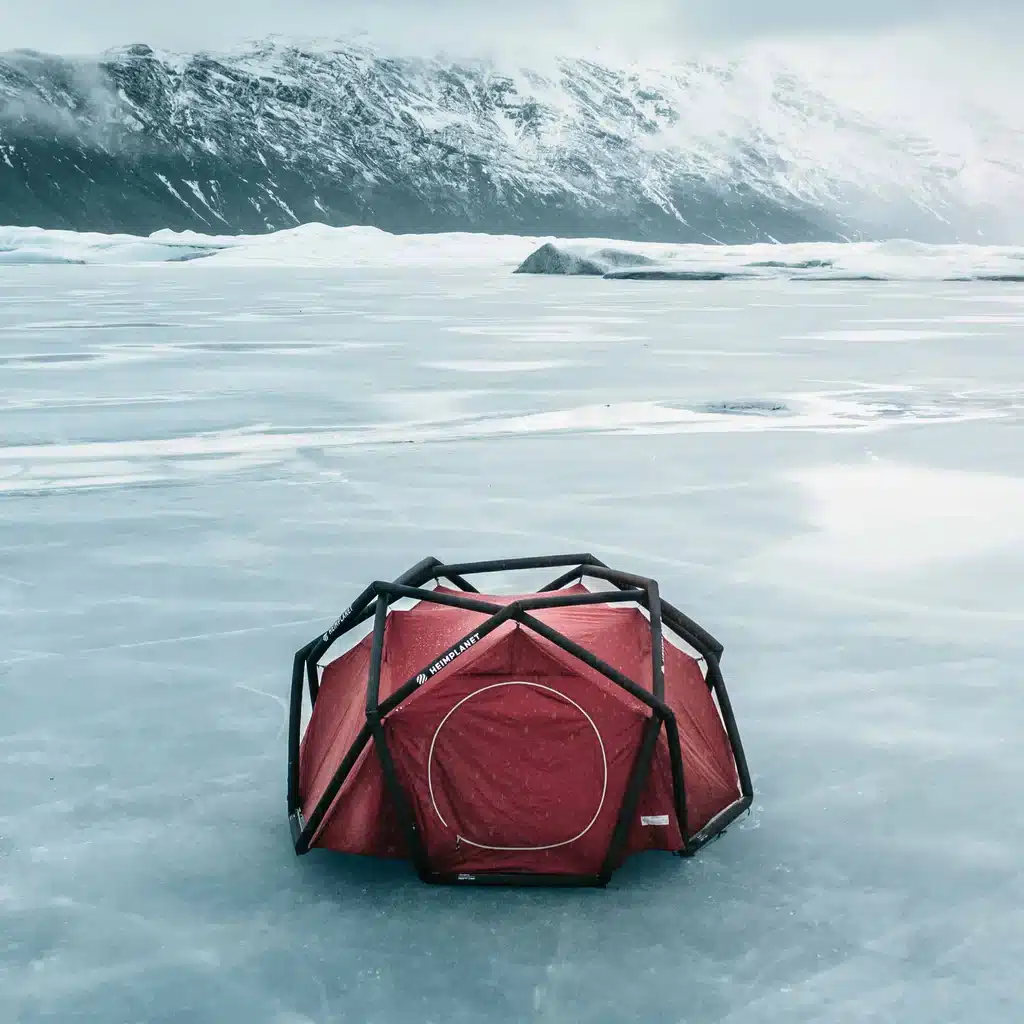
I haven’t tested the Heimplanet in the field (they’re tough to source in the US), but the specs are verified and owner reviews are consistently strong.
The Heimplanet Cave XL weighs 11.9 lbs. For a fully inflatable 3-person tent with a geodesic structure, nothing else in the blow up tent category comes close on weight. At $1,356, this German-engineered tent uses Heimplanet’s patented Inflatable Diamond Grid (IDG) technology, creating a multi-chamber geodesic frame from a single inflation point. Setup takes under 60 seconds.

The IDG system provides built-in redundancy. If one chamber deflates from a puncture, the remaining chambers maintain the tent’s shape. Heimplanet literature references wind resistance up to 180 km/h (112 mph) for their IDG technology, which exceeds every other inflatable camping tent in this roundup. Additionally, the 5,000mm waterproof rating handles heavy rain, and dual-layer construction reduces condensation.
HEIMPLANET Original | THE CAVE XL V2, 3 Person Tent | Inflatable Camping Tent | Outer Tent and Tent Floor - 5000mm | No Tent Poles Required | Supports 1% for The Planet
Nothing else in the blow up tent category comes close at this weight, and the IDG frame is rated for extreme wind.
- 11.9 lbs, light enough for a backpack or motorcycle pannier
- Geodesic diamond grid inflates from a single point in under 60 seconds
- Multi-chamber redundancy holds shape if one beam punctures
- 5,000mm waterproof rating with dual-layer condensation control
- 3-season only, with no stove jack
- 54 sq ft is tight for three adults
Who Should Buy This Ultralight Air Tent?
At 54 square feet and a 3-person capacity, the Cave XL is the smallest tent here. It targets solo overlanders or couples who want rapid camp setup after a long day on the trail. The compact packed size fits into a backpack, making it the only air tent in this list suitable for motorcycle overlanding or lightweight vehicle camping.
Consider the trade-offs, though: limited space and no winter capability. This is a 3-season tent with no stove jack and limited interior room. For overlanders who prioritize speed, weight, and wind resistance over living space, the Heimplanet Cave XL delivers performance unmatched at its weight class. A 4-season insulated version starts at approximately $1,800.
Zempire Aerospeed 6: Best Value Air Tent Under $1,000
Haven’t personally tested the Zempire, but REI’s return policy gives you confidence, and the specs hold up against everything I’ve field-tested.
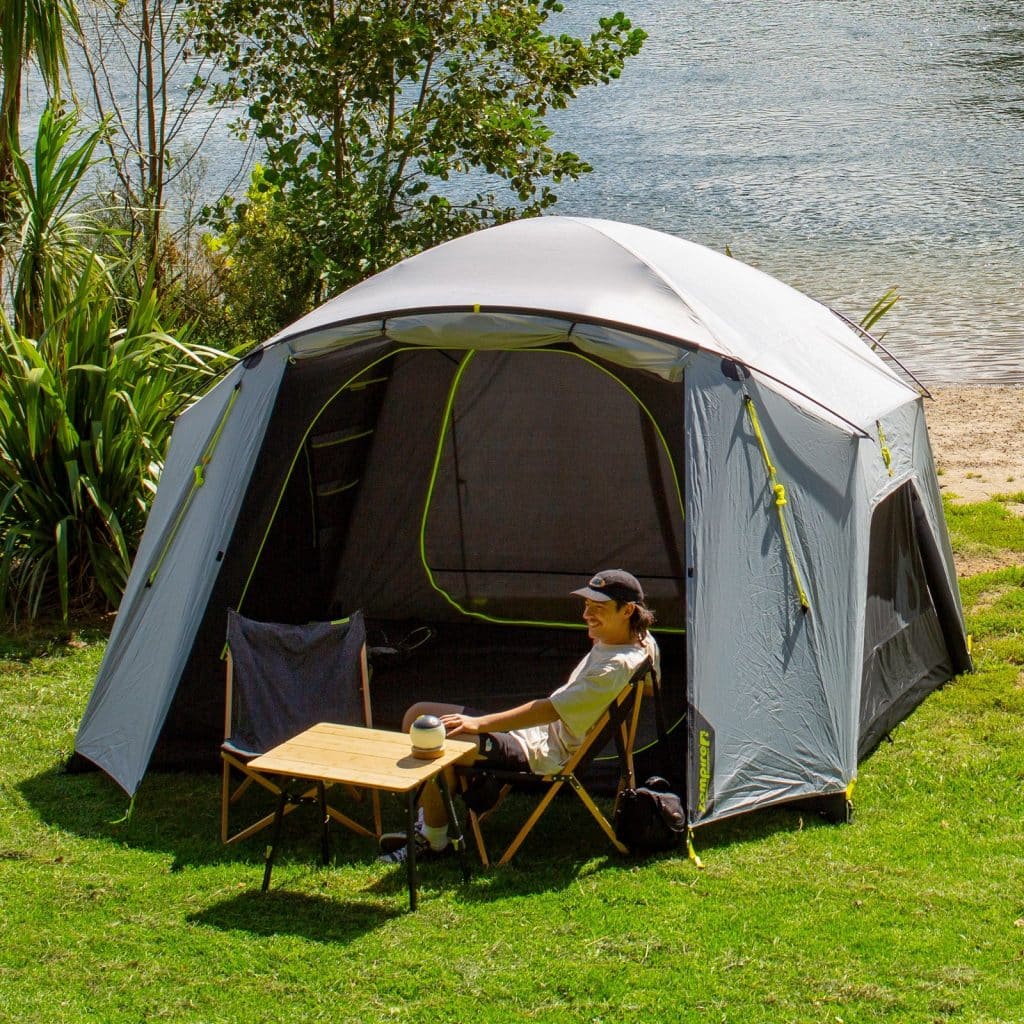
The Zempire Aerospeed 6 from New Zealand starts at $700, making it the most affordable 6-person air tent in this roundup. Zempire sells through REI in the United States, giving buyers easy access to returns and customer support. At roughly 24 lbs with a sub-2-minute inflation time, the Aerospeed 6 offers the best weight-to-capacity ratio among budget-friendly inflatable camping tents.
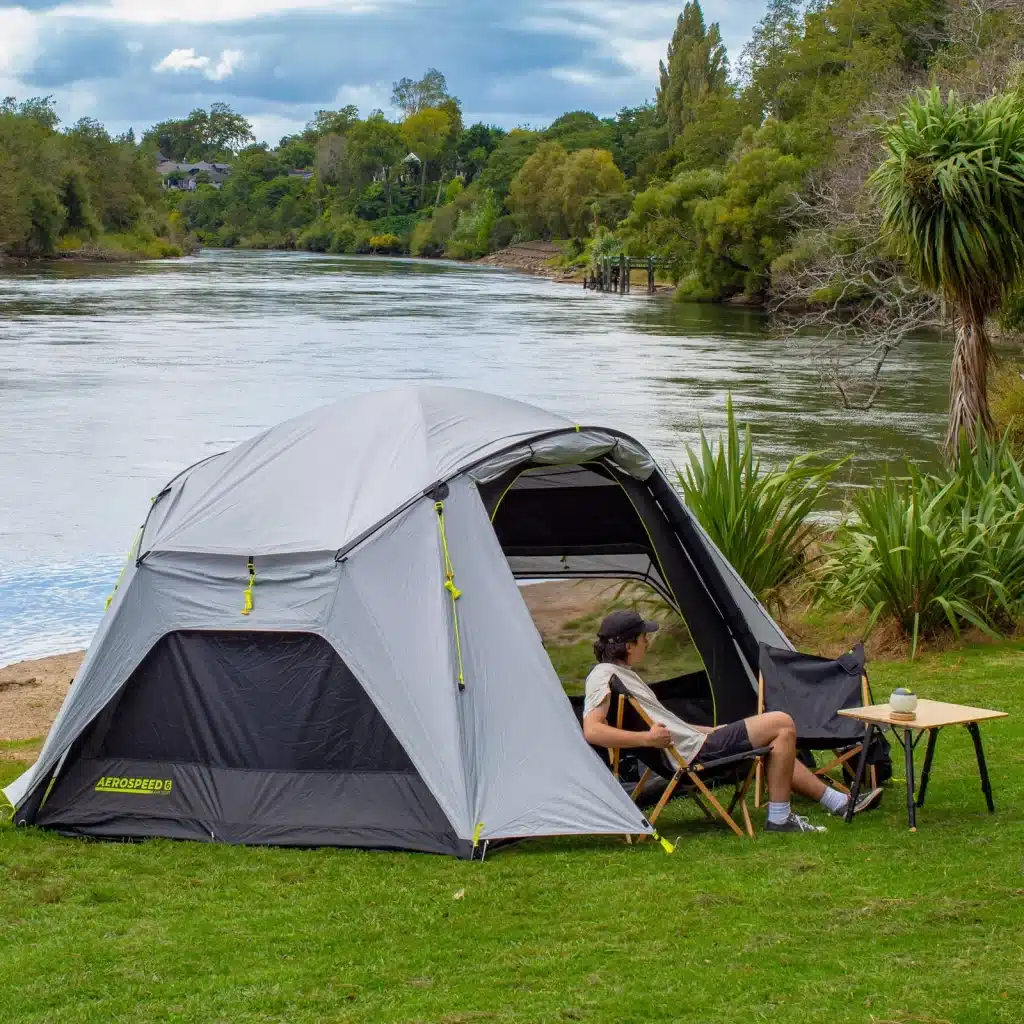
Zempire’s air frame system uses pre-attached fly sheets. Inflate, stake, done. No separate rainfly fumbling. The 88-inch peak height provides comfortable standing room, and the 6-person capacity accommodates a family of four with gear space to spare. As a result, it ranks as one of the best inflatable tent options for families on a tight budget.
Where the Aerospeed 6 Falls Short
Since this is a 3-season tent with nylon construction, it lacks the winter capabilities of RBM’s canvas models. There is no stove jack, and nylon breathes less freely than cotton canvas in hot weather. Still, for spring-through-fall camping where fast setup and light weight matter, the Zempire Aerospeed 6 costs less than any other air tent here while delivering 6-person capacity.
Coody Familia 13.6: Modular Inflatable Cabin Tent
I haven’t gotten my hands on a Coody yet, but owner reviews and the spec sheet tell a compelling story for families.
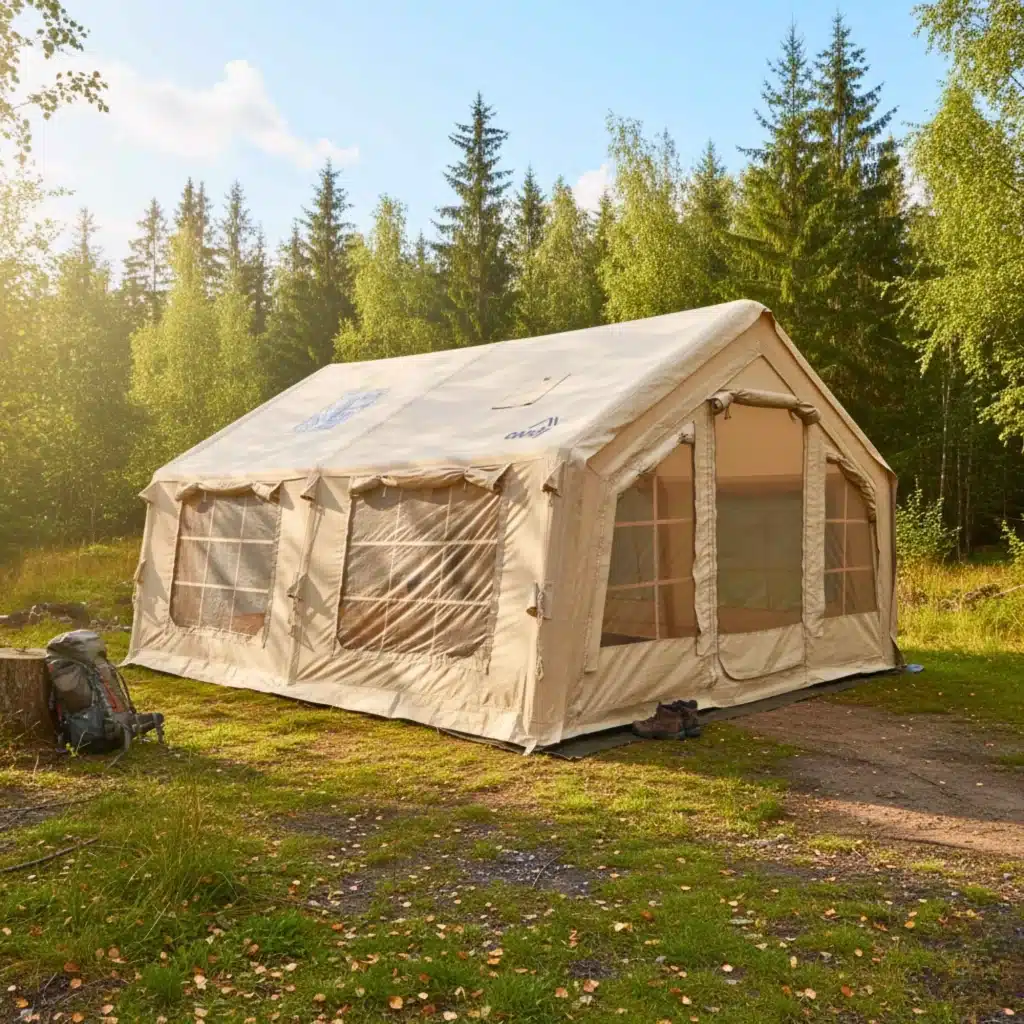
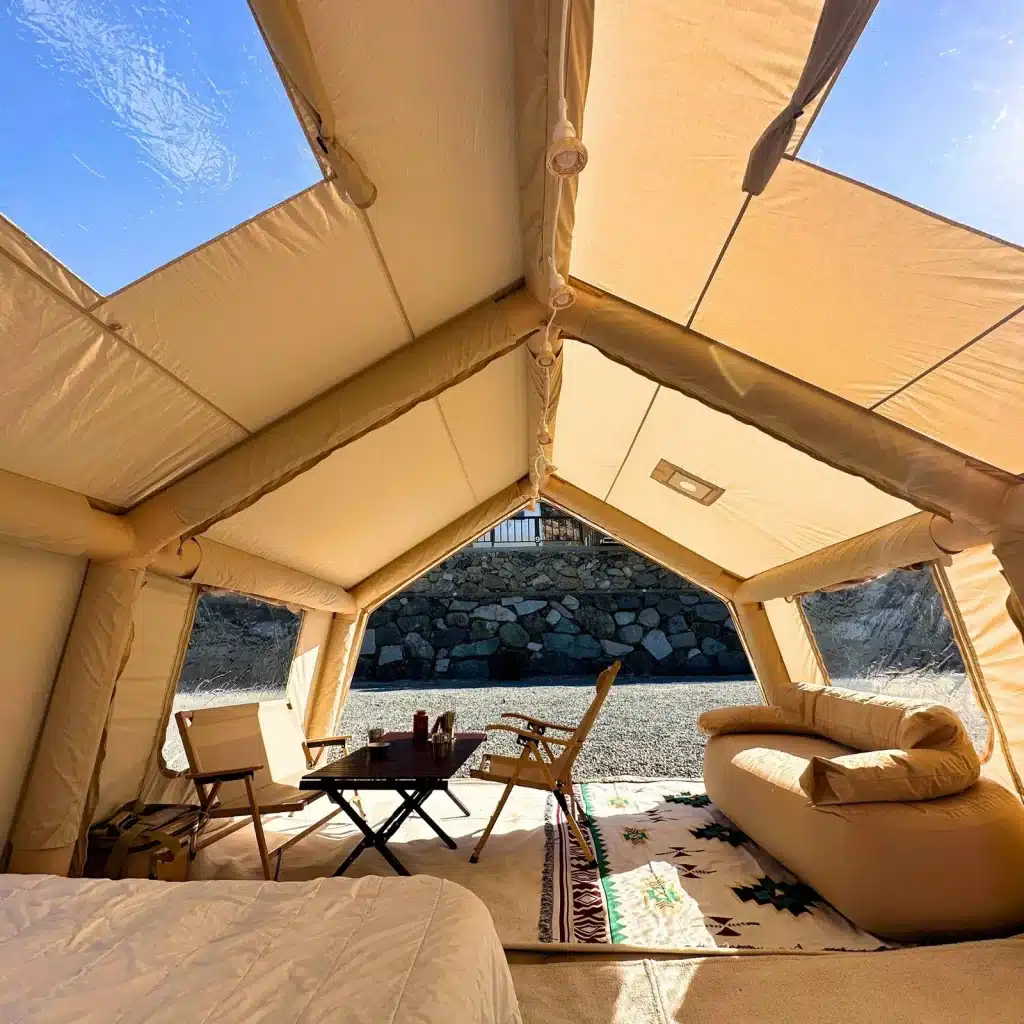
The Coody Familia 13.6 at $1,949 offers something unique in the inflatable tent market: a modular interior. This South Korean manufacturer builds 8-person air tents with configurable room dividers, allowing you to set up separate sleeping areas, a living room section, or one open floor plan. Approximately 146 square feet of floor space accommodates large groups comfortably, and an optional stove jack turns it into a winter shelter.
Coody distributes through Hot-Tent.com in the US (the same retailer carrying RBM Outdoors). At roughly 121 lbs, the tent inflates with a hand pump or electric pump in approximately 5 minutes. Construction uses premium TC canvas materials rated for all-season use. Notably, the Familia 13.6 costs $1,551 less than the Sonmez 360 while offering more floor space, which makes it one of the best inflatable tent values for large families.
The Family Camping Sweet Spot
The Coody Familia 13.6 bridges the gap between the RBM Panda’s winter capability and the Sonmez lineup’s interior comfort. Families and groups of 4-6 who want room dividers, stove jack compatibility, and sub-$2,000 pricing should give this model a serious look. The modular layout also works well as a base camp shelter for multi-day overlanding trips where you need separated living and sleeping areas. Compared to similarly sized pole tents, the 5-minute inflation setup saves significant time after long driving days.
Sonmez AIR BUSHCRAFT Premium: Compact Luxury Inflatable Tent
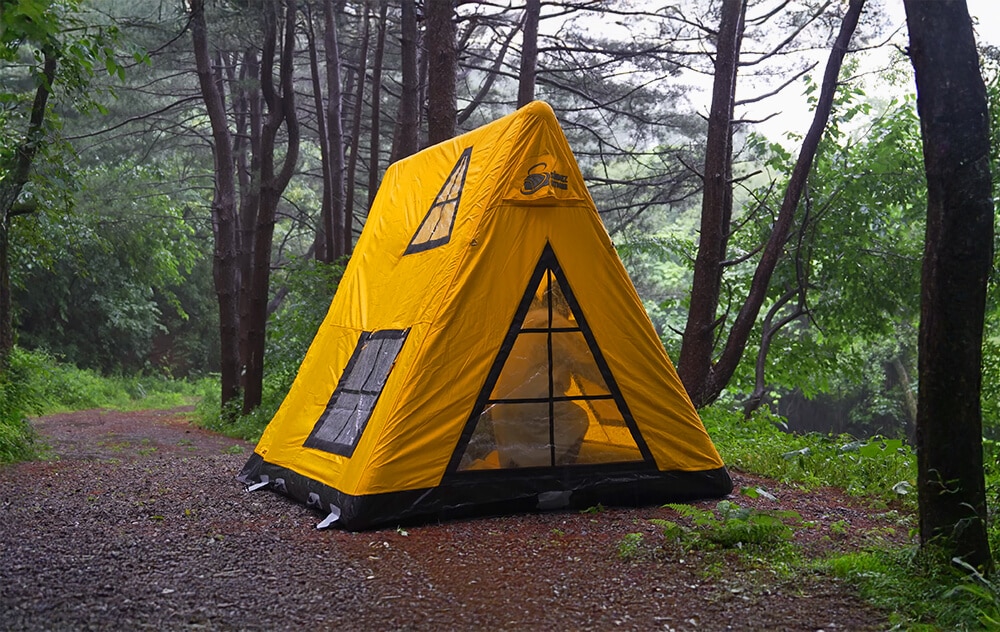
Based on manufacturer specs and product listings. Sonmez quality is well-established from my testing of their other models.
For instance, the Sonmez AIR BUSHCRAFT Premium at $1,650 targets overlanders who want Sonmez build quality in a smaller, more portable package. For example, this 4-person inflatable camping tent sets up in approximately 1 minute using the included electric inflator. At roughly 86 square feet and 66 lbs, the BUSHCRAFT Premium packs smaller and lighter than the MAXIA 480 or 360 while maintaining the same 210D ripstop construction and sealed seam waterproofing.
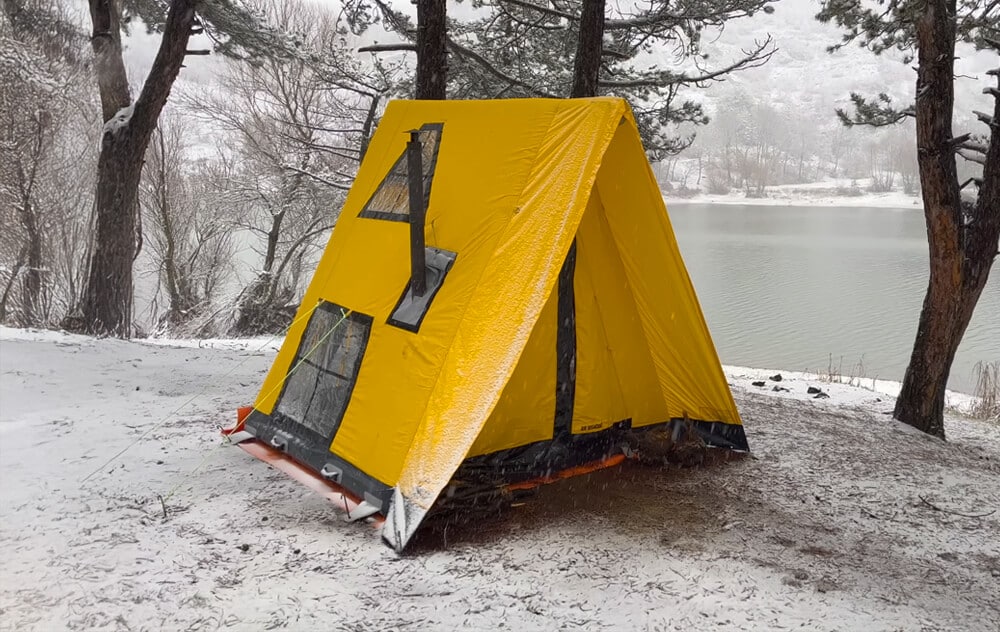
Sonmez designed the BUSHCRAFT Premium for 2-4 person groups camping from SUVs, trucks, or compact overlanding rigs.
Consequently, the reduced size makes it practical for tighter campsites and shorter camping trips where the full MAXIA 480 footprint is overkill. Likewise, interior amenities match the premium Sonmez standard with organizational pockets, ventilation windows, and a durable floor. For smaller groups seeking the best inflatable tent from a proven manufacturer, the BUSHCRAFT Premium deserves a close look.
Zonkoo Orion: Best Budget Inflatable Hot Tent
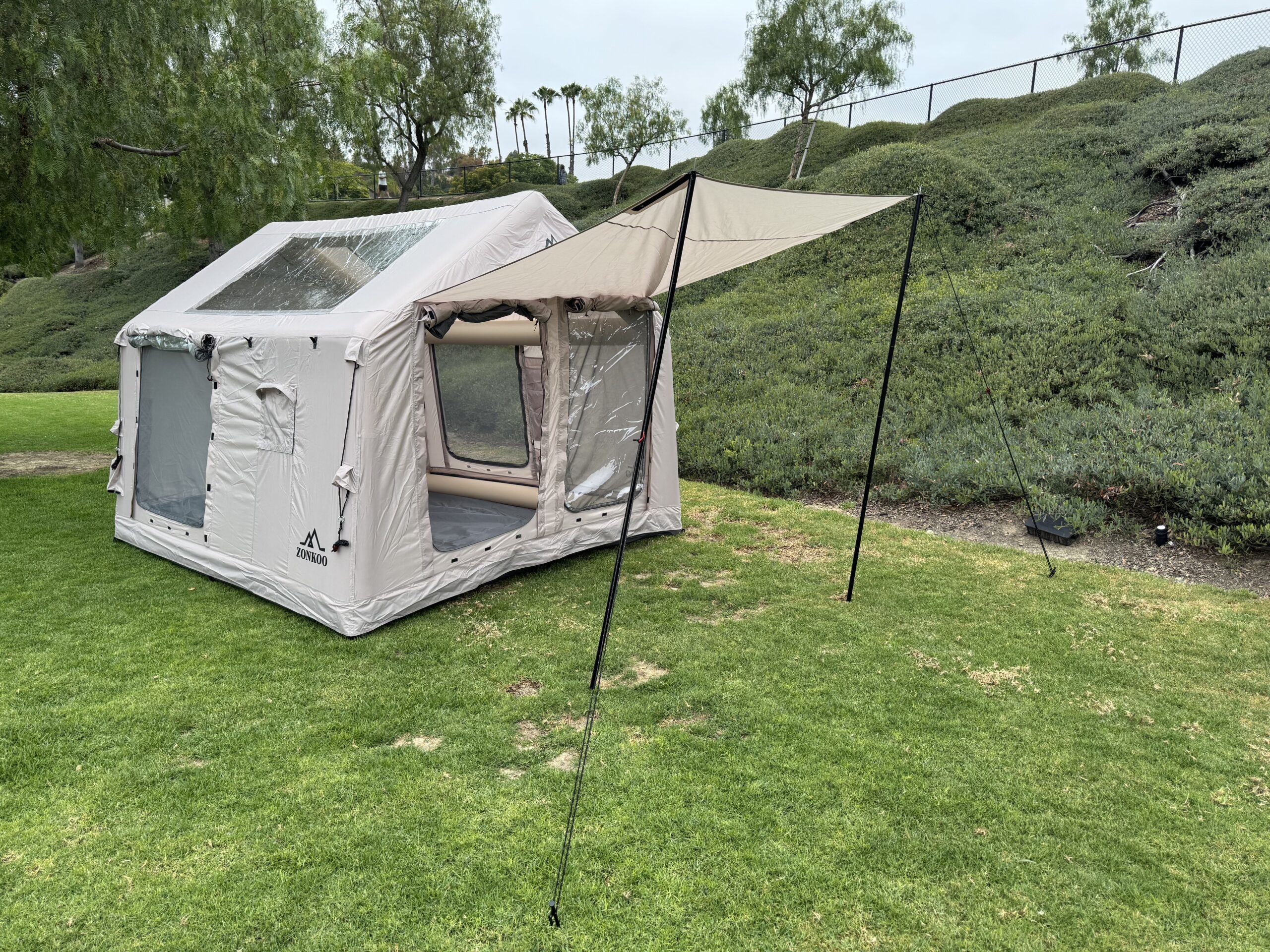
The Zonkoo Orion delivers four-season hot tent performance for $899.99, the lowest entry price for a stove-ready air tent in this roundup. Zonkoo builds the Orion from a 420D Oxford shell with a PU5000mm waterproof rating, and the air beams carry a cold rating down to -22°F. For two or three campers who want winter capability without a four-figure spend, the Orion earns a hard look.
Inside, the Orion offers 86 square feet of floor space and a 6-foot-11-inch peak, so adults stand fully upright. Five windows, including two 69-by-37-inch roof skylights, pull in light and cross-breeze. Setup runs about 7 minutes through a single-valve, pole-free air system, and one person handles the pump. Zonkoo also includes a pump, 28 stakes, a hammer, guy ropes, and a repair kit.
Where the Orion Falls Short
During hands-on testing, the diesel-heater port proved undersized for most diesel heater hoses, and the port sits far too small for a portable AC unit. Reviewers also noted a gap above the front-window zipper, which let bugs in after dark. Because the stove jack measures roughly 9.8 inches, wood-stove users get a better fit than diesel-heater users.
Still, at $899.99 the Orion undercuts every other four-season pick here, including the RBM Panda Air Medium at $1,000. For budget campers who prioritize standing room and stove compatibility over heater-port sizing, the Orion ranks as the best value inflatable hot tent in this guide. Read our full Zonkoo Orion review for the complete field breakdown.
Buy Direct From Zonkoo
Zonkoo Orion: 4-Season Hot Tent at $899.99
86 sq ft, a 6-foot-11-inch peak, PU5000mm waterproofing, and a built-in stove jack. The lowest-priced four-season air tent in this roundup.
Zonkoo Vega: Roomy Inflatable Tent for Families
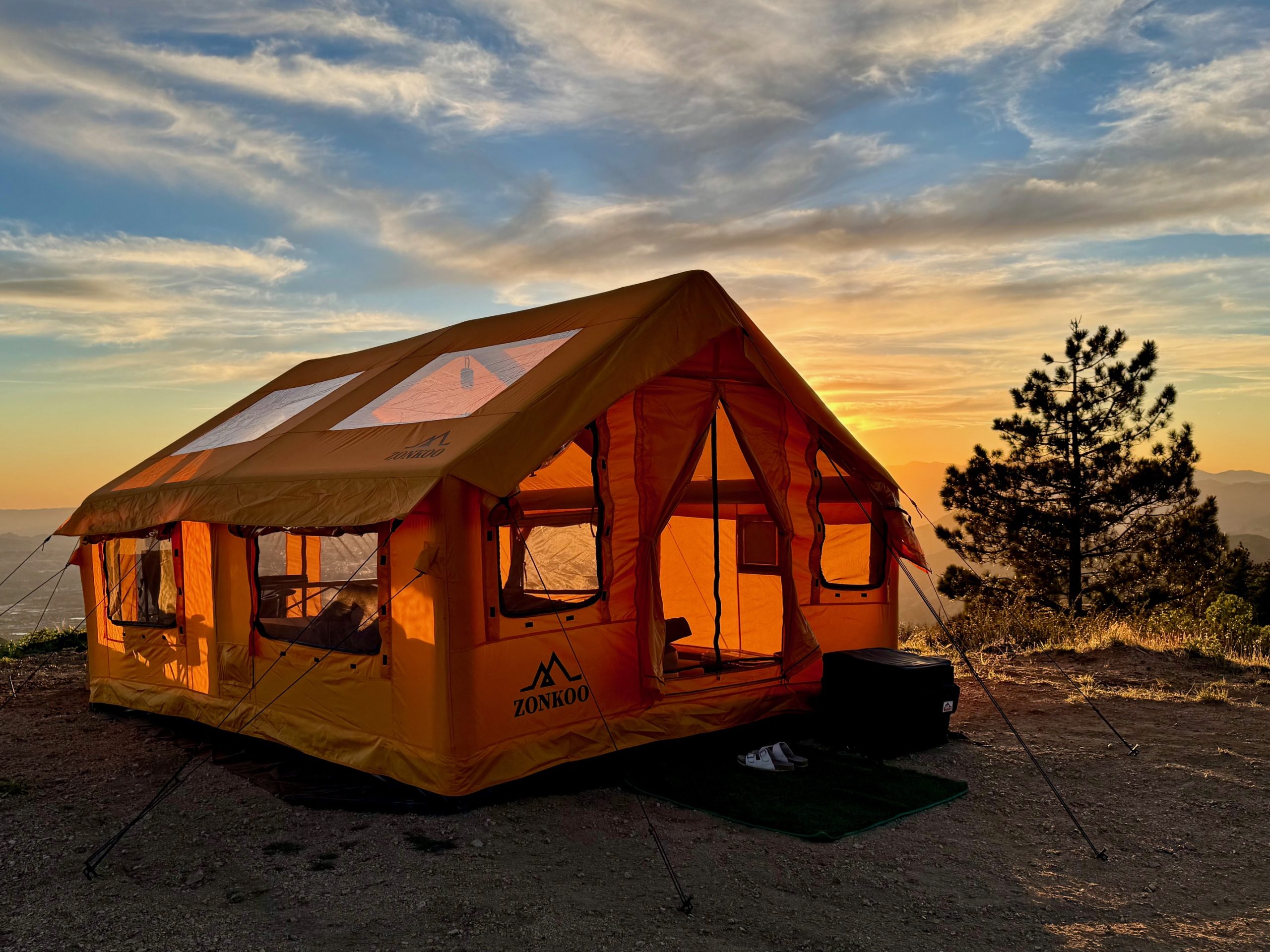
The Zonkoo Vega scales the brand’s air-tent formula up for families and small groups. Priced at $1,299.99, the Vega gives you 116 square feet of floor space and a 7-foot-1-inch peak, enough room for four to six campers plus gear. Zonkoo uses a polyester shell with a PU5000mm coating, and the pole-free structure relies on 6-inch air columns for rigidity in wind up to 50 mph.
Ventilation is the Vega’s headline feature. The entire rear panel rolls up into a full-wall opening, turning the tent into a near-pavilion on warm afternoons. Seven windows and skylights add airflow, and the three-layer side panels switch between mesh screen, clear plastic, and a solid privacy wall. Window awnings also give you shade and privacy at each opening.
Setup, Heating, and Trade-Offs
Setup takes about 11 minutes solo and drops with a partner. The Vega ships hot-tent ready, with an adjustable stove jack, a rain flap, two exterior chimney anchors, plus a fire-resistant back plate and floor pad. At 117 pounds packed, the Vega suits truck-bed or trailer hauling rather than rooftop or backpack carry.
The trade-offs center on accessories. Its proprietary screw-in air nozzle locks you into the included pump, and the AC port stays too small for major portable units like the EcoFlow Wave. No ground tarp comes in the box. For three-season family base camps, however, the Vega packs flagship features at a mid-tier price. See our full Zonkoo Vega review for setup notes and field results.
Buy Direct From Zonkoo
Zonkoo Vega: Family Air Tent at $1,299.99
116 sq ft, a 7-foot-1-inch peak, seven windows, and a full-wall rear opening. Hot-tent ready with an included stove jack and fire-resistant kit.
How Inflatable Tents Work
An inflatable tent replaces traditional poles with air-filled tubes called air beams. You inflate these beams using a hand pump or electric pump, and the pressurized tubes form the tent’s structural frame. Generally, most air beams use TPU (thermoplastic polyurethane) bladders inside a fabric sleeve. Meanwhile, the bladder holds the air pressure while the sleeve provides abrasion resistance and UV protection.
In addition, modern air beam systems use multiple chambers connected by a single inflation valve or separated into independent chambers. Independent chambers, like Heimplanet’s IDG system, provide redundancy: if one beam deflates, the others hold the tent up. In contrast, single-valve systems inflate faster but create a single point of failure.
Air pressure inside the beams typically ranges from 6-9 PSI depending on the manufacturer.
As a result, this pressurized structure provides rigidity comparable to aluminum poles. In high winds, air beams flex and absorb gusts instead of bending or snapping, which is why inflatable tents often outperform rigid pole tents in sustained wind conditions. Deflation takes 2-3 minutes by opening the valve and folding the tent.
Quick Buying Guide by Budget
| Budget Tier | Best Inflatable Tent Pick | Best For |
|---|---|---|
| Under $1,000 | Zempire Aerospeed 6 ($700) | Budget families, 3-season camping |
| $1,000 – $1,600 | RBM Panda Medium ($1,000) or Large ($1,569) | Winter camping, stove users |
| $1,300 – $2,000 | Heimplanet Cave XL ($1,356) or Coody Familia ($1,949) | Ultralight solo or large family groups |
| $1,650+ | Sonmez BUSHCRAFT ($1,650), 360 ($3,500), or MAXIA 480 ($6,800) | Premium comfort, luxury group camping |
How to Choose the Right Inflatable Tent for Camping
Choosing between these eight air tents comes down to three factors: your camping season, your group size, and your budget. Here is how each model stacks up across different buyer profiles.
Winter campers and stove users should focus on the RBM Panda Air Large ($1,569) or Panda Air Medium ($1,000). Both offer stove jack compatibility with breathable canvas construction. Meanwhile, the Coody Familia 13.6 ($1,949) adds a stove jack option with more interior space and room dividers. Notably, no other tents in this roundup support tent stoves safely.
Families and groups of 6+ looking for maximum space should consider the Sonmez MAXIA 480 ($6,800) for premium comfort or the Coody Familia 13.6 ($1,949) for budget-friendly group camping. Similarly, the Zempire Aerospeed 6 ($700) provides 6-person capacity at the lowest price, though with 3-season limits.
Solo overlanders and couples who prioritize pack weight and setup speed have several strong options. The Heimplanet Cave XL ($1,356) weighs only 11.9 lbs. The RBM Panda Air Medium ($1,000) handles winter trips with a stove. The Sonmez AIR BUSHCRAFT Premium ($3,000) delivers compact luxury. All three rank among the best inflatable tent choices for smaller groups.
Inflatable vs. Pole Tents: Which Is Better for Overlanding?
This is the most common question I hear from overlanders considering air tents. After three years switching between both types, here is my take based on real-world use.
Setup speed: Inflatable tents win decisively. Average setup runs 1-5 minutes versus 15-30 minutes for a comparably sized pole tent. After a long day driving forest roads, this difference matters more than most people expect.
Wind performance: Air beams flex instead of snapping. In sustained winds above 30 mph, inflatable tents maintain structure while aluminum poles risk bending or breaking. For instance, Heimplanet claims their IDG geodesic system handles winds up to 180 km/h (112 mph).
Repair in the field: If a pole breaks, you need a splint or replacement section. If an air beam punctures, you apply the included patch kit similarly to fixing a bike tire. The patch itself goes on in minutes, although adhesive needs 10-12 hours of curing time before reinflation for a permanent fix. Both are repairable, but air beams are simpler in principle.
Weight and pack size: Results vary by model. For example, the Heimplanet Cave XL at 11.9 lbs matches lightweight pole tents. In contrast, larger tents like the Sonmez MAXIA 480 at 165 lbs are heavier than pole equivalents because of the pump and thicker beam fabric.
For vehicle-based camping, weight matters less than pack size, and most air tents pack to similar dimensions as their pole counterparts.
Price: Inflatable tents typically cost more than comparable pole tents. At the entry level, the gap is significant: a quality 6-person pole tent runs $300-500, while the Zempire Aerospeed 6 starts at $700. At higher price points where pole tent quality plateaus, the premium narrows.
Pros and Cons of Inflatable Tents
Pros
- Setup in 1-5 minutes with a pump versus 15-30 minutes for pole tents
- Air beams flex in high wind instead of bending or snapping, improving storm performance
- No poles to lose, break, or corrode over time
- Field repair is straightforward: patch the puncture like a bike tube (adhesive needs 10-12 hours to cure)
- Canvas models with stove jacks (RBM, Coody) support four-season hot tent camping
- Lightweight options exist: Heimplanet Cave XL weighs only 11.9 lbs for a 3-person shelter
- Entry-level prices have dropped: quality 6-person models now start at $700 (Zempire)
- Modern multi-chamber designs provide redundancy if one beam punctures
Cons
- More expensive than comparable pole tents at every price tier, especially at the entry level
- Requires a pump (hand or electric), adding one more piece of gear to manage
- Air pressure drops in cold temperatures, requiring occasional top-offs in sub-freezing conditions
- Large models (MAXIA 480 at 165 lbs) weigh more than pole tent equivalents
- Fewer brand options compared to the pole tent market
- Puncture risk from sharp rocks, thorns, or campsite debris near air beams
Final Verdict: The Best Inflatable Tent Picks for 2026
After testing four of these inflatable tents personally and researching four more in depth, the air tent market in 2026 offers a legitimate alternative to traditional pole tents for every type of camper. The technology is mature, options span $700 to $6,800, and setup speed alone makes these worth serious consideration for overlanders who value time at camp over time setting up camp.

For winter camping, the RBM Panda models ($1,000-$1,569) remain the standout picks with their canvas construction and stove jack compatibility. Notably, no other brand at this price range offers genuine four-season inflatable shelter.
For maximum space and premium comfort, the Sonmez lineup ($3,000-$6,800) delivers hotel-like camping for groups willing to invest. Meanwhile, budget-conscious families should look at the Zempire Aerospeed 6 ($700) for a capable 6-person blow up tent at the lowest entry point.
Newer entries from Heimplanet, Coody, and Sonmez’s BUSHCRAFT line show the market expanding into specific niches: ultralight overlanding, modular family camping, and compact luxury. Prices continue to drop at the entry level while premium options add features once found only in hard-sided shelters. Consequently, the best inflatable tent for your next trip likely already exists in this roundup.
Use the specs comparison table above to match each tent’s capacity, weight, and season rating against your specific camping style. Ultimately, the right choice matches your group size, your climate, and your vehicle’s cargo capacity. For additional shelter options beyond inflatables, our best ground tents guide covers traditional pole alternatives.
Frequently Asked Questions
Are inflatable tents any good for camping?
Yes. Modern air tents use TPU air beams rated for 6-9 PSI, providing structural rigidity comparable to aluminum poles. After three years of testing air tents from Sonmez and RBM Outdoors, I’ve experienced zero catastrophic failures. Air beams flex in wind instead of snapping, and punctures are field-repairable with the included patch kit. The main trade-off is price: inflatable tents cost more than comparable pole tents, especially at entry-level price points.
How long do inflatable tents last?
With proper care, an inflatable tent lasts 5-10 years of regular use. The TPU bladders inside the air beams resist UV and abrasion effectively. Nylon or canvas outer fabric typically shows wear first. Store the tent dry, avoid prolonged UV exposure when packed, and check air beam pressure before each trip. Canvas models like the RBM Panda series tend to outlast nylon alternatives because of heavier fabric weight.
Are inflatable tents good in the wind?
Inflatable tents generally outperform pole tents in sustained wind. Air beams flex and absorb gusts rather than bending or breaking. Heimplanet rates their Cave XL’s geodesic IDG design for extreme wind conditions. Larger tunnel-style air tents like the Sonmez MAXIA 480 handle 30-40 mph winds when properly staked and guyed out. Always orient the narrowest profile into the prevailing wind for the best stability.
Do inflatable tents puncture easily?
In my experience, no. Air beams sit inside protective fabric sleeves and run along the tent’s upper structure, not the floor. Ground contact punctures are rare for this reason. Sharp branches pressing against the sidewall and careless handling near thorns or cacti are the most common puncture sources. Every tent in this roundup includes a patch repair kit. Applying the patch takes minutes, although the adhesive needs 10-12 hours to cure fully before reinflation.
Which is the best inflatable tent for families?
For families of 4-6, the Coody Familia 13.6 ($1,949) and Zempire Aerospeed 6 ($700) offer the best value with 6-8 person capacities. Larger families of 8+ should consider the Sonmez MAXIA 480 ($6,800) at 14-person capacity. If your family camps year-round including winter, the RBM Panda Air Large ($1,569) with its stove jack provides four-season capability at a family-friendly price.
How much does the best inflatable tent cost in 2026?
In this roundup, prices range from $700 (Zempire Aerospeed 6) to $6,800 (Sonmez MAXIA 480). Quality 4-season air tents with stove jacks start at $1,000 (RBM Panda Air Medium). Mid-range models with premium features run $1,356-$1,949 (Heimplanet, Coody). Luxury models from Sonmez range $3,000-$6,800. The sweet spot for most overlanders sits between $1,000 and $2,000, where you get four-season capability, reasonable weight, and solid construction.
Gear mentioned in this guide