



Quick Facts:
- Topic: Rated recovery points vs unrated hardware
- Number to read: Working load limit, never breaking strength
- Design factor: 6:1 on quality shackles, 3:1 on some budget hardware
- Reference figure: Crosby 3/4in shackle, 10,470 lb WLL
- Measured snatch loads: 2,900 to 4,600 lb in sand recoveries
- Marking standard: ASME B30.26
- Real weak link: Receiver tube and leverage, rarely the shackle
- Best for: Anyone running a kinetic rope or snatch strap
8 min read
In This Guide
- What Rated Recovery Points Mean
- Rated Recovery Points: Key Numbers
- Working Load Limit vs Breaking Strength
- The Hitch Receiver Recovery Point Trap
- Why Tow Balls Fail: Three Things Stack
- How to Check Whether Your Shackles Are Rated
- Rated Recovery Points vs Unrated Hardware
- Final Verdict
- Frequently Asked Questions
What Rated Recovery Points Mean
Rated recovery points carry a published working load limit from a manufacturer willing to put its name on the part. Unrated hardware carries a big number printed on a box. The gap between those two numbers decides whether a recovery ends with a stuck truck moving or a piece of steel leaving the vehicle. It is worth understanding before your next trail day.
A rating is a permission, not a prediction. Specifically, the working load limit tells you the maximum load the maker authorizes in normal service. Breaking strength tells you the load at which the part is expected to fail. Marketing copy blurs the two constantly, because the failure number is always larger and sells better.
Two Shackles, Two Different Answers
Here is the problem in one comparison. Crosby publishes a 10,470 lb working load limit for its 3/4 inch G-209 screw-pin anchor shackle, derived from a 6:1 design factor. Meanwhile, Rhino USA markets a shackle hitch receiver shipping with a 3/4 inch D-ring at “13950 LBS WORKING LOAD LIMIT” against a 41,850 lb maximum break strength, which works out to 3:1. Same nominal shackle size. Two working load limits differing by roughly a third, and the divisor is only part of the reason. The underlying steel differs too.
Neither company is lying. Both numbers follow from a stated ratio. However, a buyer comparing headline figures across brands is comparing arithmetic conventions as much as steel, and here the steel differs too. Crosby’s minimum ultimate strength is six times its working load limit, roughly 62,800 lb, against the 41,850 lb break figure on the budget part. This guide gives you the numbers, the standard behind them, and the physical checks worth running on gear already in your rig.
| Rated hitch mount | Rated bow shackle | Rated D-ring | |
|---|---|---|---|
| Product | TOP PICK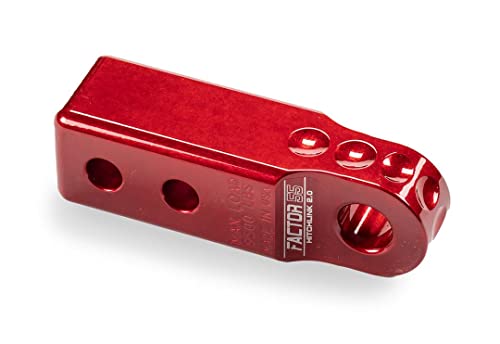 Factor 55 HitchLink 2.0 Factor 55 HitchLink 2.0 |  Crosby G-209 3/4in Crosby G-209 3/4in |  WARN Epic 3/4in D-Ring WARN Epic 3/4in D-Ring |
| Rating | ★★★★★ 4.8 438 ratings | ★★★★★ 4.7 66 ratings | ★★★★★ 4.7 291 ratings |
| Published rating | 9,500 lb WLL | 10,470 lb WLL | Rated, see listing |
| Marked on the part | Yes, WLL stamped | Yes, WLL and maker mark | Yes, maker mark |
| Where it mounts | Into a 2in receiver | Any rated point | Any rated point |
| Price | $82.58 as of Sep 12, 7:26 pm | $56.99 as of Sep 12, 7:26 pm | $61.40 as of Sep 12, 7:26 pm |
| Check Price → | Check Price → | Check Price → |
Rated Recovery Points: Key Numbers
These figures anchor everything below. Notably, the measured recovery loads at the bottom are far lower than most owners assume.
| Specification | Details |
|---|---|
| Crosby G-209 design factor | 6:1, proof load 2x WLL |
| Crosby 3/4in shackle WLL | 10,470 lb (4.75 tonnes) |
| Crosby 7/8in shackle WLL | 14,330 lb (6.5 tonnes) |
| Factor 55 HitchLink 2.0 | 9,500 lb WLL, 51,000 lb ultimate |
| ARB forged recovery points | 8,000 kg (roughly 17,600 lb) as a system |
| Class III receiver | 2in, up to 8,000 lb GTW / 800 lb tongue |
| Class IV receiver | Up to 10,000 lb GTW / 1,000 lb tongue |
| Measured snatch loads | 2,900 to 4,600 lb in sand, 5,100 lb worst case |
Working Load Limit vs Breaking Strength
One formula covers the whole subject. Working load limit equals minimum breaking strength divided by the design factor. Because the design factor varies by product type, two honestly labeled parts carry different margins.
RealTruck puts the common case plainly: most shackles use a 6:1 safety factor, so a shackle with a 30,000 lb breaking strength has a 5,000 lb working load limit. Some cargo hardware, though, is published at 3:1. Wire rope is frequently quoted at around 4:1. No single universal ratio exists, which is precisely why the ratio matters more than the headline.
Factor 55 walks through its proof load and destructive testing, which is where a published working load limit comes from. Source: Factor 55 on YouTube.
How Listings Mislead
Watch what happens on retail listings. Sellers advertise “Lab Tested 31,518lb Break Strength” and “Heavy-Duty 44,000 LB” and “42000 Lbs Maximum” across the same product category. Every one of those figures describes destruction, not operation. Reading them as capacity inflates your perceived margin by three to six times.
Consequently, the useful habit is simple. Find the working load limit first. If a listing shows only a breaking strength, divide by six for a conservative working figure, then treat the result as an estimate until the manufacturer publishes a real rating. Our guide to common off-road recovery mistakes covers several failures traced back to this exact misreading.
The Hitch Receiver Recovery Point Trap
A shackle hitch receiver is a machined insert, steel or aluminum, sliding into your 2 inch receiver tube. The insert itself is usually strong. For example, Factor 55 publishes a 9,500 lb working load limit on the HitchLink 2.0, alongside 51,000 lb ultimate strength. Those are real numbers on a genuine rated component.
The insert, however, is not the limiting part. Your receiver tube is. Factor 55 says so on its own product page. Specifically, it warns owners never to exceed the factory receiver hitch pull rating, and to pull in line without binding or side loading the shackle. A hitch receiver recovery point is therefore rated by the tube, not by the insert.
Class ratings matter here, though the familiar figures are a manufacturer convention rather than a standards number. Retailers such as CURT market Class III at up to 8,000 lb gross trailer weight, with 800 lb tongue weight. Similarly, Class IV runs to 10,000 lb and 1,000 lb. SAE J684, which governs hitches and couplings on trailers up to 10,000 lb GVWR, defines its own Class 3 as trailers up to only 5,000 lb. Draw-Tite publishes the lower number for the same reason. Critically, J684 applies its test loads slowly and statically. Specifically, the onset rate is no greater than 150 lb per second, held for five seconds. Nothing in the standard simulates a kinetic snatch.
As a result, a 9,500 lb insert bolted into an 8,000 lb-rated tube gives you an 8,000 lb system at best. Worse, the test behind it covers a load case unlike the one you are applying. Most published guides list the insert rating and stop there. Readers then end up confident in a number describing the wrong component.
Why Tow Balls Fail: Three Things Stack
Everyone repeats the rule against snatching from a tow ball. Few explain the mechanism, and the mechanism is what makes the rule transferable to other bad setups.
In the 2022 fatality at Kingman, Arizona, the recovery used a long drop hitch setting the ball well below the receiver centerline. The offset created a large bending moment when the strap snapped taut. Consequently, the drop section sheared off at the receiver. Then it flew back through the windshield of the stuck truck. The strap made it worse. Specifically, it was a three inch static tow strap rather than a kinetic rope, so the energy arrived as a sharp spike.
Three failures stacked. Leverage multiplied the force at the receiver. The ball offered no positive capture, so the strap eye climbed and released. And the wrong strap type stripped out the elasticity meant to soften the pull. Similarly, any setup adding vertical offset between the pull and the receiver reproduces the first failure regardless of hardware quality.
Therefore, the test is geometric, not brand-based. Ask where the load line sits relative to the receiver centreline. If the answer involves inches of drop, the numbers stamped on your shackle stop being the governing figure. For technique context, see our walkthrough of the safe 4WD recovery procedure.
How to Check Whether Your Shackles Are Rated
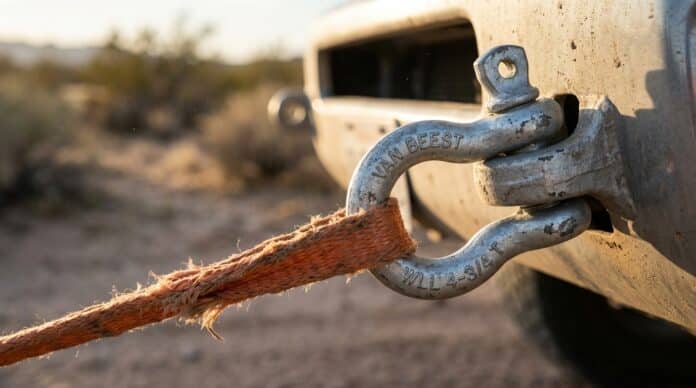
ASME B30.26 sets the marking requirements, and it gives you a field checklist requiring no tools. ASME B30.26 requires the shackle body to carry the manufacturer’s name or trademark plus the rated load. Missing or illegible markings mandate removal from service.
The Four-Point Field Check
Run four checks on every shackle in your kit. First, look for a manufacturer name or trademark forged into the body. Second, find a stamped rated load, expressed in tons or pounds. Third, confirm the pin carries the manufacturer’s mark too, since mismatched pins defeat the rating. Fourth, look for a traceability code tying the part to a production batch.
An unmarked shackle has an unknown rating. Industry suppliers state it in exactly those terms, because a rating without traceability is unverifiable. Notably, the off-road guides ranking for this topic tell readers to buy rated gear. None of them cite the standard defining the word. Running those four checks settles the rated vs unrated shackles question in your own kit inside a minute.
Soft shackles work differently. Manufacturers typically publish a minimum breaking strength rather than a working load limit. Warn’s current product page lists 25,110 lb minimum breaking strength for its 3/8 inch Spydura soft shackle. A Warn blog post and many retailer listings still show 29,700 lb for the same part number. Read the manufacturer’s live spec sheet rather than a resale listing. Our comparison of soft vs steel shackles covers the tradeoffs in detail.
Rated Recovery Points vs Unrated Hardware
In the rated vs unrated shackles debate, the practical difference is traceability rather than raw strength. A rated recovery point gives you a published limit, a marked part, a stated design factor, and an accountable manufacturer. Unrated hardware gives you a number with no ratio attached. Moreover, you have no way to audit it after a hard pull.
Strength alone rarely separates the two in normal use. Load-cell testing by Outback Travel Australia used two mid-size 4WDs bogged in sand. For example, textbook recoveries recorded 2,900 to 3,500 lb. Loads rose to 3,500 to 4,600 lb when the stuck vehicle gave no help, and around 5,100 lb with a tired strap on a steep pull. Those are sand numbers on light vehicles, though. A full-size truck framed out in mud is a different problem. Notably, the volunteer crew analyzing the Kingman recovery estimated roughly 18,750 lb of stuck force on the Super Duty involved. Within the lower range the shackle is seldom what breaks.
What Fails Instead

What fails instead is attachment geometry: tow balls, tie-down eyes never designed for shock, bumper brackets, and receiver tubes loaded off-axis. Factory tie-down points illustrate the trap well, since they secure a vehicle to a transport deck rather than absorbing a snatch. Choosing rated gear therefore buys you an auditable chain from rope to chassis, which matters far more than another 10,000 lb of headline capacity. Readers weighing one recovery method against another should read our take on kinetic strap vs winch recovery.
Factor 55 00020-01 Hitchlink 2.0 Rated at 9500 lb Ultimate Failure at 51,000 lb Convert Your Vehicles Hitch Receiver into a Recovery Point. Ideal for 4x4 Off Road Adventures – Red
A rated hitch mount with published numbers you are able to look up, which is the whole point of this article.
- Manufacturer publishes both a working load limit and an ultimate strength
- Captures the shackle positively, unlike a tow ball
- Machined single piece with no moving parts to inspect
- Your receiver tube rating still sets the real ceiling, not this part
- Aluminum construction means it wears where a steel shackle bites
Final Verdict
Rated recovery points earn their price for anyone running a kinetic rope, because kinetic recoveries produce the highest loads any attachment point sees. If you snatch, buy marked hardware with a published working load limit and a stated design factor, then attach it to a chassis-mounted point engineered for the job.
Owners who never snatch face a different calculation. Winching applies load gradually and predictably, so the shock case driving these ratings largely disappears. Even then, marked gear remains worth the modest premium, since the inspection checklist above works only on parts carrying markings in the first place.
On value, the honest read is encouraging. A quality 3/4 inch rated shackle and a proper hitch link cost a fraction of a bumper or a winch, and the measured load data points to generous margin in correctly sized gear. Read the margin narrowly, though, because those figures come from sand recoveries on light 4WDs. A full-size truck framed out in mud runs far higher, so the margin is not a licence to skip the inspection. Spending the same money on fixing your attachment geometry buys a great deal.
For most drivers the sensible package pairs a rated shackle with a purpose-built hitch link such as the Factor 55 HitchLink 2.0, used strictly within the receiver’s own rating. Owners recovering frequently, or pulling heavier rigs, should step up to chassis-mounted forged points. For instance, ARB rates its units as a matched system at 8,000 kg, and those bypass the receiver limitation entirely.
Frequently Asked Questions
What is the difference between working load limit and minimum breaking strength?
Working load limit is the maximum load a manufacturer authorizes in normal service. Minimum breaking strength is where the part is expected to fail. The design factor links them, so a 6:1 shackle with 30,000 lb breaking strength carries a 5,000 lb working load limit.
Is a shackle hitch receiver safe for a kinetic recovery?
Only up to your receiver’s rating, not the link’s. A quality hitch link is a rated component, though the receiver tube it plugs into sets the real limit. Factor 55 publishes a 9,500 lb working load limit on the HitchLink 2.0 while warning owners never to exceed the factory receiver rating. Treat the lower of the two numbers as your ceiling.
What makes a shackle rated and how do I check mine?
Under ASME B30.26 the body must carry the manufacturer’s name or trademark plus the rated load, and the pin must carry the maker’s mark. Missing or illegible markings require removal from service. A traceability code is a fourth thing worth finding, although it reflects quality-maker practice rather than a code requirement.
Why is a tow ball unsafe for a snatch recovery?
A drop hitch positions the ball below the receiver, creating leverage multiplying force during the pull. In the 2022 Kingman incident the drop section sheared off at the receiver and flew back through a windshield. A ball also lacks positive capture, so a strap eye climbs off under load.
Is my factory Class III hitch strong enough for a kinetic rope pull?
Usually yes on load, but the rating does not describe the load case. Class III is typically marketed at 8,000 lb gross trailer weight, a manufacturer convention rather than the SAE J684 class, which caps Class 3 at 5,000 lb GVWR. J684 also loads test samples slowly and statically rather than as a shock. Measured snatch loads of 2,900 to 4,600 lb sit inside the marketed figure, although geometry errors change the picture quickly.
Are factory tie-down points the same as recovery points?
No. Tie-down eyes secure a vehicle to a transport deck under static load and carry no recovery rating. Using one for a snatch loads a bracket never engineered for shock. Fit a chassis-mounted rated point instead.
Related Reading
Manufacturer rating tables are the primary source worth bookmarking, starting with the Crosby G-209 shackle specifications.